Category: Abdominal & Urinary Conditions

  • Urinary Tract Infections

    Abdominal & Urinary Conditions

    Urinary tract infections (UTIs) are ones that occur in any organs that make up the urinary tract. The kidneys filter waste products from the blood and make urine. Ureters connect the kidney to the bladder. This holds urine until it is passed.

    Illustration of organs in the urinary tract.

    Signs & Symptoms

    *  A strong need to pass urine.

    *  You pass urine more often than usual.

    *  A sharp pain or burning feeling when you pass urine.

    *  Bloody or cloudy urine.

    *  It feels like your bladder is still full after you pass urine.

    *  Pain in the abdomen, back, or sides.

    *  Chills. Fever.

    *  Nausea or vomiting.

    *  A change in mental status, especially if you are over age 70.

    Sometimes there are no symptoms with a UTI.

    Causes

    UTIs result when bacteria infect any part of the urinary tract. The bladder is the most common site.

    Persons at Greater Risk for UTIs

    *  Sexually active females.

    *  Females who use a diaphragm for birth control.

    *  Males and females who have had UTIs in the past.

    *  Anyone with a condition that doesn’t allow urine to pass freely. An enlarged prostate gland (in males) and kidney stones are examples.

    Treatment

    An antibiotic is prescribed to treat the specific infection. Pain relievers are taken as needed. If you get UTIs often, your doctor may order medical tests to find out the problem.

    Questions to Ask

    Self-Care / Prevention

    To Treat a Urinary Tract Infection (UTI)

    *  Drink at least 8 glasses of water a day.

    *  Don’t have alcohol, spicy foods, and caffeine.

    *  Get plenty of rest.

    *  Take an over-the-counter (OTC) medicine for pain or one that relieves pain and spasms that come with a bladder infection (e.g., Uristat). {Note: Uristat helps with symptoms, but doesn’t get rid of the infection. See your doctor for diagnosis and treatment.}

    *  Go to the bathroom as soon as you feel the urge. Empty your bladder all the way.

    *  Don’t have sex until the infection is cleared up.

    To Help Prevent UTIs

    *  Drink plenty of water and other fluids every day.

    *  Empty your bladder as soon as you feel the urge.

    *  Drink a glass of water before you have sex. Go to the bathroom as soon as you can after sex.

    *  If you’re prone to UTIs, don’t take bubble baths.

    *  If you’re female, wipe from front to back after using the toilet. This helps keep bacteria away from the opening of the urethra. If you use a diaphragm, clean it after each use. Have your health care provider check your diaphragm periodically to make sure it fits properly.

    Resources

    National Institute of Diabetes and Digestive and Kidney Diseases (NIDDK)

    www.niddk.nih.gov

    Healthier at Home book by the American Institute for Preventive Medicine. www.HealthyLife.com. All rights reserved.

    © American Institute for Preventive Medicine

  • Flatulence (Gas)

    Abdominal & Urinary Conditions

    Image of man plugging his nose with hand.

    Flatulence is passing gas through the anus. For the average adult, this happens about 6 to 20 times a day.

    Signs & Symptoms

    *  Pressure or discomfort in the lower abdomen or anal area.

    *  Passing gas. A foul odor occurs sometimes.

    Causes

    Gas is caused by swallowing air and digesting foods. Eating high fiber foods like beans, peas, and whole-grains create more gas than other foods. Dairy foods can create large amounts of gas in some people.

    Gas may signal other problems, too. These include lactose intolerance, taking certain antibiotics, and abnormal muscle movement in the colon.

    Gas can also be a symptom of celiac disease. With this, the lining of the small intestine is damaged from eating gluten. This is a protein in wheat, barley, and rye. Other symptoms of celiac disease are pain and bloating in the abdomen; diarrhea; weight loss; anemia; and a certain skin rash. Treatment is a gluten-free diet. Find out about celiac disease fromwww.celiac.nih.gov.

    Treatment

    Self-care treats most cases of gas. If the gas is due to another problem, treating the problem reduces or gets rid of the gas.

    Questions to Ask

    Self-Care / Prevention

    *  Try not to swallow air. Don’t have carbonated drinks and chewing gum. These can cause more air to get into your stomach.

    *  When you add fiber to your diet, do so gradually.

    *  When you pass gas, note which foods you have eaten. Eat less of the foods that often cause gas. Common ones are apples, bran, whole-wheat foods, cabbage-family vegetables, eggs, dairy products, prunes, and beans.

    *  To prevent getting gas from many “gassy” foods, try an over-the-counter product, such as Beano. This helps prevent gas from beans, bran, nuts, onions, soy, and many vegetables.

    *  Try an over-the-counter medicine with simethicone, such as Gas-X.

    *  Release the gas when you need to. Go to another room if it will help you be less embarrassed.

    Healthier at Home book by the American Institute for Preventive Medicine. www.HealthyLife.com. All rights reserved.

    © American Institute for Preventive Medicine

  • Vomiting & Nausea

    Abdominal & Urinary Conditions

    Signs & Symptoms

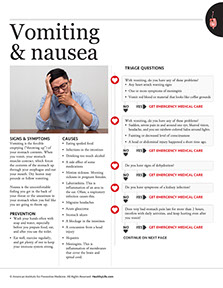
    *  Vomiting is throwing up the stomach’s contents. Dry heaves may precede or follow vomiting.

    *  Nausea is when you feel like you’re going to throw up.

    Causes

    *  Viruses in the intestines. Eating spoiled food or eating or drinking too much.

    *  A side effect of some medications, such as certain antibiotics.

    *  Motion sickness. Morning sickness in pregnant females.

    *  Labyrinthitis. This is inflammation of an area in the ear. Often, a respiratory infection causes this.

    *  Migraine headaches.

    *  Acute glaucoma.

    *  Stomach ulcers.

    *  A blockage in the small or large intestine (bowel).

    *  A concussion from a head injury.

    *  Hepatitis.

    *  Meningitis. This is inflammation of membranes that cover the brain and spinal cord.

    Questions to Ask

    Self-Care / Prevention

    For Vomiting

    *  Don’t smoke, drink alcohol, or take aspirin.

    *  Don’t eat solid foods. Don’t drink milk.

    *  Drink clear liquids at room temperature (not too hot or cold). Good examples are water; sport drinks, such as Gatorade; diluted fruit juices; ginger ale, etc. Take small sips. Drink only 1 to 2 ounces at a time. Stir carbonated beverages to get all the bubbles out before you sip them. Suck on ice chips if nothing else will stay down. {Note: For children, contact your child’s doctor about using over- the-counter (OTC) mixtures, such as Pedialyte.}

    *  Gradually return to a regular diet, but wait about 8 hours from the last time you vomited. Start with foods like dry toast, crackers, rice, and other foods that are easy to digest. Or, eat foods as tolerated. Avoid greasy or fatty foods.

    For Nausea Without Vomiting

    *  Drink clear liquids. Eat small amounts of dry foods, such as soda crackers, if they help.

    *  Avoid things that irritate the stomach, such as alcohol and aspirin.

    *  For motion sickness, use an over-the-counter medicine, such as Dramamine. You could also try Sea-Bands, a wrist band product that uses acupressure on a certain point on the wrist to control motion sickness. Sporting goods stores and drugstores sell Sea-Bands.

    Resources

    Foodsafety.gov

    www.foodsafety.gov

    Healthier at Home book by the American Institute for Preventive Medicine. www.HealthyLife.com. All rights reserved.

    © American Institute for Preventive Medicine

  • Food Poisoning

    Abdominal & Urinary Conditions

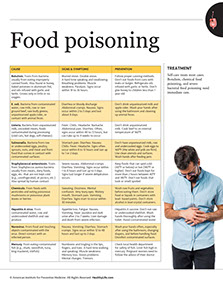
    Self-care treats most cases. Botulism, chemical food poisoning, and severe bacterial food poisoning need immediate care.

    Botulism

    Cause

    Toxin from bacteria usually from eating improperly canned foods. Also found in honey and oils infused with garlic. Grows only in little or no oxygen.

    Signs & Symptoms

    Blurred vision. Double vision. A hard time speaking and swallowing. Breathing problems. Muscle weakness. Paralysis. Signs occur within 4 to 36 hours.

    Prevention

    Follow proper canning methods. Boil home-canned food for 10 or more minutes. Don’t eat foods from cans with leaks or bulges. Refrigerate oils infused with garlic or herbs. Don’t give honey to children less than 1 year old.

    E. coli

    Cause

    Bacteria from contaminated water, raw milk, raw or rare ground beef, unpasteurized apple juice or cider, or contact with contaminated animal feces.

    Signs & Symptoms

    Diarrhea or bloody discharge. Abdominal cramps. Nausea. Signs occur within 2 to 5 days and last about 8 days.

    Prevention

    Don’t drink unpasteurized milk and apple cider. Wash your hands after using the bathroom and cleaning up animal feces.

    Listeria

    Cause

    Bacteria from unpasteurized milk, uncooked meats, foods contaminated during processing (cold cuts, hot dogs, soft cheeses).

    Signs & Symptoms

    Fever. Chills. Headache. Backache. Abdominal pain. Diarrhea. Often, signs occur within 48 to 72 hours, but can take up to 3 weeks to occur.

    Prevention

    Don’t drink unpasteurized milk. Cook beef to an internal temperature of 160ºF.

    Salmonella

    Cause

    Bacteria from raw or undercooked eggs, poultry, and meat and from food that comes in contact with contaminated surfaces.

    Signs & Symptoms

    Stomach pain. Diarrhea. Nausea. Chills. Fever. Headache. Signs occur within 8 to 12 hours and last up to 1 or 2 days.

    Prevention

    Don’t have unpasteurized milk, raw and undercooked eggs. Cook eggs to 160ºF (the white and yolk are firm). Use clean utensils and surfaces.

    Staphylococcal enterotoxin

    Cause

    Toxin from bacteria usually from meats, dairy foods, eggs, etc. that are not kept cold (e.g., unrefrigerated, at picnics, etc.) Also spread by human contact.

    Signs & Symptoms

    Severe nausea. Abdominal cramps. Diarrhea. Vomiting. Signs occur within 1 to 6 hours and last up to 3 days. Signs last longer if severe dehydration occurs.

    Prevention

    Keep foods that can spoil cold (40ºF or below) or hot (140ºF or higher). Don’t eat foods kept for more than 2 hours between 40ºF and 140ºF. Don’t eat foods that look or smell spoiled. Wash your hands often. Use clean utensils and surfaces.

    Chemicals

    Cause

    From foods with pesticides and eating poisonous mushrooms or poisonous plant leaves or berries.

    Signs & Symptoms

    Sweating. Dizziness. Mental confusion. Very teary eyes. Watery mouth. Stomach pain. Vomiting. Diarrhea. Signs start to occur within 30 minutes.

    Prevention

    Wash raw fruits and vegetables before eating them. Don’t store food or liquids in containers with lead- based paints. Don’t store alcohol in lead crystal containers.

    Hepatitis A virus

    Cause

    From contaminated water, raw and undercooked shellfish, oysters, clams, mussels, scallops, etc.

    Signs & Symptoms

    Appetite loss. Nausea. Vomiting. Fever. Jaundice and dark urine after 3 to 10 days. Liver damage and death from severe infection.

    Prevention

    Hepatitis A vaccine. Don’t eat raw or undercooked shellfish, oysters, etc.

    Norwalk-like viruses

    Cause

    From food and touching objects contaminated with the virus. Direct contact with an infected person.

    Signs & Symptoms

    Nausea. Vomiting. Diarrhea. Stomach cramps. Signs occur within 12 to 48 hours and last up to 2 days.

    Prevention

    Wash your hands often, especially after using the bathroom, changing diapers, and before handling food. Disinfect contaminated surfaces.

    Mercury

    Cause

    From eating contaminated fish (e.g., shark, swordfish, tuna, king mackerel, tilefish).

    Signs & Symptoms

    Numbness and tingling in the lips, fingers, and toes. A hard time walking and speaking. Muscle weakness. Memory loss. Mental changes. Tremors.

    Prevention

    Check local health department for safety of fish. Limit fish high in mercury. Pregnant women need to follow the advice of their doctor.

    Questions to Ask

    Self-Care / Prevention

    *  For chemical food poisoning, call the Poison Control Center (800.222.1222).

    *  Heed warnings for food products that could be harmful. News reports list these items. So does the FDA atwww.fda.gov.
    Healthier at Home book by the American Institute for Preventive Medicine. www.HealthyLife.com. All rights reserved.

    © American Institute for Preventive Medicine

  • Gallstones

    Abdominal & Urinary Conditions

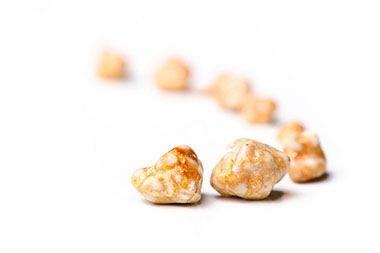
    Image of gallstones.

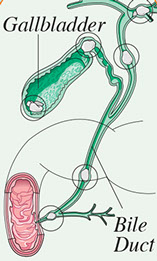
    The gallbladder stores bile. This substance helps digest fats. Gallstones form when bile hardens into pieces of stone-like material. These deposit in the gallbladder or bile ducts (which carry bile to the small intestine). The stones can range in size from less than a pinhead to 3 inches across.

    Signs & Symptoms

    *  Feeling bloated and gassy, especially after eating fried or fatty foods.

    *  Steady pain in the upper right abdomen lasting 20 minutes to 5 hours.

    *  Pain between the shoulder blades or in the right shoulder.

    *  Indigestion. Nausea. Vomiting. Severe abdominal pain with fever. Sometimes a yellow color to the skin and/or the whites of the eyes.

    {Note: Gallstone symptoms can be hard to tell apart from heart-related or other serious problems. A doctor should evaluate any new symptoms.}

    Gallstones

    Illustration of gallbadder with gallstones.

    Causes

    *  Ethnic background (i.e., Native Americans) and family history of gallstones. Being middle age.

    *  Obesity. Very rapid weight loss.

    *  Being female. Having had many pregnancies. Taking estrogen.

    *  Having diabetes. Having diseases of the small intestine.

    Treatment

    *  A low-fat diet.

    *  Surgery to remove the gallbladder. This is the most common treatment. You can still digest foods without a gallbladder.

    Questions to Ask

    Self-Care / Prevention

    *  Avoid high-fat foods. Don’t eat large meals.

    *  Get to and stay at a healthy body weight. If you are overweight, lose weight slowly (1 to 1-1/2 pounds per week). Do not follow a rapid weight loss diet unless under strict medical guidance.

    *  Eat a high fiber, low-fat diet.

    Healthier at Home book by the American Institute for Preventive Medicine. www.HealthyLife.com. All rights reserved.

    © American Institute for Preventive Medicine