Category: Home Safety

  • Make A Fire Escape Plan

    Home Safety

    Image of child with a hard hat on an a drawing of a house.

    Having an escape plan will help you act, not just react if a house fire occurs. Every second counts! According to the National Fire Protection Association (NFPA), families have, on average, less than three minutes from the time the first smoke alarm sounds to escape a fire. Get out first. Then call 911!

    The escape plan should include:

    1.  A map of the floors and rooms in your house and the yard outside of the house. Include where the doors and windows are. Note: You can get a blank grid fromwww.usfa.fema.gov/downloads/pdf/escape_grid.pdf. Or you can use a piece of graph paper or blank paper.

    2.  Two ways that each family member can get out of each room in the house. If you have a two story house, get UL-certified rescue ladders that collapse and keep them near windows on the second floor.

    3.  Names of household members who will get each young child out of the house. This lessens confusion and makes every second count.

    4.  A meeting spot outside of your house that is safe and easy to remember. Examples are on the sidewalk of a certain neighbor’s house or near your curb-side mailbox. Include your outside meeting place on your written plan.

    5.  Post the plan on the refrigerator or place it where all people living in the house can see it.

    Practice Your Escape Plan

    1.  Do this twice a year with everyone who lives in the house, including children and adults who will need help to get out.

    2.  Gather everyone and discuss the escape plan. Tell school-age children that this is like a fire drill at school, but for  your house.

    3.  Have a smoke alarm go off so everyone knows what it sounds like.

    4.  Have each person practice getting out of the house according to the plan. Practice both exit plans.

    5.  Have children practice how to get out on their own in case you cannot help them. Show them how to get low to the floor and crawl along the perimeter of the room to the exit and how to keep their mouths covered.

    6.  Tell your child to feel a closed door with the back of his or her hand before opening it. If the door is hot, tell your child to use the second way out if there is one.

    7.  If you have a rescue ladder, learn how to use it and practice once to make sure it works well. Hold the child in front of you as you back out of the window onto the ladder. Hold the child one rung above you. Keep the child between the ladder and your body as you climb down together.

    8.  Go to your meeting place and call 911!

    9.  Never go back into a house that is on fire. Tell firefighters if anyone or any pets have not yet gotten out.

    10. Remember to practice your fire escape plan every 6 months. Practice once during the day and another time at night.

    Safe at Home - Do This, Not That Book. Published by the American Institute for Preventive Medicine. www.HealthyLife.com. All rights reserved.

    © American Institute for Preventive Medicine

  • Poison Control

    Home Safety

    Female wearing cleaning gloves, holding a cleaning bottle with the word "Toxic" on it and looking at her phone in the other hand.

    The National Poison Control Center is staffed 24 hours a day. Memorize the National Poison Control Number: 800.222.1222. Buy household products, vitamins, and medicines in child-resistant packaging. Keep items in original containers. Follow label warnings.

    Carbon monoxide (CO) has no odor or color. Symptoms of CO poisoning are like those of the flu, so you may not suspect CO poisoning. Install carbon monoxide detectors in your home and garage.

    Inhalants are gases or vapors from glues, paints, cooking sprays, and over 1,000 other common products that are used to get high.

    Every hour, five children are rushed to an emergency room due to a suspected medicine poisoning.

    A child can grab and swallow something that could be poisonous in the short time it takes to answer a doorbell or a phone call.

    Teach your children not to touch anything with a skull and crossbones on the label.

    A Year of Health Hints book by the American Institute for Preventive Medicine. www.HealthyLife.com. All rights reserved.

    © American Institute for Preventive Medicine

  • Home Security

    Home Safety

    Do This, Not That

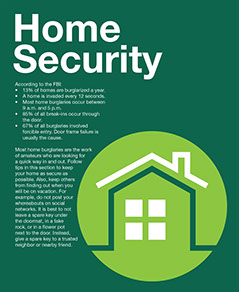
    According to the FBI:

    *  13% of homes are burglarized a year.

    *  A home is invaded every 12 seconds.

    *  Most home burglaries occur between 9 a.m. and 5 p.m.

    *  85% of all break-ins occur through the door.

    *  67% of all burglaries involved forcible entry. Door frame failure is usually the cause.

    Most home burglaries are the work of amateurs who are looking for a quick way in and out. Follow tips in this section to keep your home as secure as possible. Also, keep others from finding out when you will be on vacation. For example, do not post your whereabouts on social networks. It is best to not leave a spare key under the doormat, in a fake rock, or in a flower pot next to the door. Instead, give a spare key to a trusted neighbor or nearby friend.

    General Guidelines

    Safe at Home - Do This, Not That Book. Published by the American Institute for Preventive Medicine. www.HealthyLife.com. All rights reserved.

    © American Institute for Preventive Medicine

  • Prevent Choking & Suffocation

    Home Safety

    Do This, Not That

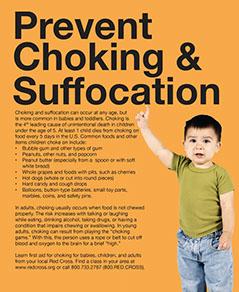
    Choking and suffocation can occur at any age, but is more common in babies and toddlers. Choking is the 4th leading cause of unintentional death in children under the age of 5. At least 1 child dies from choking on food every 5 days in the U.S. Common foods and other items children choke on include:

    *  Bubble gum and other types of gum

    *  Peanuts, other nuts, and popcorn

    *  Peanut butter (especially from a  spoon or with soft white bread)

    *  Whole grapes and foods with pits, such as cherries

    *  Hot dogs (whole or cut into round pieces)

    *  Hard candy and cough drops

    *  Balloons, button-type batteries, small toy parts, marbles, coins, and safety pins.

    In adults, choking usually occurs when food is not chewed properly. The risk increases with talking or laughing while eating, drinking alcohol, taking drugs, or having a condition that impairs chewing or swallowing. In young adults, choking can result from playing the “choking game.” With this, the person uses a rope or belt to cut off blood and oxygen to the brain for a brief “high.”

    Learn first aid for choking for babies, children, and adults from your local Red Cross. Find a class in your area atwww.redcross.orgor call 800.733.2767 (800.RED.CROSS).

    Adults

    Children
    Safe at Home - Do This, Not That Book. Published by the American Institute for Preventive Medicine. www.HealthyLife.com. All rights reserved.

    © American Institute for Preventive Medicine
  • Earth-Friendly Ways For Holiday Fun & Safety

    Home Safety

    Father and two young boys sitting on his lap.

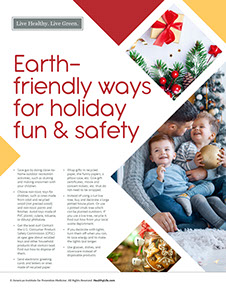
    *  Save gas by doing close-to-home outdoor recreation activities, such as skating and making snowmen with your children.

    *  Choose non-toxic toys for children, such as ones made from solid and recycled wood (not pressed wood) and non-toxic paints and finishes. Avoid toys made of PVC plastic; xylene, toluene, or dibutyl phthalate.

    *  Get the lead out! Contact the U.S. Consumer Product Safety Commission (CPSC) atcpsc.govabout recalled toys and other household products that contain lead. Find out how to dispose of them.

    *  Send electronic greeting cards and letters or ones made of recycled paper.

    *  Wrap gifts in recycled paper, the funny papers, a pillow case, etc. Give gift certificates, movie and concert tickets, etc. that do not need to be wrapped.

    *  Instead of using a cut live tree, buy and decorate a large potted house plant. Or use a potted small tree which can be planted outdoors. If you use a live tree, recycle it. Find out how from your local waste department.

    *  If you decorate with lights, turn them off when you can, to save energy and to make the lights last longer.

    *  Use glasses, dishes, and silverware instead of disposable products.

    A Year of Health Hints book by the American Institute for Preventive Medicine. www.HealthyLife.com. All rights reserved.

    © American Institute for Preventive Medicine
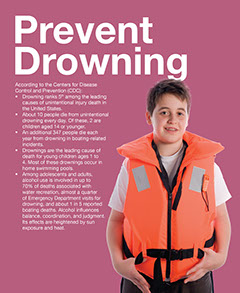
  • Prevent Drowning

    Home Safety

    Do This, Not That

    According to the Centers for Disease Control and Prevention (CDC):

    *  Drowning ranks 5th among the leading causes of unintentional injury death in the United States.

    *  About 10 people die from unintentional drowning every day. Of these, 2 are children aged 14 or younger.

    *  An additional 347 people die each year from drowning in boating-related incidents.

    *  Drownings are the leading cause of death for young children ages 1 to 4. Most of these drownings occur in home swimming pools.

    *  Among adolescents and adults, alcohol use is involved in up to 70% of deaths associated with water recreation, almost a quarter of Emergency Department visits for drowning, and about 1 in 5 reported boating deaths. Alcohol influences balance, coordination, and judgment. Its effects are heightened by sun exposure and heat.

    General Guidelines

    Safe at Home - Do This, Not That Book. Published by the American Institute for Preventive Medicine. www.HealthyLife.com. All rights reserved.

    © American Institute for Preventive Medicine