Category: Work Life

  • 5 Ways To Make It A Healthy Work Day

    WORK LIFE

    Image of a healthy lunch.

    Are you looking for ways to be your best at your job? No matter what kind of work you do, you can improve your overall health and productivity with some simple, everyday habits.

    Get enough sleep.

    The National Heart, Lung, and Blood Institute says getting the right amount of rest helps you both physically and mentally. It boosts your energy and improves your immune system. It may also lower your risk of heart disease, diabetes and stroke. It helps you think, learn, react and deal with stress and anxiety. Aim for seven to nine hours of sleep each night.

    Stay hydrated.

    Drinking enough water is important for any job – whether you sit or stand at a desk, or you’re lifting and moving throughout your day. When you are even slightly dehydrated, you can feel sluggish and you may struggle with problem-solving. If possible, take sips from a water bottle as you go through your day. The color of your urine can tell you if you’re staying hydrated. It should be colorless or light yellow, according to The American Academy of Family Physicians.

    Pack healthy snacks & lunches.

    Eating fresh fruits, vegetables, whole grains and lean protein can give you energy as you move through your day. Don’t choose unhealthy processed foods or fast food. Pack a healthy lunch the night before work, so you can just grab it and go in the morning.

    Wash your hands often.

    Areas in your workplace can be hot spots for germs that can make you sick. Wash your hands with soap and water after using the restroom, before eating, and after touching shared surfaces, such as door handles and computer keyboards. If someone around you is ill, avoid contact with them and be extra diligent about washing your hands.

    Get up & move.

    Avoid sitting at a desk all day without getting some physical activity. Get up and stretch when possible such as during a long conference call. If you get a lunch break, consider taking a 10-minute walk. This can energize you and help you cope with a stressful day.

    © American Institute for Preventive Medicine

  • How To Be A Team Player At Work

    WORK LIFE

    Concept drawing on table to being a team palyer at work.

    You’re bound to run into many different personality types at the workplace. And when you’re working as a team, it can be challenging to adjust to different work styles.

    The American Management Association says teamwork leads to better problem solving and productivity. But it’s not as simple as just saying you’re part of a team. Here are some tips to help you achieve the best possible outcome with your group:

    *Use your strengths.People have different talents and skills that make them who they are. Offer to use your unique strengths to help get things done. Don’t wait to be asked; volunteer to help when you can.

    *Don’t place blame.When things don’t go well, it’s usually not helpful to blame someone else. Instead, look at the problem and work together to find ways to solve it.

    *Listen without talking.When others have ideas or opinions, listen to their side before jumping in with your thoughts. Listen with the goal of understanding their point, not adding your own.

    *Be aware of different work styles.You may be on a team with someone who does things differently than you. Instead of trying to correct them, see if you can learn something from their way of doing things.

    *Be dependable.The best team players are those who get things done on time. Missing deadlines could cause trouble for others on your team or jeopardize your project.

    *Communicate.If you’re running into problems or have too much on your plate, tell your team about it. Someone else may be able to help so you can keep the project running smoothly. People may have no idea you’re struggling – unless you speak up and tell them.

    © American Institute for Preventive Medicine

  • Tips To Survive The Workweek

    WORK LIFE

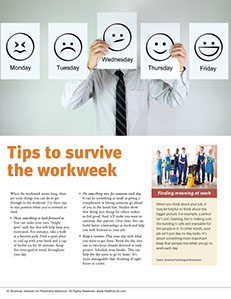
    Image of the days of the week on paper with emotion faces.

    When the workweek seems long, there are some things you can do to get through to the weekend. Try these tips to stay positive when you’re stressed or tired:

    *  Have something to look forward to. You can make your own “bright spot” each day that will help keep you motivated. For instance, take a walk at a favorite park. Find a quiet place to curl up with your book and a cup of herbal tea for 30 minutes. Keep this mini-goal in mind throughout your day.

    *  Do something nice for someone each day. It can be something as small as giving a compliment or letting someone go ahead of you in the lunch line. Studies show that doing nice things for others makes us feel good. And, it’ll make you want to continue that pattern. Over time, this can build better relationships at work and help you look forward to your job.

    *  Keep a routine. Plan your day with what you want to get done. Break the day into one or two-hour chunks devoted to each project. Schedule your breaks. This can help the day seem to go by faster. It’s more manageable than thinking of eight hours at a time.

    Finding meaning at work

    When you think about your job, it may be helpful to think about the bigger picture. For example, a janitor isn’t just cleaning; but is making sure the building is safe and enjoyable for the people in it. In other words, your job isn’t just day-to-day tasks. It’s about something more important. Keep that perspective when you go to work each day.

    Source: American Psychological Association
    © American Institute for Preventive Medicine

  • 6 Tips To Become More Productive At Work

    WORK LIFE

    Image of women at work looking at notes posted on the wall.

    Productivity means you make the most of your time. You may get more done with less time or with fewer people. But it’s not just about being fast, it’s about maintaining quality too. Learning to be productive means you can showcase your talents and abilities by doing a great job with the resources and skills you have.

    Boosting productivity is often easier said than done. When you’re tired, distracted or simply don’t know how to organize your day, it can be hard to stay productive. Try these tips to make the most of your workday – and get more satisfaction out of your career while doing it!

    1.Break down big tasks.Large projects can be overwhelming, so we often put them off because we don’t know where to start. Instead of letting a large project sit on your to-do list, write down the first step you need to do to get it done. Make it something you know you can do, and set a deadline for yourself. Once that’s done, move on to the next step, and so on.

    2.Have real conversations instead of emailing.Email chains can become time-wasters and often lead to misunderstandings or missing information. When possible, talk to someone in person or on the phone instead of starting an email trail.

    3.Check email at set times.We can’t avoid email completely, but constant inbox chimes can quickly diminish your productivity. Instead of reading every email as it comes in, turn off your email program and only check it two to three times a day.

    4.Take quick breaks when you can.Back-to-back meetings or intense work sessions can drain you. But you don’t need to wait until your lunch hour to energize yourself. If you can, take a few moments to get up and walk around. Stretch at your desk or try deep-breathing exercises.

    5.Tackle those little things to clean up your to-do list.If you have a bunch of small, quick tasks nagging at you, set some time aside to get them done. Then you can focus on the bigger, more important things without other distractions.

    6.Set your own deadlines.If a task or project doesn’t have a due date, it’s easier to put off. Even if a specific deadline hasn’t been set, you can give yourself one. This helps you avoid hanging onto those things that sit undone for days or weeks.

    © American Institute for Preventive Medicine

  • How To Make Fewer Mistakes At Work

    WORK LIFE

    Image of clock with person sleeping.

    Do you want to be your best at your job and avoid mistakes? There’s a healthy and simple way to do this: GET ENOUGH SLEEP.

    The National Sleep Foundation (NSF) says almost half of Americans said poor quality sleep affected their lives in the past seven days. And, many people report getting poor sleep on a regular basis.

    This poor sleep adds up to poor job performance, says the NSF. In one poll, up to a third of people admitted to falling asleep or feeling very sleepy at work in the last month. This can lead to minor errors, such as a typo in a letter to major mistakes that affect your career.

    When your body isn’t rested, it affects your brain and thinking in ways that could hurt your job performance and even hurt others. One study showed that when on-call resident doctors work overnight, they report 300 percent more medical errors that led to death than those who worked a 16-hour shift.

    Experts at the NSF say you should get at least seven to eight hours of sleep a night. Try to go to bed and get up at the same time each day, and create a relaxing bedroom environment for sleep. If you have chronic sleep problems, see your doctor for help.

    © American Institute for Preventive Medicine

  • Use Mindfulness At Work

    WORK LIFE

    Concept image of co-workers with graphics above them.

    With mindfulness-being focused and fully present in the here and now-you can replace multitasking habits with more directed practices to reduce stress and increase productivity,” said Dr. Romie Mushtaq, a neurologist with expertise in mind-body medicine. The result? You’ll be sharper, more efficient, and more creative.

    To clear away distractions and live in the moment, Dr. Mushtaq offers these tips for practicing mindfulness in a multitasking business:

    Focus on a single task for an allotted amount of time.

    You might say, “For 15 minutes, I’m going to read through my emails, and then for one hour, I’m going to make my phone calls.” If your job comes with constant interruptions that demand your attention, take several deep breaths and then prioritize them. Resist the urge to answer the phone every time it rings-unless it’s your boss. If someone asks you to drop what you’re doing to help with a problem, it’s okay to say, “I’ll be finished with what I’m doing in 10 minutes, then I’m all yours.”

    When you get “stuck” in a task, change your physical environment to stimulate your senses.

    Sometimes we bounce from one task to another because we just don’t have the words to begin writing that strategic plan, or we’re staring at a problem and have no ideas for solutions. That’s the time to get up, take a walk outside and look at the flowers and the birds or turn on relaxing music. Offering your senses pleasant and different stimulation rewires your brain for relaxation and reduces the effects of stress hormones, which helps to unfreeze your creativity center.

    Delegate!

    We often have little control over the external stresses in our life, particularly on the job. Have compassion for yourself, and reach out for help. If you can assign a task to somebody else who’s capable of handling it, do so. If you need to ask a colleague to help you out, ask.

    © American Institute for Preventive Medicine

  • 6 Ways To Cool A Workplace Argument

    WORK LIFE

    Image of co-workers talking.

    No matter where you work, you’re bound to meet coworkers with different personalities and work styles. As a result, there may be times when you need to work through opinions that differ. Sometimes you may be faced with a heated argument. But, this type of situation doesn’t have to get worse.

    Learn how to calm an upset coworker with these tips from the Society for Human Resource Management:

    1.Remain calm.Yelling and unprofessional behavior doesn’t help anyone find a solution. It could escalate and end up out of control.

    2.Try to understand what the other person is saying.Look at them calmly and let them talk. Follow up by asking them to explain more if needed.

    3.Use “I” statements, such as “I feel disappointed that this project isn’t going well.”Rather than, “You aren’t doing a good job on this project.” Focus on behaviors or problems, not people.

    4.Discuss solutions to the problem.Write them down on paper or a white board if needed.

    5.Make sure everyone agrees on the solution.

    6.If an agreement can’t be reached, decide if you can “agree to disagree” on the issue.If that’s not an option, consider involving a neutral third person or a human resources staff member if needed.

    Knowing how to resolve conflict in the workplace is a valuable skill you can use throughout your life. Staying calm and collected in a tense situation gives you the ability to find a productive, positive solution.

    © American Institute for Preventive Medicine

  • How To Make The Most Of Your Lunch Break

    WORK LIFE

    Image of co-workers having lunch.

    It can be tempting to skip your lunch break if you’re swamped. But taking a midday break can renew your energy and productivity through the afternoon and into the evening. Try these tips to make the most of your break:

    *Plan your afternoon.If you’re stressed about work, make a quick list of what you want to accomplish. If there’s too much to do and not enough time, determine which things are top priority and which can wait.

    *Get up from your workspace.A change of scenery can refresh you, even if it’s only for a few minutes. Staying in the same place all day can leave you feeling burned out.

    *Stop thinking about work.Take a few moments, if you can, to take a deep breath and do something you enjoy. That might be listening to a song, a quick walk outside, or having lunch with a friend.

    Lunch break naps: good or bad?

    If you get a 30 or 60 minute lunch break, should you nap during this time? The National Sleep Foundation says you can consider it. Be sure you:

    *  Keep the midday nap to 20 minutes or less.

    *  Keep it early in the day. Late afternoon or early evening naps could make it hard to fall asleep at night.

    If you find that napping interferes with your nighttime sleep, skip it. It’s more important to get good sleep at night.

    © American Institute for Preventive Medicine

  • Who’S In Your Kitchen Cabinet?

    WORK LIFE

    Illustration of cabinets inside a human's head.

    Seeking out opinions, expertise, and advice from others is a sign of strong leadership, according to author Dan Quiggle who has written about President Ronald Reagan’s advisory kitchen cabinet. Whether it’s politics or business (or life decisions), you can follow these 7 suggestions for putting yours together.

    1.Get over your desire to be right.Reagan chose to fill his kitchen cabinet with trusted advisors who were accomplished in their own rights, and whom he knew would be tough with him when necessary-not yes-men.

    2.Stock your cabinet with a variety of viewpoints.Find people with a variety of different viewpoints and knowledge sets. Include people who disagree with you (but won’t undermine you).

    3.Keep it small.Start with only two to five people whom you trust and admire. Smaller groups can be more effective, and there’s less chance individual egos will take over.

    4.Don’t over formalize things.No formal invitation, no procedure, just sit and share advice and insight.

    5.Keep in mind that you may need more than one brain trust.You may need to assemble different brain trusts for different tasks.

    6.Hear everyone out and take their advice to heart.If a majority isn’t in favor of something, you might want to rethink.

    7.Make sure everyone shares your success-oriented vision.Make sure everyone shares your success-oriented vision. After all, responsibility for making sure your kitchen cabinet shares a vision falls on your shoulders.

    © American Institute for Preventive Medicine

  • 7 Steps To A Great Work Day

    WORK LIFE

    Image of construction workers.

    1.  Allow yourself plenty of time in the morning. Don’t hit snooze on the alarm. Starting your day without rushing can help keep your stress levels down.

    2.  Take an invigorating shower or listen to upbeat music to wake up your body and mind. This will help jump-start your day.

    3.  Have a healthy breakfast with some protein and fiber to keep you going all morning. Try oatmeal with low-fat milk or an egg with whole grain toast. Pack a healthy lunch too!

    4.  When you get to work, write down the most urgent things that should be done. Respond to the most important emails or calls first. But, don’t forget about less urgent items. Write down a list of what you hope to get done by the end of the day.

    5.  Smile when you talk to people on the phone. Others will “hear” your smile in the tone of your voice. Even if you don’t feel like smiling, try it. You may find that it helps you have a more positive outlook. Smiling can “trick” your brain into feeling happy.

    6.  Don’t get overwhelmed. If your workload isn’t doable, speak up. Talk to your supervisor about small concerns before they become big problems. You may be able to get a deadline extension or find a creative way to get it done with help from a coworker.

    7.  Get to bed on time so you can start fresh and rested again tomorrow. Aim for seven to nine hours of sleep each night. Allow for some relaxing activity before bedtime to get your body and mind ready for sleep.

    Sources: American Institute of Stress, National Sleep Foundation

    © American Institute for Preventive Medicine