Category: Work Life

  • How To Reduce Stress At Work

    WORK LIFE

    Image of smiling employee.

    Get enough sleep:Poor sleep can affect your mood, judgement and memory. This can harm your ability to cope with stress.

    Look at the bright side:Each day, write down something you are thankful for. Take note of things that make you smile.

    Get moving:Exercise is a well-known way to reduce stress and improve mood. Walking just 20 minutes a day can make a difference.

    Try meditation:Meditating, praying or whatever helps you block out the stress of the day can help you relax. Finding time for peace can reduce overall stress levels.

    Find ways to laugh:Laughter can help your muscles relax, which can be soothing after a stressful day.

    Take a deep breath:Deep breathing activates a state of relaxation. Focus on deep breaths in and out for a few minutes each day.

    Stretch it out:Stretching can be relaxing and can help the body get ready for sleep. Stretch each night before bed to help you get good rest.

    Talk to others:Emotional support from friends and family is helpful during times of stress. Make plans to talk with people and have fun with loved ones during your free time.

    Sources: American Institute of Stress, Anxiety and Depression Association of America, American Psychological Association

    © American Institute for Preventive Medicine

  • Why You Shouldn’T Eat At Your Desk

    WORK LIFE

    Image of co-workers wating lunch together.

    It seems like a convenient way to get through your day. Rather than take a break to eat lunch, you grab a bite and eat while you’re at your desk. But, this may be leading the way to unhealthy habits.

    Here’s why you should escape your workspace for your meals:

    *You need a mental break.Getting up and eating away from your desk can help you clear your mind and boost mental energy.

    *Moving more is better.A 5-10 minute walk is better than no walk at all. Being active and sitting less will improve your health.

    *You may eat more mindfully.If you munch on food while working or watching a screen, you may eat more than you need to. Instead, sit down away from a screen and focus on your food. This can help you pay attention to your feelings of hunger and fullness.

    *You could be missing out on fun.Bonding with others at your workplace can be fun and enjoyable. You may even look forward to social lunch breaks, which could increase your happiness at work.

    Healthy lunch, healthy wallet

    Packing a healthy lunch can be good for your health. It can help you steer clear of the vending machine or other unhealthy options. Plus, bringing your own lunch may be healthy for your wallet. The average American spends $53 a week on lunch and coffee expenses during the workday. That adds up to more than $2,700 a year.

    © American Institute for Preventive Medicine

  • 7 Tricks To Organize Your Office Right Now

    WORK LIFE

    Image of an empty 'In' tray and a full 'Out' tray.

    1. Clean off your desktop to allow yourself adequate work space. Remove personal items to a bookshelf or wall. Consider moving your computer to a desk or cart.

    2. Set up a system to sort incoming paper (a file box or folders) labeled “to do,” “urgent,” “refer,” “consider,” “pay,” and “file.”

    3. Keep a shredder and recycling bin nearby. As you go through your inbox, shred, recycle, and sort into your system.

    4. Throw everything you need to read into a box. Grab a few articles to take with you whenever you leave your office.

    5. Use cutlery holders or small plastic containers to sort office supply items in a drawer. Keep only enough for a week or two. Place backups in a storage cabinet.

    6. Use tubs or tote bags as project files.

    7. Make a list of your files and post it on your filing cabinet for quicker retrieval of files. Analyze and consolidate items on your list before organizing the actual files.

    Source: Ineedmoretime.com

    © American Institute for Preventive Medicine

  • How To Steer Clear Ofoffice Gossip

    WORK LIFE

    Image of 3 co-workers whispering to each other while another is walking away.

    Do you know someone at work who loves to gossip? Perhaps they always have some “juicy” information about another person. If you’re just listening, and not talking, then no harm done, right?

    Not necessarily. According to the National Ethics Association, workplace gossip can damage employee relationships, decrease morale at work and even harm someone’s career. If you engage in the gossip, you may lose credibility with important people and create conflict. But how do you cut gossip out of your professional life?

    *  Identify the main source of gossip and avoid him or her. If you work in a larger office, you may be able to stay out of this person’s path. If your workplace is small, this may be more challenging. Try shutting your door when you know that person is around, or simply busy yourself with work. If approached, you can say, “I’m sorry, I can’t talk now. I have to get this project done right away.”

    *  If you get cornered and don’t know how to respond, it’s sometimes best to just be silent. If you don’t react or respond to the gossip, the other person will quickly get bored or learn you’re not interested.

    *  If these tactics don’t work and the person continues to try to pull you in, you may need to be more direct – but polite. Don’t accuse or start an argument. Instead, you could say, “I don’t think we should talk about this. I prefer to focus on my work, and not worry about other people.”

    *  If it’s you who tends to talk about others, adopt a personal policy to stop. Talking about others’ personal or professional business is almost always inappropriate, and does not help you or your co-workers. Think of the reverse: would you want someone gossiping about you? Find upbeat, interesting things to talk about around the water cooler, such as how each person’s family is doing, or what their plans are for the weekend.

    The first few times you have to stop office gossip can be hard. Stick to it, and over time, you will find that it gets easier. Eventually, you’ll stop being a magnet for the negative conversations. Your productivity at work will likely improve, and you may feel better about yourself and those you work with.

    © American Institute for Preventive Medicine

  • 8 Ways To Be Promotable

    WORK LIFE

    Image of a group of co-workers smiling.

    No matter what the job, there are certain qualities that all top-performing employees share, according to job-placement expert Phil Blair, author of Job Won! Below are Blair’s 8 ways to be promotion-worthy:

    1.Look and act promotable.You’ve got a job, but unless you plan to make it the last job you ever have, think long term. Act like you’re a man or woman on a mission, always prepared to take the next step, to take your career to the next level. Dress accordingly. In fact, dress for the job you want, not the job you have. Showcase your work when you can. Go above and beyond.

    2.Create value in everything you do.Don’t just cross things off a to-do list. If you have a job to do, do it well. Commit your best effort to all tasks, large and small. That might be challenging at times, but people notice.

    3.Be resourceful.Think outside the box. If you’re doing a job and you see a better way to do it, speak up (in a polite, respectful way). Anticipate problems and find answers before they’re needed. Don’t be afraid to do a little legwork, a little sweating before it’s necessary. It will always pay off.

    4.Get noticed.There’s nothing wrong with stepping up and stepping out: Volunteer for extra duties. Look for chances to be part of a team. Likewise look for chances to work with other departments, both to learn about that department but also to meet new people.

    5.Stay informed.Become an expert in your field. That includes staying on top of industry news and trends, company policies, and department memos. Read the company newsletter. Talk to others in the know. The more information you have at hand, the better prepared you will be when opportunity comes knocking.

    6.Keep positive.No matter what’s going on, remain level-headed, upbeat, with your eye on the prize. There are always ups and downs but focus on the long term. If you have a temper, it is your responsibility to never show it at work.

    7.Be a team player.This is about more than just getting along with others or telling a good joke. In meetings or group efforts, you want to be seen as a valued contributor who offers feedback, meets deadlines, and gets things done-all for the common good. Know your teammates, their strengths, and strive to make them look good too.

    8.Conduct effective meetings.The best way to not get anything done is to call a meeting. That’s a little harsh but meetings are probably the most abused aspect of the workday. The best meetings are short, sweet, and to the point. If you’re calling the meeting or running it, make sure you have an agenda and stick to it. Make sure only the people who need to be at the meeting are there. Stay on point. Allow everyone to speak who wants to speak, but keep them focused on the subject. Try to complete all of the tasks of the meeting before the meeting ends. If that’s not possible, assign action items with due dates.

    © American Institute for Preventive Medicine

  • Is Multitasking Really Helpful?

    WORK LIFE

    Concept image of man running with laptop.

    It seems that today’s world is built for multitasking. With smartphones and tablets, you can check your email, surf the web, and chat from nearly anywhere. And at work, you may be typing while on a conference call or checking messages during a meeting.

    But the American Psychological Association (APA) says this culture of multitasking could actually be harmful, not helpful. The brain is only capable of doing one thing at a time, and therefore, multitasking in itself is not truly possible. Your brain actually switches back and forth between tasks when you think you’re multitasking, says the APA. This process of switching costs you time, and can make you less efficient.

    In addition, Harvard Medical School says multitasking leads to errors and mistakes at work. Maybe you’re shifting back and forth between activities or thinking about something else (like the dinging of your smartphone) while you’re supposed to be doing a task. As a result, you may be more likely to miss details or forget to do things.

    So how do you break the multitasking habit? Find your main sources of distraction and put them aside. If your smartphone is the problem, try putting it in the next room or out of sight while you work on a task. At the very least, silence alerts you don’t need right away such as emails and text messages.

    If the beeping of your email at work is keeping you from focusing on your task at hand, consider closing your email program and only checking it at designated times.

    Cutting out the main sources of distraction can help you stay focused and productive at work or at home.

    © American Institute for Preventive Medicine

  • Work The Crowd

    WORK LIFE

    Image of business man smiling.

    Social gatherings, office parties, community events-they all give you an opportunity to enhance your professional image.

    But if you’re nervous about what to talk about in a crowd of strangers, Toastmasters International offers this advice to turn small talk into smart talk:

    *  Plan your topics. Think of 2 to 3 topics you can discuss with anyone.

    *  Keep it lighthearted. Avoid office gossip and controversial topics. Stay clear of topics related to sex, religion, and politics.

    *  Meet someone new. Take the first step to introduce yourself to the CEO. Or talk to someone new while waiting in the   food line.

    *  Spark a conversation. Ask open-ended questions about the person you’re getting to know.

    *  Listen attentively. Ask follow-up questions about the person or group you’re talking with. Listen more than you talk.

    *  Introduce others. Be sure to introduce a newcomer to those you’re talking with.

    *  Consider cultural differences. Take into account figures of speech, how you present humor, and personal space.

    *  Limit alcohol. Know your drink limit. If necessary, avoid alcohol altogether to keep your composure.

    © American Institute for Preventive Medicine

  • Addressing A Work Schedule That Doesn’T Work

    WORK LIFE

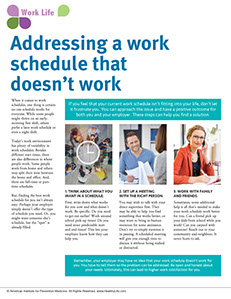
    Image of clock super imposed on an image of employees sitting in a circle.

    When it comes to work schedules, one thing is certain: no one schedule works for everyone. While some people might thrive on an early-morning first shift, others prefer a later work schedule or even a night shift.

    Today’s work environment has plenty of variability in work schedules. Besides different start times, there are also differences in where people work. Some people work from home and others may split their time between the home and office. And, there are full-time or part-time schedules.

    But, finding the best work schedule for you isn’t always easy. Perhaps your employer simply doesn’t offer the type of schedule you need. Or, you might want someone else’s schedule, but the “spot” is already filled.

    If you feel that your current work schedule isn’t fitting into your life, don’t let it frustrate you. You can approach the issue and have a positive outcome for both you and your employer. These steps can help you find a solution:

    1.  Think about what you want in a schedule. First, write down what works for you now and what doesn’t work. Be specific. Do you need to get out earlier? Work around school pick-up times? Do you need more predictable start and end times? This lets your employer know how they can help you.

    2.  Set up a meeting  with the right person. You may wish to talk with your direct supervisor first. They may be able to help you find something that works better, or may want to bring in human resources for some assistance. Don’t try to simply mention it in passing. A scheduled meeting will give you enough time to discuss it without being rushed or distracted.

    3.  Work with family and friends. Sometimes, some additional help is all that’s needed to make your work schedule work better for you. Can a friend pick up your kids from school while you work? Can you carpool with someone? Reach out to your community and neighbors. It never hurts to ask.

    Remember, your employer may have no idea that your work schedule doesn’t work for you. You have to tell them so the problem can be addressed. Be open and honest about your needs. Ultimately, this can lead to higher work satisfaction for you.

    © American Institute for Preventive Medicine

  • Is Your Job A Pain In The Neck?

    WORK LIFE

    Image of business man holding his neck.

    No, really, if you sit all day in front of a computer at work, your computer workstation may be the cause of your nagging neck and shoulder pain. And not surprising, said Dr. Vincent Fortanasce, a rehab specialist and author of End Back & Neck Pain, “The setup of your computer workstation can play a large factor in your ability to stay symptom free.” He and his coauthors point out 3 common workstation mistakes people make that lead to pain.

    *  Overreaching injuries occur because items on your desktop such as your keyboard or mouse, phone, documents, and other desk items are not on the same level surface. So you reach to grab that stapler or strain to pick up files.The solution: rearrange the desktop, adjust your chair, put the keyboard and mouse on the same surface, put things you use the most closest to you.

    *  Use of incorrect heights refers to the up and down motions and placement of items. Incorrect height occurs as a result of the positioning of the chair, including the armrests, seat back, seat pan, desktop where work is placed, monitor, and the surface holding the keyboard and mouse. Incorrect height may also refer to furniture and features of the work area that are not adjustable.The solution: a proper chair is of critical importance. Can you adjust it? Do you have to reach above your head to get items in shelves above your desk? Is the top line of the text displayed on your monitor at eye level?

    * Unbalanced work area refers to twisting motion you do to reach items. If you’re right handed, and you use your right hand for all desktop activities such as answering the phone, you may have pain on your right side. Do you twist to see your monitor?The solution: Place your monitor right in front of you. Are items you use directly ahead of you?

    Back, neck, and arm pain are often the result of repeated actions, over and over, over time. Assess what’s causing your pain and adjust your workstation.

    © American Institute for Preventive Medicine