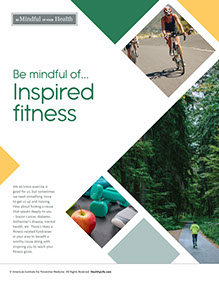
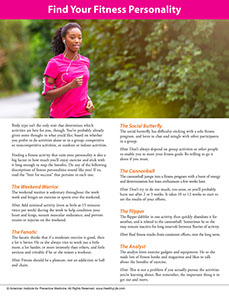
When you are fit, you are at a healthy body weight. You have energy. Exercise and a healthy diet are a regular part of your life.
Fitness has four parts:
* Heart and Lung Fitness. This is how well your heart pumps blood and sends oxygen through your body.
* Muscle Fitness. This is about your muscle strength and endurance. Muscle strength is how much weight you can lift safely. Endurance is how many times you can lift something or how long you can hold it without getting tired.
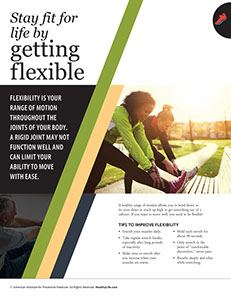
* Flexibility. This is being able to move your joints easily and without pain through a wide range of motion. This helps you reach, twist, turn, and move things without straining.
* Body Make-Up. This is how much of your body is fat and how much is muscle. Too much body fat puts extra strain on your joints and increases your risk for heart disease and other diseases. Too little body fat is not good either.
Fitness Goals
To set your goals, consider these points:
* Activities you’ve been good at before and things you think you will enjoy doing
* Equipment you have or can use
* Goals you want to achieve and your current fitness level.
Ways to Get More Fit
* Exercise.
* Recreation, such as golfing, dancing, etc.
* Active hobbies, such as working in the garden
* Chores, such as mowing the grass, walking the dog, etc.
Time to Set Your Goals
* Write down your goals. Record the date.
* Your goals should be clear and measurable. “To get stronger” is vague. “To advance from 5 to 10 push-ups by the end of the month” is clear.
* Make short term goals. Plan what you want to do by the end of the month; not a year from now.
* From time to time, review and change your goals.
Before You Begin an Exercise Program
Start slowly. Build up gradually. This gives your body time to adjust to exercise. It also helps you avoid soreness and injury. Check with your doctor before you begin an exercise program if:
* You have one or more chronic health problems (e.g., heart disease, diabetes, arthritis, etc.).
* You are overweight.
* You are a man over age 40 or a woman over age 50 and you plan to begin very active physical activity.
* You are over age 65 and are not active.
* You feel faint or very dizzy at times or you have chest pains.
* You take prescription medicine (e.g., high blood pressure pills, etc.).
* You are not sure how exercise will affect any physical problem you have.
Aerobic Exercises
Aerobic exercise makes the heart get stronger. It also helps your body make natural substances called endorphins that give a natural “high.”
A. Warm Up
Spend 5 to 10 minutes doing the activity at a slower pace or stretch all major muscle groups and parts of the body. This includes your:
* Head and neck. Shoulders, upper back, arms, and chest
* Rib cage, waist, and lower back
* Thighs (front and back). Inner thighs.
* Calves and Achilles’ tendons, which connect the calf muscles to the backs of the heels. Ankles and feet.
Extend each body part and hold it for 15 to 30 seconds. This should not cause any pain, but be a flowing, rhythmic motion that raises your heart rate a bit.
B. Aerobic Activity
Some popular aerobic activities are walking, bike riding, running, low-impact aerobics, and swimming. To be aerobic, the activity you choose should:
* Be steady and nonstop.
* Last a minimum of 10 minutes. You can start out for shorter periods of time, many times a day (e.g., do 5 minutes, twice a day). Progress to more minutes each time.
* Use large muscles of the lower body (the legs and buttocks).
* Result in a heart rate of 60 to 80% of your maximum heart rate.
* Allow you to talk without gasping for breath.
C. Cool Down
Choose a slower pace of the activity you were doing. If you were walking briskly, walk slowly. Or, stretch for about 5 minutes. Stretch all muscle groups. Stretch to the point of mild tension (not pain or burn). Hold for 10 to 30 seconds. Breathe out when you begin to stretch. Breathe in when the stretch is released.
Target Heart Rate
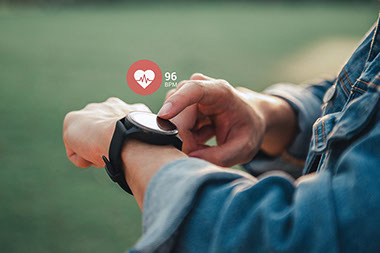
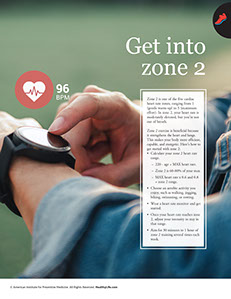
Target heart rate is 60% to 80% of your maximum heart rate (MHR). To find your MHR:
A. Subtract your age from 220:
220 – ______ (age) = ______ (MHR)
B. Multiply your MHR x .60 =
Multiply your MHR x .80 =
C. Your 60-second (target) heart rate should fall somewhere between these two numbers during the aerobic activity.
Guidelines for Aerobic Activity
* Each week, adults should:
– Do at least 2 hours and 30 minutes of moderate aerobic activity, such as brisk walking or ballroom dancing… OR
– Do 1 hour and 15 minutes of vigorous aerobic activity, such as jogging, aerobic dancing, and jumping rope… OR
– A combination of activities from the 2 listed above.
* For increased fitness or to lose weight or keep lost weight off, do 5 hours of moderate physical activity or 2 hours and 30 minutes of vigorous aerobic physical activity a week.
* Warm up for 5 to 10 minutes before each aerobic session.
* Do the aerobic activity for at least 10 minutes at a time.
* Slow down at the end, little by little. Then stretch for 5 to 10 minutes.
Stretch & Strengthen
Stretching Exercises
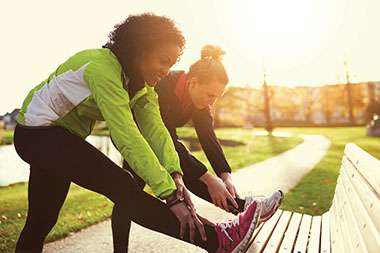
These exercises make your body more flexible. This helps you prevent injury during sports, exercise, and everyday activities. Stretching exercises should be done before and after every strengthening or aerobic workout.
* Stretch only to the point of comfort. You should feel mild tension, not pain.
* Never bounce.
* Breathe slowly and rhythmically.
* When women are pregnant, joints loosen. Pregnant women need to be extra careful not to stretch muscles too far.
Sample Exercises
A. Shoulder Shrug
Shrug your shoulders up toward your head. Then lower them. Repeat 4 times. Slowly circle your shoulders forward 8 times and then backward 8 times.
B. Hamstring Stretch
Sit on the floor with your right leg straight. Bend your left leg and touch your foot against your straight leg. Stretch forward to touch the toes of your right foot. Hold for 4 counts. Then, do this on the other side.
Strengthening Exercises
Benefits of Strength Training
* There is less chance of injury.
* Your muscles can work longer before getting tired (endurance).
* You build muscle. Muscle burns more calories than fat. This occurs even when your body is at rest.
* You have more lean tissue and less fat in the body.
* You improve your bone density. This helps prevent osteoporosis and fractures.
* Your body looks more toned.
Strengthening Guidelines
* Use weights or a stretch band. Try out different ones to find what’s right for you. For strengthening, you should be able to do at least 2 sets and repeat these 8 times. If you can’t, the weight is too heavy. If you can easily do more than 3 sets, and repeat them 12 times, use a heavier weight.
* For toning, try to do 2 sets. Repeat 15 to 20 times.
* Warm up with 15 repetitions using about half to three-quarters your usual weight.
* Give muscles a day to rest in between workouts. If you want to work out every day, do the upper body one day; the lower body the next day.
* Move slowly. Don’t jerk the weights up or drop them too fast.
* Keep your knees and elbows slightly bent.
* Breathe out when you are at the hardest part of the exercise. Breathe in when you return to the starting position. Don’t hold your breath.
* Work opposing muscles. For example, after you work the front of the arm (biceps), work the back of the arm (triceps).
* Talk to your doctor, health care provider, or a fitness consultant for a complete exercise program.
Sample Strengthening Exercises
A. Biceps Curl
Stand with your knees a bit bent, hip distance apart. Or, sit on the edge of a chair or bench. Hold one weight in each hand with your arms down the front of your thighs. Your forearms should face out. Lift the weight slowly (4 times) until it almost touches your upper arm. Keep your upper arm still. At the top of your movement, tighten the biceps muscles. Hold for 2 counts. Lower the weight to the count of 4.
B. Triceps Press
Stand with your knees bent. Keep your feet about hip distance apart. Lean forward a bit with a weight in each hand. Hold them right next to your hips. Bend your elbows. Hold them close to your sides. Don’t move your upper arms or elbows. Extend the weights as high as you can in back to the count of 4. Tighten the triceps to a count of 2. Lower your arms to the count of 4. You can do this with one arm at a time. If you do, rest the other arm on your knee.
C. Knee Push-Up
Lie face down on the floor. Rest on your knees and on the palms of your hands, about shoulder width apart. Push up. Keep your body straight from knees to shoulders. Push up and down slowly to counts of 4.
D. Shoulder Curl-Up
Lie on your back. Bend your knees. Lift your upper back off the floor with your hands crossed over your shoulders. Lift and lower slowly to counts of 4.
E. Calf Raises
Stand with your feet about hip distance apart. Rise onto your toes. Hold for 1 count and lower. Try it on the edge of a step and let your heel drop below your toes for a wider range of motion.
Prevent Sports Injuries
* Ease into any exercise program. Start off easy and build up gradually.
* Before you exercise, warm up your muscles with slow easy stretches. Do this for all sports. Don’t bounce.
* Don’t overdo it. “No pain, no gain” is not true.
* Wear the proper shoes and the right protective gear and clothing for the exercises you do. Items to wear include a helmet, shoulder, knee and wrist pads, a mouth guard, etc.
* Don’t run on hard surfaces, such as asphalt and concrete.
* Run on flat surfaces instead of uphill. Running uphill aggravates the stress put on the Achilles tendon.
* Train in the sport so you learn how to avoid injury. “Weekend athletes” are prone to injury.
* Follow the rules that apply to the sport.
* Cool down after hard exercise. Do the activity at a slower pace for 5 minutes.
Treat Sports Injuries
* If the injury does not appear serious, use RICE:
– Rest the injured area for 24 to 48 hours.
– Ice the area for 10 minutes every 2 hours for the next 48 hours during the times you are not sleeping. (After 48 hours, apply heat. Note: For achilles tendinitis and plantar fasciitis, some sports trainers advise using moist heat, not ice.)
– Compress the area. Wrap with an elastic bandage. Do not cut off circulation. Remove the bandage every 3 or 4 hours and leave it off for 15 to 20 minutes each time you do so.
– Elevate the area above heart level, if possible.
* If you sprain your finger or hand, remove rings right away. If you don’t and your fingers swell up, the rings may have to be cut off.
* Use crutches only when it is too painful to bear weight.
* Take an over-the-counter medicine for pain, if needed. Take the medicine your doctor or health care provider prefers you use.
Note: Many sports medicine providers do not advise taking aspirin-like medicines at first because these can make bleeding and bruising worse.
Benefits of Fitness
* It improves heart function and breathing.
* It makes muscles and bones stronger.
* It lowers the risk of getting some cancers, heart disease, osteoporosis, and type 2 diabetes.
* It lowers cholesterol.
* It helps keep blood pressure under control.
* It helps to control your weight.
* It relieves stress and lowers the risk of depression and anxiety. It helps you sleep better.
* It gives you more energy and can improve your job performance.
* It improves your sex drive.
* It can help you live longer.
Resources
American Council on Exercise (ACE)
888.825.3636
www.acefitness.org
Centers for Disease Control and Prevention
www.cdc.gov/physicalactivity/everyone/guidelines