Before You Go
* Find out about health concerns where you are going and if immunizations are needed.
* Carry all needed prescriptions (in their original containers) and supplies with you. Get a letter from your doctor, for taking a controlled substance, injectable medicines, notice for having a pacemaker, artificial joint, etc.
* Find out what your health insurance plan covers and if you need extra insurance.
* Ask your doctor if you need to adjust medicine dosages and activity schedules. Arrange for special needs (e.g., wheelchair, special meals, etc.) with the airline, etc.
* If you have a heart condition, carry a copy of a recent EKG test. Know how to obtain your past medical records in case of an emergency while you are away.
For Motion Sickness
* Get plenty of rest before the trip.
* Take an OTC medication (i.e., Dramamine®) 30 minutes before travel begins.
* If traveling by airplane, request a seat over the wings. Open the overhead vents and direct air at your face.
* On a cruise ship, get a cabin near the middle and close to the waterline. Spend as much time as you can on deck in the fresh air.
* When traveling by car or train, gaze straight ahead, not to the side. Sit by an open window for fresh air except in a polluted area.
* If you feel sick, breathe slowly and deeply. Avoid smoke and food odors. Eat crackers.
To Help Prevent Jet Lag
* Three nights before you leave, change your bedtime. If traveling to a different time zone and going east, go to bed 1 hour earlier for each time zone you cross; if traveling west, go to bed 1 hour later for each time zone.
* Once on the plane, change your watch and activity to match the time where you are going. If it is daytime there, stay awake; if nighttime, sleep on the plane.
To Stay Safe While You Are Away
* Do not look like a tourist. Wear plain clothes and little, if any, jewelry.
* Avoid first floor rooms and those with doors facing outside. Lock your door using the safety chain. Make sure that windows and connecting doors are locked.
* Study the emergency exit map to prepare for an escape.
* Walk at night with others and in well-lit, safe areas. Ask hotel staff for advice.
Other Tips for Air Travel
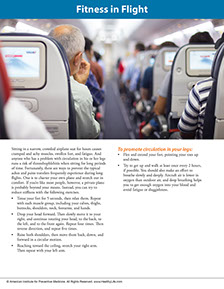
* To reduce the risk for blood clots in the legs, extend your feet and flex your ankles several times while sitting. Get up and walk every hour or so.
* To avoid ear pain, chew gum, suck on hard candy, or yawn during take-offs and landings.
* Drink water, not alcoholic or caffeinated beverages, before and during the flight.
Resources
International Association for Medical Assistance to Travellers (IAMAT)
716.754.4883
www.iamat.org