Category: Brain & Nervous System

  • Memory Loss

    Brain & Nervous System

    With short-term memory loss, you can’t recall things learned in the past seconds to minutes. With long-term memory loss, you forget things learned in the distant past, such as in childhood. It is normal to have some memory loss as you age. It is common to forget where you put your eyeglasses or keys. You may have a hard time recalling the name of a person or place, and say, “It is on the tip of my tongue.” This memory loss is temporary and not severe. When it persists or interferes with your daily life, it can be a sign of a problem.

    Signs & Symptoms

    Signs and symptoms of serious memory loss, such as amnesia, depend on the cause. The memory loss can be partial or complete. It can occur for a short time or persist. It can also come on suddenly or slowly.

    Causes

    Other than the normal memory loss that comes with aging, causes include:

    *  Depression.

    *  Excess alcohol. Drug use.

    *  Side effects of some medicines.

    *  Alzheimer’s disease and other forms of dementia. Dementias result in a decline of all areas of mental ability. This includes learning, problem solving, language, behaviors, and memory loss.

    *  Mild cognitive impairment. This is a medical illness. With this, people have abnormal memory for their age and education. They have a harder time learning new information or recalling things.

    *  Posttraumatic stress disorder.

    *  Seizures. Head trauma.

    *  Stroke.

    *  Brain infections or tumors.

    Treatment

    Memory loss that persists, is severe, or that interferes with daily life needs a medical diagnosis. When another problem is the cause and is treated with success, memory loss improves. For other causes, such as Alzheimer’s disease, there is no cure. The goal is to treat symptoms and provide safety and comfort.

    Questions to Ask

    Self-Care / Prevention

    To Help Prevent Memory Loss

    *  Keep the brain active. Read, do puzzles, etc.

    *  Eat a balanced diet. Take vitamins and minerals, as advised by your doctor.

    *  Get regular exercise.

    *  Protect the head from injury.

    *  Follow tips under Prevention for Stroke (Brain Attack).

    *  Don’t smoke or use illegal drugs. Limit alcohol.

    *  Manage stress.

    *  Get regular eye exams. Get your hearing checked. If needed, wear eyeglasses and/or a hearing aid.

    To Help Remember Things

    *  Follow a routine for daily and weekly activities.

    *  Listen carefully. Link newly learned things to past memories.

    *  Repeat what you want to remember out loud. Write it down if you need to.

    *  Keep track of important things to do, phone numbers, etc. Use a calendar, planner, PDA, etc.

    *  Set up a system to remind you of daily medications to take, bills to pay, appointments to keep, etc.

    *  Put your keys, eyeglasses, etc. in the same place.

    Healthier at Home book by the American Institute for Preventive Medicine. www.HealthyLife.com. All rights reserved.

    © American Institute for Preventive Medicine

  • Multiple Sclerosis

    Brain & Nervous System

    Multiple Sclerosis (MS) is a chronic disease of the brain and spinal cord. With MS, a covering that protects nerves (myelin) and the nerves are damaged or destroyed. Over time, scar tissue forms along the damaged myelin. Nerves can’t send signals like they should. As a result, movement, sensation, etc. are impaired or lost.
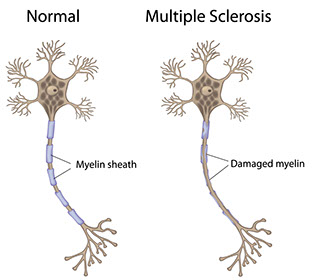
    Illustration showing multiple sclerosis.

    Signs & Symptoms

    *  Fatigue.

    *  Feelings of pins and needles. Numbness. Leg stiffness.

    *  Poor coordination. Unsteady gait. Impaired movement.

    *  Bladder problems.

    *  Blurred vision. Double vision. Loss of vision in one eye.

    *  Depression. Mild problems with memory, learning, etc.

    *  Swallowing problems.

    Early signs and symptoms may be mild and present for years before MS is diagnosed.

    Symptoms vary from person to person. They may last for hours or weeks. They can vary from day to day and can come and go with no set pattern.

    Some persons have only a few symptoms over the course of the disease. For others, symptoms continue and/or worsen with time. Most persons with MS get symptom flare-ups (relapses) that are followed by partial or complete recoveries (remissions).

    Causes

    The exact cause of MS is not known. It may be due to a number of factors. These include: A virus, genetics, and an immune system problem. Toxins, trauma, poor nutrition, and other factors may also play a role. Things known to come before the onset of MS include: Overwork; fatigue, the postpartum period for women; acute infections; and fevers. Multiple sclerosis is more common in:

    *  Women than in men.

    *  Caucasians than in Hispanics or African Americans. It is rare among Asians and certain other ethnic groups.

    *  Adults between the ages of 20 and 50. Young children, teens, and older adults can also have MS.

    *  People who are born and live up to at least age 15 years old in places farther from the equator. These include North America, Europe, and Southern Australia.

    Treatment

    There is no cure yet for MS, but most people with it live a normal life span. Treatment for MS includes:

    *  Prescribed medication to lessen the number and severity of flare-ups and to slow the progression of the disease. Research favors early treatment with this type of medicine.

    *  Short-term courses of IV or oral corticosteroids. These reduce inflammation during MS flare-ups.

    *  Medications to control and treat MS symptoms. Treating infections, when present.

    *  Physical and occupational therapy.

    *  Counseling. Support groups.

    *  Clinical trails. Accesswww.clinicaltrials.gov.

    Questions to Ask

    Self-Care / Prevention

    *  Follow your doctor’s guidelines for home care.

    *  Maintain a normal routine at work and at home. Avoid activities that lead to fatigue or put too much physical stress on the body. Get plenty of rest.

    *  Manage emotional stress.

    *  Avoid the heat and sun. Don’t take hot showers or baths. Increased body temperature can cause symptoms. Cool baths or swimming in a pool may improve symptoms by lowering body temperature.

    *  Have body massages to help maintain muscle tone.

    *  Treat a fever as soon as it occurs.

    *  Get regular exercise. Physical therapy may be helpful.

    *  Get counseling, if needed.

    *  Get a seasonal flu shot every year and other vaccines as advised.

    *  If you smoke, quit!

    Resources

    Multiple Sclerosis Foundation

    888.MS.FOCUS (673.6287)

    www.msfocus.org

    National Multiple Sclerosis Society

    800.FIGHT.MS (344.4867)www.nationalmssociety.org
    Healthier at Home book by the American Institute for Preventive Medicine. www.HealthyLife.com. All rights reserved.

    © American Institute for Preventive Medicine
  • Parkinson’S Disease

    Brain & Nervous System

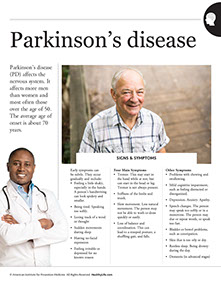
    Parkinson’s disease (PD) affects the nervous system. It occurs equally in men and women of all races and ethnic groups. It most often affects people over the age of 50. The average age of onset is 60 years.

    Signs & Symptoms

    Early symptoms can be subtle. They occur gradually and include:

    *  Feeling a little shaky. A person’s handwriting can look spidery.

    *  Being tired. Speaking too softly.

    *  Losing track of a word or thought.

    *  Having no facial expression.

    *  Feeling irritable or depressed for no known reason.

    The Four Main Symptoms

    *  Tremor. This may start in the hand while at rest, but can start in the head or leg. Tremor is not always present.

    *  Stiffness of the limbs and trunk.

    *  Slow movement. Less natural movement. The person may not be able to wash or dress quickly or easily.

    *  Loss of balance and coordination. This can lead to a stooped posture, a shuffling gait, and falls.

    Other Symptoms

    *  Problems with chewing and swallowing.

    *  Having a hard time changing positions.

    *  Depression. Anxiety.

    *  Speech changes. The person may speak too softly or in a monotone. The person may slur or repeat words, or speak too fast.

    *  Bladder or bowel problems, such as constipation.

    *  Skin that is too oily or too dry.

    *  Restless sleep. Being drowsy during the day. Having a harder time staying asleep at night.

    *  Dementia (in advanced stages).

    Causes

    The exact cause of Parkinson’s disease is not known. What is known, though, is that certain cells in the lower part of the brain can’t produce dopamine. Nerves need this to coordinate body movement.

    {Note: Some medicines can bring on symptoms like ones of Parkinson’s disease. Examples are strong tranquilizers and metoclopramide (Reglan), a drug used for some digestive problems.}

    Risk Factors

    *  Family history of the disease.

    *  Aging. For some persons, the neurons that produce dopamine wear away with aging.

    *  Rarely, repeated trauma to the head. This can happen to boxers. Muhammad Ali has this condition.

    *  Damage to nerve cells through a chemical process called oxidation.

    *  Toxins in the environment.

    Treatment

    Parkinson’s disease is not yet curable. Symptoms can be relieved or controlled. Treatment includes:

    *  Medicines, such as levodopa, selegiline, and apomorphine.

    *  Physical therapy. Speech therapy.

    *  Direct electrical brain stimulation.

    *  Neurosurgery.

    Questions to Ask

    Self-Care / Prevention

    *  Follow your treatment plan.

    *  Plan and maintain safety in the home. Replace razor blades with electric shavers. Use nonskid rugs and handrails to prevent falls, etc.

    *  Make tasks easy to do. Wear loafers, not tie shoes. Wear clothes that can be pulled on. Use items with snaps or Velcro closures instead of buttons.

    *  Prevent constipation.

    *  Stay as active as you can. Do the activities and exercises advised by your doctor and/or physical therapist.

    *  Take warm baths. Get massages to help with rigid muscles.

    *  Eat healthy foods. If you take levodopa, limit the protein in your diet, as advised by your doctor. A high protein diet can lessen the effects of levodopa.

    Resources

    National Parkinson Foundation (NPF)

    800.4PD.INFO

    800.473.4636

    www.parkinson.org

    Healthier at Home book by the American Institute for Preventive Medicine. www.HealthyLife.com. All rights reserved.

    © American Institute for Preventive Medicine
  • Traumatic Brain Injury

    Brain & Nervous System

    Model brain with a puff of smoke above it.

    This type of brain injury may happen when there is a blow, bump, or jolt to the head. Sports injuries are a common cause of traumatic brain injury (TBI).

    Of all injuries, ones to the brain are most likely to result in death or disability for life.

    It may not look cool to wear a helmet when you ride a bike, rollerblade, etc., but doing so is the best way to prevent a severe head injury. Find out about protective helmets for the sport(s) you do from the Consumer Product Safety Commission atcpsc.gov.

    Learn more from the Brain Injury Association of America atbiausa.org.

    Health at Home Lifetime book by the American Institute for Preventive Medicine. www.HealthyLife.com. All rights reserved.

    © American Institute for Preventive Medicine
  • A Beautiful Brain

    Brain & Nervous System

    A pink paper brain with 2 dumb bells next to it.

    Like a great conductor, our brain directs our every movement, sound, and emotion. It never stops working and thinking for us, but we rarely return the favor and think about the health of our brain. A healthy brain can concentrate, analyze, plan, learn, remember, feel, and so much more.

    While a healthy lifestyle supports a healthy brain, a happy brain also stays engaged. Feed your brain by playing games, learning new things, and staying connected with friends and family.

    Health at Home Lifetime book by the American Institute for Preventive Medicine. www.HealthyLife.com. All rights reserved.

    © American Institute for Preventive Medicine
  • How Aging Affects Memory

    Brain & Nervous System

    Image of 2 elderly male friends hugging.

    Many people are afraid that growing old means losing the ability to think, reason, or remember.

    Some short-term memory loss does come with aging. You may, for example, forget where you put your keys or not remember the name of a person you just met. This is normal. Memory lapses that interfere with your normal activities, though, are not a normal part of aging. Nor is confusion.

    People who have changes in personality, behavior, or skills may have a brain or nervous system condition. These problems could also be a side effect of certain medicines, too much alcohol, or depression. This chapter gives information on common brain and nervous conditions in older persons.

    Health at Home Lifetime book by the American Institute for Preventive Medicine. www.HealthyLife.com. All rights reserved.

    © American Institute for Preventive Medicine

  • Alzheimer’S Disease

    Brain & Nervous System

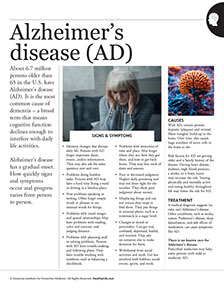
    About 5.3 million persons in the U.S. have Alzheimer’s disease (AD). It is the most common cause of dementia – a broad term that means cognitive function declines enough to interfere with daily life activities. Nearly half of people age 85 and older may have AD, but it is not a normal part of aging.

    Signs & Symptoms

    Alzheimer’s disease has a gradual onset. How quickly signs and symptoms occur and progress varies from person to person. The average time span is about 3 to 6 years after symptoms start. Survival can be as long as 20 years.

    The Alzheimer’s Association gives these 10 symptoms for AD:

    *  Memory changes that disrupt daily life. Persons with AD forget important dates, events, and/or information. They may also ask the same question over and over.

    *  Problems doing familiar tasks. Persons with AD may have a hard time fixing a meal or driving to a familiar place.

    *  New problems speaking or writing. Persons with AD often forget simple words or phrases or use unusual words for things. An example is calling a toothbrush “that thing for my mouth.”

    *  Problems with visual images and spatial relationships. Persons may have problems with reading, color and contrast, and judging distance.

    *  Problems with planning and/or solving problems. Persons with AD have trouble making and following plans. They have trouble working with numbers, such as balancing a checkbook.

    *  Problems with awareness of time and place. Persons with AD may forget where they are, how they got there, and how to get back home. They may lose track of dates and seasons.

    *  Poor or decreased judgment. Persons with AD neglect daily grooming and may not dress right for the weather. They show poor judgment about money.

    *  Misplacing things. Persons with AD lose things and can not retrace their steps to find them. They put things in unusual places, such as a wristwatch in a sugar bowl.

    *  Changes in mood or personality. Persons with AD can get very confused, depressed, fearful, and worried. They rely on someone else to make decisions for them.

    *  Withdrawal from social activities and work. Persons with AD get less involved with hobbies, social events, sports, and work.

    Causes

    With AD, certain protein deposits (plaques) and twisted fibers (tangles) build up in the brain. Over time, this causes large numbers of nerve cells in the brain to die.

    Risk factors for AD are getting older and a family history of the disease. Having heart disease, diabetes, high blood pressure, a stroke, or a brain injury may increase the risk. Staying physically and mentally active and eating healthy throughout life may lower the risk for AD.

    Treatment

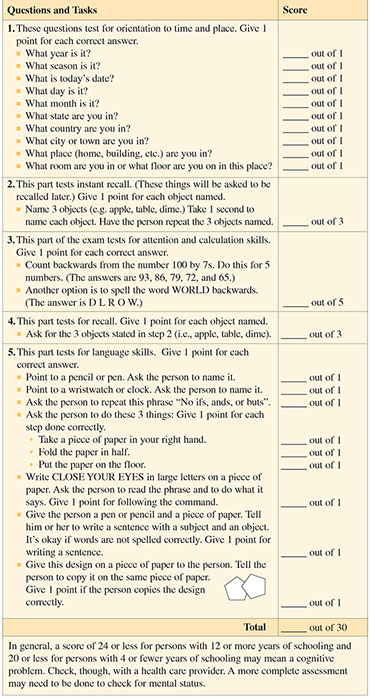
    A medical diagnosis suggests (or rules out) Alzheimer’s disease. Other conditions, such as depression, a severe lack of vitamin B12, and blood clots in the brain can cause symptoms like AD. So can side effects of some medicines.

    There is no known cure for Alzheimer’s disease. Prescribed medicines may help some persons with mild to moderate AD.

    Questions to Ask

    Self-Care / Prevention

    There is no known prevention. Studies are being done to find out ways to lower the risk of AD and delay the onset of symptoms. Some studies suggest to do things that keep the mind active. This includes crossword puzzles and reading.

    Good planning, medical care, and social management help both the person and caregivers cope with symptoms and maintain the quality of life for as long as possible. An Advance Directive should be done in the early stages of AD to allow for the person’s wishes. It’s very helpful to put structure in the life of the person in the early stages of AD. To do this:

    *  Maintain daily routines.

    *  See that the person with AD eats well- balanced meals and stays as active as he or she can. Activities like going for walks with others are good.

    *  Post safety signs like “Don’t touch.” Make “to do” lists of daily tasks.

    *  Put things in their proper places after use. This helps the person find things when he or she needs them.

    *  Make sure the person carries identification or wears a medical ID bracelet.

    Resources

    Alzheimer’s Disease Education & Referral (ADEAR) Center

    800.438.4380

    www.nia.nih.gov/alzheimers

    Alzheimer’s Association

    800.272.3900

    www.alz.org

    Healthier at Home book by the American Institute for Preventive Medicine. www.HealthyLife.com. All rights reserved.

    © American Institute for Preventive Medicine

  • Alzheimer’S Disease 2

    Brain & Nervous System

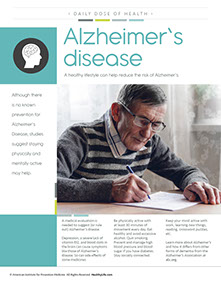
    Old man working on a cross word puzzle.

    A healthy lifestyle can help reduce the risk of Alzheimer’s.

    Although there is no known prevention for Alzheimer’s Disease, studies suggest staying physically and mentally active may help.

    A medical evaluation is needed to suggest (or rule out) Alzheimer’s disease.

    Depression, a severe lack of vitamin B12, and blood clots in the brain can cause symptoms like those of Alzheimer’s disease. So can side effects of some medicines.

    Be physically active with at least 30 minutes of movement every day. Eat healthy and avoid excessive alcohol. Quit smoking. Prevent and manage high blood pressure and blood sugar if you have diabetes. Stay socially connected.

    Keep your mind active with work, learning new things, reading, crossword puzzles, etc.

    Learn more about Alzheimer’s and how it differs from other forms of dementia from the Alzheimer’s Association atalz.org.

    Health at Home Lifetime book by the American Institute for Preventive Medicine. www.HealthyLife.com. All rights reserved.

    © American Institute for Preventive Medicine

  • Bell’S Palsy

    Brain & Nervous System

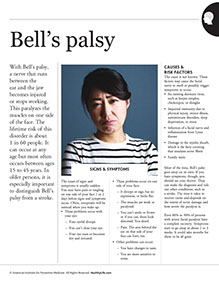
    With Bell’s palsy, a nerve that runs between the ear and the jaw becomes inflamed. This paralyzes the muscles on one side of the face. Bell’s palsy occurs in about 1 in 2,000 people each year. It can occur at any age. In older persons, it is especially important to distinguish Bell’s palsy from a stroke.

    Signs & Symptoms

    The onset of signs and symptoms is usually sudden. You may have pain or tingling on one side of your face 1 or 2 days before signs and symptoms occur. Often, symptoms will be noticed when you wake up.

    *  These problems occur on one side of your face:

    – It droops or sags, has no expression, or looks flat.

    – The muscles are weak or paralyzed.

    – You can’t smile or frown or if you can, these look distorted. You drool.

    – Pain. The area behind the ear on that side of your face can hurt, too.

    *  These problems occur with your eye:

    – Your eyelid droops.

    – You can’t close your eye.

    – Your eye tears.

    *  Other problems can occur:

    – You have changes in taste.

    – You are more sensitive to noise.

    Causes, Risk Factors & Care

    The cause is not known. These factors may cause the facial nerve to swell:

    *  A virus, such as shingles

    *  A physical blow that damages the facial nerve

    *  Decrease in blood flow and pressure on the facial nerve. This could be due to circulation problems.

    *  Family traits

    Most of the time, Bell’s palsy goes away on its own. If you have symptoms, though, you should see your doctor. He or she can make the diagnosis and rule out other conditions, such as a stroke. The time it takes to recover varies and depends on the extent of nerve damage and how severe the paralysis is. Even 80% to 90% of persons with severe facial paralysis have a complete recovery. Symptoms start to go away in about 2 to 3 weeks. It could take months for them to be all gone.

    Self-care can help with the discomfort. For severe cases, a doctor may prescribe:

    *  Nerve conduction tests of the facial nerves

    *  Physical and/or speech therapy

    *  Corticosteroid medicine to reduce swelling of the affected nerve

    *  Eye drops to comfort and protect the affected eye

    *  Electric stimulation to the affected muscle

    *  Surgery, on occasion, to reduce pressure on the facial nerve

    *  Plastic surgery may be done in rare cases, if the face remains paralyzed.

    Self-Care

    Try to be patient. Bell’s palsy is a cause for distress, but is not dangerous. The goal of self-care is to ease symptoms and to prevent damage to the eye.

    For Pain:

    *  Take an over-the-counter medicine for pain.

    *  Cover or close your eye. Apply a heating pad (set on low) to the painful area. Do this for 15 minutes at a time, 2 times a day.

    *  Soak a washcloth in hot water. Wring it out. Close your eye and place it on the closed eye for 15 minutes.

    If You Cannot Close Your Eye:

    *  Wear wraparound goggles during the day to protect your eyes from dust, dirt, and dryness. Wear an eye patch at night to help hold the eyelid shut.

    *  Exercise the affected facial muscles as advised by your doctor or physical therapist. Do a facial massage for 15 to 20 minutes a day. With an oil or a cream, massage the muscles of your forehead, cheek, lips, and eye area.

    *  Use over-the-counter artificial tears as advised by your doctor.

    *  Keep up with your normal activities.

    *  Eat soft foods, if you need to.

    When to Seek Medical Care

    Contact Doctor When:

    *  You have no improvement in symptoms 3 weeks after you have been diagnosed with Bell’s palsy.

    *  You have any of these problems after a diagnosis of Bell’s palsy:

    –  Symptoms get worse.

    –  The numbness or weakness appear to be spreading or affect an area or body part not affected before.

    –  Your eye gets very red or irritated.

    –  Fever

    –  Severe pain

    –  Swelling or a lump in front of the ear

    Get Immediate Care When:

    You have signs of a stroke.

    {Note: Immediate care is advised because the initial symptoms of Bell’s palsy are similar to ones of a stroke. This is especially true for older persons.}

    Health at Home Lifetime book by the American Institute for Preventive Medicine. www.HealthyLife.com. All rights reserved.

    © American Institute for Preventive Medicine