Category: Medical Care

  • Reducing Presurgery Jitters

    Medical Care

    Image of older women looking nervous.

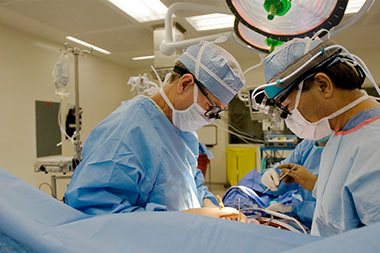
    Knowing what to expect prior to surgery can reduce pre-operation stress and make you feel more comfortable.

    *  The hospital will have you sign a surgical consent form. Take the time to read it over. Ask your doctor any questions you may have.

    *  Expect a visit from the anesthesiologist or the surgeon (or both). They will review the surgical plans with you. This includes the time and length of surgery, estimated recovery room time, and the type of anesthesia being used. The anesthesiologist will need to know about any previous surgeries, any medical conditions, and any allergies to medications. Ask him or her what time you can expect to return to your room.

    *  Eating in the hours prior to surgery can cause life-threatening vomiting during the operation, so there are usually a prescribed number of hours prior to surgery when no food should be eaten. If a meal is brought to you, don’t eat it until you’ve double-checked with a nurse. It may be a mistake that could cause your surgery to be canceled. Your patient chart should read NPO or non per os (nothing by mouth).

    *  Depending on the nature of the operation, some surgical “preps” may be ordered. This may include a special liquids-only diet, cleaning and shaving of the surgical area, placing a catheter into the bladder, giving an enema, or putting drops into the eyes.

    *  A sleeping pill may be offered the night prior to surgery. Most people will feel anxious about the surgery and find the medication helpful. You are not required to accept it, however, and your patient chart should indicate your preference.

    *  Before surgery, give all valuables or possessions to a friend or relative. These would include jewelry, watches, and eyeglasses. If you wear contact lenses, remove them.

    Page from A Year of Health Hints book by the American Institute for Preventive Medicine. www.HealthyLife.com. All rights reserved.

    © American Institute for Preventive Medicine

  • Saving Money In The Hospital

    Medical Care

    Image of women in wheel chair talking with two nurses.

    Don’t stay in the hospital unless you need to! The daily hospital rate in some sections of the country is now as high as $1,000. And that doesn’t include the costs for treatments, medicines, or doctor’s fees. The hospital should never be viewed as a place to get a good rest. Consider these tips:

    *  Choose outpatient services whenever you can. Many routine lab tests, diagnostic tests and surgeries can be done for less money as an outpatient. You avoid the cost of an overnight stay in a hospital.

    *  As an inpatient, stay only the prescribed time that is necessary. Ask your doctor about home health care, which can provide a wide range of services at less cost than in a hospital.

    *  Beware of duplication of tests. Be sure to ask the doctor about what blood tests, X-rays, and medical procedures you can expect.

    *  Be sure you know when checkout time is and make plans to observe it; otherwise, you’re likely to be charged for an extra day’s stay.

    *  If your health problem isn’t an emergency, avoid being admitted to a hospital on a weekend. The hospital staff is reduced then, and testing will usually not begin until Monday.

    *  Same-day or ambulatory surgery is a big moneysaver when compared to inpatient surgery.

    *  Keep a list of all services you receive in the hospital. Ask for an itemized bill so you can make sure you are billed correctly.

    Hospital Admissions

    Arrange as much as you can before being admitted. Ask the following questions:

    *  Can you have the needed forms mailed to your home before being admitted? This will give you more time to review and complete them. Can you be “preadmitted” over the telephone?

    *  Is your insurance coverage well understood by both the billing department and you?

    *  Can you reserve a private or semiprivate room with your coverage?

    *  What identification will you need to have?

    *  Do you need special foods? If so, how can you arrange for them?

    Page from Health at Home book by the American Institute for Preventive Medicine. www.HealthyLife.com. All rights reserved.

    © American Institute for Preventive Medicine

  • Informed Consent

    Medical Care

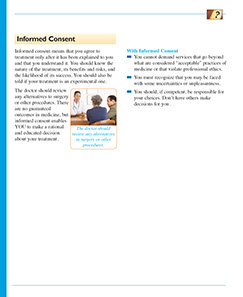
    Image of person filling out forms.

    Informed consent means that you agree to treatment only after it has been explained to you and that you understand it. You should know the nature of the treatment, its benefits and risks, and the likelihood of its success. You should also be told if your treatment is an experimental one.

    The doctor should review any alternatives to surgery or other procedures. There are no guaranteed outcomes in medicine, but informed consent enables YOU to make a rational and educated decision about your treatment.

    With Informed Consent

    *  You cannot demand services that go beyond what are considered “acceptable” practices of medicine or that violate professional ethics.

    *  You must recognize that you may be faced with some uncertainties or unpleasantness.

    *  You should, if competent, be responsible for your choices. Don’t have others make decisions for you.

    Page from the Healthier at Home book by the American Institute for Preventive Medicine. www.HealthyLife.com. All rights reserved.

    © American Institute for Preventive Medicine

  • Review Your Patient Chart

    Medical Care

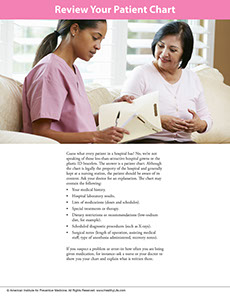
    Guess what every patient in a hospital has? No, we’re not speaking of those less-than-attractive hospital gowns or the plastic ID bracelets. The answer is a patient chart. Although the chart is legally the property of the hospital and generally kept at a nursing station, the patient should be aware of its content. Ask your doctor for an explanation. The chart may contain the following:

    *  Your medical history.

    *  Hospital laboratory results.

    *  Lists of medications (doses and schedules).

    *  Special treatments or therapy.

    *  Dietary restrictions or recommendations (low-sodium diet, for example).

    *  Scheduled diagnostic procedures (such as X-rays).

    *  Surgical notes (length of operation, assisting medical staff, type of anesthesia administered, recovery notes).

    If you suspect a problem or error-in how often you are being given medication, for instance-ask a nurse or your doctor to show you your chart and explain what is written there.

    Page from A Year of Health Hints book by the American Institute for Preventive Medicine. www.HealthyLife.com. All rights reserved.

    © American Institute for Preventive Medicine

  • See Your “Primary” Doctor Before You See A Specialist

    Medical Care

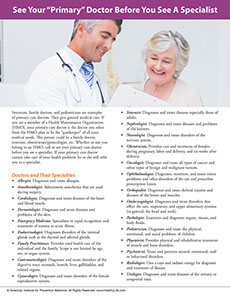
    Internists, family doctors, and pediatricians are examples of primary care doctors. They give general medical care. If you are a member of a Health Maintenance Organization (HMO), your primary care doctor is the doctor you select from the HMO plan to be the “gatekeeper” of all your medical needs. This person could be a family doctor, internist, obstetrician/gynecologist, etc. Whether or not you belong to an HMO, call or see your primary care doctor before you see a specialist. If your primary care doctor cannot take care of your health problem, he or she will refer you to a specialist.

    Doctors and Their Specialties

    Common doctors and a description of their specialties are listed below.

    *  Allergist. Diagnoses and treats allergies.

    *  Anesthesiologist. Administers anesthetics that are used during surgery.

    *  Cardiologist. Diagnoses and treats diseases of the heart and blood vessels.

    *  Dermatologist. Diagnoses and treats diseases and problems of the skin.

    *  Emergency Medicine. Specializes in rapid recognition and treatment of trauma or acute illness.

    *  Endocrinologist. Diagnoses disorders of the internal glands such as the thyroid and adrenal glands.

    *  Family Practitioner. Provides total health care of the individual and the family. Scope is not limited by age, sex, or organ system.

    *  Gastroenterologist. Diagnoses and treats disorders of the digestive tract: stomach, bowels, liver, gallbladder, and related organs.

    *  Gynecologist. Diagnoses and treats disorders of the female reproductive system.

    *  Internist. Diagnoses and treats diseases especially those of adults.

    *  Nephrologist. Diagnoses and treats diseases and problems of the kidneys.

    *  Neurologist. Diagnoses and treats disorders of the nervous system.

    *  Obstetrician. Provides care and treatment of females during pregnancy, labor and delivery, and six weeks after delivery.

    *  Oncologist. Diagnoses and treats all types of cancer and other types of benign and malignant tumors.

    *  Ophthalmologist. Diagnoses, monitors, and treats vision problems and other disorders of the eye and prescribes prescription lenses.

    *  Orthopedist. Diagnoses and treats skeletal injuries and diseases of the bones and muscles.

    *  Otolaryngologist. Diagnoses and treats disorders that affect the ears, respiratory, and upper alimentary systems (in general, the head and neck).

    *  Pathologist. Examines and diagnoses organs, tissues, and body fluids.

    *  Pediatrician. Diagnoses and treats the physical, emotional, and social problems of children.

    *  Physiatrist. Provides physical and rehabilitative treatment of muscle and bone disorders.

    *  Psychiatrist. Treats and prevents mental, emotional, and/or behavioral disorders.

    *  Radiologist. Uses x-rays and radiant energy for diagnosis and treatment of disease.

    *  Urologist. Diagnoses and treats diseases of the urinary or urogenital tract.

    Page from A Year of Health Hints book by the American Institute for Preventive Medicine. www.HealthyLife.com. All rights reserved.

    © American Institute for Preventive Medicine

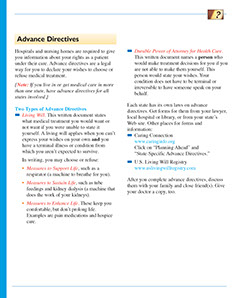
  • Advance Directives

    Medical Care

    Hospitals and nursing homes are required to give you information about your rights as a patient under their care. Advance directives are a legal way for you to declare your wishes to choose or refuse medical treatment.

    {Note: If you live in or get medical care in more than one state, have advance directives for all states involved.}

    Two Types of Advance Directives

    *  Living Will. This written document states what medical treatment you would want or not want if you were unable to state it yourself. A living will applies when you can’t express your wishes on your own and you have a terminal illness or condition from which you aren’t expected to survive. In writing, you may choose or refuse:

    – Measures to Support Life, such as a respirator (a machine to breathe for you).

    – Measures to Sustain Life, such as tube feedings and kidney dialysis (a machine that does the work of your kidneys).

    – Measures to Enhance Life. These keep you comfortable, but don’t prolong life. Examples are pain medications and hospice care.

    *  Durable Power of Attorney for Health Care. This written document names a person who would make treatment decisions for you if you are not able to make them yourself. This person would state your wishes. Your condition does not have to be terminal or irreversible to have someone speak on your behalf.

    Each state has its own laws on advance directives. Get forms for them from your lawyer, local hospital or library, or from your state’s Web site. Other places for forms and information:

    *  Caring Connection:www.caringinfo.org– Click on “Planning Ahead” and “State-Specific Advance Directives.”

    *  U.S. Living Will Registry:www.uslivingwillregistry.com

    After you complete advance directives, discuss them with your family and close friend(s). Give your doctor a copy, too.

    Page from the Healthier at Home book by the American Institute for Preventive Medicine. www.HealthyLife.com. All rights reserved.

    © American Institute for Preventive Medicine

  • The Ins And Outs Of Ambulatory Surgery

    Medical Care

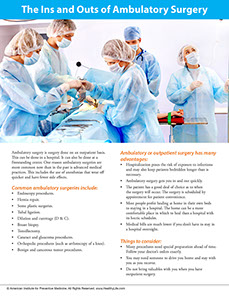
    Ambulatory surgery is surgery done on an outpatient basis. This can be done in a hospital. It can also be done at a freestanding center. One reason ambulatory surgeries are more common now than in the past is advanced medical practices. This includes the use of anesthesias that wear off quicker and have fewer side effects. Common ambulatory surgeries include:

    *  Endoscopy procedures.

    *  Hernia repair.

    *  Some plastic surgeries.

    *  Tubal ligation.

    *  Dilation and curettage (D & C).

    *  Breast biopsy.

    *  Tonsillectomy.

    *  Cataract and glaucoma procedures.

    *  Orthopedic procedures (such as arthroscopy of a knee).

    *  Benign and cancerous tumor procedures.

    Ambulatory or outpatient surgery has many advantages:

    *  Hospitalization poses the risk of exposure to infections and may also keep patients bedridden longer than is necessary.

    *  Ambulatory surgery gets you in and out quickly.

    *  The patient has a good deal of choice as to when the surgery will occur. The surgery is scheduled by appointment for patient convenience.

    *  Most people prefer healing at home in their own beds to staying in a hospital. The home can be a more comfortable place in which to heal than a hospital with its hectic schedules.

    *  Medical bills are much lower if you don’t have to stay in a hospital overnight.

    Things to consider:

    *  Many procedures need special preparation ahead of time. Follow your doctor’s orders exactly.

    *  You may need someone to drive you home and stay with you as you recover.

    *  Do not bring valuables with you when you have outpatient surgery.

    Page from A Year of Health Hints book by the American Institute for Preventive Medicine. www.HealthyLife.com. All rights reserved.

    © American Institute for Preventive Medicine

  • Save By Being A Wise Consumer

    Medical Care

    What price, health care?

    It is more common to know the price of a car than the price of health care services. It is also more common to take more time looking for a car than a doctor. To be prepared to take care of your health and health care costs, plan ahead:

    *  Don’t wait until you get sick to find a doctor. Having a doctor can save the expense of having to go to an urgent care center or emergency room.

    *  Know what costs your health plan covers and what you need to pay.

    *  Post a list of places your health plan approves for treatment. When you need care, use them instead of out-of-plan ones, which could cost you extra money.

    *  If you have a yearly deductible, budget for this with the rest of your bills.

    Check credentials.

    You can’t afford to trust your health to just anyone. Find out about doctors from:

    *  American Board of Medical Specialties (ABMS) at 866.ASK.ABMS (275.2267) orwww.abms.org.

    *  DocFinder atwww.docboard.org/docfinder.html.

    *  The Federation of State Medical Boards at 888.ASK.FCVS (275.3287) orwww.fsmb.org.

    *  Health Grades atwww.healthgrades.com.

    Look for quality.

    Check out the track records of health plans, hospitals, and doctors. Contact the Agency for Health Care Research and Quality atwww.ahrq.gov.

    Protect yourself from medical errors.

    These could cost extra money and can even cost you your life. Be your own watch dog. Take an active role in every decision about your health care. If needed, have a family member or friend oversee your care.

    Know about tax breaks.

    Medical and dental expenses are tax deductible if they exceed 7.5% of your adjusted gross income. If you are self-employed, you may be allowed to deduct 45% of the cost of your health insurance premium. Find out fromwww.irs.gov.

    Cover image to the Healthy Savings book by the American Institute for Preventive Medicine. www.HealthyLife.com. All rights reserved.

    © American Institute for Preventive Medicine

  • Tell & Ask The Doctor Checklist

    Medical Care

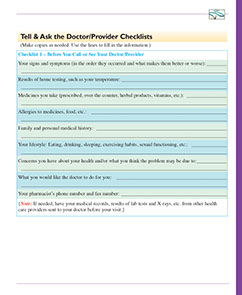
    Tell & Ask the Doctor Checklist

    Page from the Healthier at Home book by the American Institute for Preventive Medicine. www.HealthyLife.com. All rights reserved.

    © American Institute for Preventive Medicine

  • How To Avoid Hospital Germs

    Medical Care

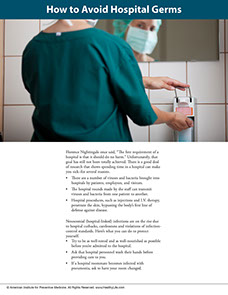
    Image of nurse using antibacterial dispenser.

    Florence Nightingale once said, “The first requirement of a hospital is that it should do no harm.”

    Unfortunately, that goal has still not been totally achieved. There is a good deal of research that shows spending time in a hospital can make you sick-for several reasons.

    *  There are a number of viruses and bacteria brought into hospitals by patients, employees, and visitors.

    *  The hospital rounds made by the staff can transmit viruses and bacteria from one patient to another.

    *  Hospital procedures, such as injections and I.V. therapy, penetrate the skin, bypassing the body’s first line of defense against disease.

    Nosocomial (hospital-linked) infections are on the rise due to hospital cutbacks, carelessness and violations of infection-control standards. Here’s what you can do to protect yourself.

    *  Try to be as well-rested and as well-nourished as possible before you’re admitted to the hospital.

    *  Ask that hospital personnel wash their hands before providing care to you.

    *  If a hospital roommate becomes infected with pneumonia, ask to have your room changed.

    Page from A Year of Health Hints book by the American Institute for Preventive Medicine. www.HealthyLife.com. All rights reserved.

    © American Institute for Preventive Medicine