Category: Medical Care

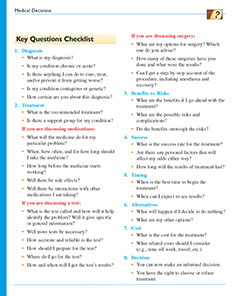
  • Key Questions Checklist

    Medical Care

    Diagnosis

    *  What is my diagnosis?

    *  Is my condition chronic or acute?

    *  Is there anything I can do to cure, treat, and/or prevent it from getting worse?

    *  Is my condition contagious or genetic?

    *  How certain are you about this diagnosis?

    Treatment

    *  What is the recommended treatment?

    *  Is there a support group for my condition?

    If you are discussing medications:

    *  What will the medicine do for my particular problem?

    *  When, how often, and for how long should I take the medicine?

    *  How long before the medicine starts working?

    *  Will there be side effects?

    *  Will there be interactions with other medications I am taking?

    If you are discussing a test:

    *  What is the test called and how will it help identify the problem? Will it give specific or general information?

    *  Will more tests be necessary?

    *  How accurate and reliable is the test?

    *  How should I prepare for the test?

    *  Where do I go for the test?

    *  How and when will I get the test’s results?

    If you are discussing surgery:

    *  What are my options for surgery? Which one do you advise?

    *  How many of these surgeries have you done and what were the results?

    *  Can I get a step-by-step account of the procedure, including anesthesia and recovery?

    Benefits vs. Risks

    *  What are the benefits if I go ahead with the treatment?

    *  What are the possible risks and complications?

    *  Do the benefits outweigh the risks?

    Success

    *  What is the success rate for the treatment?

    *  Are there any personal factors that will affect my odds either way?

    *  How long will the results of treatment last?

    Timing

    *  When is the best time to begin the treatment?

    *  When can I expect to see results?

    Alternatives

    *  What will happen if I decide to do nothing?

    *  What are my other options?

    Cost

    *  What is the cost for the treatment?

    *  What related costs should I consider (e.g., time off work, travel, etc.).

    Decision

    *  You can now make an informed decision.

    *  You have the right to choose or refuse treatment.
    Page from the Healthier at Home book by the American Institute for Preventive Medicine. www.HealthyLife.com. All rights reserved.

    © American Institute for Preventive Medicine

  • Save By Being A Wise Health Care Consumer

    Medical Care

    Close up of hand using a tablet.

    *  Before you receive services, know what your plan covers. Find out from your insurance plan’s website handbook, or customer service representative.

    *  Find out if the cost for 9-1-1 EMS transport is covered or if you need to use a certain ambulance company.

    *  Choose providers who accept your insurance. Find out if prior approval or a referral is needed for services to be covered.

    *  Consider a Consumer Driven Health Plan. You pay a higher deductible and pay for health care costs from a tax-exempt health account. With a high-deductible health plan, you can set aside pre-tax money in a health savings account (HSA). Use this to pay for your deductible and medical costs. Money you don’t spend adds up from year to year, to use for future medical expenses.

    *  Learn if acupuncture and massage therapy fees are covered.

    *  Get recommended tests, exams, and vaccines.

    *  Make sure you use covered services, such as dental cleanings, tests and exams, virtual visits, and the Nurse Advice Line.

    *  Find out about tax breaks for medical expenses fromirs.gov.

    *  Stay informed of changes in health care offerings on national and state levels.

    A Year of Health Hints book by the American Institute for Preventive Medicine. www.HealthyLife.com. All rights reserved.

    © American Institute for Preventive Medicine
  • The Id Card That Can Save Your Life

    Medical Care

    Image of a medical alert tag.

    Heart attacks, car accidents, and other emergencies that leave you unconscious or in a state of shock make it impossible to communicate with health professionals. This is why carrying some sort of medical identification is so important. Three options to consider:

    *  Medic Alert tags. These medical tags alert others to the fact that you have a medical condition that might deserve immediate attention. The tags are given for such conditions as epilepsy or diabetes. To obtain one, contact the MedicAlert Foundation International, 2323 Colorado Ave., Turlock, CA 95382, 1.888.633.4298 orwww.medicalert.org.

    *  Microfilm ID cards. Many hospitals give their patients special cards that contain a small piece of film called microfiche. The film contains extensive medical history information that you provide when the card is issued. During an emergency, the card is read with the use of a microfilm machine.

    *  Nonmedical ID cards. Medical information can be written on a card that is provided by a variety of health organizations or one that is “homemade.” Because there is no official record of this information, health professionals may be reluctant to use some of it.

    Medical ID cards should include the following information.

    *  Name.

    *  Address.

    *  Phone number.

    *  Person to call in an emergency.

    *  Physician’s name and phone number.

    *  Blood type.

    *  Allergies.

    *  Medical conditions.

    *  Required medication.

    *  Pharmacy name and phone number.

    *  Poison control phone number (1.800.222.1222).

    Page from A Year of Health Hints book by the American Institute for Preventive Medicine. www.HealthyLife.com. All rights reserved.

    © American Institute for Preventive Medicine

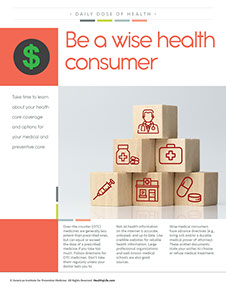
  • Be A Wise Health Consumer

    Medical Care

    Set of blocks stacked with medical icons.

    Take time to learn about your health care coverage and options for your medical and preventive care.

    Over-the-counter (OTC) medicines are generally less potent than prescribed ones, but can equal or exceed the dose of a prescribed medicine if you take too much. Follow directions for OTC medicines. Don’t take them regularly unless your doctor tells you to.

    Not all health information on the internet is accurate, unbiased, and up to date. Use credible websites for reliable health information. Large professional organizations and well-known medical schools are also good sources.

    Wise medical consumers have advance directives (e.g., living will and/or a durable medical power of attorney). These written documents state your wishes to choose or refuse medical treatment.

    A Year of Health Hints book by the American Institute for Preventive Medicine. www.HealthyLife.com. All rights reserved.

    © American Institute for Preventive Medicine
  • Know What Treatment You’Ve Agreed To

    Medical Care

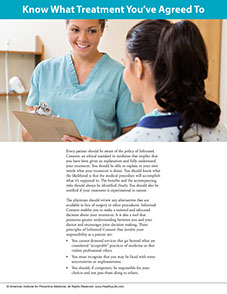
    Image of doctor and patient talking.

    Every patient should be aware of the policy of Informed Consent, an ethical standard in medicine that implies that you have been given an explanation and fully understand your treatment. You should be able to explain in your own words what your treatment is about. You should know what the likelihood is that the medical procedure will accomplish what it’s supposed to. The benefits and the accompanying risks should always be identified clearly. You should also be notified if your treatment is experimental in nature.

    The physician should review any alternatives that are available in lieu of surgery or other procedures. Informed Consent enables you to make a rational and educated decision about your treatment. It is also a tool that promotes greater understanding between you and your doctor and encourages joint decision making.

    Three principles of Informed Consent that involve your responsibility as a patient are:

    *  You cannot demand services that go beyond what are considered “acceptable” practices of medicine or that violate professional ethics.

    *  You must recognize that you may be faced with some uncertainties or unpleasantness.

    *  You should, if competent, be responsible for your choices and not pass them along to others.

    Page from A Year of Health Hints book by the American Institute for Preventive Medicine. www.HealthyLife.com. All rights reserved.

    © American Institute for Preventive Medicine

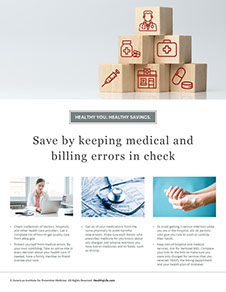
  • Save By Keeping Medical Andbilling Errors In Check

    Medical Care

    Female doctor on her computer.

    *  Check credentials of doctors, hospitals, and other health care providers. Get a complete list of how to get quality care fromahrq.gov.

    *  Protect yourself from medical errors. Be your own watchdog. Take an active role in every decision about your health care. If needed, have a family member or friend oversee your care.

    *  Get all of your medications from the same pharmacy to avoid harmful interactions. Make sure each doctor who prescribes medicine for you knows about any allergies and adverse reactions you have had to medicines and to foods, such as shrimp.

    *  To avoid getting a serious infection while you are in the hospital, ask all persons who give you care to wash or sanitize their hands.

    *  Keep lists of hospital and medical services. Ask for itemized bills. Compare your lists to the bills to make sure you were only charged for services that you received. Notify the billing department and your health plan of mistakes.

    A Year of Health Hints book by the American Institute for Preventive Medicine. www.HealthyLife.com. All rights reserved.

    © American Institute for Preventive Medicine
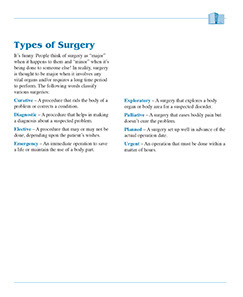
  • Types Of Surgery

    Medical Care

    Image of doctors performing surgery.

    It’s funny. People think of surgery as “major” when it happens to them and “minor” when it’s being done to someone else! In reality, surgery is thought to be major when it involves any vital organs and/or requires a long time period to perform. The following words classify various surgeries:

    Curative

    A procedure that rids the body of a problem or corrects a condition.

    Diagnostic

    A procedure that helps in making a diagnosis about a suspected problem.

    Elective

    A procedure that may or may not be done, depending upon the patient’s wishes.

    Emergency

    An immediate operation to save a life or maintain the use of a body part.

    Exploratory

    A surgery that explores a body organ or body area for a suspected disorder.

    Palliative

    A surgery that eases bodily pain but doesn’t cure the problem.

    Planned

    A surgery set up well in advance of the actual operation date.

    Urgent

    An operation that must be done within a matter of hours.

    Page from Health at Home book by the American Institute for Preventive Medicine. www.HealthyLife.com. All rights reserved.

    © American Institute for Preventive Medicine

  • Be Wise, Stretch Your Health Care Dollars

    Medical Care

    Small shopping cart with pills and money.

    Use discounts and coupons for services and supplies that you need.* Examples are:

    *  Membership discounts on prescriptions, over-the-counter (OTC) medicines, eyeglasses, and contact lenses. You can get these if you are a member of wholesale clubs, such as Costco, Sam’s Club, AAA, and AARP.

    *  Advertised specials, such as buy-one-get-one free prescription eyeglasses

    *  Coupons from local drug stores for OTC medications and supplies, such as a home blood pressure monitor

    *  Get treatment for a condition before it becomes more serious and more expensive to manage.

    *  Ask your doctor if you could benefit from taking part in a clinical trial for a condition you have. Clinical trials provide free expert medical care for persons who qualify. You can also get information for them fromclinicaltrials.gov.

    *  Follow your doctor’s advice for which products to buy.

    A Year of Health Hints book by the American Institute for Preventive Medicine. www.HealthyLife.com. All rights reserved.

    © American Institute for Preventive Medicine
  • Long-Term Care Insurance

    Medical Care

    Image of couple talking to an insurance agent.

    Long-term care insurance is meant to cover the cost of nursing home care and long-term  home health care. Medicare and private health insurances do not cover these costs. This kind of insurance is not government regulated. You may want to purchase this for yourself. Your children may want to purchase it for you to protect themselves from having to pay for your long-term care or to protect their future inheritance.

    Find out more about long-term care insurance from:

    *  LongTermCare.gov athttp://longtermcare.gov. Learn the basics of long-term care and ways to pay for it. Use the LTC PathFinder tool to get information on long-term care insurance that is most relevant and useful to you now.

    *  National Advisory Center for Long-Term Care Insurance atwww.longtermcareinsurance.org. Get help from an unbiased long-term care insurance advisor. Ask for multi-company comparative quotes  for long-term care insurance.

    *  Consider a policy that starts paying on the 90th day instead of day 1. The difference in price can be 30%. Do this only if you can afford the long-term care center’s cost for the first 3 months on your own.

    *  Check Moody’s and Standard & Poors at your local library. Look for insurers rated “A” or better.

    *  Read the complete policy coverage. Consult an attorney or knowledgeable person to review it with you.

    *  Pay premiums, by check, directly to the insurance company. Never pay in cash.

    *  Fill out the policy application yourself or with a friend or relative. Don’t allow someone to do it for you.

    *  Be cautious of companies advertised by celebrities.

    *  Insist on coverage that does not require a hospital stay before going to a nursing home.

    *  Resist high pressure insurance agents or claims that their long-term care insurance is endorsed by the government.

    Be cautious before you purchase a policy. Ask the following questions:

    *  Will the policy cover home health care? Does this include “aides” or housekeeping coverage or just “skilled” care?

    *  Does the policy cover Alzheimer’s disease, specifically?

    *  Must you be medically ill to receive benefits? What about custodial care?

    *  Does the coverage include nursing home custodial care, adult day care, or other community-based services?

    *  Does the policy require a prior hospital stay before entering a nursing home?

    *  Are there exclusions for “pre-existing” illnesses? Are there waiting periods?

    *  How long is a stay in a nursing home covered? (The average stay is just under 4 years.)

    *  How much will the nursing home be paid on a daily basis from this policy? What is the daily charge of the nursing home? You will have to pay the difference between the insurance coverage and what the nursing home charges.

    *  If premiums are being paid, is there a guarantee that the policy can be renewed?

    *  Is the policy one that can’t be canceled?

    *  Will your coverage keep up with inflation?

    *  Are premiums waived while getting benefits?

    Page from the Health at Home Lifetime book by the American Institute for Preventive Medicine. www.HealthyLife.com. All rights reserved.

    © American Institute for Preventive Medicine

  • Save By Staying Healthy

    Medical Care

    An ounce of prevention is worth more than a pound of cure. The healthier you are, the less you will need to pay for medical care. Also, the state of your health is one of the main factors in setting the cost of health and life insurance.

    Don’t send money up in smoke.

    Cigarette smoking is bad for your health. It’s bad for your wallet, too. A person who smokes two packs a day spends over $3,000 a year just on cigarettes. Hundreds of dollars more are spent on extra dental and medical costs. The cost of health, life, and disability insurance is about 30% higher for persons who smoke.

    Weight does matter.

    Obesity is a leading cause of preventable death. Losing weight can lower the risk for type 2 diabetes, heart disease, and other chronic diseases. These can cost you and your employer a lot of money to treat. Obese persons who buy health insurance on their own may have to pay more. Insurance companies may even turn them down.

    Be fit at little or no cost.

    Take part in fitness programs at work. Join a mall walkers program. Walk with a friend. Follow along with fitness programs on TV. Or, if you have a stationary bike, ride it while you watch TV. Being active every day is a huge investment in your health.

    Look at your genes.

    Find out what health problems both sides of your family have or had. Start with your parents, brothers, and sisters. Then find out about ones your grandparents, uncles, aunts, and first cousins have or had. Once you know what health problems run in your family, talk with your doctor. He/she can suggest ways to lower your risk of getting them.

    Don’t back quacks.

    Find out about products and treatments that don’t work or could cause harm fromwww.quackwatch.organdwww.fda.gov. Don’t waste money on things that don’t help.

    Be savvy about AD-vice.

    Check with your doctor before you follow advice from Web sites and ads that promote products. Many are costly and give little or no benefit.

    Detect to protect.

    Have screening tests and exams that can help detect health problems in early stages when they are easier and less costly to treat. Follow your doctor’s advice.

    Money well spent.

    If you have no health insurance or your health plan does not pay for screening tests or doctor visits, it is still important to have them. Paying for these now could save you thousands in medical costs in the future. Tests may cost less than you think.

    Know thy “health self.”

    The more you know about your health problems, the easier it is to make informed choices about how to take care of them. Find out what you need to do from your doctor. Get reliable facts, too, from trusted sources.

    Follow your doctor’s treatment plan.

    This helps to improve your health. It helps keep problems from getting worse. For example, keeping blood pressure under control can reduce the risk of having a stroke or a heart attack.

    A shot in the arm for your health.

    Get vaccines, as needed, to prevent illnesses. This applies to children, as well as adults. The Centers for Disease Control and Prevention give guidelines for vaccines every year. Find out what they are atwww.cdc.gov/vaccines. Also, if you plan to travel to other countries, find out what vaccines you should get. Find out fromwww.cdc.gov/travel.

    Know about the Vaccines for Children (VFC) Program.

    Your children may be able to get free or low-cost vaccines. Find out fromwww.cdc.gov/vaccines/programs/vfc/default.htm.

    Cover image to the Healthy Savings book by the American Institute for Preventive Medicine. www.HealthyLife.com. All rights reserved.

    © American Institute for Preventive Medicine