Category: Alternative Medicine

  • Alternative Medicine Systems

    Alternative Medicine

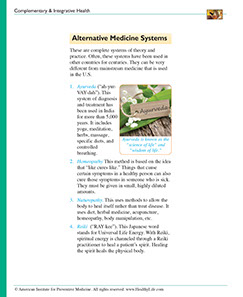
    Image of leaf with tag that has the word "Ayurveda"

    These are complete systems of theory and practice. Often, these systems have been used in other countries for centuries. They can be very different from mainstream medicine that is used in the U.S.

    1.  Ayurveda (“ah-yur-VAY-dah”). This system of diagnosis and treatment has been used in India for more than 5,000 years. It includes yoga, meditation, herbs, massage, specific diets, and controlled breathing.

    2.  Homeopathy This method is based on the idea that “like cures like.” Things that cause certain symptoms in a healthy person can also cure those symptoms in someone who is sick. They must be given in small, highly diluted amounts.

    3.  Naturopathy. This uses methods to allow the body to heal itself rather than treat disease. It uses diet, herbal medicine, acupuncture, homeopathy, body manipulation, etc.

    4.  Reiki  (“RAY-kee”). This Japanese word stands for Universal Life Energy. With Reiki, spiritual energy is channeled through a Reiki practitioner to heal a patient’s spirit. Healing the spirit heals the physical body.
    Page from the Healthier at Home book by the American Institute for Preventive Medicine. www.HealthyLife.com. All rights reserved.

    © American Institute for Preventive Medicine
  • Herb Alert

    Alternative Medicine

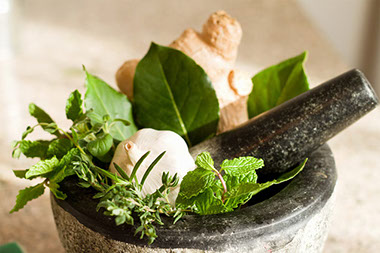
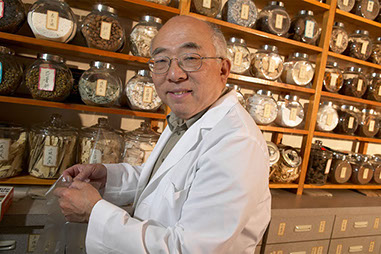
    Image of man at herb store.

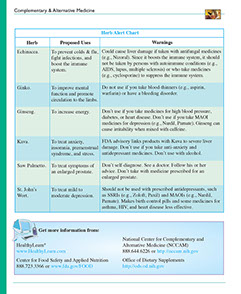
    Echinacea

    Proposed Uses

    To prevent colds & flu, fight infections, and boost the immune system.

    Warnings

    Could cause liver damage if taken with antifungal medicines (e.g., Nizoral). Since it boosts the immune system, it should not be taken by persons with autoimmune conditions (e.g., AIDS, lupus, multiple sclerosis) or who take medicines (e.g., cyclosporine) to suppress the immune system.

    Ginko

    Proposed Uses

    To improve mental function and promote circulation to the limbs.

    Warnings

    Do not use if you take blood-thinners (e.g., aspirin, warfarin) or have a bleeding disorder.

    Ginseng

    Proposed Uses

    To increase energy.

    Warnings

    Don’t use if you take medicines for high blood pressure, diabetes, or heart disease. Don’t use if you take MAOI medicines for depression (e.g., Nardil, Parnate). Ginseng can cause irritability when mixed with caffeine.

    Kava

    Proposed Uses

    To treat anxiety, insomnia, premenstrual syndrome, and stress.

    Warnings

    FDA advisory links products with Kava to severe liver damage. Don’t use if you take anti-anxiety and antidepressant medicines. Don’t use with alcohol.

    Saw Palmetto

    Proposed Uses

    To treat symptoms of an enlarged prostate.

    Warnings

    Don’t self-diagnose. See a doctor. Follow his or her advice. Don’t take with medicine prescribed for an enlarged prostate.

    St. John’s Wort

    Proposed Uses

    To treat mild to moderate depression.

    Warnings

    Should not be used with prescribed antidepressants, such as SSRIs (e.g., Zoloft, Paxil) and MAOIs (e.g., Nardil, Parnate). Makes birth control pills and some medicines for asthma, HIV, and heart disease less effective.

    Resources

    Center for Food Safety and Applied Nutrition

    888.723.3366 or

    www.fda.gov/FOOD

    National Center for Complementary and Alternative Medicine (NCCAM)

    888.644.6226 orwww.nccam.nih.gov

    Office of Dietary Supplements

    www.ods.od.nih.gov

    Mental Health America

    www.mentalhealthamerica.net/list-cam-treatments

    Page from the Healthier at Home book by the American Institute for Preventive Medicine. www.HealthyLife.com. All rights reserved.

    © American Institute for Preventive Medicine
  • Cam Safe Use

    Alternative Medicine

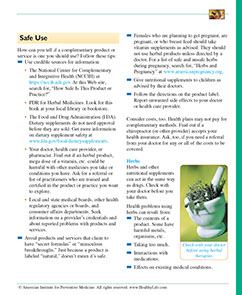
    Image of using CAM safely.

    How can you tell if a complementary product or service is one you should use? Follow these tips:

    *  Use credible sources for information:

    – The National Center for Complementary and Integrative Health (NCCIH) athttps://nccih.nih.gov. At this Web site, search for, “How Safe Is This Product or Practice?”

    – PDR for Herbal Medicines. Look for this book at your local library or bookstore.

    – The Food and Drug Administration (FDA). Dietary supplements do not need approval before they are sold. Get more information on dietary supplement safety atwww.fda.gov/food/dietarysupplements.

    – Your doctor, health care provider, or pharmacist. Find out if an herbal product, mega dose of a vitamin, etc. could be harmful with other medicines you take or conditions you have. Ask for a referral or list of practitioners who are trained and certified in the product or practice you want to explore.

    – Local and state medical boards, other health regulatory agencies or boards, and consumer affairs departments. Seek information on a provider’s credentials and about reported problems with products and services.

    *  Avoid products and services that claim to have “secret formulas” or “miraculous breakthroughs.” Just because a product is labeled “natural,” doesn’t mean it’s safe.

    *  Females who are planning to get pregnant, are pregnant, or who breast-feed should take vitamin supplements as advised. They should not use herbal products unless directed by a doctor. For a list of safe and unsafe herbs during pregnancy, search for, “Herbs and Pregnancy” atwww.americanpregnancy.org.

    *  Give nutritional supplements to children as advised by their doctors.

    *  Follow the directions on the product label. Report unwanted side effects to your doctor or health care provider.

    Consider costs, too. Health plans may not pay for complementary methods. Find out if a chiropractor (or other provider) accepts your health insurance. Ask, too, if you need a referral from your doctor for any or all of the costs to be covered.

    Herbs

    Herbs and other nutritional supplements can act in the same way as drugs. Check with your doctor before you take them.

    Health problems using herbs can result from:

    *  The contents of a product. Some have harmful metals, organisms, etc.

    *  Taking too much.

    *  Interactions with medications.

    *  Effects on existing medical conditions.

    Page from the Healthier at Home book by the American Institute for Preventive Medicine. www.HealthyLife.com. All rights reserved.

    © American Institute for Preventive Medicine
  • The Healing Touch

    Alternative Medicine

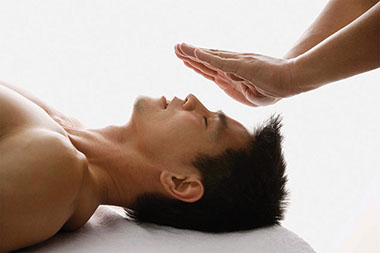
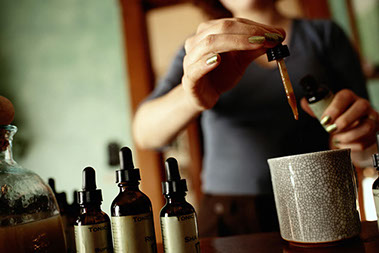
    Image of person having healing touch therapy.

    Balance your energy field

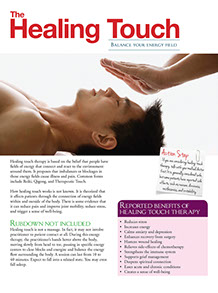
    Healing touch therapy is based on the belief that people have fields of energy that connect and react to the environment around them. It proposes that imbalances or blockages in those energy fields cause illness and pain. Common forms include Reiki, Qigong, and Therapeutic Touch.

    How healing touch works is not known. It is theorized that it affects patients through the connection of energy fields within and outside of the body. There is some evidence that it can reduce pain and improve joint mobility, reduce stress, and trigger a sense of well-being.

    Rubdown not included

    Healing touch is not a massage. In fact, it may not involve practitioner to patient contact at all. During this energy therapy, the practitioner’s hands hover above the body, moving slowly from head to toe, pausing in specific energy centers to clear blocks and energize and balance the energy flow surrounding the body. A session can last from 10 to 40 minutes. Expect to fall into a relaxed state. You may even fall asleep.

    Reported benefits of healing touch therapy

    *  Reduces stress

    *  Increases energy

    *  Calms anxiety and depression

    *  Enhances recovery from surgery

    * Hastens wound healing

    *  Relieves side-effects of chemotherapy

    *  Strengthens the immune system

    *  Supports grief management

    *  Deepens spiritual connection

    *  Eases acute and chronic conditions

    *  Creates a sense of well-being

    Action Step

    If you are considering healing touch therapy, talk with your medical doctor first. It is generally considered safe, but some patients have reported side effects, such as nausea, dizziness, restlessness, and irritability.

    Page from Ways to Well-Being book by the American Institute for Preventive Medicine. www.HealthyLife.com. All rights reserved.

    © American Institute for Preventive Medicine
  • Complementary & Integrative Health

    Alternative Medicine

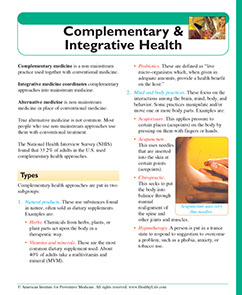
    Image of complementary medicine.

    Complementary medicine is a non-mainstream practice used together with conventional medicine.

    Integrative medicine coordinates complementary approaches into mainstream medicine.

    Alternative medicine is non-mainstream medicine in place of conventional medicine.

    True alternative medicine is not common. Most people who use non-mainstream approaches use them with conventional treatment.

    The National Health Interview Survey (NHIS) found that 33.2% of adults in the U.S. used complementary health approaches.

    Natural products.

    These use substances found in nature, often sold as dietary supplements. Examples are:

    *  Herbs. Chemicals from herbs, plants, or plant parts act upon the body in a therapeutic way.

    * Vitamins and minerals. These are the most common dietary supplement used. About 40% of adults take a multivitamin and mineral (MVM).

    * Probiotics. These are defined as “live micro-organisms which, when given in adequate amounts, provide a health benefit on the host.”

    Mind and body practices

    These focus on the interactions among the brain, mind, body, and behavior. Some practices manipulate and/or move one or more body parts. Examples are:

    *  Acupressure. This applies pressure to certain places (acupoints) on the body by pressing on them with fingers or hands.

    *  Acupuncture. This uses needles that are inserted into the skin at certain points (acupoints).

    *  Chiropractic. This seeks to put the body into balance through manual realignment of the spine and other joints and muscles.

    *  Hypnotherapy. A person is put in a trance state to respond to suggestion to overcome a problem, such as a phobia, anxiety, or tobacco use.

    *  Meditation. This increases calmness and physical relaxation by using:

    – A quiet location that is free of or has few distractions.

    – A comfortable posture.

    – A specific focus on a word or sensation.

    – An openness to let distractions come and go without judging them.

    *  Massage therapy. This uses touching and rubbing techniques to relieve sore muscles and promote relaxation.

    *  Qi gong (“chee-GUNG”). This is part of traditional Chinese medicine. It uses movement, meditation, and controlled breathing to enhance the flow of “qi” in the body. (Qi is an ancient term for vital energy.)

    *  Relaxation therapies. These include breathing exercises, guided imagery, and progressive muscle relaxation.

    *  Tai chi. This is a series of postures and exercises of moving the body slowly and gently, and with awareness while breathing deeply.

    *  Yoga. A system of exercising using postures, breathing, and meditation.

    Page from the Healthier at Home book by the American Institute for Preventive Medicine. www.HealthyLife.com. All rights reserved.

    © American Institute for Preventive Medicine