Category: Financial Health

  • Financial Health News 3

    FINANCIAL HEALTH

    © American Institute for Preventive Medicine

  • Save For More Than Just A Rainy Day

    Financial Health

    Invest in your future.

    Money doesn’t grow on trees, but it can grow when you save and invest it wisely. First, identify what you want to save for:

    *  Emergency funds? (Plan for three to six months of expenses.) Holiday expenses? Vacations? A house? College for your kids? Retirement?

    *  Rank order your goals.

    Invest, but do not put all your eggs in one basket.

    Diversify with stocks, bonds, mutual funds, IRAs, real estate, and commodities, such as gold and silver. Find out more about investing fromwww.mymoney.gov. Things you can do on your own:

    *  If your employer has a retirement plan, such as a 401(k), have as much deducted from your pay as possible, especially if your employer matches some or all of the amount you contribute.

    *  Get resources on planning for retirement and long-term care fromwww.csrees.usda.gov/fsll.

    *  Check out “529” prepaid tuition and savings plans for college fromwww.collegesavings.org. These offer tax-saving advantages.

    *  Get professional investment advice from employer sponsored programs or from your financial planner. Find a certified professional from the Association for Financial Counseling and Planning Education atwww.afcpe.org.

    Revisit your budget:

    *  Pay off credit card or high interest debts first. Then use some or all of the payment money for your savings plan.

    *  Put aside whatever you can in savings accounts, checking accounts, and certificates of deposit.

    *  Look for additional ways to save fromhttp://investor.gov/sites/default/files/Saving-and-Investing.pdf

    *  Decide the best ways you are likely to save money.

    – Have your paycheck automatically deposited in your bank and have some go directly into one or more savings accounts.

    – Save money you get from tax refunds, work bonuses, and extra income.

    Action Step

    Beware of investments that promise high returns with little or no risk. If it sounds too good to be true, it usually is.

    Ways to Well-Being. Published by the American Institute for Preventive Medicine.

    © American Institute for Preventive Medicine

  • Piggy Bank Smarts

    FINANCIAL HEALTH

    Image of hand placing a dollar bill into a piggy bank.

    Smart money management begins at home. Washington University researcher Michal Grinstein-Weiss found that teaching kids about money in childhood helps them better manage their mortgage loans as adults. The study was in Social Work Research.

    The professor offers 5 ways parents can teach their kids financial literacy:

    1. Discuss and explain basic finances around the dinner table, especially the difference between needs and wants.

    2. Teach kids how to save and set short-term goals (a new toy) and long-term goals (college). Kids will follow by example if they see you saving for something such as a family vacation.

    3. Open a savings account for your child as early as possible. Even if you bank online, visit the bank with your child to make a deposit because actions reinforce behaviors. Review monthly statements together.

    4. Teach kids budgeting and money-management skills. Help your child figure out how much money to save for how long to reach a goal amount.

    5. Get kids involved in daily activities and decisions about spending. Take them grocery shopping and have them compare prices of different brands. Count out the cash during a sale.

    © American Institute for Preventive Medicine

  • Where Does The Money Go?

    FINANCIAL HEALTH

    Image of scale with bills on one side and a piggy bank on the other side.

    Regular expenses are a necessary part of life. In your household, you probably have a certain amount of money coming in and a different amount going out.

    Even if you have a rough idea of how much you spend, tracking your monthly expenses can help you find out a lot about your money. Small amounts here and there can quickly add up. For one month, write down everything you spend on bills, food, gas, clothes, and any other purchases – even your morning latte. Then, you can look for ways to cut back on unnecessary costs. Money you have left at the end of the month can be saved for an emergency fund or for future needs.

    © American Institute for Preventive Medicine

  • Planning For Your Child’S Expenses

    FINANCIAL HEALTH

    Image of piggy bank next to '529' blocks on top of books.

    It can feel like a dark cloud hanging overhead – the upcoming expense of your child’s college education. Whether your child is one month or 16 years old, it’s never too late to start putting some money away to invest in your child’s future.

    529 college savings plans

    A 529 allows you to save money to pay for your child’s college education tax-free. If the money is used on higher education, you won’t be taxed on the withdrawal either.

    Usually, the money must be used on tuition, room, board, or certain supplies required for college enrollment, or you may have to pay a penalty and taxes.

    Prepaid tuition plans

    When you set up a prepaid tuition plan, you “lock in” today’s tuition prices. In general, these plans must be used on colleges within your state to get the lower tuition rate.

    Savings accounts

    You can set up a savings account in your child’s name that you manage. This is called a custodial account. When your child is old enough, he or she can access the funds.

    IRA and Roth IRA accounts

    IRAs, or individual retirement accounts, are investment accounts that let you save without getting taxes taken out. With a deductible IRA, you must claim your money that goes into the IRA as tax deductible. Then, taxes are incurred when you withdraw the savings later.

    If you put money into a Roth IRA, your earnings are tax-free if you wait to withdraw them after five years – and if they’re used for college tuition.

    Coverdell education savings accounts (ESA)

    Coverdell ESAs are like an IRA for college. If the money is used for education, you won’t pay any taxes when you withdraw it.

    Because each family’s budget and needs are different, there is no single solution that works for everyone. Carefully consider the pros and cons of each option before you move forward.

    Before you begin saving for college….

    If possible, talk with a financial advisor before you begin. Some plans, such as a deductible IRA, may depend upon your income and other factors. And, an expert in the field can help you choose the best option for your situation.

    Ask questions. Be sure to ask the representative about:

    *  Fees and commissions to pay

    *  When and how taxes are incurred on the money you invest

    *  Interest you may earn

    *  Risk involved with investments

    *  Whether you can use the money for other things (if your child doesn’t go to college or gets a full scholarship, for instance)

    *  Whether the money must be used in-state

    Don’t forget about federal loans, which are an option for many families – especially if college is right around the corner.

    © American Institute for Preventive Medicine

  • 3 “S”S To Close The Deal On A Car

    FINANCIAL HEALTH

    A man with a car salesmen looking at a new car.

    1.See.See what you agreed to. Look at all the paperwork for the loan documents. Check the annual percentage rate (APR), which is the cost of your loan interest measured by a yearly rate. Look at the finance charges, which includes the total amount of interest and certain fees you’ll pay.

    2.Say no.Say no if you’re not comfortable. If you are unhappy with the loan conditions or the vehicle, don’t feel forced into it. You can always leave without finishing the deal if you change your mind. If you’re not sure, tell them you need more time to think about it. Dealers cannot force you to sign the loan.

    3.Sign.Sign all the blanks. Before you drive away with your new vehicle, make sure both you and the dealer have signed everything in the loan papers. All blanks should be filled in. You should also get a copy of all the paperwork on the spot.

    © American Institute for Preventive Medicine

  • Protect Your Personal Information

    FINANCIAL HEALTH

    Image of laptop with shield and lock key.

    Identity theft is a serious crime. It happens when someone steals your personal information such as your social security number or credit card numbers and uses it without your permission. You may see mistakes or mystery charges on your bank, credit card, or other account statements. You may receive bills for products or services you never received. Protect your personal information, urges the Federal Trade Commission. Get detailed information online atwww.ftc.gov/idtheft.

    *Keep your important papers secure.Limit what you carry in your wallet or purse. Pick up new checks at the bank instead of having them mailed to your home. Take outgoing mail to a collection box or the post office. Don’t leave it in your mailbox. Shred sensitive documents, receipts, credit card offers, insurance forms, checks, bank statements, and similar documents.

    *Secure your social security number.Only give it out when necessary (and ask if you can use a different kind of identification).

    *Protect your computer and mobile devices.Use anti-virus software. Don’t open files or click on links sent by strangers. Remove the memory cards from mobile devices before recycling them.

    *Protect your data online.Keep your passwords private. Don’t over share on social networking sites. If you post too much information about yourself, an identity thief can use that information to answer challenging questions on your accounts (birthdays, mother’s name, pet names, high school).

    © American Institute for Preventive Medicine

  • 4 “D”S For Avoiding Fraud

    FINANCIAL HEALTH

    Lock sitting on top of credit cards.

    1.  Do protect your personal information all the time. Never share your birthday, social security number, credit card number or passwords with others. No one should call or email you asking for this information.

    2.  Do stand your ground. Scammers may try to scare you by saying if you don’t give them money, you’ll be arrested or turned into the IRS. Don’t believe them. Police and government agencies don’t use phone calls to collect money.

    3.  Don’t trust caller ID. Scammers can change the caller ID to look like an official business or even a government agency.

    4.  Don’t pay someone with wire transfers or gift cards. Some scammers will tell you to wire them money or may ask you to send them gift cards. Don’t do it. A real organization would not ask you to send money this way.

    © American Institute for Preventive Medicine

  • Questions To Ask Before Choosing A Financial Planner

    FINANCIAL HEALTH

    Image of women writing different types of investments.

    1. How are you paid? Is it by a fee and commission? Do you fully disclose the fees and the commissions you earn on every investment you make or service you offer? If paid by fees, what is the average fee your clients pay?

    2. How many years have you been in the business? How long have you been a financial planner?

    3. Can you give me some references of people you have worked with for more than two years?

    4. What is your typical client like? Income levels, issues, investment amounts?

    5. What training did you have to be a planner? What requirements were needed to attain this degree or title?

    6. How many hours of continuing education must you have to keep your degree/designation?

    7. What does a completed financial plan look like?

    8. What is the most important difference your work made in someone’s life?

    9. How many clients do you have?

    10. How many support staff do you have? What are their credentials?

    11. Do you have a privacy statement?  May I have a copy?

    12. Is there an agreement among you and your staff to keep information confidential? Have there ever been any violations of that agreement?

    13. Do you have a copy of your Form ADV (a required disclosure form from the securities authorities)? Have you been responsible for any securities violations?

    14. Do you have a formal contract to define the responsibilities of the clients and those of the planners? Does it also address a protocol to settle differences and to terminate the relationship? How long does the contract last?

    Answers you will get to these questions can vary suggests Lynn S. Evans, CFP, author of Power of the Purse: Fear-Free Finances for Baby Boomer Women. You may have other questions that are important to you. Examples include if the offices are nearby and if you can communicate by email).

    A question regarding the planner’s investment performance is absent. For good reason: the planner’s average return on an investment is not the key to his or her success. The ability to meet the clients’ goals is what really counts.

    Lost without cyberspace?

    What if you couldn’t get a Wi-Fi signal on your smartphone? How anxious would you be if you forgot your phone or lost it? Worry about not being able to see instant news and weather? Or freak about a low battery? If you say yes, you may be a nomophobe (that’s having no mobile phone phobia), according to Iowa State University researchers, in the journal Computers in Human Behavior. Take the 20-question test and judge for yourself atwww.news.iastate.edu/news/2015/08/26/nomophobia. It’s not an addiction but an obsession, they say.

    © American Institute for Preventive Medicine

  • 4 Money Mistakes To Avoid

    FINANCIAL HEALTH

    Image of 3 friends.

    Little everyday choices can have a big impact on your finances. If you want to save more or spend less, think about whether you’re making any of these mistakes.

    Mistake #1: You put off saving money.

    Do you think that you can wait a few more months or even years before you need to save for retirement, your kids’ college or other future needs? Even if you can only put away a few dollars each week, start now. It can add up over time and the sooner you start, the more money you’ll have later.

    Mistake #2: You spend too much on “treats.”

    We all like to treat ourselves once in a while. But, if you’re spending money on treats often, such as going to the movies or buying yourself a new item, you could be creating money problems. Look for low-cost or free ways to reward yourself. Set aside some time with a friend, take a hot bath, watch a favorite movie at home or check out free museums and concerts.

    Mistake #3: You get lots of coupons in your mail and email.

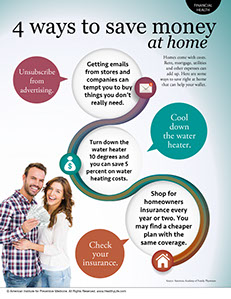
    If you get catalogs in the mail and your inbox is filled with coupons and deals, this could be wrecking your money goals. After all, you may not need the items that are advertised. But, they look like such a good deal that you decide to buy them anyway. Do you really need another sweater or pair of jeans, or are you buying them because of the sale? Unsubscribe from email coupons and newsletters, and throw catalogs in the recycling bin. This can help lower the temptation to shop.

    Mistake #4: You don’t know how much money you really have.

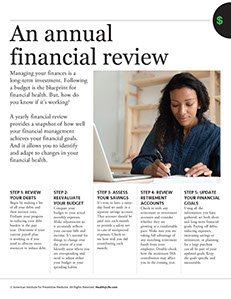
    If you are struggling financially, it can be hard to look at your bank account balances. But, it’s better to know what you can afford than to go deeper into debt. Make a budget of what you have and what you can spend each month after bills are paid. Try to stick to your budget and find ways to cut out unnecessary items.

    © American Institute for Preventive Medicine