Category: Mature Health: Over Age 50
  • Help For Hearing Loss

    Mature Health: Over Age 50

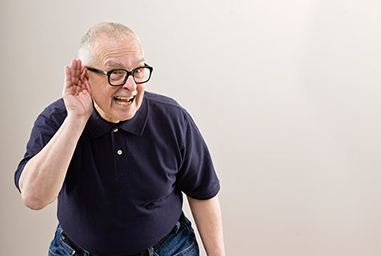
    Image of mature man with hand up to his ear trying to hear.

    Do people seem to mumble a lot lately? Do you have trouble hearing in church or theaters? Do you lose the thread of conversation at the dinner table or at family gatherings? Does your family repeatedly ask you to turn down the volume on the TV or radio?

    These are signs of gradual, age-related hearing loss called presbycusis. High-pitched sounds are especially difficult to discern. Another way to detect this problem is to hold a watch to your ear. If you can’t hear it ticking, see an otolaryngologist (a physician who treats disorders of the ear, nose, and throat) or an otologist (a physician who specializes in ear disorders).

    You should also get help if one or both ears ring continuously, or if loud noises cause pain in your ears.

    Hearing loss from presbycusis cannot be restored, but hearing aids. along with the following self-help methods, are helpful.

    *  Ask people to speak clearly, distinctly, and in a normal tone.

    *  Look at people when they are talking to you. Watch their expressions to help you understand what they are saying. Ask them to face you.

    *  Try to limit background noise when having a conversation.

    *  In a church or theater, sit near, but not in the front row. Sit in the third or fourth row with people sitting around you.

    *  To rely on sight instead of sound, install a buzzer, flasher, or amplifier on your telephone, door chime, and alarm clock.

    Also, an audiologist (hearing therapist) may be able to show you other techniques for “training” yourself to hear better.
    A Year of Health Hints book by the American Institute for Preventive Medicine. www.HealthyLife.com. All rights reserved.

    © American Institute for Preventive Medicine
  • Hospice Care

    Mature Health: Over Age 50

    Hospice care is for people with a terminal illness. To enter a hospice program (and to receive Medicare benefits), a doctor’s diagnosis is required stating that life expectancy is no more than about 6 months. No efforts are made to prolong life or to hasten death. The patient is kept comfortable and pain free. Hospice eases the process of dying. Most referrals for hospice come from doctors. Hospice care may be provided in:

    *  The home. Eighty percent of persons enrolled in hospice are cared for at home.

    *  A hospital

    *  A nursing home

    *  A hospice facility

    The bulk of care, especially with home hospice, is usually given by family members and friends. It is supported by a hospice care team which includes doctors, social workers, therapists, volunteers, clergy, nurses, and family members. The team plans care that ensures quality of life. {Note: VA offers Hospice & Palliative Care.}

    Most health insurance plans include the option of hospice care. Medicare and Medicaid cover the costs if the facility or hospice organization is certified by them. Under Medicare, the length of stay is two 90 day benefit periods. This may be followed by a 30 day period. Extensions are available. Persons must be certified to be terminally ill at the start of each period.

    Sometimes patients are charged if they do not qualify for reimbursement. Hospice care is based on need. No one is rejected for lack of finances.

    Some advantages to hospice care include:

    *  Availability of 24 hour a day, 7 day a week assistance. This is true for hospice care in hospitals, nursing homes, and hospice facilities. Find out if the home hospice program offers this service.

    *  Respite for family caretakers when care is given in the home

    *  Emotional comfort and support by trained hospice staff and volunteers

    *  Bereavement counseling

    Resources

    The National Hospice and Palliative Care Organization

    1-703-837-1500

    www.nhpco.org

    Health at Home Lifetime book by the American Institute for Preventive Medicine. www.HealthyLife.com. All rights reserved.

    © American Institute for Preventive Medicine
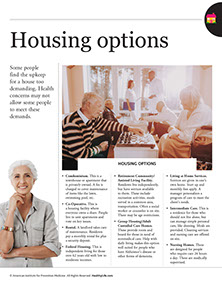
  • Housing Options

    Mature Health: Over Age 50

    Some people find the upkeep for a house too demanding. Health concerns may not allow some people to meet these demands. Consider other housing options:

    *  Condominium. This is a townhouse or apartment that is privately owned. A fee is charged to cover maintenance of items like the lawn, swimming pool, etc.

    *  Co-Operative. This is a housing facility where everyone owns a share. People live in unit apartments and vote on key issues.

    *  Rental. A landlord takes care of maintenance. Residents pay a monthly rental fee plus a security deposit.

    *  Retirement Community/Assisted Living Facility. Residents live independently, but have services available to them. These include recreation activities, meals served in a common area, transportation. Often a social worker or counselor is on site. There may be age restrictions.

    *  Federal Housing. This is independent living for those over 62 years old with low to moderate incomes.

    *  Group Housing/Adult Custodial Care Homes. These provide room and board for those in need of nonmedical care. Help with daily living makes this option well suited for Alzheimer’s patients.

    *  Life Care at Home (LCAH). Services are given in one’s own home. Start up and monthly fees apply. A manager personalizes a program of care to meet the client’s needs.

    *  Intermediate Care. This is a residence for those who should not live alone, but can manage simple personal care, like dressing. Meals are provided. Cleaning services and nursing care are offered on site.

    *  Nursing Homes. These are designed for people who require care 24 hours a day. These are medically supervised. Find and compare nursing homes in your area atwww.medicare.gov/NHCompare/home.asp.

    Health at Home Lifetime book by the American Institute for Preventive Medicine. www.HealthyLife.com. All rights reserved.

    © American Institute for Preventive Medicine
  • What To Do About Liver Spots

    Mature Health: Over Age 50

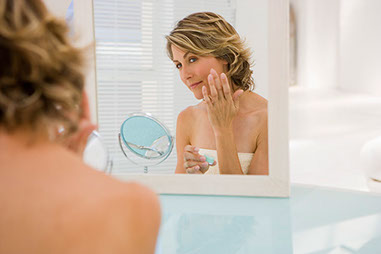
    Image of women looking in a mirror examing her face.

    Years spent soaking up the sun can result in circular patches of light brown pigmentation, called liver spots or age spots, on your face, arms, neck, and the back of your hands. Liver spots have nothing to do with the liver, though; they’re “superfreckles”-areas of dark pigment triggered by overexposure to the sun. Here’s what you can do to minimize liver spots.

    *  Apply a concealer (cover-up cream) that matches your skin tone.

    *  Always apply a sunscreen lotion with a sun protection factor (SPF) of 15 or higher 30 to 45 minutes before you go outdoors.

    *  Apply an over-the-counter bleaching cream to the discolored areas. (These products can take months to work and lighten spots only slightly.)

    If these tactics don’t help, consult a dermatologist. He or she may recommend one of the following medical treatments for liver spots.

    *  A prescription bleaching cream.

    *  A prescription peeling cream, like Retin-A.

    *  Chemical peels (a mild acid is applied with a cotton swab to each patch of pigment).

    *  Dermabrasion (the skin is numbed, then rubbed with a high-speed electrical device).

    These treatments all produce some discomfort and sometimes leave a permanent white spot where the skin has been treated, however.

    A Year of Health Hints book by the American Institute for Preventive Medicine. www.HealthyLife.com. All rights reserved.

    © American Institute for Preventive Medicine
  • Four Ingredients For A Happy Retirement

    Mature Health: Over Age 50

    Image of retired man gardening.

    Retirement involves major changes in your income, lifestyle, social life, and self-image. Not surprisingly, retirement can be very stressful-or blissful. Advance planning is a key ingredient for a happy retirement. A survey conducted by researchers at the University of Michigan found that 75 percent of those who had planned for retirement enjoyed it. Here are some specific ways you can make retirement less stressful and more satisfying.

    Get a part-time job.

    For some people, gradual retirement is easier to handle than being employed one day and unemployed the next. To smooth the transition, you may want to either work part-time at your present job for a few months or get a part-time job at another firm when you leave.

    Practice living on a retirement budget before you retire.

    And start saving for retirement as far ahead of time as possible. Don’t expect Social Security to cover all your expenses.

    Take care of yourself while you’re young.

    You can help to preserve your health by eating a low-fat diet, not smoking, drinking moderately (if at all), learning to manage stress, getting regular checkups, and being physically active.

    Cultivate hobbies and other outside interests.

    Fitness activities, community work, or academic studies can fill the void left by not having to report to work every day. To prevent boredom, consider a variety of activities-indoor and outdoor, mental and physical, group and individually oriented. And start thinking about projects you’d like to work on well before retirement, so you don’t stall out when the time comes.

    A Year of Health Hints book by the American Institute for Preventive Medicine. www.HealthyLife.com. All rights reserved.

    © American Institute for Preventive Medicine

  • Make The Most Of Mealtime

    Mature Health: Over Age 50

    Image of a man pan stirring vegetables.

    Mealtime is something to look forward to. But for some older adults, especially men living alone, preparing meals can be both awkward and troublesome. This can lead to the “tea and toast” syndrome of skipped or unbalanced meals. Hit-or-miss eating habits can, in turn, lead to loss of energy and malnutrition. Coupled with the fact that older adults often need more calcium than other folks (for strong bones), more fiber (to prevent constipation), and adequate supplies of other important dietary components, poor meal habits can directly affect your health.

    Here are a few hints to make preparing meals and eating meals more pleasant and convenient.

    *  Make a list before you shop for food. Include fish, poultry, lean meats, nonfat dairy products, whole-grain breads and cereals, fresh fruits and vegetables.

    *  When you shop for meat or produce, ask a store clerk to cut or repackage large quantities into smaller single- or double-serving portions.

    *  Take advantage of salad bars in supermarkets. They’re a convenient way to incorporate fresh vegetables into your diet.

    *  Buy some back-up supplies of nutritious foods-like tuna canned in water or low-salt soups-for days when you don’t have the time or inclination to cook a full meal from scratch.

    *  Read labels. Avoid foods high in fat, salt, and sugar. These ingredients contribute to many of the chronic health problems that affect people after age 40.

    *  Prepare double portions of main dishes, so you can reheat leftovers a day or two later.

    *  Share shopping, meal preparation, and meals with a friend or neighbor.

    A Year of Health Hints book by the American Institute for Preventive Medicine. www.HealthyLife.com. All rights reserved.

    © American Institute for Preventive Medicine

  • Six Ways To Build Better Brainpower

    Mature Health: Over Age 50

    Image of adults writing and using a computer.

    Research shows that older adults who lead active, stimulating lives keep their brains fit and healthy, too. Your mind needs “exercise,” just like the rest of your body.

    Some mind-stimulating tips include:

    *  Learn something new-or try something different-every day. Studies show that curiosity keeps people mentally sharp.

    *  Play mind-stretching games such as Scrabble, chess, and cards.

    *  Do the crossword puzzle in the daily newspaper.

    *  Read books and magazine articles about subjects of interest to you.

    *  Attend lectures, plays, and exhibits, and watch educational television.

    *  Use memory aids, such as appointment calendars, “to do” lists, and Post-it notes.

    Also, concentrate on what people say, repeat what you want to remember out loud, and associate an action with an object (like leaving your tote bag near the door so you remember to take it with you when you leave).

    A Year of Health Hints book by the American Institute for Preventive Medicine. www.HealthyLife.com. All rights reserved.

    © American Institute for Preventive Medicine

  • Debunking The Myth Of Senility

    Mature Health: Over Age 50

    Image of mature male with a family member holding his hand in comfort.

    Don’t think that you’re getting senile just because you forget someone’s name or can’t remember where you parked your car. Everyone forgets occasionally. The truth is, most people do not become senile. Senility (or senile dementia) is a state of confusion and forgetfulness triggered by mental decline. Almost 100 different conditions mimic the symptoms of senility. (Alzheimer’s disease is the most common. Poor nutrition, hormone disorders, and use of certain medications can also cause confusion and forgetfulness. Even then, senility is misdiagnosed up to 20 percent of the time. So don’t assume that you or anyone else is senile without a thorough medical exam.

    A Year of Health Hints book by the American Institute for Preventive Medicine. www.HealthyLife.com. All rights reserved.

    © American Institute for Preventive Medicine
  • How To Care For Mature Skin

    Mature Health: Over Age 50

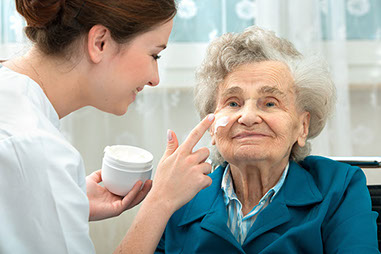
    Image of a caregiver placing cream on a mature women's face.

    As your skin ages, the sebaceous glands produce less oil, and the skin loses elasticity. The result is dry, wrinkled skin-unless you take steps to prevent (or minimize) those effects. Here’s what to do to stay one step ahead of Mother Nature.

    *  Shower or bathe with a mild soap or transparent glycerin soaps to prevent dry, flaky skin. Don’t use deodorant soaps on your face-they’re too harsh for sensitive facial skin.

    *  Avoid alcohol-based astringents, toners, or after-shave lotions, which dry the skin.

    *  Apply a moisturizing lotion immediately after showering or bathing. (Dry skin makes wrinkles more noticeable, so using a moisturizer makes wrinkles less noticeable.)

    *  Use a room or furnace humidifier during the winter months, to further prevent dry skin.

    *  When washing dishes or working with strong detergents, protect your hands with rubber gloves.

    *  Apply sunscreen lotion with a sun protection factor (SPF) of 15 or higher whenever you go outdoors.

    If you’re thinking about having a face lift, chemical peel, or collagen injection for wrinkles, contact your local medical society for the names of board-certified surgeons or dermatologists with experience in the procedure you’re considering.

    A Year of Health Hints book by the American Institute for Preventive Medicine. www.HealthyLife.com. All rights reserved.

    © American Institute for Preventive Medicine