Category: Medical News

  • Know The Facts About Alzheimer’S Disease

    MEDICAL NEWS

    Image of elderly man with hand on chin.

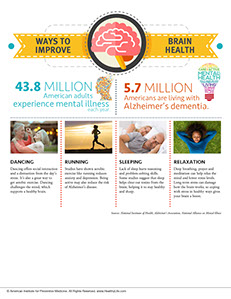
    According to the Alzheimer’s Association, more than 5 million Americans are living with Alzheimer’s today. It is the 6th leading cause of death in the U.S. When someone has trouble thinking, memory loss or behavioral changes, it can be devastating to the person and their family.

    Alzheimer’s starts with mild symptoms, but gets worse over time. A person may start to forget more and be less able to do things for themselves. In its later stages, a person often needs constant care and may be unable to do daily tasks, such as feeding themselves.

    Treating Alzheimer’s today

    Although there is no cure, there are treatments available that can improve the symptoms. Certain medicines can help someone with Alzheimer’s have more independence, dignity and comfort for a longer period of time. But, they don’t stop the disease.

    Because each person’s health is different, only a doctor can help you decide which medicine may be right for you or your loved one. Medicines are often started at the lowest dose and increased, if needed.

    Medical experts continue to research Alzheimer’s and hope to find a cure.

    Can it be prevented?

    Experts don’t know how to prevent Alzheimer’s, though they are trying to find out. Living a healthy lifestyle with exercise, a good diet, and not smoking definitely helps the body. They believe these things may help the brain stay healthy too. If you’re concerned about memory loss or signs of Alzheimer’s, talk to your doctor.

    © American Institute for Preventive Medicine

  • Prediabetes: Are You At Risk?

    MEDICAL NEWS

    Prediabetes infograph.

    © American Institute for Preventive Medicine

  • Tastes Better, Still Harmful

    MEDICAL NEWS

    Image of e-cigarettes.

    More than two out of every five middle and high school students who smoke report using either flavored little cigars or flavored cigarettes, according to a report by the Centers for Disease Control and Prevention (CDC). The study, based on data from a 2011 National Youth Tobacco Survey, is CDC’s first attempt to measure usage of flavored little cigars and cigarettes by youth in the U.S. The findings were published online in the Journal of Adolescent Health on Oct. 22, 2013.

    “Flavored or not, cigars cause cancer, heart disease, lung disease and many other health problems. Flavored little cigars appeal to youth and the use of these tobacco products may lead to disfigurement, disability and premature death,” CDC director Dr. Tom Frieden said in an agency news release. “We need to take comprehensive steps to reduce all tobacco use for all of our youth.”

    One reason flavored cigarettes and little cigars appeal to young people is because the candy and fruit flavors mask the harsh taste of tobacco. The flavored little cigars are also more affordable. Unlike cigarettes, they are not taxed in most states and can be bought individually or in doubles, so teens do not have to buy a whole pack at a time.

    Little cigars have become more popular in recent years. Sales have increased 240 percent from 1997 to 2007, with flavored brands making up almost 80 percent of the market share.

    The CDC also reported that e-cigarette (electronic cigarette) use among young smokers has doubled, due in part to brands that come in flavors such as bubble gum, gummy bear, orange cream soda and cotton candy.

    Health officials are concerned that flavored tobacco products obscure the health risks of smoking and entice young people into continued use of tobacco.

    © American Institute for Preventive Medicine

  • Warning Sign For Fragile Bones

    MEDICAL NEWS

    Image of older women with a broken arm.

    A broken wrist is a warning sign, according to the International Osteoporosis Foundation. If you’re an adult age 50 or over and have broken your wrist, get tested for osteoporosis, they urge.

    Osteoporosis is a chronic “silent” disease that causes bones to weaken and become more fragile and breakable. At age 50, up to 1 in 2 women and 1 in 5 men will go on to suffer a brittleness fracture in their lifetimes. Fractures can result in pain, disability, loss of quality of life and independence, or even early death.

    Consider these facts from the IOF:

    *  A first fracture doubles the risk for future fractures.

    *  One in 4 women who suffer a vertebral (spinal) fracture will experience another fracture within one year.

    *  50% of all hip fractures come from 16% of the postmenopausal women with a history of fracture, including wrist fractures.

    *  Despite the fact that a first fracture is a clear warning sign, only 2 in 10 patients with initial bone breaks get a follow-up test for osteoporosis or risk of falls.

    *  Osteoporosis can be treated and bones can become stronger.

    © American Institute for Preventive Medicine

  • 4 Questions To Ask Before Having Surgery

    MEDICAL NEWS

    Image of doctors.

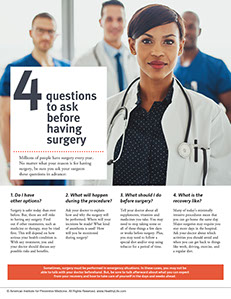
    Millions of people have surgery every year. No matter what your reason is for having surgery, be sure you ask your surgeon these questions in advance:

    1.Do I have other options?Surgery is safer today than ever before. But, there are still risks to having any surgery. Find out if other treatments, such as medicine or therapy, may be tried first. This will depend on how serious your health condition is. With any treatment, you and your doctor should discuss any possible risks and benefits.

    2.What will happen during the procedure?Ask your doctor to explain how and why the surgery will be performed. Where will your incisions be made? What kind of anesthesia is used? How  will you be monitored  during surgery?

    3.What should I do before surgery?Tell your doctor about all supplements, vitamins and medicines you take. You may need to stop taking some or all of these things a few days or weeks before surgery. Plus, you may need to follow a special diet and/or stop using tobacco for a period of time.

    4.What is the recovery like?Many of today’s minimally invasive procedures mean that you can go home the same day. Major surgeries may require you stay more days in the hospital. Ask your doctor about which activities you should avoid and when you can get back to things like work, driving, exercise, and a regular diet.

    Sometimes, surgery must be performed in emergency situations. In these cases, you may not be able to talk with your doctor beforehand. But, be sure to talk afterward about what you can expect from your recovery and how to take care of yourself in the days and weeks ahead.

    © American Institute for Preventive Medicine

  • Busting Myths About Alzheimer’S

    MEDICAL NEWS

    Image of eldery man in wheelchair with daughter and granddaughter.

    More than 5 million Americans are living with Alzheimer’s and many myths still exist about it.

    MYTH: Alzheimer’s and dementia mean the same thing.

    FACT:Dementia is a group of symptoms that can be caused by Alzheimer’s and other diseases. Up to 80 percent of dementia cases are caused by Alzheimer’s disease. But, dementia can be caused by other conditions, such as Parkinson’s disease.

    MYTH: Everyone gets forgetful with age, so Alzheimer’s is no big deal.

    FACT:Alzheimer’s is not a normal part of aging. Alzheimer’s gets worse over time. Eventually, someone with Alzheimer’s will be unable to have a conversation or do normal everyday tasks. The earlier Alzheimer’s is diagnosed, the sooner treatment can start. This may help delay the disease’s progression.

    MYTH: Alzheimer’s won’t hurt you physically. You can live with the memory loss and other symptoms.

    FACT:Alzheimer’s is the sixth leading cause of death in the United States. Some people may live up to 20 years after diagnosis, but there are no survivors.

    MYTH: Medicine can cure Alzheimer’s.

    FACT:Treatments can help slow down the disease, but there is no cure. Alzheimer’s will eventually progress, even with treatment. The treatments may help improve quality of life for those with Alzheimer’s and their caregivers. Research is underway to find ways to prevent the disease and hopefully cure it.

    Source: Alzheimer’s Association

    Look for early signs of Alzheimer’s

    Detecting Alzheimer’s early is important. Since everyone forgets things from time to time, it can be hard to know what’s normal forgetfulness and what’s something more serious. People in the early stages may still work, drive and do daily tasks. They may think they are fine, and deny they have any memory issues.

    Look for these signs as possible flags that could mean early Alzheimer’s and talk to a doctor if you notice them:

    *  Problems coming up with the right word for something

    *  Can’t remember names when introduced to new people

    *  Trouble performing tasks at work or home

    *  Forgetting something that was just read or told

    *  Losing a valuable or important item

    *  Having trouble planning or organizing

    Though these signs don’t mean a person has Alzheimer’s for sure, it’s best to see a doctor.

    © American Institute for Preventive Medicine

  • Get Out Of Your Seat

    MEDICAL NEWS

    Image of women standing and talking on the phone.

    There are lots of things you can do to keep your body healthy. Eat nutritious foods like fruits and vegetables, get exercise, and see your doctor as needed for checkups. But the American Cancer Society says there’s something else we need to do: don’t sit so much.

    A large study showed that women who sat for more than six hours per day had a higher risk of cancer than those who sat for three hours or less. In addition, studies have found links between sitting for long periods and dying younger, the ACS says.

    But what if you have to sit for your job? There are some ways you can reduce your sitting time:

    *  Stand during conference calls.

    *  Take a quick standing or walking break every hour if you can.

    *  Park farther away from the building.

    *  Walk during your lunch break.

    Remember, every little bit helps. A few minutes of walking here and there can add up to big health benefits.

    © American Institute for Preventive Medicine

  • Know The Signs Of Autism

    MEDICAL NEWS

    Image of father and young son.

    Autism affects about 1 in 68 children in our country today, according to the CDC. Autism is a developmental disability that can affect how a person interacts with others, learns, and behaves. For some people, the symptoms are severe. Others can lead fairly normal, independent lives.

    Although experts don’t know what causes autism in many cases, they do know that treating it early can help improve symptoms. Many children with autism show some signs between one and two years of age.

    Now is a great time to learn the early signs of autism and talk to your child’s physician if needed. Some signs to watch for are if your child:

    *  Doesn’t respond to his or her name

    *  Doesn’t point, wave, or gesture

    *  Doesn’t look people in the eye or respond to facial expressions

    *  Doesn’t like physical contact with others

    *  Repeats words or phrases over and over, often without knowing what they mean

    *  Performs repeated body movements such as rocking, spinning, or twirling hands or fingers

    *  Has obsessive interests in only a few activities

    *  Gets very upset with change or differences in routines

    *  Is very interested in organization, such as lining things up in a certain way

    *  Talks in a “robot-like” voice with no emotion or change in tone

    If your child has one of these signs or you notice any unusual behavior, it doesn’t mean your child has autism. But, you should talk with your child’s doctor if you are concerned or have questions about your child’s well-being.

    © American Institute for Preventive Medicine

  • Protect Your Baby

    MEDICAL NEWS

    Image of mother and baby.

    Whooping cough (also known as pertussis) is a respiratory infection that can cause severe coughing or trouble breathing. When babies get it, they are often put in the hospital. And most of them get whooping cough from someone at home, such as a parent, sibling, or grandparent, or from childcare providers.

    Whooping cough can be prevented. Do it, urges the CDC.

    Babies and children get a series of five DTaP shots to protect them against diphtheria, tetanus and whopping cough. Babies get the first dose at two months, so until they are fully immunized, you need to keep them safe.

    Insist that everyone who comes in close contact with your newborn be up-to-date with whooping cough vaccination. Teens and adults need only one dose of Tdap vaccine, which came out in 2005. Tell grandparents they need to get this vaccine, too.

    © American Institute for Preventive Medicine

  • Temporary Tattoos Harmful Too

    MEDICAL NEWS

    Close up image of wrist getting a temporary tattoo.

    What’s the harm in a temporary tattoo applied at the beach or boardwalk or state fair? Maybe a lot is wrong.

    The FDA is reporting problems such as redness, blisters, raised red weeping sores, loss of skin color, increased sensitivity to sunlight, and even permanent scarring from seemingly harmless henna tattoos.

    Here’s why. Some temporary tattoo “artists” are using harmful coloring such as hair dye or “black henna” instead of traditional henna, a reddish-brown coloring made from a flowering plant.

    Inks marketed as black henna may be a mix of henna with other ingredients, or may really be hair dye alone. The reason for adding other ingredients is to create a tattoo that is darker and longer lasting, but use of black henna is potentially harmful. The temporary tattoos made with black henna are dark black.

    Temporary tattooing is not regulated by anyone. No one is checking to make sure the artist is following safe practices. Don’t assume this is a safe thing to do.

    For any problems or long-lasting rashes, see a doctor. You may report a problem to the FDA’s MedWatch:www.fda.gov/Safety/MedWatch/HowToReport/default.htm.

    © American Institute for Preventive Medicine