Category: Medication

  • Plan For Emergencies

    Medication

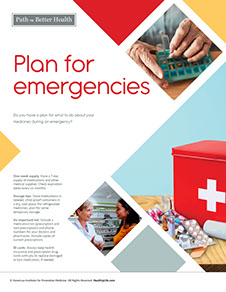
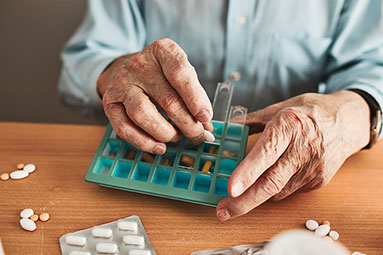
    Close up of hands filling a medication pill holder.

    Do you have a plan for what to do about your medicines during an emergency?

    One-week supply:Have a 7-day supply of medications and other medical supplies. Check expiration dates every six months.

    Storage tips:Store medications in labeled, child-proof containers in a dry, cool place. For refrigerated medicines, plan for some temporary storage.

    An important list:Include a medication list (prescription and non-prescription) and phone numbers for your doctors and pharmacies. Include copies of current prescriptions.

    ID cards:Always keep health insurance and prescription drug cards with you to replace damaged or lost medication, if needed.

    A Year of Health Hints book by the American Institute for Preventive Medicine. www.HealthyLife.com. All rights reserved.

    © American Institute for Preventive Medicine

  • Safe Use Of Medications

    Medication

    Image of man picking up medications.

    *  Things to tell your doctor:

    – Things you have had an allergic reaction to.

    – If you are pregnant or breast-feeding.

    – If another doctor is also treating you.

    – If you have diabetes or kidney or liver disease.

    – If you use alcohol, tobacco, or drugs.

    *  See that your doctor has an up-to-date list of all the medicines you take. This includes prescribed and over-the-counter (OTC) ones, vitamins, and herbal supplements. Keep an up-to-date list in your wallet.

    *  Ask your doctor these questions: What is the medicine for? When should I take it? How long do I need to take it? Should I take it with or without food? Can I crush the pill or open up the capsule if I can’t swallow it whole? Write the answers down.

    *  Give a list of all medicines and supplements you take to your local and mail order pharmacist. Harmful mixtures with other drugs and with foods can be identified.

    *  Get prescribed medicines from a licensed pharmacy.

    *  Keep medicines in their original containers or in ones with sections for daily doses.

    *  Let your doctor know about your past reactions to certain medicines. As some people age, they may be more sensitive to some medications, such as painkillers or sedatives.

    *  Ask about the possible side effects of a medication. Find out what you should do if you have any.

    *  Ask if you can drink alcohol while taking the medication(s). Alcohol can lessen the effects of some medicines. Other medicines, such as sedatives, can be deadly when used with alcohol.

    *  Don’t take someone else’s medication.

    *  Safely discard unused and expired medicines. Use a community drug take-back program. Or, take medicines from their containers and mix them with used coffee grounds or kitty litter. Put this in a sealable bag and place it in the trash.

    *  Try to reduce the need for some medications, such as sleeping pills or laxatives. A warm bath and a glass of milk might help you fall asleep. Having more fiber in your diet can reduce or replace the need for a laxative. Check with your doctor on ways other than medicines to help treat your problem.

    *  Even if you feel better, don’t stop taking a prescribed medicine unless your doctor tells you to. Also, don’t skip doses.

    Resources

    U.S. Food and Drug Administration

    www.fda.gov

    Page from the Healthier at Home book by the American Institute for Preventive Medicine. www.HealthyLife.com. All rights reserved.

    © American Institute for Preventive Medicine

  • Save Money On Medications

    Medication

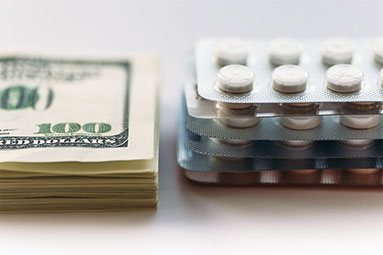
    Small stack of money next to a small stack of pills.

    *  Find out if medications are no longer needed and/or if you could reduce your need of any medication through lifestyle changes.

    *  Take a list of the medications that your health plan prefers (formulary) to office visits.

    *  Ask if one medication can replace the work of two or three.

    *  Ask for free samples and/or a prescription for a few days’ supply to find out if the medicine works for you before you pay for a full prescription.

    *  Ask your doctor or pharmacist if lower-cost options exist, either in a generic form (co-pays for generics cost less, too), a less expensive brand-name drug, or an over-the-counter (OTC) drug.

    *  Ask your doctor if it would save money to prescribe pills that could be cut in half.

    *  Use a mail order pharmacy for prescribed medicines you take on a regular basis. You can usually get a 3-month supply for the same cost that you would pay for a 30 day supply at a drug store.

    *  Shop around for the lowest costs. Compare costs from your pharmacy, large chain pharmacies, and grocery and retail stores that have pharmacies. Use Web sites that compare prices for prescription medicines.

    A Year of Health Hints book by the American Institute for Preventive Medicine. www.HealthyLife.com. All rights reserved.

    © American Institute for Preventive Medicine

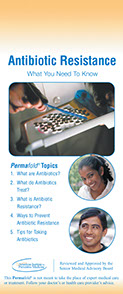
  • Antibiotic Resistance

    Medication

    Antibiotics are medicines that kill bacteria or prevent their growth. They are used for bacterial infections. They do not treat viral or other types of infections.

    Antibiotics Come in Many Forms

    *  Pills

    *  Topical ointments

    *  Injections

    *  Through IV’s

    There are many kinds of antibiotics. Some fight off many types of bacteria. These are broad-spectrum ones. Others target specific bacteria. These are narrow-spectrum ones. If you need an antibiotic, your doctor will prescribe one which works against the bacteria that causes the infection you have.

    What is Antibiotic Resistance?

    Some bacteria, which were once fought off by an antibiotic, have become stronger than the medicine. The antibiotic no longer works against them. This is called “antibiotic resistance.” The bacteria “resist” or don’t let the antibiotic do its job. This is not good!

    If your infection does not respond to an antibiotic, your illness may last longer. You may need a different antibiotic. You may need to get it through an IV in a hospital. You can also pass the resistant bacteria germs to other persons. This adds to the problem. Three out of four hospital-acquired infections are from drug resistant bacteria. These infections, such as one called MRSA, are getting harder and harder to treat.

    Certain bacteria have become so resistant that no antibiotic is able to fight them off. Bacterial resistance happens faster than new antibiotics can be developed. This presents a huge public health problem. Diseases that were once treated with antibiotics are now resistant to them. In some cases, an untreatable illness can lead to disability or even death.

    Overuse of Antibiotics Can Cause Resistance

    *  Taking antibiotics often. This allows bacteria to change forms and survive. Much overuse comes from taking antibiotics for viral infections, such as colds and the flu.  Antibiotics do not work against these. Researchers at the Centers for Disease Control estimate that one-third of outpatient prescriptions for antibiotics each year are not needed.

    *  Antibiotics are given to animals that humans eat. Antibiotic resistance may be transferred from animals to humans especially from eating raw and undercooked eggs, meats, fish, and shellfish. Antibacterials are also sprayed on fruit trees. People may pick up resistant bacteria on fruit if it is not washed before eaten.

    *  Antibacterials are added to many cleaning and other products. These include dishwashing liquids and liquid hand soaps. This is not needed. People are using antibacterials in healthy households. Frequent use of these make germs more drug-resistant.

    Misuse of Antibiotics Can Cause Resistance

    *  The biggest misuse is taking antibiotics for viral infections. In spite of this, persons ask for and sometimes demand antibiotics even when they will not help. Don’t do this!

    *  Not taking an antibiotic as prescribed. This can be from skipping doses. It can be from not taking the right dose at the right time. Often, it comes from not taking all of the antibiotic. These things allow the  bacteria to grow, change forms, and survive.

    *  Taking a broad-spectrum antibiotic that targets many bacteria instead of one that targets select types of bacteria. Discuss this with your doctor when he or she prescribes an antibiotic.

    Do Antibiotics Prevent Infections?

    Antibiotics may be prescribed to prevent or reduce the risk for some bacterial infections. This is only for certain reasons, though. Examples are:

    *  To prevent a bacterial infection of the valves of the heart. An antibiotic may be prescribed for persons with certain heart conditions who are having dental work.

    *  To reduce the risk of bacterial infections that comes with some surgeries. Antibiotics may be given before and/or after the surgery.

    For the most part, though, antibiotics should not be taken to prevent infections. Do not ask your doctor for an antibiotic for these reasons:

    *  To prevent getting colds

    *  To prevent getting the flu

    *  To keep from getting another infection when you have a cold or the flu. You may have asked your doctor for an antibiotic in the past for this. Don’t do it anymore.

    *  To prevent getting anthrax. The American Medical Association has advised doctors not to prescribe antibiotics to prevent anthrax or to have them on hand “just in case.” Antibiotics do not prevent anthrax. You should take them only after you are exposed to it.

    *  To prevent getting small pox. A virus causes this. An antibiotic will not treat it.

    When to Use Antibiotics

    Below is a list of conditions and when an antibiotic may or may not be needed.

    For Acne

    MAYBE. Antibiotics may be prescribed if self-care measures aren’t effective. See your doctor.

    For Bronchitis

    MAYBE. Most often, a virus, smoking, or secondhand smoke causes bronchitis and does not need an antibiotic. Bronchitis from a bacterial infection may need an antibiotic if you smoke, are older than 40 years of age, or if you have a condition or take medication that makes it hard for you to fight infections. See your doctor.

    For Common Cold

    NO. Viruses cause colds.

    For Cough

    MAYBE. Most often, coughs are due to cigarette smoke, cold and flu viruses, and allergies. Antibiotics are not needed for these. If the cough is a symptom of bacterial infection, such as pneumonia, an antibiotic is needed. See your doctor.

    For Earache / Ear Infection

    MAYBE. Some earaches and ear infections do not need antibiotics. Some do. See your doctor.

    For Flu

    NO. A virus causes the flu. It does not need an antibiotic. Consult your doctor if flu symptoms do not improve or if they get worse. This is important if you are elderly or have a condition or take medication that makes it hard for you to fight infections.

    For Lyme Disease

    YES. Lyme disease needs to be treated with an antibiotic.

    For Meningitis

    MAYBE. Meningitis can be viral or bacterial. Bacterial meningitis needs antibiotics (often given through an IV). Antibiotics do not treat viral meningitis. Meningitis needs immediate medical care.

    For Peptic Ulcer

    MAYBE. If H. pylori bacteria is the cause, antibiotic therapy is needed. If the cause is repeated use of aspirin, ibuprofen, and similar drugs, antibiotics are not needed.

    Pinkeye “Conjunctivitis”

    MAYBE. Conjunctivitis can be from bacteria, a virus, or an allergic response. A doctor may prescribe antibiotic eye drops for the bacterial and viral forms, since it is hard to tell the two apart. An antibiotic is not needed for an allergic response.

    For Pneumonia

    YES. A bacterial infection usually causes pneumonia.

    Scarlet Fever

    YES. This is a bacterial infection.

    Sexually Transmitted Infections (STIs)

    YES for syphilis, chlamydia, gonorrhea, and trichomoniasis. Antibiotics treat these infections.

    NO for genital herpes, human papillomavirus (HPV), hepatitis B, and HIV. Viruses cause these STDs. They do not need antibiotics.

    Sinus Infection

    MAYBE. Many sinus infections are caused by viruses or fungi. These do not need an antibiotic. Sinus infections caused by bacterial infections, especially ones that are severe and/or last longer than 2 weeks, may need an antibiotic.

    Skin Infection

    YES for bacterial infections, such as strep or staphylococcal ones.

    NO for fungal infections, such as athlete’s foot.

    Sore Throat

    MAYBE. Most sore throats and  bouts of tonsillitis are caused by viruses. These do not need an antibiotic. See your doctor to rule out a strep throat. A rapid strep test or throat culture diagnoses strep  throat, which needs an antibiotic.

    Stomach “Flu”

    MAYBE. Often the cause is a virus (Gastroenteritis) which does not need an antibiotic. If food poisoning is the cause and it comes from listeria, E. coli, or   salmonella bacteria, antibiotic therapy is needed.

    Sty (Eyelid Infection)

    NO. A sty does not need an antibiotic. It can be treated with self-care.

    Urinary Tract Infection (UTI)

    YES. This is a bacterial infection. A sample of your urine may be tested to find out which type of bacteria is the cause of the infection.

    Ways to Prevent Antibiotic Resistance

    Use Antibiotics the Right Way

    *  Follow your doctor’s advice on antibiotic use. Don’t ask your doctor to prescribe an antibiotic for a cold, the flu, or other viral illnesses. The fewer antibiotics you use, the less chance you will have of developing resistant bacteria.

    *  Ask your doctor if a shorter instead of longer course of an antibiotic will treat the infection.

    *  If you have an illness that does not need an antibiotic, ask your doctor what you can do to feel better sooner. You may be told to take medicines to relieve symptoms. These may include ones to help with fever and congestion. A bronchodilator may be prescribed for bronchitis. Ask about herbal medicines that would be helpful and safe for you to take. Find out reasons you should be seen again.

    *  Take a prescribed antibiotic as directed. Take the right dose. Use a medicine spoon for liquid medicines. Don’t skip doses. Ask how the medicine should be taken. With food? Between meals? With plenty of water? Read the directions on the label.

    *  Don’t stop taking an antibiotic if you feel better. Finish all of it. Don’t save pills for later use.

    *  Don’t take leftover antibiotics from a past infection. This can make it harder for your doctor to identify the cause of a current infection.

    *  Limit use of topical antibiotics, such as Neosporin®. Don’t use one for more than five days at a time, unless your doctor tells you to. Follow the directions given on the package.

    *  Don’t take someone else’s antibiotic.

    Stay Healthy to Reduce the Need for Antibiotics

    *  Wash your hands often. Wash them thoroughly with regular soap and water for 10 to 30 seconds. Wash them after you shake hands, before you eat, after you use the bathroom, etc.

    *  Use antibacterial soaps, detergents, mouthwashes, and toys with an antibacterial coating sparingly, if at all. These are not necessary.

    *  Get plenty of rest. Drink plenty of water.

    *  Get recommended vaccinations for your children and yourself. Follow your doctor’s or local health department’s advice.

    *  Don’t smoke. Avoid secondhand smoke. This lowers the risk of getting infections, such as ear infections.

    *  Thoroughly wash raw fruits and vegetables before you eat them to remove possible antibacterial residues.

    *  Store, handle, and prepare foods correctly. This helps to keep them safe from harmful bacteria. To learn more about this, accesswww.fightbac.org.

    *  Avoid close contact with persons who are sick. When you care for a person with an infection or who is ill, take measures to avoid picking up germs. Wash your hands often. Use a paper towel to dry your hands. Wear disposable gloves as advised.

    Tips for Taking Antibiotics

    Tips for Taking Antibiotics

    *  Find out how you should take the medicine. Ask questions if you don’t understand what you are told to do.

    *  Stop taking an antibiotic and get immediate medical care if you get signs of a severe allergic reaction.

    *  Let your doctor know if an antibiotic gives you troubling side effects, such as diarrhea, headaches, a vaginal yeast infection, etc. Tell your doctor right away if you vomit after taking the antibiotic.

    *  Before being prescribed medication, tell your doctor if you are allergic to penicillin, sulfa drugs, etc. Be able to state the name and dose of any prescribed antibiotic you have recently taken. Also, tell the doctor all other medicines, herbals, and vitamins that you take.

    *  Know that antibiotics can make birth control pills less effective. If you take birth control pills, use another birth control method, such as a diaphragm, condom, etc. while you take the antibiotic.

    *  Find out if you should stay out of the sun while you take the antibiotic.

    *  Use and store the antibiotic as advised. Some antibiotics will not work as intended if chewed or crushed. Some that come in capsules should not be opened and stirred into food. Some need to be stored in a cool place. Liquid forms may need to be kept in the refrigerator.

    *  Find out what foods and drinks you should avoid when you take an antibiotic. For example, some kinds of penicillin should not be taken with acidic foods or drinks. These include oranges, apple juice, colas, and alcohol.

    *  For females who get a vaginal yeast infection when taking an antibiotic, use an over-the-counter medicine, such as Monistat®. Or, take medicine as prescribed by your doctor. Also, eat yogurt with live cultures of “lactobacillus acidophilus.” This may prevent a vaginal yeast infection while you take an antibiotic.

    Signs of a Severe Allergic Reaction

    *  A hard time breathing or swallowing

    *  Severe swelling all over, or of the face, lips, tongue, and/or throat

    *  Severe skin rash or hives

    *  Increase in heart rate, dizziness, weakness

    What Do Antibiotics Treat?

    Some persons think that antibiotics “cure” most ailments. This is not true. Antibiotics treat only bacterial infections. They do not fight viruses, fungi, and other kinds of germs.

    Your doctor will diagnose what kind of infection you have. You should not take antibiotics for viral or fungal infections. This could increase the risk for antibiotic resistance.

    Resources

    Alliance for the Prudent Use of Antibiotics (APUA)

    www.tufts.edu/med/apua

    Centers For Disease Control and Prevention

    www.cdc.gov/drugresistance

    U.S. Food and Drug Administration (FDA)

    www.fda.gov

    Search for “Antibiotic Resistance.”
    Antibiotic Resistance brochure by the American Institute for Preventive Medicine. www.HealthyLife.com. All rights reserved.

    © American Institute for Preventive Medicine

  • Aspirin Dos And Don’Ts

    Medication

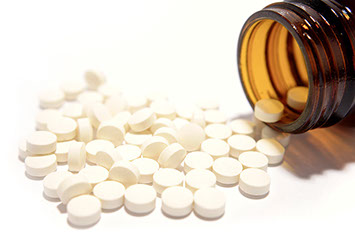
    Image of a pill bottle with pills spilled out.

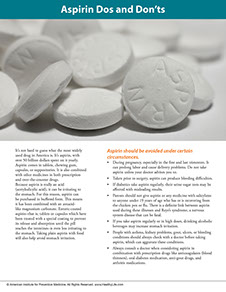
    It’s not hard to guess what the most widely used drug in America is. It’s aspirin, with over 50 billion dollars spent on it yearly. Aspirin comes in tablets, chewing gum, capsules, or suppositories. It is also combined with other medicines in both prescription and over-the-counter drugs.

    Because aspirin is really an acid (acetylsalicylic acid), it can be irritating to the stomach. For this reason, aspirin can be purchased in buffered form. This means it has been combined with an antacid-like magnesium carbonate. Enteric-coated aspirin-that is, tablets or capsules which have been treated with a special coating to prevent its release and absorption until the pill reaches the intestines-is even less irritating to the stomach. Taking plain aspirin with food will also help avoid stomach irritation.

    Aspirin should be avoided under certain circumstances.

    *  During pregnancy, especially in the first and last trimesters. It can prolong labor and cause delivery problems. Do not take aspirin unless your doctor advises you to.

    *  Taken prior to surgery, aspirin can produce bleeding difficulties.

    *  If diabetics take aspirin regularly, their urine sugar tests may be affected with misleading results.

    *  Parents should not give aspirin or any medicine with salicylates to anyone under 19 years of age who has or is recovering from the chicken pox or flu. There is a definite link between aspirin used during these illnesses and Reye’s syndrome, a nervous system disease that can be fatal.

    *  If you take aspirin regularly or in high doses, drinking alcoholic beverages may increase stomach irritation.

    *  People with asthma, kidney problems, gout, ulcers, or bleeding conditions should always check with a doctor before taking aspirin, which can aggravate these conditions.

    *  Always consult a doctor when considering aspirin in combination with prescription drugs like anticoagulants (blood thinners), oral diabetes medication, anti-gout drugs, and arthritis medications.

    Page from A Year of Health Hints book by the American Institute for Preventive Medicine. www.HealthyLife.com. All rights reserved.

    © American Institute for Preventive Medicine

  • Use Caution With Sleeping Pills

    Medication

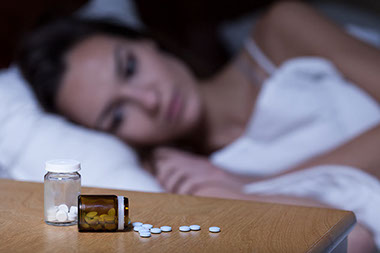
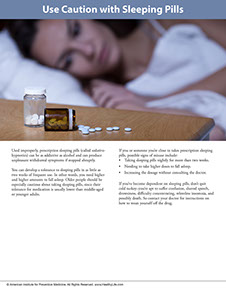
    Image of women trying to sleep with pills on her nightstand.

    Used improperly, prescription sleeping pills (called sedative-hypnotics) can be as addictive as alcohol and can produce unpleasant withdrawal symptoms if stopped abruptly.

    You can develop a tolerance to sleeping pills in as little as two weeks of frequent use. In other words, you need higher and higher amounts to fall asleep. Older people should be especially cautious about taking sleeping pills, since their tolerance for medication is usually lower than middle-aged or younger adults.

    If you or someone you’re close to takes prescription sleeping pills, possible signs of misuse include:

    *  Taking sleeping pills nightly for more than two weeks.

    *  Needing to take higher doses to fall asleep.

    *  Increasing the dosage without consulting the doctor.

    If you’ve become dependent on sleeping pills, don’t quit cold turkey-you’re apt to suffer confusion, slurred speech, drowsiness, difficulty concentrating, relentless insomnia, and possibly death. So contact your doctor for instructions on how to wean yourself off the drug.

    Page from A Year of Health Hints book by the American Institute for Preventive Medicine. www.HealthyLife.com. All rights reserved.

    © American Institute for Preventive Medicine

  • Tips For Medication Safety

    Medication

    Do This, Not That

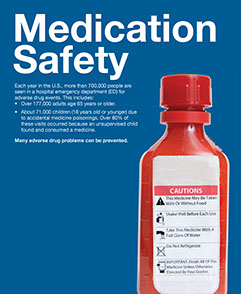
    Each year in the U.S., more than 700,000 people are seen in a hospital emergency department (ED) for adverse drug events. This includes:

    *  Over 177,000 adults age 65 years or older.

    *  About 71,000 children (18 years old or younger) due to accidental medicine poisonings. Over 80% of these visits occurred because an unsupervised child found and consumed a medicine.

    Many adverse drug problems can be prevented.

    CHILDREN

    ADULTS

    Safe at Home - Do This, Not That Book. Published by the American Institute for Preventive Medicine.

    © American Institute for Preventive Medicine

  • How To Take Painkillers Safely

    Medication

    Image of pills.

    Millions of Americans suffer from some form of chronic or severe pain. Many will seek relief with painkilling drugs or analgesics. Painkillers treat the symptom of pain rather than the root cause.

    Simple analgesics. This type of painkiller, such as aspirin or acetaminophen, provides relief from pain at the site of the injury or inflammation. (Aspirin decreases inflammation in addition to its analgesic effect.) These are not habit forming and they maintain effectiveness even after repeated use.

    Narcotic analgesics. Analgesics such as codeine or morphine provide relief by acting on the central nervous system, rather than by decreasing inflammation. The cause of the pain does not disappear, but it is easier to endure. These drugs also cause sedation. As the body builds up a tolerance to the narcotic, dosages may need to be increased. When discontinued, withdrawal symptoms can occur.

    To minimize unwanted effects of painkillers:

    *  Take painkillers with a full glass of milk or water. It will speed entry into the digestive system and minimize stomach upset.

    *  Remember that all drugs have side effects. Find out early what to expect by asking the pharmacist for the drug package insert or asking your physician.

    *  Take only the weakest form and the smallest dosage that will provide relief.

    *  Don’t wait until the pain is too severe to begin your medication. Delay makes it more difficult for the painkiller to be effective, and you may need a stronger dose.

    *  If pain keeps you from sleeping, never take a sleeping pill along with painkillers. Use analgesics only for the pain itself.

    *  If you are a cigarette smoker, painkillers may be metabolized at a different rate so tell your doctor if you smoke.

    *  Before considering switching painkillers because of side effects, ask your doctor if he or she can reduce your dosage.

    *  If you are taking a narcotic type of painkiller, check with your physician about alternating it with aspirin or an acetaminophen analgesic. This will help reduce the possibility of developing a tolerance.

    *  Don’t think of painkillers as your only weapon against pain. There are other techniques, such as relaxation training or cold compresses that your physician can help you with.

    Page from A Year of Health Hints book by the American Institute for Preventive Medicine. www.HealthyLife.com. All rights reserved.

    © American Institute for Preventive Medicine

  • Medication Interactions

    Medication

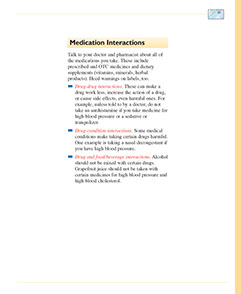
    Talk to your doctor and pharmacist about all of the medications you take. These include prescribed and OTC medicines and dietary supplements (vitamins, minerals, herbal products). Heed warnings on labels, too.

    Drug-drug interactions

    These can make a drug work less, increase the action of a drug, or cause side effects, even harmful ones. For example, unless told to by a doctor, do not take an antihistamine if you take medicine for high blood pressure or a sedative or tranquilizer.

    Drug-condition interactions

    Some medical conditions make taking certain drugs harmful. One example is taking a nasal decongestant if you have high blood pressure.

    Drug and food/beverage interactions

    Alcohol should not be mixed with certain drugs. Grapefruit juice should not be taken with certain medicines for high blood pressure and high blood cholesterol.

    Page from the Healthier at Home book by the American Institute for Preventive Medicine. www.HealthyLife.com. All rights reserved.

    © American Institute for Preventive Medicine

  • Medication Safety

    Medication

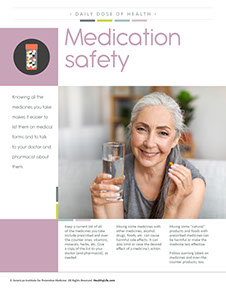
    Smiling women holding a glass of water in one hand and a pill in the other hand.

    Knowing all the medicines you take makes it easier to list them on medical forms and to talk to your doctor and pharmacist about them.

    Keep a current list of all of the medicines you take. Include prescribed and over-the-counter ones, vitamins, minerals, herbs, etc. Give a copy of the list to your doctor (and pharmacist), as needed.

    Mixing some medicines with other medicines, alcohol, drugs, foods, etc. can cause harmful side effects. It can also limit or raise the desired effect of a medicine’s action.

    Mixing some “natural” products and foods with prescribed medicines can be harmful or make the medicine less effective.

    Follow warning labels on medicines and over-the-counter products, too.

    A Year of Health Hints book by the American Institute for Preventive Medicine. www.HealthyLife.com. All rights reserved.

    © American Institute for Preventive Medicine