Signs & Causes
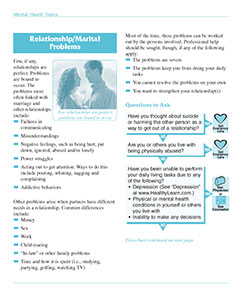
Few, if any, relationships are perfect. Problems are bound to occur. The problems most often linked with marriage and other relationships include:
* Failures in communicating
* Misunderstandings
* Negative feelings, such as being hurt, put down, ignored, abused and/or lonely
* Power struggles
* Acting out to get attention. Ways to do this include pouting, whining, nagging and complaining
* Addictive behaviors
Other problems arise when partners have different needs in a relationship. Common differences include:
* Money
* Sex
* Work
* Child-rearing
* “In-law” or other family problems
* Time and how it is spent (i.e., studying, partying, golfing, watching TV)
Most of the time, these problems can be worked out by the persons involved. Professional help should be sought, though, if any of the following apply:
* The problems are severe
* The problems keep you from doing your daily tasks
* You cannot resolve the problems on your own
* You want to strengthen your relationship(s)
Questions to Ask
Self-Help
Ways to Improve Communication
* Avoid blaming the other person. This puts him or her on the defensive and prevents communication. When blaming starts, listening stops.
* Take 51% of the responsibility for listening to what is being said. Ask questions to clear up what you don’t understand.
* Be sincere, honest, and show concern in your conversation. Don’t be sarcastic or make fun of the other person.
* Try to let go. Before getting into an argument, ask yourself if the issue can simply be “let go.” Ask the other person, too. If you both say yes, drop it and don’t let it re-surface at a later time.
* It’s alright to discuss problem issues, but be certain that you focus on how to solve the problem, not placing blame for it.
* Put yourself in the other person’s shoes. Try to see his or her point of view.
* Remind each other of the many positive strengths of the relationship. Build on these strong points. Don’t dwell on the negative ones.
* Don’t bring up old issues, disputes or grudges. When past problems enter in, the conversation can get out of hand.
* Timing is critical. Ask yourself if it is the right time to bring up an issue. If the other person is undergoing problems with work, school, kids, health and/or family, adding yet another problem to their burden is not likely to solve the issue. It may serve to cause them more anguish. If possible, wait until the other person’s burden has lightened to bring up yet another problem.
* Don’t approach an issue with the idea of changing the other person’s mind or convey an attitude that you’re right and he or she is wrong.
* Share the issue. The problem belongs to both you and the other person. Work to understand your partner’s position first, then to have him or her understand your position.
* Omit distractions. Don’t attempt to discuss an issue while driving a car, taking care of children, doing a household chore or doing anything that will take your attention away from the issue and the other person.
* Make sure you know your own position and be ready to state it clearly to the other person.
* Communicate in an assertive way.
– State your position in terms of what your feelings about the issue are.
– Don’t make demands of the other person or put them down.
– Use “I” rather than “you” messages. For example, if you are upset by the fact that the other person has begun to neglect their appearance, instead of saying “You look like a slob,” it would be better to state “I like it better when your appearance is neat.”
* Listen with your heart. Hear what the other person is saying regardless of how they say it. Allow him or her to be comfortable while they are stating their position. Don’t take an “attack” position and wait tensely for your turn to talk. Don’t interrupt them while they are speaking.
* Make a plan. This should consist of what you can do to solve the issue and what you are willing to do. Knowing these things in advance can speed the solution and reconciliation process.
* Go in peace. Let the discussion of a problem run its course and end in peace with both of you at ease. Don’t continue to “stew” over who said what, the decisions that came out of the argument and whether the other person gained more than you did in the bargaining session. If you still feel uncomfortable with the solutions, re-state your position and try again. Be aware, however, that some issues may not be able to be changed. For example, in the case of differing sexual desires/needs, forcing or asking that your partner engage in sexual activity beyond their desire for it will not benefit you or your partner and will only cause more tension.
Jealousy
* If you experience abnormal jealousy in relation to situations or persons in your life, the following suggestions may be helpful:
* Admit your jealousy. Pretending there is no problem or that it is not a serious problem only compounds the issue.
* Look for the cause of the jealousy. Some of the causes may be:
– Your present or a past partner cheated on you which has caused you to feel insecure. Your partner seems to pay more attention to others, work or social friendships. Members of the opposite sex find your partner attractive and pay a lot of attention to him or her. You fear your partner may one day lose interest in you and seek another partner.
* Express your fears and concerns to your partner.
* Learn about jealousy. Read books on the subject, talk to people who live with jealous persons to get an idea of what it’s like to experience a partner’s jealous responses. Or, talk to other people who experience extreme jealous feelings themselves.
* Communicate. Talk to your spouse/partner about your feelings. Perhaps they are doing something they are not aware of that is causing you distress.
* Talk to a counselor if you cannot curb your jealous responses on your own.
* If you are the victim of someone’s abnormal jealousy or if you know someone who is abnormally jealous, the following suggestions may help you deal with them:
– Be supportive. Recognize that your partner has a problem and encourage them to work on their behavior. Give them positive feedback as they progress.
– Hold your ground. If your partner questions you, state your explanation clearly and without anger.
– Be objective. Try to see the situation from your jealous partner’s point of view when possible. Avoid doing things that may be causing their jealousy and spend quality time together as a couple.
– Don’t provoke jealousy. If you know your partner is prone to certain jealous reactions, don’t flirt with people in their presence, don’t ridicule, antagonize or tease your spouse/partner about their jealousy. Don’t leave “fake clues” to an alleged infidelity.
– Don’t isolate yourself. Do not withdraw or avoid other social relationships. This can be the consequence of dealing with a violent or otherwise abusive jealous person.
* Seek professional help. If you and your partner cannot work out your jealousy problems through communication, companionship and trying to create an otherwise satisfying relationship, consult a counselor.
Sex
* Discuss your sexual needs with your partner.
* Ask your partner about his or her sexual needs.
* Develop areas where both you and your partner have compatible needs/desires.
Money Matters
* Set financial goals. Decide together what you want to accomplish within a certain time (example: 6 months, 5 years, throughout life). Continue to review and modify your plans, if necessary.
* Organize financial records. Keep track of statements, check stubs and receipts. These can help monitor spending.
* Establish a credit history in both partners’ names.
* Limit the number of credit cards you have, how much you charge on them or get rid of them entirely. Opt for credit cards with the lowest interest rates, if you use them.
* Get professional help from an accountant, financial planner or other specialist if you need help managing your money.
* Develop a realistic budget. You can do this in one of two ways:
– Single Fund – Both partners have a joint account and agree that “what’s mine is yours.” This works if both of you can agree on a budget and spending practices.
– Separate Finances – This works well if both partners work. Each person is responsible for an agreed-on portion of the household costs. They are then free to do whatever they wish with the rest of their money with no resentments from the other partner.