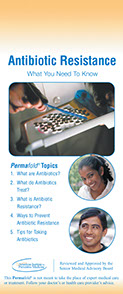
Antibiotics are medicines that kill bacteria or prevent their growth. They are used for bacterial infections. They do not treat viral or other types of infections.
Antibiotics Come in Many Forms
* Pills
* Topical ointments
* Injections
* Through IV’s
There are many kinds of antibiotics. Some fight off many types of bacteria. These are broad-spectrum ones. Others target specific bacteria. These are narrow-spectrum ones. If you need an antibiotic, your doctor will prescribe one which works against the bacteria that causes the infection you have.
What is Antibiotic Resistance?
Some bacteria, which were once fought off by an antibiotic, have become stronger than the medicine. The antibiotic no longer works against them. This is called “antibiotic resistance.” The bacteria “resist” or don’t let the antibiotic do its job. This is not good!
If your infection does not respond to an antibiotic, your illness may last longer. You may need a different antibiotic. You may need to get it through an IV in a hospital. You can also pass the resistant bacteria germs to other persons. This adds to the problem. Three out of four hospital-acquired infections are from drug resistant bacteria. These infections, such as one called MRSA, are getting harder and harder to treat.
Certain bacteria have become so resistant that no antibiotic is able to fight them off. Bacterial resistance happens faster than new antibiotics can be developed. This presents a huge public health problem. Diseases that were once treated with antibiotics are now resistant to them. In some cases, an untreatable illness can lead to disability or even death.
Overuse of Antibiotics Can Cause Resistance
* Taking antibiotics often. This allows bacteria to change forms and survive. Much overuse comes from taking antibiotics for viral infections, such as colds and the flu. Antibiotics do not work against these. Researchers at the Centers for Disease Control estimate that one-third of outpatient prescriptions for antibiotics each year are not needed.
* Antibiotics are given to animals that humans eat. Antibiotic resistance may be transferred from animals to humans especially from eating raw and undercooked eggs, meats, fish, and shellfish. Antibacterials are also sprayed on fruit trees. People may pick up resistant bacteria on fruit if it is not washed before eaten.
* Antibacterials are added to many cleaning and other products. These include dishwashing liquids and liquid hand soaps. This is not needed. People are using antibacterials in healthy households. Frequent use of these make germs more drug-resistant.
Misuse of Antibiotics Can Cause Resistance
* The biggest misuse is taking antibiotics for viral infections. In spite of this, persons ask for and sometimes demand antibiotics even when they will not help. Don’t do this!
* Not taking an antibiotic as prescribed. This can be from skipping doses. It can be from not taking the right dose at the right time. Often, it comes from not taking all of the antibiotic. These things allow the bacteria to grow, change forms, and survive.
* Taking a broad-spectrum antibiotic that targets many bacteria instead of one that targets select types of bacteria. Discuss this with your doctor when he or she prescribes an antibiotic.
Do Antibiotics Prevent Infections?
Antibiotics may be prescribed to prevent or reduce the risk for some bacterial infections. This is only for certain reasons, though. Examples are:
* To prevent a bacterial infection of the valves of the heart. An antibiotic may be prescribed for persons with certain heart conditions who are having dental work.
* To reduce the risk of bacterial infections that comes with some surgeries. Antibiotics may be given before and/or after the surgery.
For the most part, though, antibiotics should not be taken to prevent infections. Do not ask your doctor for an antibiotic for these reasons:
* To prevent getting colds
* To prevent getting the flu
* To keep from getting another infection when you have a cold or the flu. You may have asked your doctor for an antibiotic in the past for this. Don’t do it anymore.
* To prevent getting anthrax. The American Medical Association has advised doctors not to prescribe antibiotics to prevent anthrax or to have them on hand “just in case.” Antibiotics do not prevent anthrax. You should take them only after you are exposed to it.
* To prevent getting small pox. A virus causes this. An antibiotic will not treat it.
When to Use Antibiotics
Below is a list of conditions and when an antibiotic may or may not be needed.
For Acne
MAYBE. Antibiotics may be prescribed if self-care measures aren’t effective. See your doctor.
For Bronchitis
MAYBE. Most often, a virus, smoking, or secondhand smoke causes bronchitis and does not need an antibiotic. Bronchitis from a bacterial infection may need an antibiotic if you smoke, are older than 40 years of age, or if you have a condition or take medication that makes it hard for you to fight infections. See your doctor.
For Common Cold
NO. Viruses cause colds.
For Cough
MAYBE. Most often, coughs are due to cigarette smoke, cold and flu viruses, and allergies. Antibiotics are not needed for these. If the cough is a symptom of bacterial infection, such as pneumonia, an antibiotic is needed. See your doctor.
For Earache / Ear Infection
MAYBE. Some earaches and ear infections do not need antibiotics. Some do. See your doctor.
For Flu
NO. A virus causes the flu. It does not need an antibiotic. Consult your doctor if flu symptoms do not improve or if they get worse. This is important if you are elderly or have a condition or take medication that makes it hard for you to fight infections.
For Lyme Disease
YES. Lyme disease needs to be treated with an antibiotic.
For Meningitis
MAYBE. Meningitis can be viral or bacterial. Bacterial meningitis needs antibiotics (often given through an IV). Antibiotics do not treat viral meningitis. Meningitis needs immediate medical care.
For Peptic Ulcer
MAYBE. If H. pylori bacteria is the cause, antibiotic therapy is needed. If the cause is repeated use of aspirin, ibuprofen, and similar drugs, antibiotics are not needed.
Pinkeye “Conjunctivitis”
MAYBE. Conjunctivitis can be from bacteria, a virus, or an allergic response. A doctor may prescribe antibiotic eye drops for the bacterial and viral forms, since it is hard to tell the two apart. An antibiotic is not needed for an allergic response.
For Pneumonia
YES. A bacterial infection usually causes pneumonia.
Scarlet Fever
YES. This is a bacterial infection.
Sexually Transmitted Infections (STIs)
YES for syphilis, chlamydia, gonorrhea, and trichomoniasis. Antibiotics treat these infections.
NO for genital herpes, human papillomavirus (HPV), hepatitis B, and HIV. Viruses cause these STDs. They do not need antibiotics.
Sinus Infection
MAYBE. Many sinus infections are caused by viruses or fungi. These do not need an antibiotic. Sinus infections caused by bacterial infections, especially ones that are severe and/or last longer than 2 weeks, may need an antibiotic.
Skin Infection
YES for bacterial infections, such as strep or staphylococcal ones.
NO for fungal infections, such as athlete’s foot.
Sore Throat
MAYBE. Most sore throats and bouts of tonsillitis are caused by viruses. These do not need an antibiotic. See your doctor to rule out a strep throat. A rapid strep test or throat culture diagnoses strep throat, which needs an antibiotic.
Stomach “Flu”
MAYBE. Often the cause is a virus (Gastroenteritis) which does not need an antibiotic. If food poisoning is the cause and it comes from listeria, E. coli, or salmonella bacteria, antibiotic therapy is needed.
Sty (Eyelid Infection)
NO. A sty does not need an antibiotic. It can be treated with self-care.
Urinary Tract Infection (UTI)
YES. This is a bacterial infection. A sample of your urine may be tested to find out which type of bacteria is the cause of the infection.
Ways to Prevent Antibiotic Resistance
Use Antibiotics the Right Way
* Follow your doctor’s advice on antibiotic use. Don’t ask your doctor to prescribe an antibiotic for a cold, the flu, or other viral illnesses. The fewer antibiotics you use, the less chance you will have of developing resistant bacteria.
* Ask your doctor if a shorter instead of longer course of an antibiotic will treat the infection.
* If you have an illness that does not need an antibiotic, ask your doctor what you can do to feel better sooner. You may be told to take medicines to relieve symptoms. These may include ones to help with fever and congestion. A bronchodilator may be prescribed for bronchitis. Ask about herbal medicines that would be helpful and safe for you to take. Find out reasons you should be seen again.
* Take a prescribed antibiotic as directed. Take the right dose. Use a medicine spoon for liquid medicines. Don’t skip doses. Ask how the medicine should be taken. With food? Between meals? With plenty of water? Read the directions on the label.
* Don’t stop taking an antibiotic if you feel better. Finish all of it. Don’t save pills for later use.
* Don’t take leftover antibiotics from a past infection. This can make it harder for your doctor to identify the cause of a current infection.
* Limit use of topical antibiotics, such as Neosporin®. Don’t use one for more than five days at a time, unless your doctor tells you to. Follow the directions given on the package.
* Don’t take someone else’s antibiotic.
Stay Healthy to Reduce the Need for Antibiotics
* Wash your hands often. Wash them thoroughly with regular soap and water for 10 to 30 seconds. Wash them after you shake hands, before you eat, after you use the bathroom, etc.
* Use antibacterial soaps, detergents, mouthwashes, and toys with an antibacterial coating sparingly, if at all. These are not necessary.
* Get plenty of rest. Drink plenty of water.
* Get recommended vaccinations for your children and yourself. Follow your doctor’s or local health department’s advice.
* Don’t smoke. Avoid secondhand smoke. This lowers the risk of getting infections, such as ear infections.
* Thoroughly wash raw fruits and vegetables before you eat them to remove possible antibacterial residues.
* Store, handle, and prepare foods correctly. This helps to keep them safe from harmful bacteria. To learn more about this, accesswww.fightbac.org.
* Avoid close contact with persons who are sick. When you care for a person with an infection or who is ill, take measures to avoid picking up germs. Wash your hands often. Use a paper towel to dry your hands. Wear disposable gloves as advised.
Tips for Taking Antibiotics
Tips for Taking Antibiotics
* Find out how you should take the medicine. Ask questions if you don’t understand what you are told to do.
* Stop taking an antibiotic and get immediate medical care if you get signs of a severe allergic reaction.
* Let your doctor know if an antibiotic gives you troubling side effects, such as diarrhea, headaches, a vaginal yeast infection, etc. Tell your doctor right away if you vomit after taking the antibiotic.
* Before being prescribed medication, tell your doctor if you are allergic to penicillin, sulfa drugs, etc. Be able to state the name and dose of any prescribed antibiotic you have recently taken. Also, tell the doctor all other medicines, herbals, and vitamins that you take.
* Know that antibiotics can make birth control pills less effective. If you take birth control pills, use another birth control method, such as a diaphragm, condom, etc. while you take the antibiotic.
* Find out if you should stay out of the sun while you take the antibiotic.
* Use and store the antibiotic as advised. Some antibiotics will not work as intended if chewed or crushed. Some that come in capsules should not be opened and stirred into food. Some need to be stored in a cool place. Liquid forms may need to be kept in the refrigerator.
* Find out what foods and drinks you should avoid when you take an antibiotic. For example, some kinds of penicillin should not be taken with acidic foods or drinks. These include oranges, apple juice, colas, and alcohol.
* For females who get a vaginal yeast infection when taking an antibiotic, use an over-the-counter medicine, such as Monistat®. Or, take medicine as prescribed by your doctor. Also, eat yogurt with live cultures of “lactobacillus acidophilus.” This may prevent a vaginal yeast infection while you take an antibiotic.
Signs of a Severe Allergic Reaction
* A hard time breathing or swallowing
* Severe swelling all over, or of the face, lips, tongue, and/or throat
* Severe skin rash or hives
* Increase in heart rate, dizziness, weakness
What Do Antibiotics Treat?
Some persons think that antibiotics “cure” most ailments. This is not true. Antibiotics treat only bacterial infections. They do not fight viruses, fungi, and other kinds of germs.
Your doctor will diagnose what kind of infection you have. You should not take antibiotics for viral or fungal infections. This could increase the risk for antibiotic resistance.
Resources
Alliance for the Prudent Use of Antibiotics (APUA)
www.tufts.edu/med/apua
Centers For Disease Control and Prevention
www.cdc.gov/drugresistance
U.S. Food and Drug Administration (FDA)
www.fda.gov
Search for “Antibiotic Resistance.”