Category: Uncategorized

  • The Keys To Physical Well-Being Are Healthy Habits

    Personal Safety

    Couple eating watermelon.

    *  Eat nutritious foods.

    *  Get to and maintain a healthy weight.

    *  Be physically active.

    *  Get enough sleep and rest.

    *  See that you and all family members age 6 months and older get an annual flu vaccine. It is the single best way to prevent getting seasonal flu.

    Dos

    *  Balance work and play.

    *  Wash your hands often with soap and water or hand sanitizer containing 60% alcohol.

    *  Avoid secondhand smoke.

    Don’ts

    *  Don’t be a workaholic.

    *  Don’t be around people who have the flu.

    *  Don’t use tobacco in any form.

    A Year of Health Hints book by the American Institute for Preventive Medicine. www.HealthyLife.com. All rights reserved.

    © American Institute for Preventive Medicine
  • Manger Anger

    Mental Health

    Don’t let mental wrath create physical problems.

    “Holding on to anger is like grasping a hot coal with the intent of throwing it at someone else; you are the one who gets burned.” – Buddha

    Too much or chronic anger can lead to depression, headaches, heart disease, high blood pressure, or problems with alcohol or drugs. It can also trigger domestic violence, property damage, or road rage.

    Learn to manage anger.

    Managing your anger can enhance emotional well-being and lead to a happier, healthier life.

    *  Share your anger with a trusted friend, family member, teacher, etc.

    *  Express your feelings in ways that don’t offend or  accuse others.

    *  Keep a record of reasons and times you have too much anger. You may start to see patterns that can be changed.

    *  Channel your energy in positive ways. Write poetry, clean out your cabinets, or take a walk.

    *  Distract yourself. Play music.

    *  Learn to accept things that you cannot change, such as traffic jams.

    *  Lighten up. Look for humor in situations that result  in anger.

    *  Meditate or do yoga.

    *  Think before you act or speak.

    *  Eat healthy foods and don’t skip meals.

    Signs of anger:

    *  Feeling restless

    *  Clenched teeth

    *  Trembling lips or hands

    *  Increased heart rate or blood pressure

    *  Yelling. Slamming doors.

    *  Being less productive

    *  Sleeping problems

    *  Violent outbursts

    Action Step

    If anger interferes with your day-to-day life or has caused physical or emotional harm to you or someone else, seek help from your doctor or a mental health care provider.

    ays to Well-Being book by the American Institute for Preventive Medicine. www.HealthyLife.com. All rights reserved.

    © American Institute for Preventive Medicine
  • Tips For Medication Safety

    Medication

    Do This, Not That

    Each year in the U.S., more than 700,000 people are seen in a hospital emergency department (ED) for adverse drug events. This includes:

    *  Over 177,000 adults age 65 years or older.

    *  About 71,000 children (18 years old or younger) due to accidental medicine poisonings. Over 80% of these visits occurred because an unsupervised child found and consumed a medicine.

    Many adverse drug problems can be prevented.

    CHILDREN

    ADULTS

    Safe at Home - Do This, Not That Book. Published by the American Institute for Preventive Medicine.

    © American Institute for Preventive Medicine

  • Help For Restless Legs

    SELF-CARE CORNER

    Close up feet laying in bed.

    Do you feel a twitchy, jumpy feeling in your legs when you sit or lie down? Do you have an urge to move your legs when you go to bed at night? If so, you may have restless legs syndrome (RLS).

    What is RLS?

    RLS is known as a sleep disorder, although it can happen when you’re awake or asleep. It occurs when you’re resting or lying still, and is more common at night. Because it can interfere with sleep, RLS is linked to:

    *  Daytime sleepiness

    *  Memory problems or trouble concentrating

    *  Mood changes

    *  Job performance issues

    *  Problems with personal relationships

    RLS affects people of any age, but tends to cause more problems in older adults.

    What causes it?

    RLS can run in families, especially if your symptoms began before age 40. Experts believe RLS may be related to a problem in the part of the brain that controls movement. It may be linked to certain health problems, including:

    *  Low iron in your blood (iron deficiency anemia)

    *  End-stage renal (kidney) disease

    *  Neuropathy (nerve damage)

    Most of the time, though, there’s no clear cause of RLS.

    Self-care tips for restless legs

    You may be able to manage mild RLS at home. Try these tips:

    *  Avoid caffeine. Drinks like coffee, tea, energy drinks and cola usually contain caffeine.

    *  Don’t smoke. Ask your doctor if you need help quitting.

    *  Avoid alcohol.

    *  Get moderate exercise early in the day. Don’t exercise right before bedtime.

    *  Try relaxation techniques like deep breathing, meditation or yoga before bed.

    *  Make sleep a priority. Go to bed and get up at the same time each day. Aim for seven to eight hours of sleep each night.

    See your doctor regularly and tell your doctor about any symptoms you’re having. You may also want to ask if you should get your iron levels checked. Doctors sometimes treat more severe cases of RLS with medications.

    Sources: American Academy of Family Physicians, National Institute of Neurological Disorders and Stroke, Restless Legs Syndrome Foundation

    © American Institute for Preventive Medicine
  • Stop Snoring

    SELF-CARE CORNER

    Women wearing a CPAP mask while sleeping.

    Almost everyone snores sometimes. But some people snore a lot, and it may be disruptive to their sleep and those around them. Snoring may just be a nuisance, but it could also be a sign of a serious problem.

    What is snoring?

    Snoring is the harsh sound made when air vibrates the tissue around your airway while you breathe. When you sleep, it’s normal for your throat to relax and your tongue to slide back into your mouth. However, if anything obstructs the flow of air, you get vibrations known as snoring.

    The sound can range from gentle to grating, depending on the degree of obstruction or the specific structure of your airway.

    Causes

    *  Stuffy nose from a cold or allergies

    *  Sleep position

    *  Bulky throat tissue from large tonsils or adenoids

    *  Your unique mouth anatomy

    *  Being overweight

    *  Poor muscle tone due to age, alcohol consumption, or sleep deprivation

    *  A serious condition called Obstructive Sleep Apnea (OSA)

    What makes snoring dangerous?

    Excessive snoring may be a sign of obstructive sleep apnea (OSA). This condition occurs when breathing is fully or partially obstructed for more than 10 seconds during sleep. You may wake with a snort or gasp and then fall back to sleep for another cycle of snoring, followed by breath obstruction.

    People with OSA often sleep poorly due to multiple cycles of apnea disrupting deep sleep. They are also at higher risk for high blood pressure, heart conditions, and stroke.

    Talk to your doctor if you or your partner notice you are frequently snoring.

    Warning signs for OSA:

    *  Feeling very drowsy during the day

    *  Morning headaches

    *  Gasping or choking at night

    *  High blood pressure

    *  Snoring disrupting your bed partner’s sleep

    *  Chest pain at night

    If your doctor determines you do not have OSA, you may want to try other strategies to reduce snoring:

    *  Sleep on your side.

    *  Avoid alcohol and caffeine at night.

    *  Lose some weight.

    *  Treat nasal congestion.

    *  Try devices such as nasal strips or nasal dilators.

    *  Explore ways to get better sleep.

    © American Institute for Preventive Medicine
  • Exercise Your Feet

    BE FIT

    Close up of feet walking on treadmill, with an overlapping illustration of a foot skeleton.

    Without strong and flexible feet, walking, running, and other kinds of movement may become painful.

    Just like every other part of your body, your feet need exercise. Next time you work out, include these movements for healthy feet:

    *Ankle circles:Keeping your leg still, slowly circle your ankle four or five times in one direction, then switch.

    *Calf raises:Standing near a wall or other support, lift up onto the ball mounds of your feet, then slowly lower back down 10-20 times. Focus on lifting straight up and straight down.

    *Toe lifts:Standing on bare feet, try lifting your big toe without moving your ankle or other toes. Then keep your big toe down and lift your other four toes together. Alternate back and forth.

    *Pick up a marble:Either standing with support or sitting in a chair, try picking up a marble or other small object using your toes.

    © American Institute for Preventive Medicine
  • No Time To Exercise? Move Your Body Instead

    BE FIT

    Father and son walking the dog.

    Exercise is great for your health. But sometimes it’s hard to fit it into a busy schedule. Don’t worry – you can do movement instead.

    If there are days when you don’t have time for exercise, you can still move. Adding movement into your day is a way to improve your health without investing as much time. There’s no gym or special equipment involved.

    Why should I move more?

    Studies show that people who move their bodies every day live longer than those who don’t. It’s also good for the environment. If you walk or bike to your destination, you save gas and carbon emissions. If you take the stairs instead of the elevator, you save electricity.

    Movement ideas

    Not sure how to get started with movement? You can find things that work for your life. Think about ways you can move instead of sit. Here are some ideas:

    *Avoid the elevator and take the stairs if you can.You can burn calories two to three times faster climbing stairs than walking briskly on flat ground. Can’t take it the whole way? Take the stairs halfway and the elevator the rest of the way. Try to take stairs instead of escalators, too.

    *Park farther away from the front door and walk a little more whenever possible.Many studies have shown that people who live in cities walk more and weigh less than people who live in areas where they drive more.

    *Whenever possible, bike or walk instead of driving.People who commute to work by biking or walking tend to weigh less than people who always drive.

    *If you live far from where you are going, consider driving part of the way and walking the rest of the way.Even a half-mile walk is good movement.

    *Choose hobbies you enjoy that are active, but don’t feel like exercise.This may include gardening, dancing or walking while listening to music or an audiobook.

    *Walk in place or lift weights while watching your favorite TV show.Stretch or walk in place while talking on the phone at home or work.

    Sources: American Heart Association, Veterans Health Administration

    © American Institute for Preventive Medicine
  • Up Your Vo2 Max

    BE FIT

    VO2 max measures how much oxygen your body uses when working at a high level of exercise.

    A high VO2 max indicates good cardiovascular fitness, while a low VO2 max means you should consider moving your body more. You don’t have to become an elite athlete. Even a small increase in fitness has significant health benefits. If your doctor clears you to do aerobic exercise, try these workouts to increase VO2 max.

    Interval training:This involves alternating short periods of moderate to high-intensity aerobic exercise with short periods of low-intensity exercise. Alternate 3 minutes of moderate/high-intensity with 2 minutes of low-intensity for 30 minutes.

    High-intensity training:This is a form of interval training that uses short, intense bouts of exercise at your max, followed by a longer rest period.

    Steady-state training:This type of training is long bouts of cardio at a pace you can maintain for at least 30 minutes. Your heart rate should be elevated, but you should still be able to carry on a conversation.

    © American Institute for Preventive Medicine

  • Exercise Smart

    Fitness

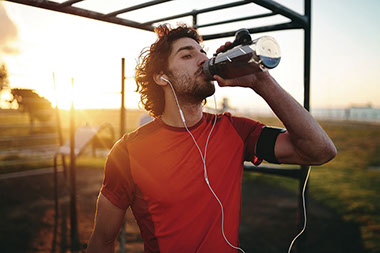
    Man with towel behind neck while drinking out of a water bottle.

    Weekend athletes are more prone to injuries than persons who exercise on a regular basis. To help lower the risk of injury, warm up your muscles with light activity or walking. Cool down at the end of exercising and stretch afterward.

    Each week, adults need 150 minutes of moderate intensity exercise, plus 2 days of muscle strengthening activity.

    Schedule physical activities into your day. Exercise while you watch TV. Take brief walks during lunchtime or breaks at work.

    Poor-fitting athletic shoes can cause pain in your feet and other areas of the body. Choose a shoe for the activity (e.g., running, walking, and tennis). Try new shoes on after a workout or at the end of the day when your feet tend to be their largest.

    Water is the best fluid to drink before, during and after you exercise. Drink 1 to 2 cups of water 15 minutes before you exercise. During exercise, drink about 1/2 cup every 10 to 20 minutes. Taking in large amounts all at once could cause a bloated feeling.

    Page from HealthyLife Weigh book by the American Institute for Preventive Medicine. www.HealthyLife.com. All rights reserved.

    © American Institute for Preventive Medicine