Category: Uncategorized

  • Telehealth: What To Know

    MEDICAL NEWS

    Phone and stethoscope.

    Telehealth or telemedicine uses video calls or other technology to help you see your doctor. This allows you to have medical appointments from home instead of going to the doctor’s office.

    Getting ready

    If you want to use telehealth, but don’t know how, contact your doctor’s office. Different doctors and hospitals use different apps and technology for their telemedicine appointments. Ask them for instructions on how to get set up.

    Before your appointment, check with your insurance company about coverage for telehealth appointments. Prepare a list of questions to ask your doctor so you’ll be sure to cover everything.

    If you need help

    If you’re feeling overwhelmed, ask a tech-savvy friend or family member to help. Usually, you only need:

    1.  A strong internet connection. Your connection needs to be fast enough for video chats.

    2.  A smartphone, tablet or computer that connects to your wi-fi and has a working microphone, speaker and camera. Most newer devices have all of these built in.

    Telehealth can be a safe and convenient way to have your medical appointments. Don’t be intimidated by technology. With a little help, you can be up and running – and it may become your favorite way to have your doctor visits!

    Source: National Institutes on Aging

    © American Institute for Preventive Medicine

  • Stroke Faq’s

    MEDICAL NEWS

    Purple background with paper cut out of head and brain.

    A stroke occurs when oxygen flow to the brain is disrupted. Within minutes of a stroke, brain cells begin to die from lack of oxygen. As more cells die, parts of the brain become damaged and may no longer function properly.

    Three main types of strokes

    *  Ischemic stroke is caused by a blockage in the blood vessels of the brain. It is the most common type of stroke.

    *  Transient ischemic stroke (TIA), also known as a mini-stroke, is a type of ischemic stroke in which blood flow is blocked for only a few minutes. TIA’s are often a warning sign that a more severe stroke may occur.

    *  Hemorrhagic stroke is caused by a blood vessel in the brain leaking blood or bursting. The buildup of blood puts pressure on brain cells, which causes damage.

    Signs & Symptoms

    *  Numbness or weakness in the face, limbs, or body on one side

    *  Sudden vision trouble

    *  Confusion and difficulty speaking

    *  Severe headache

    *  Dizziness and trouble with balance or walking

    Early identification of a stroke is essential to minimize harm to the brain. Every minute is critical for getting fast and effective treatment.

    Knowing the warning signs of a stroke means you can quickly seek medical help. Getting medical attention within the first few hours of a stroke ensures the best possible outcome and recovery. If you suspect a stroke, call 911 right away.

    Effects of a stroke

    The brain controls many essential body functions, including movement, speech, breathing, digestion, memories, and emotions. The damage caused by a stroke can lead to long-term disability or even death.

    The exact impact of a stroke depends on the area of the brain affected, the length of time between the start of the stroke and treatment, and any underlying conditions.

    Possible side effects of a stroke include:

    *  Weakness or paralysis on one or both sides of the body

    *  Difficulty forming or understanding speech

    *  Impairment of memory, concentration, thinking, and judgment

    *  Trouble chewing or swallowing

    *  Bladder and bowel control issues

    *  Depression

    © American Institute for Preventive Medicine
  • Breaking Bad Habits Now

    WELL-BEING

    Doctor holding an apple in hand wrap with a tape measure.

    If you’re hoping to make a change, these tips may help:

    Avoid.If certain places or people make you want to engage in unhealthy habits, try your best to stay away.

    Replace.Focus on what you can do instead of the bad habit. For instance, take a walk or drink a glass of water.

    Plan.If you know you’ll be tempted with a bad habit, practice what you can do. Picture yourself not giving in. Have a plan for yourself.

    Buddy up.Ask a friend or family member to support you. They can cheer you on and encourage you when you need it.

    Source: National Institutes of Health

    © American Institute for Preventive Medicine
  • Poison Prevention Starts At Home

    WELL-BEING

    Image of posion cans with warning labels.

    Did you know more than 90 percent of all poisonings happen at home? While children are affected the most, people of all ages can be harmed by poisoning. Here’s what to know to make your home safe.

    Caring for cleaners

    Do not mix household cleaners or other products. The chemicals in these products can create a toxic gas when mixed. Never mix bleach with ammonia products or other cleaners. Use only one product at a time.

    Keep cleaners, chemicals, medicines, and anything that could be poisonous locked up and put away.

    Mindful of medicines

    Never share prescription medicines with anyone. The other person may not be able to safely take your medicine. Or, they could be taking another medicine that isn’t safe when mixed with yours. Make sure your doctor or pharmacist knows about all medicines you are taking.

    Keep all medicines clearly labeled with the type of medicine and dosage. If you don’t understand your medicine or how much to take, ask your doctor or pharmacist.

    Don’t try to take medicines in the dark, because you could accidentally take the wrong one. Keep all medicines, even over-the-counter ones, put away and out of reach of children.

    Battery safety

    Treat batteries like poison. Keep them away from children.

    The small, round “button” batteries are especially dangerous because they are easy for children to swallow. A swallowed battery can cause permanent damage to the throat and even death within just a couple of hours.

    Beware of e-cigarettes

    E-Cigarettes are shaped like cigarettes but they contain a small heater and battery. The “juice” used inside these devices contains high levels of nicotine. Even a tiny amount of the juice from e-cigarettes can cause poisoning in a child. It can cause seizures and even death.

    Keep e-cigarettes away from children at all times. If you throw used e-cigarette juice in the trash, wrap it up and take it outside or someplace where a child cannot get to it.

    Know the number

    If you think you or someone else has been exposed to poison, call (800) 222-1222. This connects you to your local poison center. The call is free and confidential. They can tell you what to do next. Do not try to treat poisoning yourself with home remedies.

    © American Institute for Preventive Medicine
  • What Is Cbd?

    WELL-BEING

    CBD oil in small glass jar.

    CBD (or cannabidiol) oil may be purchased in many pharmacies and other stores. It is claimed to treat more than 50 health conditions like sleep problems, anxiety and pain. But, experts say there’s little evidence that it works for most of them.

    What is CBD?

    CBD oil comes from the cannabis plant. Cannabis plants can be marijuana or hemp.

    A chemical called tetrahydrocannabinol (THC) causes the mental changes that make a person “high” when they use marijuana. CBD oil should contain little to no THC so it can’t make a person high. However, there is no way to know for sure that the CBD product is THC-free.

    The Food and Drug Administration (FDA) tested CBD products. Some products were found to contain THC, even though CBD should not contain it. Other products had a different amount of CBD than what the label stated.

    What does CBD do?

    Experts don’t know exactly how CBD works in the body. There is solid evidence that it can help control seizure disorders in children. But, evidence that it helps treat other conditions is lacking. In fact, the FDA has warned several companies about selling CBD with untested health claims.

    Does CBD have side effects?

    In studies, people didn’t report serious side effects when taking CBD. There were some reports of diarrhea. Also, CBD may interact with a person’s other medications. People who take other medicines or have health conditions should ask a doctor before using CBD.

    Should I use CBD?

    There isn’t enough evidence to recommend CBD for health problems other than seizures. Experts say you should stick with proven treatments for health problems. Always talk with a doctor before using any natural treatment, including CBD.

    Source: National Institutes of Health

    © American Institute for Preventive Medicine
  • Health Tests For Women 2

    Medical Exams

    Bone Mineral Density Test (BMD)

    Why you need this:

    Osteoporosis occurs four times more often in women than in men. Get tested as often as advised by your doctor.

    What to do before the test:

    Dress in clothing that makes it comfortable to lie on a table.

    What to expect:

    A common and reliable method used is the Dexa-Scan (DXA). With your clothes on, you lie on a table. A low energy X-ray is taken of your hip and/or spine. Portable BMD screening devices are used to scan a heel or fingers. They are not as accurate as a DXA scan, but may be used at workplaces, health fairs, etc. Other ways to measure bone mineral density are CT scans, X-rays, and ultrasounds.

    What the results mean:

    Normal is a BMD value less than 1 standard deviation below the young adult mean. Osteopenia (low bone mass) is a BMD value between -1 and -2.5 standard deviation below the young adult mean. Osteoporosis is a BMD value at least -2.5 standard deviations below the young adult mean.

    Breast Exam by Doctor or Nurse

    Why you need this:

    Screens for signs of breast problems, including cancer.

    What to do before the test:

    If you still menstruate, it is best to schedule the exam 3 or more days after your menstrual period. Your breasts are usually more swollen and tender the week before your period.

    What to expect:

    The doctor or nurse carefully feels your breasts and under your arms for lumps or anything else that seems unusual.

    What the results mean:

    If a lump or other problem is felt, the doctor may prescribe a mammogram or other follow up tests.

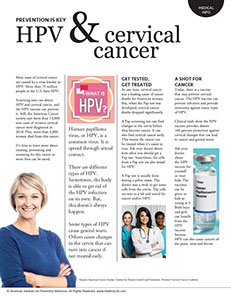
    Cervical Cancer Screening – Pap Test and Human Papillomavirus (HPV) Test

    Why you need this:

    HPV test checks for DNA of high-risk types of human papillomavirus that can cause abnormal cells and cervical cancer. HPV test results are of value only with your Pap test results. Having a Pap test and an HPV test is an option for women ages 30 and older. If both tests are negative, the risk for cervical cancer is very low and women can opt to wait five years before another screening. Note: More than 40 types of HPV infect the vulva, cervix, anus, and penis. HPV testing for cervical cancer does not screen for other forms of cancers linked to HPV. It does not screen for genital warts and  other sexually transmitted infections, either.

    What to do before the test:

    You do not need any special preparation before an HPV test, but follow the same procedures as for Pap test, listed on this page, if both tests are done at the same time. HPV testing can also be done to provide more information when a Pap test’s results are not clear.

    What to expect:

    An HPV test is done the same way as a Pap test. The test can be done at the same time as the Pap test, using the same swab or a second swab.

    What the results mean:

    A negative HPV test means you do not have an HPV type that is linked to cervical cancer.

    A positive HPV test means you do have an HPV type that may be linked to cervical cancer. This does not mean you have cervical cancer now. But it could be a warning.

    Treatment depends on results your HPV and Pap test results. This includes:

    *  Having repeat tests to monitor changes

    *  Taking a closer look at your cervix (a colposcopy)

    *  Removing abnormal cells

    *  Treating for cancer, if present

    Cervical Cancer Screening – Pap Test (or Pap Smear)

    Why you need this:

    Checks for cell changes on the cervix that might become cervical cancer if they are not properly treated. Regular screening and follow-up can help prevent cervical cancer or find it early. Cervical cancer is the most preventable type of female cancer. Note: The Pap test does not screen for ovarian, uterine, vaginal, or vulvar cancers.

    What to do before the test:

    If you still menstruate, schedule the test for a time you will not be having a menstrual period. Don’t douche, tub-bathe, or use vaginal creams for 48 to 72 hours before the test. Avoid sex within 24 hours of the test.

    What to expect:

    You need to undress below the waist. You lie down on the exam table and put your feet in the stirrups attached to the bottom of the table. A device called a speculum is inserted into the vagina. A long cotton swab is used to take a sample of cells from the cervical area. This does not usually hurt. You may feel a brief pinch. The sample is analyzed for abnormal cells.

    What the results mean:

    Results come back as:

    *  Negative (normal) – No cell changes were found on your cervix. Continue to get regular Pap tests in the future.

    *  Unclear – This means the cells on the cervix could be abnormal. Or, the cells could not be clearly identified. Cell changes could be due to an infection, menopause, or other life changes. The changes could also be related to human papillomavirus (HPV) types that have a high risk for cervical cancer. Your doctor can order a test to check for HPV.

    *  Abnormal – Cell changes were found on your cervix. A likely cause is HPV, but this does not mean you have cervical cancer. Abnormal cells can be: Low-grade changes are minor and could go back to normal on their own. Your doctor can order a test to check for HPV types that have a high risk for cervical cancer. High-grade changes are serious. They could turn into cancer if they are not removed. Cancer may be found, but other tests need to confirm this.

    Chlamydia Screening

    Why you need this:

    Three fourths of females with this STI have no symptoms, so they can pass it on to others without knowing it. When it is not treated, pelvic inflammatory disease can result. This can make a woman unable to get pregnant.

    What to expect:

    The doctor takes a urine test or uses a swab or brush to take a sample of cells from the infected area, such as the cervix or uterus. The sample is checked for the bacteria that causes chlamydia. It is also checked for gonorrhea at the same time because this STI has symptoms like that of chlamydia.

    What the results mean:

    If the test is positive, you have an active infection. The doctor will prescribe a course of antibiotics to treat chlamydia (or gonorrhea). Your sex partner(s) should be treated, too.

    Mammogram

    Why you need this:

    Screens for signs of breast problems, including cancer.

    What to do before the test:

    Schedule the test at an approved testing facility. Find out from the National Cancer Institute at 800.4.CANCER (422.6237) orwww.cancer.gov. If you still menstruate, try not to schedule the test during the week before a period. On the day of the test, don’t wear lotions, powders, perfumes or deodorant. They can cause shadows on the X-ray pictures. Wear slacks or a skirt with a blouse or top, so you only need to undress from the waist up.

    What to expect:

    You will need to undress above the waist. You put on a gown that covers your front and back. The test is quick and easy: You stand up in front of the X-ray machine. The person who takes the X-rays places one breast between two plastic plates. The plates press your breast and make it flat. This can feel uncomfortable, but it lasts only seconds. The machine has an automatic release. The same test is done on the other breast. Then side images are taken for both breasts for a total of 4 X-rays.

    What the results mean:

    A radiologist reads the X-rays and sends the results to your doctor. A report is sent to you within 30 days. A normal result means the radiologist did not find anything that needs follow up. Continue to get screening mammograms. If the result is abnormal, it means the radiologist saw:

    *  A change from a past mammogram.

    *  A change that needs follow up.

    *  Your doctor will order follow up tests, as needed, such as an ultrasound or an MRI. If one of these shows a solid mass, your doctor may prescribe a biopsy of the mass.

    The good news is that about 80% of lumps are not cancerous.

    Pelvic Exam

    Why you need this:

    Checks for problems on the outside of the vaginal area and inside the vagina and cervix.

    What to do before the test:

    Follow guidelines for Pap smear.

    What to expect:

    The doctor does a physical exam of the vaginal area. A Pap smear is usually done with a pelvic exam. The doctor may also insert a gloved and lubricated finger into the rectum. This can feel uncomfortable, but does not usually cause pain.

    What the results mean:

    If no problems are found, continue to have pelvic exams yearly or as advised by your doctor. If a problem is found, your doctor will prescribe follow-up tests or exams.

    Men's and Women's Self-Care Book. Published by the American Institute for Preventive Medicine.

    © American Institute for Preventive Medicine

  • A Safer Way To Shovel Snow

    Personal Safety

    Image of a person shoveling snow.

    Many people know that shoveling snow can put many at risk for back injury or a heart attack, but think, “It won’t happen to me” and shovel anyway.

    Shoveling snow strains the back, because you bend at the waist to lift a load. And shoveling can trigger a heart attack in three ways. The increase in activity requires your heart to work harder. Also, without realizing it, you may hold your breath as you lift, which can trigger a sudden rise in heart rate and blood pressure. And cold weather causes blood vessels to constrict, so the heart has to pump more blood.

    If you have a history of back problems or heart problems, don’t shovel snow, period. Have someone else do it. If you’re over age 40 and overweight, if you have high blood pressure, if you smoke, or if you lead a sedentary life, check with your doctor before lifting a shovel.

    The following hints can help make a tough job easier, even if you’re not at special risk for back or heart problems.

    *  Dress properly. Protect your head and hands from the cold, and don’t bundle up so much that you overheat or can’t move freely.

    *  To prevent back strain, keep your knees slightly bent and both feet planted firmly on the ground or pavement.

    *  Consider removing snow with a snowblower or plow instead of a shovel-it’s far less stressful and gets the job done quickly.

    A Year of Health Hints book by the American Institute for Preventive Medicine. www.HealthyLife.com. All rights reserved.

    © American Institute for Preventive Medicine