Category: Stress Management

  • Reduce Outdoor Air Pollution To Breathe Cleaner Air

    Stress Management

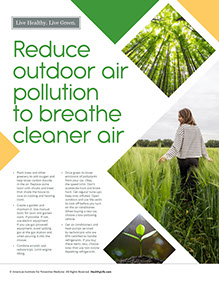
    Looking up at a forrest of trees.

    *  Plant trees and other greenery to add oxygen and help lower carbon dioxide in the air. Replace some lawn with shrubs and trees that shade the house to save on cooling and heating costs.

    *  Create a garden and maintain it. Use manual tools for lawn and garden work, if possible. If not, use electric equipment. If you use gas powered equipment, avoid spilling gas at the gas station and when pouring it into the mower.

    *  Combine errands and reduce trips. Limit engine idling.

    *  Drive green to lower emissions of pollutants from your car. Obey the speed limit. Don’t accelerate hard and brake hard. Get regular tune-ups. Keep tires inflated. Open windows and use the vents to cool off before you turn on the air conditioner. When buying a new car, choose a low-polluting vehicle.

    *  Get air conditioners and heat pumps serviced by technicians who are EPA-certified to handle refrigerants. If you buy these items new, choose ones that use non-ozone-depleting refrigerants.

    Page from HealthyLife Weigh book by the American Institute for Preventive Medicine. www.HealthyLife.com. All rights reserved.

    © American Institute for Preventive Medicine

  • “Rehearse” For Stressful Events

    Stress Management

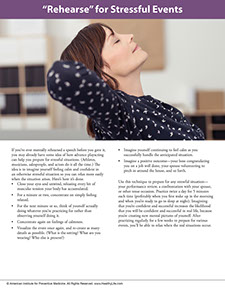
    Image of women giving a business proposal in front of co-workers.

    If you’ve ever mentally rehearsed a speech before you gave it, you may already have some idea of how advance playacting can help you prepare for stressful situations. (Athletes, musicians, salespeople, and actors do it all the time.) The idea is to imagine yourself feeling calm and confident in an otherwise stressful situation so you can relax more easily when the situation arises. Here’s how it’s done.

    *  Close your eyes and unwind, releasing every bit of muscular tension your body has accumulated.

    *  For a minute or two, concentrate on simply feeling relaxed.

    *  For the next minute or so, think of yourself actually doing whatever you’re practicing for rather than observing yourself doing it.

    *  Concentrate again on feelings of calmness.

    *  Visualize the event once again, and re-create as many details as possible. (What is the setting?  What are you wearing? Who else is present?)

    *  Imagine yourself continuing to feel calm as you successfully handle the anticipated situation.

    *  Imagine a positive outcome-your boss congratulating you on a job well done, your spouse volunteering to pitch in around the house, and so forth.

    Use this technique to prepare for any stressful situation-your performance review, a confrontation with your spouse, or other tense occasion. Practice twice a day for 5 minutes each time (preferably when you first wake up in the morning and when you’re ready to go to sleep at night). Imagining that you’re confident and successful increases the likelihood that you will be confident and successful in real life, because you’re creating new mental pictures of yourself. After practicing regularly for a few weeks to prepare for various events, you’ll be able to relax when the real situations occur.

    Page from A Year of Health Hints book by the American Institute for Preventive Medicine. www.HealthyLife.com. All rights reserved.

    © American Institute for Preventive Medicine
  • Tune Out To Tune In

    Stress Management

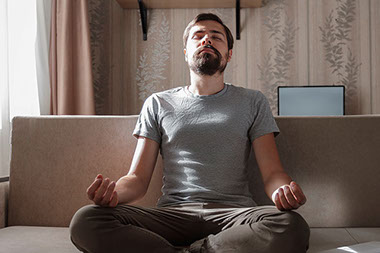
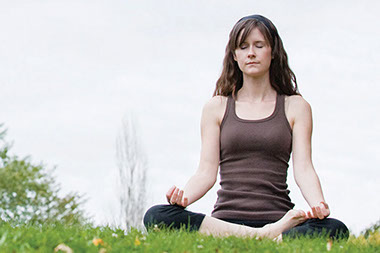
    Image of women meditating.

    Meditate to alleviate anxiety and stress.

    Meditation is a stress management technique that allows you to be in the present moment without interruptions from the kids, deadlines, meetings, and the long to-do list swimming through your mind. It can be practiced anytime in short spurts to relieve immediate stress or for longer periods to help reduce the risks of stress-related illnesses.

    How meditation can help

    Meditation does not replace proper diagnosis and treatment for a medical problem, but it can promote well-being and may also reduce symptoms of the following conditions:

    *  Anxiety

    *  Pain

    *  Depression

    *  Stress

    *  Insomnia

    *  Chronic back pain

    *  Asthma

    *  Hot flashes

    *  Physical or emotional symptoms that may occur with chronic illnesses, such as heart disease and cancer and bothersome side effects of their treatment.

    Guru advice:

    *  Practice meditation two times a day, preferably morning and night. Five to 10 minutes a session is good for starters.

    *  Choose a quiet place – not a place that you work, exercise, or sleep, if possible.

    *  Get rid of distractions. If you are worried about the phone ringing or the kids waking, you won’t relax.

    *  Assume a comfortable position. Focus on your breathing.

    *  Pay attention to your slowing heart rate and your relaxed muscles.

    *  Focus on a single point in the room. Good props include candles, incense or quiet music.

    *  Once the mind quiets, focus on your body. Start at your feet, then move slowly upward, noticing how everything feels.

    Action Step

    Take at least 10 minutes every morning to calm your mind. Sit or lie down. Breathe slowly and deeply. Focus on the feeling in your lungs and chest.

    Page from Ways to Well-Being book by the American Institute for Preventive Medicine. www.HealthyLife.com. All rights reserved.

    © American Institute for Preventive Medicine
  • Don’T Be Afraid To Cry

    Stress Management

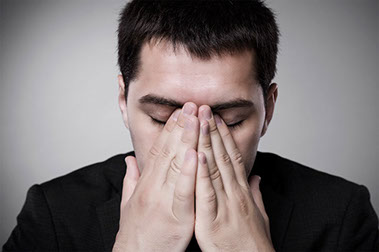
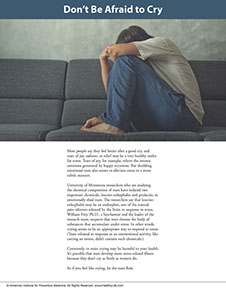
    Image of person with hands over face.

    Most people say they feel better after a good cry, and tears of joy, sadness, or relief may be a very healthy outlet for stress. Tears of joy, for example, relieve the intense emotions generated by happy occasions. But shedding emotional tears also seems to alleviate stress in a more subtle manner.

    University of Minnesota researchers who are studying the chemical composition of tears have isolated two important chemicals, leucine-enkephalin and prolactin, in emotionally shed tears. The researchers say that leucine-enkephalin may be an endorphin, one of the natural pain relievers released by the brain in response to stress. William Frey, Ph.D., a biochemist and the leader of the research team, suspects that tears cleanse the body of substances that accumulate under stress. In other words, crying seems to be an appropriate way to respond to stress. (Tears released in response to an unemotional activity, like cutting an onion, didn’t contain such chemicals.)

    Conversely, to resist crying may be harmful to your health. It’s possible that men develop more stress-related illness because they don’t cry as freely as women do.

    So if you feel like crying, let the tears flow.

    Page from A Year of Health Hints book by the American Institute for Preventive Medicine. www.HealthyLife.com. All rights reserved.

    © American Institute for Preventive Medicine
  • “Remember” To Relax With Biofeedback

    Stress Management

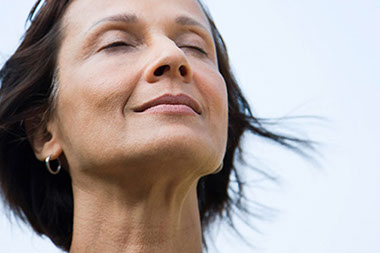
    Image of women deep breathing.

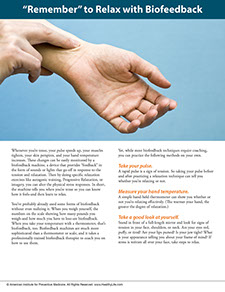
    Whenever you’re tense, your pulse speeds up, your muscles tighten, your skin perspires, and your hand temperature increases. These changes can be easily monitored by a biofeedback machine, a device that provides “feedback” in the form of sounds or lights that go off in response to the tension and relaxation. Then by doing specific relaxation exercises like autogenic training, Progressive Relaxation, or imagery, you can alter the physical stress responses. In short, the machine tells you when you’re tense so you can know how it feels-and then learn to relax.

    You’ve probably already used some forms of biofeedback without even realizing it. When you weigh yourself, the numbers on the scale showing how many pounds you weigh-and how much you have to lose-are biofeedback. When you take your temperature with a thermometer, that’s biofeedback, too. Biofeedback machines are much more sophisticated than a thermometer or scale, and it takes a professionally trained biofeedback therapist to coach you on how to use them.

    Yet, while most biofeedback techniques require coaching, you can practice the following methods on your own.

    Take your pulse. A rapid pulse is a sign of tension. So taking your pulse before and after practicing a relaxation technique can tell you whether you’re relaxing or not.

    Measure your hand temperature. A simple hand-held thermometer can show you whether or not you’re relaxing effectively. (The warmer your hand, the greater the degree of relaxation.)

    Take a good look at yourself. Stand in front of a full-length mirror and look for signs of tension in your face, shoulders, or neck. Are your eyes red, puffy, or tired? Are your lips pursed? Is your jaw tight? What is your appearance telling you about your frame of mind? If stress is written all over your face, take steps to relax.

    Page from A Year of Health Hints book by the American Institute for Preventive Medicine. www.HealthyLife.com. All rights reserved.

    © American Institute for Preventive Medicine