Blog

  • Stages Of Change 2

    Healthylife® QuitWell™

    Part 1

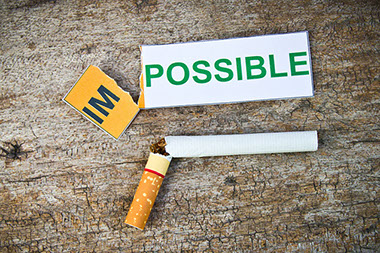
    Broken cigarette with a paper ripped to spell Possible from Impossible.

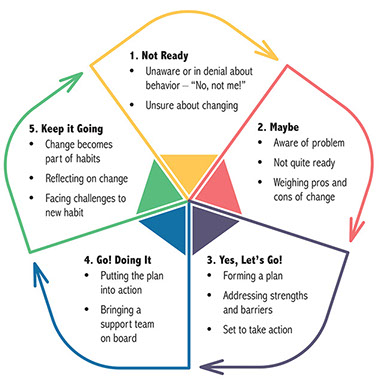
    This program does not assume you are ready to change. Or, you may be ready to make certain changes but not others. Other changes you may not have even thought of yet! The tools and strategies in this guide are designed to help you move forward through the stages of change.

    Using the diagram below, consider which stage you are at. What best describes where you are at today?

    Diagram showing the different stages of quitting.

    © American Institute for Preventive Medicine

  • Spend Time With Animals

    Healthylife® QuitWell™

    Part 4

    Man and his dog.

    Spend time with a pet. Volunteer at a shelter. Spend time with a friend or family member’s pet. Go to a pet store, or look into adopting a rescue animal.

    Spending time with a pet can:

    *  Decrease production of cortisol, a stress hormone that can put you on edge and make you ill over time.

    *  Increase serotonin, which helps you feel relaxed and happy.

    *  Help you feel secure. Pets, especially dogs, can love unconditionally and may sense when you need extra support. Some pets are trained to help you manage certain emotions, like anxiety.

    © American Institute for Preventive Medicine

  • Snuff Out Smokeless Tobacco

    Tobacco Cessation

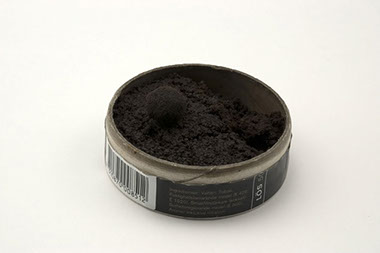
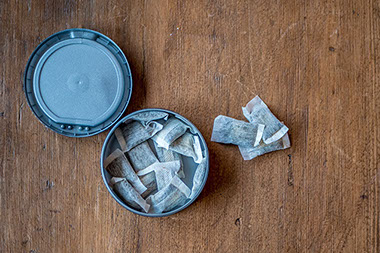
    Image of smokeless tobacco.

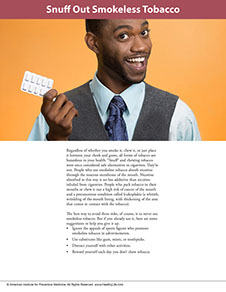
    Regardless of whether you smoke it, chew it, or just place it between your cheek and gums, all forms of tobacco are hazardous to your health. “Snuff” and chewing tobacco were once considered safe alternatives to cigarettes. They’re not. People who use smokeless tobacco absorb nicotine through the mucous membrane of the mouth. Nicotine absorbed in this way is no less addictive than nicotine inhaled from cigarettes. People who pack tobacco in their mouths or chew it run a high risk of cancer of the mouth and a precancerous condition called leukoplakia (a whitish, wrinkling of the mouth lining, with thickening of the area that comes in contact with the tobacco).

    The best way to avoid these risks, of course, is to never use smokeless tobacco. But if you already use it, here are some suggestions to help you give it up.

    *  Ignore the appeals of sports figures who promote smokeless tobacco in advertisements.

    *  Use substitutes like gum, mints, or toothpicks.

    *  Distract yourself with other activities.

    *  Reward yourself each day you don’t chew tobacco.

    Page from A Year of Health Hints book by the American Institute for Preventive Medicine. www.HealthyLife.com. All rights reserved.

    © American Institute for Preventive Medicine

  • Smoking & Your Health

    Healthylife® QuitWell™

    Part 1

    The word "Help" spelled out in clay, as well as lungs and cigarettes.

    Smoking is the number one cause of premature, preventable deaths in the United States. According to the Centers for Disease Control and Prevention (CDC), more than 480,000 Americans die each year due to smoking. Many of those are from cancer, heart disease, stroke, and lung disease. Very few, if any, smokers go through their lives without having harmful effects. Smoking affects more than just your lungs-every part of the body is damaged.

    Smoking can also cause:

    *  Chronic obstructive pulmonary disease

    *  Aortic aneurysm

    *  Diabetes

    *  Osteoporosis (brittle bones)

    *  Rheumatoid arthritis

    *  Macular degeneration (age-related)

    *  Cataracts

    And contributes to:

    *  Airway infections

    *  Impaired immune responses

    *  Miscarriage

    *  Pregnancy complications

    *  Low birth weight, cleft lip/palate, and risk of SIDS

    *  Erectile disfunction

    *  Frequent colds and a weakened immune system

    After You Quit

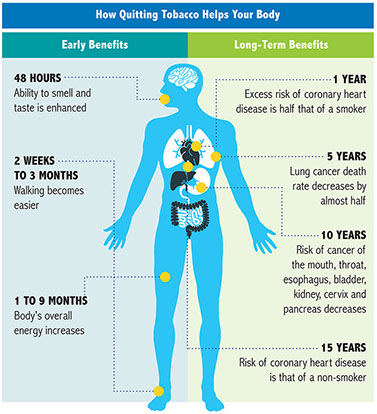
    As soon as you stop smoking, your body responds. Changes in your body start happening right away.

    Chart showing how quitting tobacco helps your body.

    © American Institute for Preventive Medicine

  • Smokeless Tobacco & Your Health

    Healthylife® QuitWell™

    Part 1

    Image of chewing tobacco.

    Smokeless tobacco includes chewing tobacco, which may also be called oral tobacco or spit tobacco. Smokeless tobacco also includes both moist and dry snuff, snus, and dissolvable tobacco products. Smokeless tobacco is not a safe form of tobacco, even if that is often how it is marketed by tobacco companies. Smokeless tobacco carries many serious risks.

    Smokeless tobacco can cause cancers of the:

    *  Mouth, tongue, cheek & gums

    *  Esophagus

    *  Pancreas

    Smokeless tobacco can also cause:

    *  Sores in the mouth called leukoplakia that can become cancer

    *  Stained teeth

    *  Bad breath

    *  Gum disease, cavities, tooth decay, and tooth loss

    *  Bone loss around the teeth

    *  Heart disease

    *  High blood pressure

    *  Increased risk of heart attack and stroke

    *  Pregnancy complications and low birth weight

    © American Institute for Preventive Medicine

  • Smokeless Inhalation

    Healthylife® QuitWell™

    Part 4

    Senior women deep breathing.

    This is one of the best Urge Tamers you will learn. Do this deep breathing when you have an urge.

    1. Breathe in deeply through your nose.

    2. Hold your breath for 3 seconds.

    3. Slowly breathe out through pursed lips to make a “whooshing” sound.

    4. Keep breathing this way until the urge goes away. Sometimes you may need to do the smokeless inhalation 2-3 times, or up to 12-13 times. An increase in oxygen helps you feel relaxed.

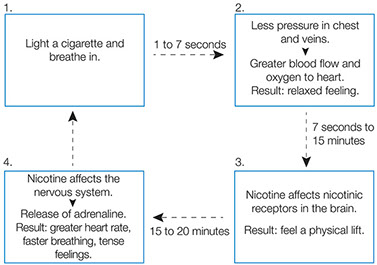
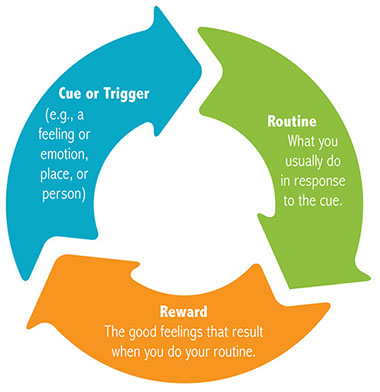
    The smoking cycle:

    Avoiding tobacco/nicotine and using smokeless inhalation can help you break the cycle.

    © American Institute for Preventive Medicine

  • Separate Tobacco/Nicotine From Situations

    Healthylife® QuitWell™

    Part 2

    Image of couple walking.

    Many times you may feel that you want to smoke, dip, or vape when what you really want is something else. When uncomfortable feelings arise, such as anger, sadness, boredom, or frustration, you may reach for a cigarette (or can or vape pen) without even pausing. You have worn a deep groove in your mind, creating a habit that can happen without much thought.

    Chart showing how to separate nicotine from situations.

    Tobacco/nicotine does not clear up or change these feelings. If nothing else, it simply creates a “smoke screen.” When the smoke clears, your problems are still there. The next time you get an urge, ask yourself, “What do I really want?” or “What do I need to figure out?” Use the mindfulness tools to help you think logically.

    © American Institute for Preventive Medicine

  • Secondhand Smoke

    Healthylife® QuitWell™

    Part 1

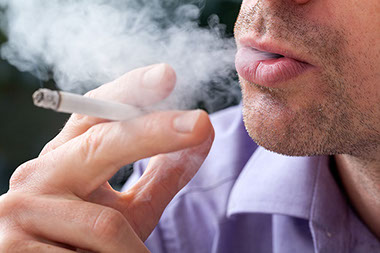
    Image of cigarette and smoke.

    Secondhand smoke is the smoke that occurs when a cigarette, pipe, or cigar is lit. The secondhand smoke going into the room from the end of a burning cigarette is not filtered. People breathing in secondhand smoke are breathing in this smoke, as well as what the smoker blows into the room. Secondhand smoke puts non-smoking bystanders (maybe your loved ones) at risk for the same health problems as the smoker.

    Some of the toxins found in secondhand smoke are tar, nicotine, carbon monoxide, carbon dioxide, methane, nitrogen dioxide, cadmium, benzpyrene, ammonia, hydrogen cyanide, acetone, pyridine, and formaldehyde. Although secondhand smoke becomes mixed with the air, there are safety risks for both the smoker and non-smokers, as well as pets who breathe these vapors in.

    Infants & Children

    Children of smokers are at a higher risk for respiratory infections, tonsillitis, pharyngitis, and middle ear infections. Asthma can become more severe. Children of smokers are also much more likely to start smoking.

    Pets

    Your beloved fur ball can develop serious health problems, including nose and lung cancers, from secondhand smoke. Secondhand smoke can also cause respiratory illness in cats and dogs and make skin conditions worse. Thirdhand smoke, or the smoke residue that settles on surfaces, can be especially damaging to cats. When cats lick their fur to clean themselves, they lick the toxins from smoke. This makes cats more than twice as likely to develop malignant lymphoma, a type of cancer.

    Protect Your Loved Ones

    To protect others from secondhand smoke, avoid smoking in enclosed spaces that you share with others, like your house or car. If you are going to smoke, go outside and make sure windows are closed to the house near the area you are smoking. Avoid using a “smoking room” in the house or smoking in an attached garage-smoke will still get into the rest of the house.
    © American Institute for Preventive Medicine

  • Tobacco Scorecard & Action Planning

    Healthylife® QuitWell™

    Part 6

    Person writing in notebook.

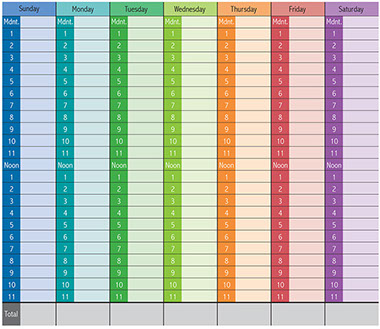
    You can make copies of this page to use. Place a slash in the box which indicated the time you used tobacco or nicotine.

    Action Planning

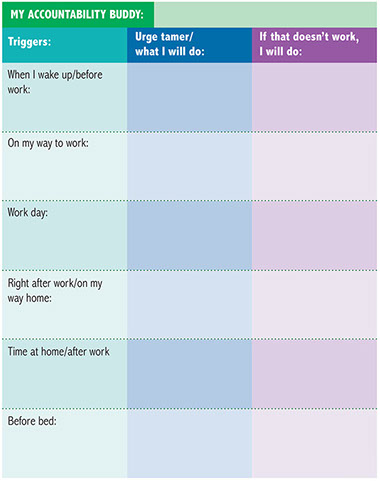
    Remember, an “okay” plan today beats a “great” plan tomorrow. Use this template to write out your quit plan. By this point, you probably know most of your expected triggers during the day. Write both your planned urge tamer/response to the trigger and another idea, in case you need it.

    Chart of Action Planning.

    © American Institute for Preventive Medicine

  • Relaxation Techniques

    Healthylife® QuitWell™

    Part 4

    A couple resting on sofa with their dog.

    We will teach you four skills to relax:

    *Relaxation Reflex:Getting rid of muscle tension.

    *Mental Imagery:Thinking of calm, restful places.

    *Deep Natural Breathing:Feeling relaxed by breathing in more oxygen.

    *Spend Time with Animals:Feeling relaxed, happy and secure.

    These relaxation strategies are not designed to take your stress away. Done correctly, they will help you calm your body and mind so that you can think more logically, see major problems as manageable challenges, and get through a tough day.

    If something helps you-even a little-add it to your quitting tool kit. Remember, you will probably need a lot of strategies to be successful in the long run. One strategy may work on Monday morning, but you’ll need another tool on Friday afternoon!

    © American Institute for Preventive Medicine