Blog

  • The Skinny Ontransfat

    HEALTHY EATING

    Image of pencil erasing the words "Trans Fats".

    Saturated or unsaturated? Mono or poly? Good or bad?

    The FDA has taken action to phase out the remaining trans fat in the nation’s food supply.

    Unlike mono and poly unsaturated fats, which are liquid at room temperature, or saturated fats, which occur naturally in animal products such as butter and meat, trans fat is manmade by adding a hydrogen atom to oil and changing its molecular structure.

    Crisco may have been the original product for trans fat-a cheap way to add fat to foods and make them shelf-stable. Now, it can be found in everything from donuts to prepackaged cookie dough to boxed macaroni and cheese to microwave popcorn.

    “If it’s easy to make and it’s a convenience food, it may have some trans fat in it,” according to experts at Penn State Hershey Medical Center.

    Research has shown that trans fat increases bad cholesterol (LDL) levels and lowers levels of the good cholesterol (HDL) in the body. That can lead to a number of problems, such as hardening of the arteries, heart attack, heart disease, and stroke.

    The FDA’s action will remove trans fat from a category of foods known as “Generally Recognized As Safe” and place it in the category of food additive, which could open manufacturers up to liabilities if they don’t find an alternative.

    © American Institute for Preventive Medicine
  • The Scoop On Shoveling

    WELL-BEING

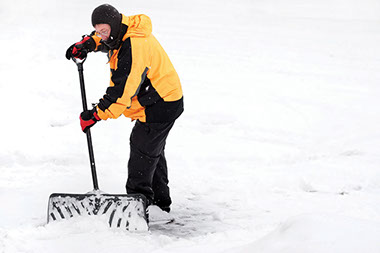
    Image of man shoveling snow.

    Push the snow, dress in layers, and warm up first are sensible rules for shoveling snow. Here are some guidelines you may not know:

    *  Avoid caffeine or nicotine before shoveling, especially if you have a history of or are at high risk for a heart attack. These stimulants may increase your heart rate and cause your blood vessels to constrict, which places extra stress on the heart. If you have a heart condition, respiratory issues, or back problems, check with your doctor before doing any shoveling.

    *  Drink plenty of water to avoid dehydration.

    *  Try to shovel fresh snow, before it becomes packed or refrozen. It may be helpful to shovel a few times during a snowfall rather than waiting until the storm ends when the snow is deeper and heavier.

    *  Switch hands periodically and alternate the side to which you are throwing snow to more evenly distribute the work load and repetitive muscle use.

    *  Use a sturdy snow shovel that has open ends to allow you to easily toss the snow off to the side.

    *  Pace yourself. Be sure to take frequent breaks to rest and avoid overexertion. Exhaustion can make you more susceptible to injury, hypothermia, and frostbite.

    Most important:

    If you begin to experience any pain in your chest, arm or neck, shortness of breath or profuse sweating, stop shoveling immediately and seek emergency medical attention.

    [Source: Kessler Institute]

    © American Institute for Preventive Medicine

  • The Salty 6: Hidden Sources Of Salt

    HEALTHY EATING

    Image of a bowl of soup.

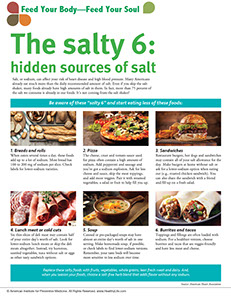
    Salt, or sodium, can affect your risk of heart disease and high blood pressure. Many Americans already eat much more than the daily recommended amount of salt. Even if you skip the salt shaker, many foods already have high amounts of salt in them. In fact, more than 75 percent of the salt we consume is already in our foods. It’s not coming from the salt shaker! Be aware of these “salty 6” and start eating less of these foods:

    1. Breads and rolls

    When eaten several times a day, these foods add up to a lot of sodium. Most bread has 100 to 200 mg of sodium per slice. Check labels for lower-sodium varieties.

    2. Pizza

    The cheese, crust and tomato sauce used for pizza often contain a high amount of sodium. Add pepperoni and sausage and you’ve got a sodium explosion. Ask for less cheese and sauce, skip the meat toppings, and add more veggies. Pair it with steamed vegetables, a salad or fruit to help fill you up.

    3. Sandwiches

    Restaurant burgers, hot dogs and sandwiches may contain all of your salt allowance for the day. Make burgers at home without salt or ask for a lower-sodium option when eating out (e.g., roasted chicken sandwich). You can also share the sandwich with a friend and fill up on a fresh salad.

    4. Lunch meat or cold cuts

    Six thin slices of deli meat may contain half of your entire day’s worth of salt. Look for lower-sodium lunch meats or skip the deli meats altogether. Instead, try hummus, sautéed vegetables, tuna without salt or eggs as other tasty sandwich options.

    5. Soup

    Canned or pre-packaged soups may have almost an entire day’s worth of salt in one serving. Make homemade soup, if possible, or check labels to find lower-sodium versions. Remember, your taste buds will become more sensitive to less sodium over time.

    6. Burritos and tacos

    Toppings and fillings are often loaded with sodium. For a healthier version, choose burritos and tacos that are veggie-friendly and have less meat and cheese.

    Replace these salty foods with fruits, vegetables, whole grains, lean fresh meat and dairy. And, when you season your foods, choose a salt-free herb blend that adds flavor without any sodium.

    Source: American Heart Association

    © American Institute for Preventive Medicine

  • The Rise Of Food Allergies

    HEALTHY EATING

    Image of an older Asian couple stretching.

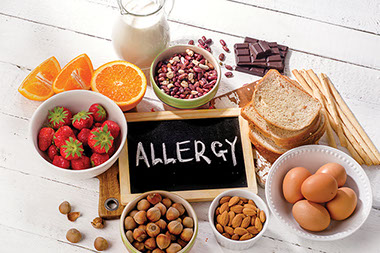
    The body’s immune system is designed to fight off unwanted invaders, such as viruses, bacteria and fungi. But when the immune system reacts to something that isn’t usually harmful, such as pollen, dust, or certain foods, it’s considered an allergy.

    The Centers for Disease Control and Prevention (CDC) says 5 out of every 100 children in the U.S. have a food allergy today. About 4 percent of all adults also have food allergies.

    While some reactions may be mild, such as hives or tingling, other food allergies can cause a life-threatening allergic reaction known as anaphylaxis.

    Increase in allergies – and questions

    The Centers for Disease Control and Prevention reports that food allergies increased 18 percent among children from 1997 to 2007.

    Researchers are still trying to find out why food allergies continue to increase. However, they do know a few key facts about food allergies:

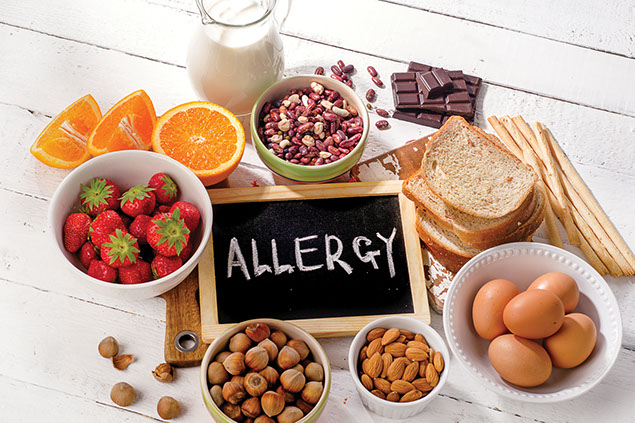
    *  Up to 90 percent of all food allergies involve eggs, dairy, peanuts, tree nuts, fish, shellfish, wheat and soy.

    *  Food allergies can occur at any age, not just during childhood. Even if you’ve eaten a food before without problems, you can become allergic to it later.

    *  If you have a parent with allergies, asthma, or eczema, you are more likely to have food allergies.

    *  Kids with food allergies are up to 4 times more likely to have asthma and other allergies, such as hay fever.

    *  Allergies to fish, shellfish, peanuts, and tree nuts tend to last a person’s entire life. Dairy, egg, and soy allergies are sometimes outgrown.

    *  There is no cure for allergies: the allergic food must be avoided.

    A recent analysis in the Journal of the American Medical Association shows that introducing some allergenic foods to a baby earlier in life could lower the risk of food allergies. Talk to your pediatrician before giving your child new foods, especially if allergies run in the family.

    Severe allergic reactions: WHAT TO DO

    Anaphylaxis is a severe allergic reaction that can be deadly. Symptoms include facial or lip swelling, paleness, weakness, difficulty breathing, vomiting and fainting. If someone is having anaphylaxis, it’s important to:

    *  Ask if the person has epinephrine (EpiPen or another injector) and see if they need help injecting it. It is usually injected into a person’s thigh. This should be done quickly.

    *  Call 911 immediately.

    *  Even if the person starts to feel better, he or she should still go to the hospital and seek medical care. The epinephrine delays the reaction, but the allergy must still be treated by a doctor right away.

    © American Institute for Preventive Medicine
  • The Right Work Posture For You

    WORK LIFE

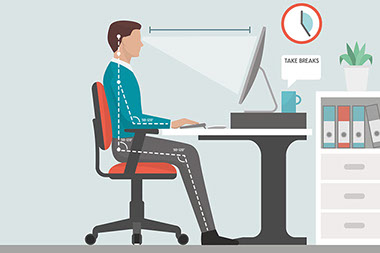
    Illustration of correct posture while sitting at a desk.

    Many people sit at a computer as part of their daily job. If a chair, desk or workstation isn’t working for you, it can cause sore muscles and joints and even an injury. To stay safe and healthy at the computer, follow these ergonomics guidelines.

    Remember to get up and move whenever possible! A walk during your lunch break, taking the stairs or doing stretches at your desk can help you feel energized and burn a few extra calories. Look for ways to get your body moving, even if it’s only for five to 10 minutes. A little exercise is better than none at all.

    Monitor:Monitor should be at eye level or slightly below. Monitor to eye distance:  20 to 40 inches

    Arms:Armrests should allow shoulders to relax. Elbows should be close to the body. Minimal bend at the wrist.

    Chair:Backrest should conform to the spine. Chair should have lumbar (lower back) support.

    Legs:Thighs parallel to the floor.

    Feet:Feet should be flat on the floor. Use a footrest if needed.

    Take breaks:Every 20-25 minutes

    Source: Occupational Safety and Health Administration

    © American Institute for Preventive Medicine
  • The One Question Parents Need To Ask

    FAMILY LIFE

    Image of gun and bullets.

    Before you let your child play at another person’s house, you may ask some safety questions. For instance, you’ll probably want to know if adults are there, when they will be home, and what they will be doing.

    There’s another question that may be harder to ask, but your child’s life may depend on it: “Is there an unlocked gun in your house?”

    The American Academy of Pediatrics says half of all U.S. homes contain firearms. More than a third of all accidental shootings of children happen in the homes of friends, neighbors or relatives.

    Follow these gun safety tips to help keep loved ones safe:

    *  Never keep a loaded gun in the house or in a car.

    *  Keep guns locked up and unloaded. Lock ammunition up in a separate location. Be sure your kids can’t get the keys.

    *  Put trigger locks on all guns.

    *  Know how to operate a gun before you load it.

    *  Don’t point a gun at another person.

    *  Unload the gun before setting it down.

    © American Institute for Preventive Medicine

  • The Oldest-Old Americans- A Growing Group

    WELL-BEING

    Image of doctor and patient.

    Is 90 the new 85? In 1980, there were 720,000 people aged 90 and older in the United States. In 2010, there were 1.9 million people aged 90 and older. By 2050, the ranks of people 90 and older may reach 9 million, according to a report from the U.S. Census Bureau, commissioned by the National Institute on Aging.

    An average person who has lived to 90 years of age has a life expectancy today of 4.6 more years (versus 3.2 years in 1929-1931), while those who pass the century mark are projected to live another 2.3 years.

    The majority of those 90 years and older reported having one or more limitations in physical function. Two-thirds had difficulty with activities such as walking or climbing stairs.

    Women aged 90 years and older outnumber men nearly 3 to 1.

    What does this mean for you? Will Grandma find a place to live with you? Will you even want to retire early if you’re healthy and intending to live another third of your life? Have you saved for retirement and beyond? What can you do now to keep from having disabilities when you are older?

    © American Institute for Preventive Medicine
  • The Lowdown On High Blood Pressure

    MEDICAL NEWS

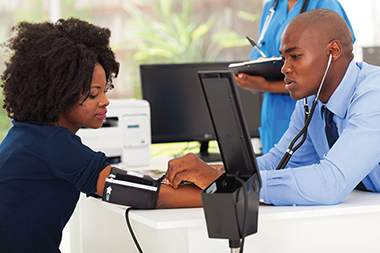
    Image of women having her blood pressure checked.

    Because 1 in 3 American adults suffers from high blood pressure, regular and accurate blood pressure checks are important for correctly diagnosing and treating hypertension (the medical term for high blood pressure).

    Dr. Robert Zelis, a cardiologist at Penn State Milton S. Hershey Medical Center, says there are three groups of people who may want to consider checking blood pressure on their own, in addition to having it measured at their annual physical exam.

    *  The first is those with so-called “white-coat hypertension.” These are patients who get so worked up about being in a doctor’s office that their readings will always be high there.

    *  The second is those who already take medication to control their blood pressure and need to monitor how it’s working.

    *  The third is those who suffer from chronic conditions such as diabetes or high cholesterol or who have risk factors such as obesity, smoking, or a strong family history of hypertension.

    Whether a blood pressure check is done at the doctor’s office or at home, it’s important to follow the same procedure:

    *  Make sure the blood pressure cuff is large enough and easy to use.

    *  Sit in a chair with a straight back, with both feet flat on the floor. Your legs should not be crossed.

    *  Make sure your arm is supported on something such as a table or armrest.

    *  Don’t take a measurement with the cuff placed on top of clothing. Bare skin is best.

    *  Wait 30 seconds after sitting down before you take your measurement.

    *  Take a second reading 30 seconds after you have finished the first to confirm your initial results.

    *  Take the measurements at the same time of day.

    *  Record your results to spot patterns.

    © American Institute for Preventive Medicine
  • The Link Betweenstress & High Blood Pressure

    SUCCESS OVER STRESS

    Image of business man thinking.

    It’s a common belief that stress causes high blood pressure. Have you ever heard someone say, “My blood pressure went through the roof!” when referring to a stressful event? Indeed, stress can cause a temporary spike in your blood pressure. You may notice symptoms like a pounding heart or sweaty palms as stress hormones flood your system.

    But, the American Heart Association says these effects are only temporary. Fortunately, stress has not been shown to raise your blood pressure permanently. But, this doesn’t mean you should ignore high stress levels. Chronic stress isn’t good for you emotionally, and may be linked to a higher risk for heart disease, obesity, depression and other health conditions.

    Although more research needs to be done on this topic, experts know that the “fight or flight” response we feel when we are faced with stress does have an effect on our bodies. It’s normal to deal with this once in a while, but when it happens often, it can take a toll on you physically and emotionally. In addition, many people turn to unhealthy habits, such as smoking, drinking or overeating to help cope with stress.

    If you’re dealing with high stress levels from work, personal matters, or other issues, don’t try to tough it out. Talk with your doctor or a mental health care provider about ways you can get the help and support you need.

    © American Institute for Preventive Medicine

  • The Line On Fallen Power Lines

    WELL-BEING

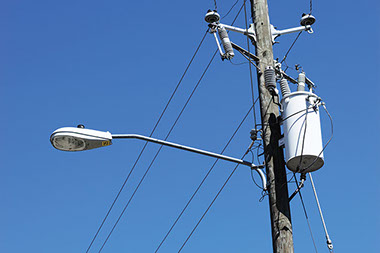
    Image of a telephone poll and power lines.

    High winds and storms can cause power lines to fall. Be alert and always assume all fallen lines are energized, says MidAmerican Energy. Stay away from anything that is touching the line, such as a tree, fence, or vehicle.

    *  Do not touch someone who is being shocked by a fallen power line.

    *  Report the downed line to 911.

    *  Shuffle, don’t run, from a fallen line. Shuffle with your feet together and on the ground. Warn others not to run. When a live wire touches the ground, electricity travels through the ground in all directions. If you run or take large steps, you increase the chance you could be shocked.

    *  Stay safe inside your car if a line comes down on or near your vehicle. Don’t touch metal parts of the car such as the radio. Wait until electrical workers turn off the power and tell you it’s safe to leave the vehicle.

    © American Institute for Preventive Medicine