Blog

  • Set Yourself Up For Success

    Healthylife® Weigh

    Part 5

    Man running along hiking trail.

    Create a consistent routine for yourself. Reduce the number of excuses you can make. Tips for creating an exercise habit:

    *Seize your moment.Be aware of when your motivation to exercise is high. You may prefer mornings over evenings. Or, the opposite. Plan to exercise when you are more likely to be physically and mentally on board with it.

    *Get ready ahead of time.Pack a bag with clothes, shoes, deodorant, hair ties, a water bottle, a small towel, and other supplies you’ll need. When exercise comes up on your calendar, all you have to do is grab the bag.

    *Get ready for round 2 ahead of time.Have several days’ worth of workout clothes clean and ready to go. Store workout clothes together so it is easy to re-fill your gym bag. Make it easier to repeat your habit.

    *Commit to repeating your routine.Join a recreational sports team, sign up for a class, or pay for a personal training package. Even if you are not feeling up to it one day, having it on the schedule may get you there.

    *Be accountable to someone.Commit to meeting a friend for exercise at a certain time. Get a workout buddy and swap shoes. If you don’t show up, they won’t be able to work out either! Or, commit to logging your workout on social media or with a friend.

    *Be patient.It may take time to find an activity you like. It may take even longer to feel like it is a normal part of your day to exercise. Keep going. You’ll get there!
    © American Institute for Preventive Medicine
  • Set Goals

    Healthylife® Weigh

    Part 3

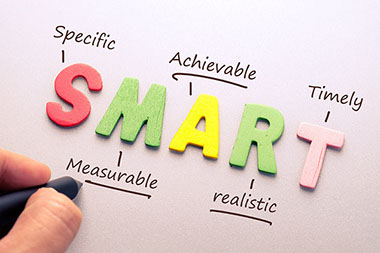
    The word Smart spelled out with wood lettering and hand writing definition for setting a smart goal.

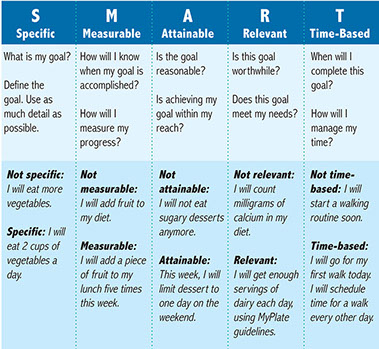
    Think of the actions you take on a daily basis as small steps toward your bigger goal. This guide has already given you many ideas for small steps, such as making half of your plate fruits and vegetables and choosing fewer sugar-sweetened drinks. Identify your next step and use the S.M.A.R.T. tool to improve the chances of reaching your goal.

    Stay motivated with the small successes you achieve along the way. Use yourEating & Exercise Tracker™every day for feedback on the effect your actions have on your energy level, mood, and weight.

    S.M.A.R.T. chart.

    © American Institute for Preventive Medicine
  • Set Fitness Goals

    Healthylife® Weigh

    Part 5

    Active women with armband to hold smartphone.

    Set your own fitness goals. Other people may have suggestions, but choose a goal that you want to go after. Other people’s fitness goals should not interfere with one you set for yourself.

    *  Write down your goals. This gives them more importance.

    *  Your goals should be within reach, but challenging. Make sure your goals are S.M.A.R.T. Does your goal meet the criteria?

    *  Know why you are setting each goal. For example, you may be doing this exercise for stress relief or to try something new. Or, you are meeting a friend and want to help them stick to their goal.

    *  Review and adjust your goals as needed. It takes practice to know how to set reasonable but challenging goals for yourself.

    *  Track your progress and reward yourself for successes.

    © American Institute for Preventive Medicine
  • Set A Weight Loss Goal

    Healthylife® Weigh

    Part 1

    Reflection of patient's face in the mirror and dietician measuring her body circuit.

    Long-term weight loss goal

    For my height, a weight of _______ lbs. would put me within a healthy BMI range. After subtracting this weight from my current weight, I know I need to lose _______ lbs. (SeeBMI chartfor an estimate of your healthy weight range.)

    Short-term weight loss goal

    My current weight (_______) x 0.10 (10%) = _______

    To lose 10% of my current weight, I would need to lose _______ lbs.

    A gradual weight loss of 1 to 2 pounds a week may be healthy. However, weight loss does not occur at a constant rate. Losing weight too quickly can be stressful for your system and can make it easier to re-gain lost weight. Also, losing weight very quickly, as well as repeated bouts of losing and gaining weight, increases the risks of gallstones.

    When should I weigh myself?

    There is no perfect answer. In general, you should weigh yourself without clothes at the same time of day (e.g., in the morning when you first wake up). Weigh yourself once a week to get a good idea about what direction your weight is going.

    You can also assess how your clothes fit, especially structured clothes like jeans or suit jackets. Even when overall weight is unchanged, your body composition may have improved. Lean body mass, especially muscle, takes up less space than fat tissue. Building lean body mass and reducing fat mass is important to overall health and will help you manage your weight over time.

    © American Institute for Preventive Medicine

  • Self-Discovery: Hunger

    Healthylife® Weigh

    Part 6

    Smiling women with an apple.

    *  List the last meal or snack you ate. Write down everything you ate or drank.

    *  Was this a planned meal or snack? If no, what triggered you to have this meal or snack?

    *  How many hours had it been since you last ate?

    *  Did your meal or snack satisfy your hunger?

    *  Do you think this was physical or emotional hunger?

    *  List a situation that is an emotional eating trigger for you (e.g., boredom while watching TV or stress at work).

    © American Institute for Preventive Medicine

  • Seek Downtime Daily

    Healthylife® Weigh

    Part 6

    Women on park bench reading and drinking coffee.

    Downtime is idle time between activities. Examples are the moments you have waiting at a red light, the time spent riding in an elevator, or the extra time you have during a lunch break.

    Idle time allows your brain to rest, process, and store information (how you learn and form memories). If you’ve ever had a great idea come to you in the shower, you know how creative your mind is during this time. Appreciate downtime to reduce feelings of boredom.

    Often, multi-tasking or a feeling that you must always be doing something steals this time away. The resulting “addiction to activity” does not let your mind rest during the day. The result can be a feeling of being busy all the time. You may feel like you need “time to think.” If you go all day without downtime, it can be harder to quiet your mind at night and go to sleep.

    Practice letting your mind rest every day. If you are used to filling   your time with multiple tasks at once, the following exercise may be  eye-opening!

    Try This: Sit in a room or outside for 15 minutes and do nothing. Don’t look at your phone or seek any other distractions. Let thoughts enter your mind.

    Reflect: How did you feel at the end of 15 minutes?

    Ways to Include Downtime Daily

    *  Turn off notifications on your phone. Set aside time for social media during the day-and avoid it at other times.

    *  Listen to music instead of the news or talk radio while driving. Or, sit in silence and let your mind wander.

    *  Set an alarm on your phone to remind you to take at least five minutes of “blank space” time during your day.

    © American Institute for Preventive Medicine
  • Scramble Your Daily Behaviors

    Healthylife® Weigh

    Part 4

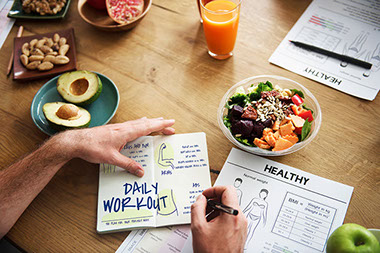
    Person writing in fitness notebook with healthy snacks on table.

    Changing how you go about your day can help get rid of eating cues and prepare you to establish new, healthy habits. Examples:

    *  Change the order of morning events: get up, shower, brush hair, eat breakfast, brush teeth, read paper, walk dog.

    *  Change the order of work events: take off coat, talk with co-workers, organize desk, review appointments or assignments, open email,  make calls.

    *  Alter driving routine: wear gloves, turn on/off radio, raise/lower volume, try listening to a new station, open/close windows, take a new route to work.

    *  Develop new telephone behavior. Stand instead of sit, hold phone with your opposite hand to your opposite ear, talk in a different room, walk as you talk.

    Be realistic.Allow time to establish a new habit. Some new habits are picked up quickly. Others may take several weeks or months of practice.

    Be consistent.Practice your new behaviors every day. This is how your new behavior will become a reliable habit.

    © American Institute for Preventive Medicine

  • Say Nice Things To Yourself

    Healthylife® Weigh

    Part 4

    Woman holding red heart shape.

    These nice things are called affirmations. What you say to yourself is powerful. You may not strongly believe it at first, but keep going.

    1. State your affirmation in the present tense.

    2. Say what you want, rather than what you don’t want.

    3. Include feeling words that add positive emotion.

    4. Be specific about what you want, rather than being vague.

    5. Make the words simple and easy to remember.

    Here are a few ideas.

    *  I am special and unique.

    *  I am proud to be me.

    *  I take care of my body.

    *  I trust myself.

    *  I am thankful for my life.

    *  I love to play and have fun.

    *  I am a good friend.

    *  I love to learn.

    *  I am courageous.

    *  I am lovable.

    *  I am gentle and strong.

    *  I am learning from this experience.

    *  I choose to respect myself.

    *  I choose to be in control.

    *  I am in control of many things, but not all things.

    Start today.Choose one or two affirmations. Write this statement on a sticky note and put it where you will see it, like the bathroom mirror or on your computer monitor. Say it out loud or repeat it silently to yourself.

    The Poisoned Parrot

    Imagine you have a parrot. This parrot repeats everything you say about yourself, over and over again. It comments on your life, especially the things that go wrong.

    For example, you come home with several bags of treats and soda. The parrot squawks, “There you go again. You’re never going to lose weight. You could have made a list, but you didn’t. You keep saying you’re going to change, but you aren’t. You’re never going to change your habits.”

    How do you feel? How long would you put up with this parrot? Don’t put up with a bully in your head. Notice this “parrot” and cover the cage.

    © American Institute for Preventive Medicine
  • Resistance Training

    Healthylife® Weigh

    Part 5

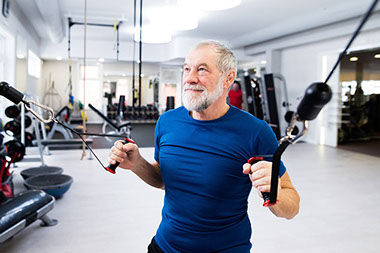
    Fit senior man in gym working out with weights.

    Make resistance training part of your exercise routine. Resistance training:

    *  Builds endurance. Your muscles can work longer before getting tired.

    *  Builds muscle. Muscle increases your resting metabolism. This means that even when your body is at rest, you are burning more fuel.

    *  Improves bone density. This helps prevent osteoporosis and fractures.

    *  Makes your body look more toned.

    *  Reduces the chance of injury while exercising.

    Tips for Resistance Training:

    *  Use free weights, a stretch band, or your body weight. Use the Dyna® Band and Exercise Guide if you received these with HealthyLife® Weigh.

    *  Follow guidelines on resistance machines for proper form. Ask a personal trainer to make sure you are doing exercises correctly.

    *  Work out with a friend. Have someone spot you.

    *  Warm up with 15 repetitions, using ½ to ¾ of your usual weight.

    *  Rest your muscles for a day in between workouts. If you want to work out every day, do the upper body one day; the lower body the next.

    *  Move slowly. Don’t jerk the weights up or drop them too fast.

    *  Breathe out when you are at the hardest part of the exercise. Breathe in when you return to the starting position. Don’t hold your breath.

    *  Work opposing muscles. For example, after you work the front of the arm (biceps), work the back of the arm (triceps).

    Examples of Resistance Training:

    Knee Push-Up: Rest on your knees and on the palms of your hands, about shoulder width apart. Push up. Keep your body straight from knees to shoulders. Push up and down slowly to the count of 4.

    Calf Raises: Stand with your feet about hip distance apart. Rise onto your toes. Hold for 1 count and lower. Try it on the edge of a step and let your heel drop below your toes for a wider range of motion.

    © American Institute for Preventive Medicine

  • Relieve The Pressure

    Healthylife® Weigh

    Part 6

    Multi-generation family enjoying christmas meal at home.

    Avoiding all holiday food challenges is nearly impossible. Adjust your goals and your action plan for success during this time. Your goal may be to “maintain, don’t gain” during a holiday season.

    Celebration days throughout the year are likely a small fraction of your overall year. Of course, stretching celebration days into weeks and months as a “holiday season” can pose challenges to your healthy goals. Even during traditional “holiday seasons,” stick with your healthy habits on nearly all days.

    Healthy Holiday Strategies:

    *  Have a healthy snack (fiber-rich carbohydrate + protein & a healthy fat) before going to the event.

    *  Keep a drink in your hand (choose water most of the time) and sip throughout the event.

    *  Avoid tables with appetizers and food. Talk with others away from where snacks are served.

    *  Prioritize exercise. This will help you manage stress and keep your metabolism running hot.

    *  Focus on people, not food. Visit friends and relatives. Take non-food gifts, such as flowers.

    *  Modify meals to include less sugar, saturated fat, and sodium.

    *  Create new traditions that are not planned around food. Do volunteer work or plan a hike/outdoor adventure with friends and family.

    *  Use stress management tools in this guide.

    *  Get enough quality sleep.

    © American Institute for Preventive Medicine