Blog

  • Thyroid Problems

    General Health Conditions

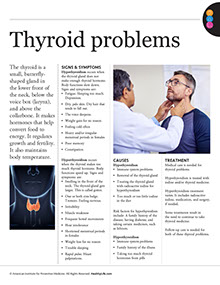
    The thyroid is a small, butterfly-shaped gland in the lower front of the neck, below the voice box (larynx), and above the collarbone. It makes hormones that help convert food to energy. It regulates growth and fertility. It also maintains body temperature.

    Signs & Symptoms

    Hypothyroidism occurs when the thyroid gland does not make enough thyroid hormone. Body functions slow down. Signs and symptoms are:

    *  Fatigue. Sleeping too much.

    *  Depression.

    *  Dry, pale skin. Dry hair that tends to fall out.

    *  The voice deepens.

    *  Weight gain for no reason.

    *  Feeling cold often.

    *  Heavy and/or irregular menstrual periods in females.

    *  Poor memory.

    *  Constipation.

    Hyperthyroidism occurs when the thyroid makes too much thyroid hormone. Body functions speed up. Two common forms are Graves’ disease and multinodular goiter. Signs and symptoms are:

    *  Swelling in the front of the neck. The thyroid gland gets larger. This is called goiter.

    *  One or both eyes bulge. Tremors. Feeling nervous.

    *  Mood swings.

    *  Weakness.

    *  Frequent bowel movements.

    *  Heat intolerance.

    *  Shortened menstrual periods in females.

    *  Weight loss for no reason.

    *  Fine hair or hair loss.

    *  Rapid pulse. Heart palpitations.

    {Note: In elderly persons, symptoms for this can be more like ones for hypothyroidism.}

    Causes

    For Hypothyroidism

    *  Immune system problems.

    *  Removal of the thyroid gland.

    *  Treating the thyroid gland with radioactive iodine for hyperthyroidism.

    *  Too much or too little iodine in the diet.

    Risk factors for hypothyroidism include: A family history of the disease; having diabetes; and taking certain medicines, such as lithium.

    For Hyperthyroidism

    *  Immune system problems.

    *  Family history of the illness.

    *  Taking too much thyroid hormones from pills.

    Treatment

    Medical care is needed for thyroid problems.

    Hypothyroidism is treated with iodine and/or thyroid medicine.

    Hyperthyroidism treatment varies. It includes radioactive iodine, medication, and surgery, if needed.

    Some treatments result in the need to continue to take thyroid medicine.

    Follow-up care is needed for both of these thyroid problems.

    Questions to Ask

    Self-Care / Prevention

    *  Take medication as directed.

    *  Tell your doctor if symptoms come back or still bother you.

    *  Follow your doctor’s advice for self-care measures.

    Neck Check

    To see if you have a lump on your thyroid gland or if it is enlarged, the American Association of Clinical Endocrinologists recommends this quick self-test:

    1.  Tilt your chin up slightly and swallow a glass of water in front of a mirror.

    2.  Look at your neck as you swallow.

    3.  Check for any bulges or protrusions between your Adam’s apple and collarbone. If you see any, contact your doctor.

    Resources

    American Thyroid Association
    www.thyroid.org

    Healthier at Home book by the American Institute for Preventive Medicine. www.HealthyLife.com. All rights reserved.

    © American Institute for Preventive Medicine

  • Thyroid Awareness

    Ear, Nose & Throat Conditions

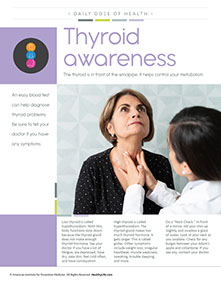
    Doctor examining women's neck.

    The thyroid is in front of the windpipe. It helps control your metabolism.

    An easy blood test can help diagnose thyroid problems. Be sure to tell your doctor if you have any symptoms.

    Low thyroid is called hypothyroidism. With this, body functions slow down because the thyroid gland does not make enough thyroid hormone. See your doctor if you have a lot of fatigue, are depressed, have dry, pale skin, feel cold often, and have constipation.

    High thyroid is called hyperthyroidism. The thyroid gland makes too much thyroid hormone. It gets larger. This is called goiter. Other symptoms include weight loss, irregular heartbeat, muscle weakness, sweating, trouble sleeping, and more.

    Do a “Neck Check:” In front of a mirror, tilt your chin up slightly and swallow a glass of water. Look at your neck as you swallow. Check for any bulges between your Adam’s apple and collarbone. If you see any, contact your doctor.

    Health at Home Lifetime book by the American Institute for Preventive Medicine. www.HealthyLife.com. All rights reserved.

    © American Institute for Preventive Medicine
  • Testicle Problems

    Men’s Health

    The testicles (also called testes) are two oval shaped organs that make and store sperm. They also make male sex hormones. The testicles are inside the scrotum. This sac of skin hangs under the penis. The scrotum can swell or be painful without a testicle problem. An example of this is an inguinal hernia.

    Problems that affect the testicles include: Injury, swelling and infection; torsion; undescended testicles; and cancer.

    Signs & Symptoms

    For Injury, Swelling, and/or Infection

    *  Pain and swelling in the scrotum.

    *  Feeling of heaviness in the scrotum.

    For Torsion of a Testicle

    *  Sudden and severe pain in the scrotum.

    *  Swelling. Most often, this occurs in one testicle.

    *  Fever.

    *  Abdominal pain. Nausea. Vomiting.

    For Undescended Testicles

    *  In baby boys, testicles do not descend into the scrotum from the abdomen before birth or within months of birth like they should.

    For Cancer of a Testicle

    In the early stages, there may be no symptoms. When symptoms occur, they include:

    *  A lump on a testicle, epididymis, or vas deferens.

    *  An enlarged testicle.

    *  A heavy feeling, pain or discomfort in the testicle or scrotum.

    *  A change in the way a testicle feels.

    *  A dull ache in the lower abdomen or groin.

    *  Enlarged or tender breasts.

    *  Sudden pooling of fluid in the scrotum.

    Causes

    For Injury, Swelling, and Infection

    *  Trauma to the testicles from being hit, kicked, struck, etc. Often, this occurs during sports. Though rare, trauma to the abdomen can cause the testicles to move outside the scrotum.

    *  Orchitis. With this, a testicle is inflamed. Often it is due to an infection, such as mumps or chlamydia. The epididymis can also be inflamed from an infection.

    For Torsion of a Testicle

    When the spermatic cord twists, a testicle rotates. This cuts off blood supply to and from the testicle.

    *  This usually occurs in males under age 30, most often between the ages of 12 and 18.

    *  Symptoms often occur after physical activity or during sleep.

    *  Symptoms may occur for no known reason.

    For Undescended Testicles

    Testicles fail to drop from inside the pelvic area down into the scrotum before birth or within a year of birth.

    For Cancer of a Testicle

    The cause is not known. Risk factors include:

    *  Undescended testicles that are not corrected in infants and young children. Parents should see that their infant boys are checked at birth for this problem.

    *  Having cancer of a testicle in the past.

    *  A family history of cancer of a testicle, especially in an identical twin.

    *  Injury to the scrotum.

    Treatment

    For Injury, Swelling, and/or Infection

    *  Pain from a minor injury to a testicle usually goes away on its own.

    *  Antibiotics treat bacterial infections. Untreated infections can cause infertility.

    For Torsion of a Testicle

    Emergency medical care is needed. The testicle may be untwisted by hand. If not, surgery is needed to restore blood flow to the testicle.

    For Undescended Testicles

    Surgery is done to bring the testicles down into the scrotum.

    For Cancer of a Testicle

    This kind of cancer is almost always curable if it is found and treated early. Surgery is done to remove the testicle. Other things can further treat the disease:

    *  Chemotherapy.

    *  Radiation therapy.

    *  If needed, lymph nodes are removed by surgery.

    Questions to Ask

    Self-Care / Prevention

    To Avoid Injury to the Scrotum

    *  Wear protective gear and clothing during exercise and sports.

    *  Wear an athletic cup to protect the testicles.

    To Help Prevent Infections

    *  See that your children get vaccines for measles, mumps, and rubella (MMR) as advised by their doctor.

    *  To help prevent STDs, follow “Safer Sex” guidelines.

    To Treat Infections

    *  Take medication as prescribed.

    *  Take an over-the-counter medicine for pain and swelling, if needed. Follow directions.

    *  Rest.

    *  Apply cold compresses or an ice pack to painful, swollen area.

    Testicular Self-Exam

    Talk to your doctor about doing testicular self-exams (TSEs). If you choose to do TSEs, follow your doctor’s advice.

    The best time to do a TSE is after a warm bath or shower. This relaxes the scrotum, allows the testicles to drop down, and makes it easier to find anything unusual. Doing a TSE is easy and takes only a few minutes.

    1.  Stand in front of a mirror. Look for any swelling on the skin of the scrotum.

    2.  Examine each testicle with both hands. Place your index and middle fingers underneath the testicle and your thumbs on top. Gently roll one testicle then the other between your thumbs and fingers. One testicle may be larger. This is normal. Examine each testicle for any lumps. These are usually painless and about the size of a pea.

    3.  Find the epididymis. This is the comma-shaped cord behind the testicle. It may be tender to the touch. Check it for lumps.

    4.  Examine the vas deferens. This is the tubelike structure at the back of each testicle. Check it for lumps.

    Resources

    National Cancer Institute

    800.4.CANCER (422.6237)

    www.cancer.gov

    Healthier at Home book by the American Institute for Preventive Medicine. www.HealthyLife.com. All rights reserved.

    © American Institute for Preventive Medicine
  • Put Your Tennis Elbow On Ice

    Bone & Muscle Problems

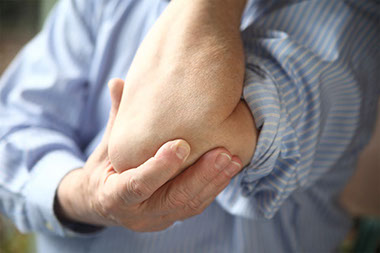
    Close up image of elbow.

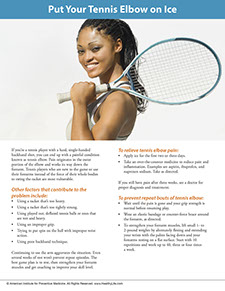
    If you’re a tennis player with a hard, single-handed backhand shot, you can end up with a painful condition known as tennis elbow. Pain originates in the outer portion of the elbow and works its way down the forearm. Tennis players who are new to the game or use their forearms instead of the force of their whole bodies to swing the racket are most vulnerable.

    Other factors that contribute to the problem include:

    *  Using a racket that’s too heavy.

    *  Using a racket that’s too tightly strung.

    *  Using played out, deflated tennis balls or ones that are wet and heavy.

    *  Using an improper grip.

    *  Trying to put spin on the ball with improper wrist action.

    *  Using poor backhand technique.

    Continuing to use the arm aggravates the situation. Even several weeks of rest won’t prevent repeat episodes. The best game plan is to rest, then strengthen your forearm muscles and get coaching to improve your skill level.

    To relieve tennis elbow pain:

    *  Apply ice for the first two or three days.

    *  Take an over-the-counter medicine to reduce pain and inflammation. Examples are aspirin, ibuprofen, and naproxen sodium. Take as directed.

    If you still have pain after three weeks, see a doctor for proper diagnosis and treatment.

    To prevent repeat bouts of tennis elbow:

    *  Wait until the pain is gone and your grip strength is normal before resuming play.

    *  Wear an elastic bandage or counter-force brace around the forearm,  as directed.

    *  To strengthen your forearm muscles, lift small 1- to 2-pound weights by alternately flexing and extending your wrists with the palms facing down and your forearms resting on a flat surface. Start with 10 repetitions and work up to 40, three or four times a week.

    A Year of Health Hints book by the American Institute for Preventive Medicine. www.HealthyLife.com. All rights reserved.

    © American Institute for Preventive Medicine
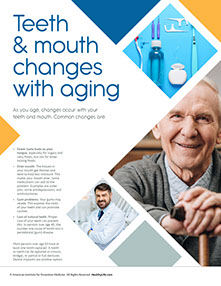
  • Teeth & Mouth Changes With Aging

    Dental & Mouth Concerns

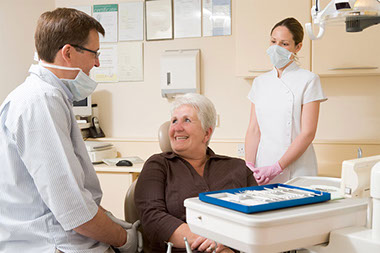
    Image of older women at the dentist office.

    As you age, changes occur with your teeth and mouth. Common changes are:

    *  Fewer taste buds on your tongue, especially for sugary and salty foods, but not for bitter tasting foods

    *  Drier mouth. The tissues in your mouth get thinner and tend to hold less moisture. This makes your mouth more dry. Some medications can add to the problem. Examples are water pills, some antidepressants, and antihistamines.

    *  Gum problems. Your gums may recede. This exposes the roots of your teeth and can promote cavities.

    *  Loss of natural teeth. Proper care of your teeth can prevent this. In persons over age 40, the number one cause of tooth loss is periodontal (gum) disease.

    More than half of persons over age 50 have at least one tooth replaced. A tooth or teeth can be replaced as crowns, bridges, partial or full dentures. Dental implants are another option.

    Health at Home Lifetime book by the American Institute for Preventive Medicine. www.HealthyLife.com. All rights reserved.

    © American Institute for Preventive Medicine
  • Take Everyday Steps To Add Years To Your Life

    General Health Conditions

    Couple jogging together.

    *  Choose mostly plant foods. Eat at least five servings of fruits and veggies a day. Choose ones of different colors. Eat a variety of whole grain foods, beans, and lentils.

    *  Limit red meat. Avoid meats with nitrates and nitrites and a lot of salt. Examples are ham, hot dogs, and smoked sausage.

    *  Be physically active for 30 or more minutes every day. You choose the way(s).

    *  Take medicines as prescribed. If needed, use pill containers or a daily checklist to remind you to do this.

    *  Wash your hands often.

    *  Brush your teeth twice a day. Floss every day.

    *  Get 7-9 hours of quality sleep.

    *  Stay connected to friends and family.

    *  Keep learning something new.

    *  Avoid or limit alcohol.

    – Men: Up to 2 drinks a day

    – Women and persons age 65 years and older: Up to 1 drink a day

    – One drink =

    4-5 ounces of wine

    1-1/2 ounces whiskey, gin, vodka

    12 ounces regular beer

    12 ounces wine cooler

    Health at Home Lifetime book by the American Institute for Preventive Medicine. www.HealthyLife.com. All rights reserved.

    © American Institute for Preventive Medicine
  • Take Control Of Your Health

    General Health Conditions

    Man jogging with his dog.

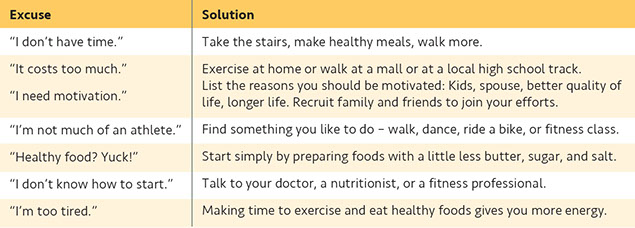
    It’s easy to complain, make excuses, list a million reasons why you can’t lose weight or get fit. Take control by changing the way you think about your health. Don’t let excuses hold you back.

    Action Step:Make a date with family members to walk after dinner – every night. Those left behind have to do the dishes.

    Health at Home Lifetime book by the American Institute for Preventive Medicine. www.HealthyLife.com. All rights reserved.

    © American Institute for Preventive Medicine
  • Take Control Of Your Blood Pressure

    General Health Conditions

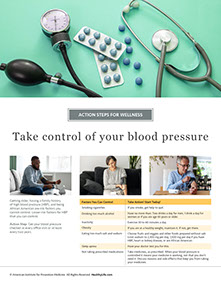
    Part of a blood pressure cuff and medications.

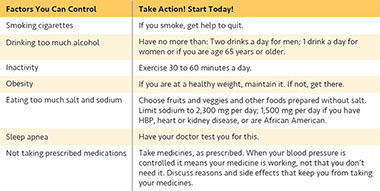
    Getting older, having a family history of high blood pressure (HBP), and being African American are risk factors you cannot control. Lower risk factors for HBP that you can control.

    Action Step:Get your blood pressure checked at every office visit or at least every two years.

    Health at Home Lifetime book by the American Institute for Preventive Medicine. www.HealthyLife.com. All rights reserved.

    © American Institute for Preventive Medicine

  • Take Care Of Your Health

    General Health Conditions

    Women riding bike in the fields.

    Taking care of your health is within your reach.

    *  Maintain good health habits for eating, physical activity, and sleeping.

    *  Manage stress.

    *  See your doctor or health care provider on a regular basis.

    *  Take medicines, as advised.

    *  Don’t use tobacco products. If you do, quit.

    *  Keep track of your health history.

    *  Get health information from reliable sources, such as your doctor and credible Web sites.

    Health at Home Lifetime book by the American Institute for Preventive Medicine. www.HealthyLife.com. All rights reserved.

    © American Institute for Preventive Medicine

  • Take A Good Look At Your Gums

    Dental & Mouth Concerns

    Image of man at the dentist office looking at xrays.

    Plaque buildup, crooked teeth, illness, poorly fitting dentures, trapped food particles, and certain medications can irritate or destroy your gums. With good oral hygiene, however, you can prevent gum (periodontal) disease. If caught in the early stages, gum disease is easily treated. If ignored, the gums and supporting tissues wither, and your teeth may loosen and fall out.

    Knowing the signs and symptoms of periodontal disease is important for early treatment. Pay attention to the following:

    *  Swollen red gums that bleed easily (a condition called gingivitis).

    *  Teeth that are exposed at the gum line (a sign that gums have pulled away from the teeth).

    *  Permanent teeth that are loose or separate from each other.

    *  Bad breath and a foul taste in the mouth.

    *  Pus around the gums and teeth.

    A Year of Health Hints book by the American Institute for Preventive Medicine. www.HealthyLife.com. All rights reserved.

    © American Institute for Preventive Medicine