Blog

  • A Simple Remedy For Prickly Heat

    Skin Conditions

    Image of women sitting in grass field on sunny summer day.

    Feeling hot and sticky is bad enough. A visible sign of discomfort only makes it worse. Such is the case with prickly heat (also known as heat rash), identified by clusters of small blisters that itch and appear where you perspire the heaviest – the armpits, neck, back, or creases in the elbows (but not the face).

    Hot, humid weather, sensitive skin, and excess weight all aggravate prickly heat. Here are some simple ways to find relief:

    *  Wear loose, lightweight clothing.

    *  Dust the affected area with cornstarch.

    *  Take cool baths to reduce itching.

    *  Avoid hot, humid environments and stay in air-conditioned places, if possible.

    The key to managing prickly heat is to avoid sweating by staying in a cool environment. The rash will disappear in a couple of days.

    A Year of Health Hints book by the American Institute for Preventive Medicine. www.HealthyLife.com. All rights reserved.

    © American Institute for Preventive Medicine

  • Preventing Cancer

    Cancer

    Nearly 1 in 4 deaths in the U.S. is due to cancer. In the U.S., the lifetime risk for developing cancer is:

    *  Slightly less than 1 in 2 for men

    *  A little more than 1 in 3 for women

    What is Cancer?

    *  Cancer is a broad group of diseases.

    *  All types of cancer begin when cells in a part of the body start to grow out of control and become abnormal.

    *  These extra cells may form a mass of tissue called a growth or tumor.

    *  The tumor destroys healthy tissue.

    *  If the tumor gets bigger, it can invade and grow into other tissues and organs.

    *  Cancer cells also can break away and spread through the lymphatic system or blood stream to other parts of the body. This is called metastasis.

    *  Tumors that are not cancer are called benign. They do not grow into other tissues. They cannot spread to other parts of the body. Benign tumors can cause problems, especially if they grow very large and press on healthy tissues and body organs, but they almost never threaten life.

    *  Untreated cancers can cause serious illness and even death.

    Warning Signs & Symptoms

    You can have cancer for years without having symptoms. There is usually no pain at the onset of cancer. As different types of cancers grow, warning signs may occur. See your doctor for a proper diagnosis.

    For Bladder Cancer

    *  Blood in urine

    *  Pale yellow-red colored urine to bright red urine

    *  Frequent urination or feeling the need to without being able to urinate

    *  Pain during urination

    For Breast Cancer

    *  Lump or firmness in your breast or under your arm

    *  A change in the size or shape of your breast

    *  A nonmilky discharge from the nipple. Sometimes this has blood.

    *  Inverted or tender nipple

    *  The skin on a breast, areola, or nipple may be scaly, red, or swollen.

    *  An area of the breast may retract or pucker.

    Discuss with your doctor the pros and cons of doing monthly breast self-exams and how to perform them. Ask, too, about your risk for breast cancer. You can also call 800.4.CANCER (422.6237) or accesswww.cancer.gov/bcrisktoolfor the Breast Cancer Risk Assessment Tool.

    Note: Men can get breast cancer, too, and should report a breast lump or other change to their doctors.

    For Colon and Rectal Cancers

    *  Rectal bleeding or red or dark blood in or on the stool. Very narrow stools.

    *  Change in bowel habits for 2 or more weeks or constipation or diarrhea for 1 week or longer

    *  Frequent gas pains, cramps, bloating, or feeling of fullness in the abdomen

    *  Feeling that your bowel does not empty completely

    *  Weight loss with no explanation

    For Kidney Cancer

    *  Blood in urine

    *  Lump or mass on the side or lower back

    *  Low back pain on one side (not due to an injury)

    *  Weight loss without trying

    *  Fever that doesn’t go away after a few weeks and that is not from an infection

    *  Feeling very tired

    *  Swelling of the ankles and legs

    For Lung Cancer

    *  Cough that gets worse or does not go away. Hoarse voice. Coughing up blood or rust-colored phlegm

    *  Shortness of breath. New onset of wheezing.

    *  Chest pain. Often, this worsens with taking deep breaths, coughing, or laughing.

    *  Bronchitis, pneumonia, and other lung infections occur often and keep coming back.

    *  Tiredness

    *  Unexplained weight loss

    For Ovarian Cancer

    These 4 symptoms last almost daily for longer than a few weeks:

    *  Bloating or swelling of the abdomen

    *  Pain in the upper abdomen or pelvic pressure

    *  Trouble eating or feeling full quickly

    *  Urgent need to urinate or urinating often

    For Prostate Cancer

    Early prostate cancer often does not cause symptoms. When symptoms occur, they may include:

    *  Problems urinating

    *  Blood in the urine or semen

    *  Pain in the lower back, hips, ribs, or upper thighs

    *  Trouble having or keeping an erection

    *  Weakness or numbness in the feet or legs

    For Testicular Cancer

    *  A lump on either testicle or surrounding area

    *  An enlarged testicle

    *  A feeling of heaviness in the scrotum

    *  A dull ache in the lower abdomen or groin

    *  Sudden build-up of fluid in the scrotum

    *  Pain or discomfort in a testicle or the scrotum

    *  Enlarged or tender breasts

    These symptoms could also be caused by other problems, such as infection or trauma of the scrotum or testicle from being hit or kicked. See your doctor if any of these symptoms lasts 2 weeks or longer. Males who are 15 and older should do a testicular self-exam if and as often as their doctors advise. Results are best after a warm bath or shower, which relaxes the scrotum, allowing the testicles to drop down for easier examination.

    For Throat Cancer

    *  A sore in the mouth that does not heal

    *  Numbness of the tongue or other mouth area

    *  Pain in the mouth or bad breath that persists. A sore throat or a feeling that something is caught in the throat. This doesn’t go away.

    *  A white or red patch on the gums, tongue, tonsil, or lining of the mouth

    *  Hoarseness or other changes in the voice

    *  Lump or mass in the neck or cheek or a feeling of a lump in the throat

    *  Pain in the front of the neck, sometimes going up to the ears

    *  Trouble chewing or swallowing or moving the jaw or tongue.

    *  A cough that doesn’t go away

    *  Pressure, fullness, or burning sensations as food goes down the throat

    *  Upset stomach, heartburn, vomiting, and choking on food

    *  Unexplained weight loss

    Basal and Squamous Cell Cancers

    *  Basal cell. More than 90% of all skin cancers in the U.S. are this type. It grows slowly. It seldom spreads to other parts of the body.

    *  Squamous cell. This type of skin cancer spreads more often than the basal cell type. It is still rare for it to spread, though.

    Basal and squamous cell cancers are found mainly on areas of the skin that are exposed to the sun, like the head, face, neck, hands, and arms. These skin cancers can occur anywhere, though.

    Early Warning Signs of Basal and Squamous Cell Cancers

    Small, smooth, shiny, pale, or waxy lump.

    Firm red lump.

    A lump that bleeds or develops a crust.

    A flat, red spot that is rough, dry, or scaly.

    Warning Signs of Melanoma

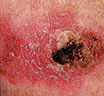
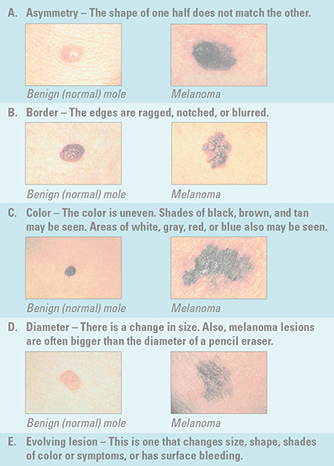
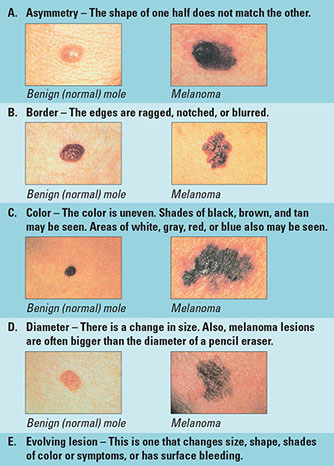
    This type of skin cancer can spread to other parts of the body and be fatal if not treated early. Often, the first sign is a change in the size, shape, or color of an existing mole. It also may appear as a new, abnormal, or “ugly looking” mole. Learn the ABCD and E’s that can help you detect it early.

    Skin Self-Exam

    *  Do an exam monthly, after a shower or bath. To check your skin, use:

    – A well-lit room

    – A full-length mirror

    – A hand-held mirror

    *  Locate your birthmarks, moles, and blemishes. Check for a change in the size, texture, or color of a mole. Check for a sore that does not heal.

    Check all areas.

    1.  Look at the front and back of your body in the mirror. Raise your arms and look at your left and right sides.

    2.  Bend your elbows and look carefully at the palms of your hands. Look at both sides of your forearms and upper arms.

    3.  Look at the back and front of your legs. Look between the buttocks and around the genital area.

    4.  Sit and closely examine your feet. Look at the soles and between the toes.

    5.  Look at your face, neck, and scalp. Use a comb to move your hair so you can see your scalp.

    See your doctor if you find anything unusual.

    Causes & Risk Factors

    With all cancers, genes that control cell growth and division malfunction. Damage to genes can occur from many factors.

    Factors that damage genes include:

    *  Tobacco use and exposure

    *  Exposure to ultraviolet (UV) rays from the sun and indoor tanning

    *  Exposure to cancer causing chemicals

    *  A person’s genetic makeup and immune status

    *  Use of certain medicines, such as DES (a synthetic estrogen)

    *  Certain viruses and bacteria:

    – Human papillomavirus (HPV). This causes most cervical cancers and some vaginal and vulvar cancers.

    – Hepatitis B virus (HBV). This raises the risk for liver cancer.

    – Human immunodeficiency virus (HIV). This raises the risk for some cancers, such as Kaposi sarcoma and non-Hodgkin lymphoma.

    – Helocobactor pylori (H. pylori) bacteria, the main cause of stomach ulcers, raises the risk for stomach cancer.

    Lower Your Risk

    There are many things you can do to prevent and lower your risk of getting cancer. Do them for yourself. Do them for your loved ones.

    *  Protect yourself from ultraviolet (UV) radiation. Limit time in the sun. Wear sunscreen, sunglasses, a hat, and clothing that protects your skin. And, don’t fake bake. Sun lamps and tanning booths also emit cancer-causing rays.

    *  Have X-rays only when necessary.

    *  Avoid asbestos, pesticides, herbicides, and other cancer-causing agents. Protect yourself from cancer-causing chemicals at work and elsewhere.

    *  Have your home tested and treated for radon, if found.

    *  Do regular physical activity. Control your weight.

    *  Eat healthy foods. Have 5-9 colorful fruits and vegetables per day. Opt for whole-grain breads and cereals. Limit red meat and foods high in fat.

    *  Limit alcohol -no more than two drinks per day for men; no more than one drink per day for women.

    *  Find ways to manage stress. Too much stress can weaken your immune system.

    *  Talk with your doctor about taking vitamins, herbal products, or other supplements.

    *  Follow your doctor’s advice to prevent, lower the risk, and treat virus and bacteria that can cause cancer.

    *  The obvious – avoid tobacco:

    – Don’t smoke it.

    – Don’t shove it between your lips and gums.

    – Don’t inhale it secondhand.

    – Avoid thirdhand smoke – tobacco toxins that linger in carpets, clothes, furniture, and other materials hours or even days after a cigarette is put out.

    Screening Tests & Treatments

    Screening tests help detect some types of cancer in early stages, when they are most treatable.

    Finding and removing precancerous tissue can prevent cancers of the cervix, colon, and rectum.

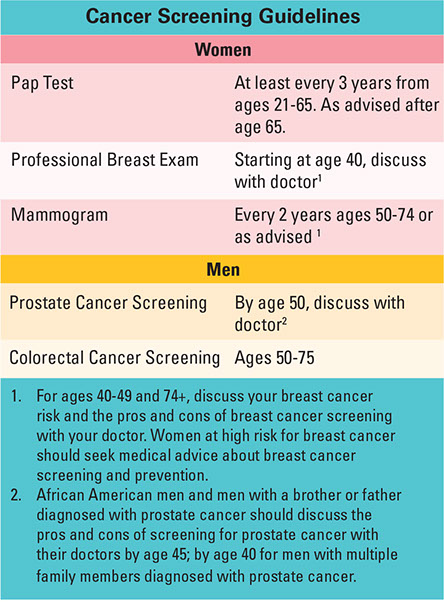
    Get screening tests, as listed below, or as advised by your doctor. If you are at a greater risk for one or more cancers, you may need screenings earlier or more often. You may need additional screenings. If a certain type of cancer is common in your family, consider asking your doctor about genetic testing. Also, check with your insurance plan to find out if and when screening tests are covered.

    Treatment

    Treatment depends on the type of cancer, the stage it is in, and individual factors. Cancer treatment includes:

    *  Surgery to remove the cancerous tumor(s) and clear any obstruction to vital passageways

    *  Radiation therapy

    *  Chemotherapy

    *  Biological therapy

    *  Targeted therapy, such as drugs, that affect only the cancer cells

    *  Stem cell or bone marrow transplant

    *  Clinical trials

    Resources

    American Cancer Society

    800.ACS.2345 (227.2345)

    www.cancer.org

    National Cancer Institute

    800.4.CANCER (422.6237)

    www.cancer.gov

    Clinical Trials

    www.clinicaltrials.gov

    Preventing Cancer brochure by the American Institute for Preventive Medicine. www.HealthyLife.com. All rights reserved.

    © American Institute for Preventive Medicine

  • Prevent Colorectal Cancer

    Cancer

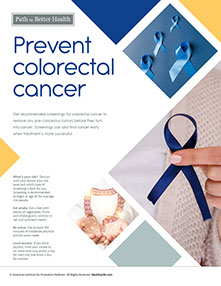
    Hand holding blue ribbon for colon cancer awareness.

    Get recommended screenings for colorectal cancer to remove any pre-cancerous tumors before they turn into cancer. Screenings can also find cancer early when treatment is more successful.

    What’s your risk?:Discuss with your doctor your risk level and which type of screening is best for you. Screening is recommended to begin at age 45 for average risk people.

    Eat wisely:Eat a diet with plenty of vegetables, fruits and whole grains, and low in red and luncheon meats.

    Be active:Get at least 150 minutes of moderate physical activity every week.

    Limit alcohol:If you drink alcohol, limit your intake to no more than two drinks a day for men and one drink a day for women.

    Health at Home Lifetime book by the American Institute for Preventive Medicine. www.HealthyLife.com. All rights reserved.

    © American Institute for Preventive Medicine

  • How To Prevent Bowel Problems

    Mature Health: Over Age 50

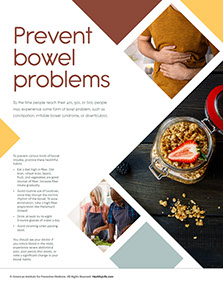
    Image of fiber rich grains and berries.

    By the time people reach their forties, fifties, or sixties, they will usually experience some form of bowel trouble such as diverticulosis, irritable bowel, and constipation.

    To prevent various kinds of bowel trouble, practice these healthful habits.

    *  Eat a diet high in fiber. (Oat bran, wheat bran, beans, fruit, and vegetables are good sources of fiber.)

    *  Avoid routine use of laxatives, since they disrupt the normal rhythm of the bowel. To ease elimination, take a high-fiber preparation like Metamucil instead.

    *  Drink at least six to eight 8-ounce glasses of water a day.

    *  Avoid straining when passing stool.

    You should see your doctor if you notice blood in the stool, experience severe abdominal pain, pass pencil-thin stools, or note a significant change in your bowel habits.

    A Year of Health Hints book by the American Institute for Preventive Medicine. www.HealthyLife.com. All rights reserved.

    © American Institute for Preventive Medicine

  • Prenatal Health Care Visits

    Pregnancy & Prenatal Care

    How Many Visits

    How often will you need to see your prenatal health care provider? That depends on:

    *  Your medical history and needs

    *  How your pregnancy is going

    *  The provider’s advice

    Call your health care provider when you think or know you are pregnant. Ask to be seen. A common schedule for prenatal visits is:

    *  A first visit.

    *  About once a month for the first six months

    *  Every 2 weeks for the 7th and 8th months

    *  Every week after that until the baby is born

    You and your provider will schedule the exact dates of all of your visits.

    The First Visit

    Facts about the first prenatal visit:

    *  It confirms whether or not you are pregnant.

    *  It gives you a “due date.” That’s the date your baby is likely to be born.

    *  It takes longer than the rest of the visits.

    *  It gives you and your health care provider a lot of information.

    At the first visit, your health care provider will probably:

    *  Do a urine test or a blood test to make sure that you are pregnant.

    *  Ask questions about your medical history and your family’s medical history.

    *  Talk about depression, physical abuse, and safety concerns.

    *  Do a complete physical exam to check:

    – Your height and weight. These are used to get your body mass index (BMI) number. This tells if your weight is okay or too high or too low.

    – Your blood pressure

    – Your heart and lungs

    – Your ears, nose, and throat

    – Your breasts

    – Your abdomen

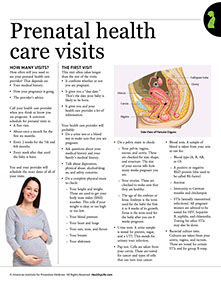
    *  Do a pelvic exam to check:

    – Your pelvis, vagina, uterus, and cervix. These are checked for size, shape, and structure. The size of your uterus tells how many weeks pregnant you are.

    – Your ovaries. These are checked to make sure that they are healthy.

    – The age of the embryo or fetus. Embryo is the term used for the baby the first 4 to 8 weeks of its growth. Fetus is the term used for the baby after you are 8 weeks pregnant.

    Do some other tests:

    * Blood tests. A sample of blood is taken from your arm to test for:

    – Blood type (A, B, AB, or O)

    – A positive or negative D blood type (this used to be called Rh factor)

    – Anemia

    – Immunity to German measles and chickenpox

    – STDs (sexually transmitted diseases). All pregnant women are advised to be tested for HIV, hepatitis B, syphilis, and chlamydia. Testing for other STDs may also be done.

    *  Bacterial culture tests:

    – Cell cultures are taken from your cervix, vagina, and rectum.

    – These are tested for certain STDs and for group B strep.

    *  Urine tests. A urine sample is tested for protein, sugar, and a UTI. This stands for urinary tract infection.

    *  Pap test. Cells are taken from your cervix. These are tested for cancer and types of cells that can turn into cancer.

    Rest of the Visits

    At later visits, you can expect your health care provider to:

    *  Weigh you.

    *  Feel your abdomen. This checks for the height of the uterus and the position of the baby.

    *  Take your blood pressure.

    *  Test your urine for protein and sugar.

    *  Test your blood for anemia.

    *  Give you a vaccine to help protect you from the flu. Your health care provider decides if vaccines are needed.

    *  Check for signs of swelling in your ankles, hands, face, and feet.

    *  Listen for your baby’s heartbeat (after the 10th week).

    *  Take a blood sample for a “quad marker screen.” This tests for four substances in the blood. High or low levels of the four substances can screen for certain birth defects. Other tests would need to be done to confirm a birth defect. Birth defects happen in only a very small number of babies, though. This test is done between weeks 15 and 20. You may be able to choose if you have this test or not.

    *  Ask you if you have started to feel your baby move.

    *  Test you for gestational diabetes. A test is done for this between weeks 24 and 28. It is done even when urine tests don’t show sugar. But it may be done earlier if a routine urine test shows sugar. It also may be done earlier if you are at high risk for diabetes.

    *  Do a second blood test from your arm.

    *  Test a second cell culture from your vagina and rectum (between weeks 35 and 37). This checks for group B strep. A cell culture test may also be done as early as week 32 if you have a lot of vaginal discharge or if you have a history of preterm labor. That’s when labor happens 3 or more weeks before your due date.

    What actually happens at each visit will depend on your needs at the time.

    Special Tests

    Ultrasound

    This test shows the baby’s position. It shows how the baby is growing. Your bladder should be full for this test. Here is what happens during an ultrasound:

    *  A gel is rubbed on your belly.

    *  A hand-held device is passed over your belly. It doesn’t hurt at all.

    *  The test usually lasts 5 to 10 minutes. It can take up to 45 minutes. This will depend on the baby’s position and movement.

    *  Sound waves and a TV-like screen give a picture, which you can see, of your baby.

    You may be given a video or printed copy of the picture. If so, ask your health care provider to explain it. The picture may show if your baby is a girl or boy. Would you rather keep the baby’s sex a surprise? If so, tell your provider before you have your ultrasound. That way, no one will let the secret slip. You see the picture only if it doesn’t show the baby’s sex.

    An ultrasound may be done to:

    *  Find an IUD that was in place at conception

    *  Tell the age of the fetus

    *  Show how the fetus is lying before amniocentesis and CVS tests.

    *  See if you are carrying more than one baby

    *  Diagnose some birth defects (if done around 19 weeks by a doctor certified in OB ultrasound)

    *  Identify the source of any problems

    Ultrasound is thought to be safe for both mother and baby. It is usually done between weeks 18 and 20 of the pregnancy. It may be done between weeks 10 and 14 if the baby is at high risk for Down’s syndrome.

    Amniocentesis

    Amniocentesis. This is a test for certain birth defects. It can also show how mature the fetus’s lungs are. The test takes about an hour. It is usually done between weeks 15 and 20. It can, though, be done at any time up to delivery, if needed. Here is what happens during amniocentesis:

    *  An ultrasound test locates the fetus and placenta.

    *  A needle is put into the uterus. The needle enters through the wall of the mother’s abdomen.

    *  The doctor uses ultrasound to guide the needle. The needle is put in an area away from the developing baby.

    *  Only two-thirds of an ounce of amniotic fluid is taken out. The fluid is sent to a lab.

    Amniocentesis will show the baby’s sex. But it is never done for that purpose alone. That’s because there is about 1 chance in 100 to 1 chance in 200 that the mother may miscarry. This could happen within 3 weeks after the test. Amniocentesis is not a routine test. It tests for genetic problems if:

    *  The mother is over age 35 or asks to have genetic testing.

    *  The mother or her partner has a parent, brother, sister, or child with a genetic or metabolic problem.

    *  The mother has had a baby with a defect in the past.

    *  The mother has a family history of special problems, such as hemophilia (a bleeding disorder) or spina bifida.

    *  Both mother and father are Ashkenazi Jews. These Jewish people are from Eastern European descent. A person of this ethnic group has a 1 in 4 chance of carrying the gene for Tay-Sachs disease. If both parents carry this gene, there is a 1 in 4 chance that their baby will get Tay-Sachs disease.

    It may feel scary to read about amniocentesis. Even if you have the test, it doesn’t mean your baby will have a birth defect. In fact, most tests give normal results.

    Amniocentesis may be done later in a pregnancy to find out if the baby’s lungs are mature enough for the baby to be able to breathe on its own after birth.

    CVS

    CVS stands for chorionic villus sampling. It shows birth defects early in a pregnancy. It is usually done during weeks 10 to 12. In CVS, ultrasound is used to help take a sample of the fetal membrane. The sample is taken from the uterus through the vagina and cervix. Or the fetal membrane sample can be taken from the wall of the mother’s abdomen in the same way as with amniocentesis. The sample is sent to the lab. Like amniocentesis, cells can be grown to look for genetic problems. But CVS can find these sooner, because it is done earlier in the pregnancy.

    CVS can’t show how mature the fetus’s lungs are. It does not test AFP. This is a protein in the blood. It is one of the four substances in the “quad marker screen.” The risk that the mother may miscarry is small. A CVS test should be done at centers that do a lot of CVS tests. A Maternal Fetal Medicine Specialist is skilled in doing this test.

    Prenatal Self-Care book by the American Institute for Preventive Medicine. www.HealthyLife.com. All rights reserved.

    © American Institute for Preventive Medicine

  • Pregnancy Tests

    Pregnancy & Prenatal Care

    How can you find out for sure if you are pregnant? Do a home pregnancy urine test. You can do one yourself. Facts about these tests:

    *  They test for a hormone called HCG. HCG is present in the urine only during pregnancy.

    *  You can buy them over-the-counter. Look for them at the drug store or supermarket.

    *  They are 95 to 100% error-free. But you have to do what the label says.

    *  They come in many brands. Some brands include a second test in the package.

    *  They are not all used the same way. Read the label to find out what to do. Some can be used the day after you miss a period. That’s about 14 days after conception. Some have you wait 3 to 5 days after you miss a period. Some have you use your first morning urine sample.

    {Note: If your test is positive, call your health care provider. Make a date to be seen. Ask what prenatal vitamins (vitamin pills) you should take. Do this if you are not already taking them. It is a good idea to start taking prenatal vitamins before you get pregnant and right at the start of pregnancy. Doing this, especially getting enough folic acid, may prevent some birth defects. Prenatal vitamins will supply the minerals you need, too.}

    *  Get a lab or in-office urine test. Ask your health care provider to order one. Facts about these tests:

    – They test for HCG in the urine.

    – They are nearly 100% error-free.

    – They can confirm pregnancy 7 to 10 days after conception.

    *  Get a blood test. Ask your health care provider to order it. Facts about these tests:

    – They test for HCG in the blood.

    – They are 100% error-free.

    – They can confirm pregnancy 7 days after conception. That’s even before you miss a period.

    Always follow up your pregnancy test with a medical exam. Your health care provider can see signs of pregnancy by or even before the 6th week!

    Prenatal Self-Care book by the American Institute for Preventive Medicine. www.HealthyLife.com. All rights reserved.

    © American Institute for Preventive Medicine

  • Safe Pregnancy After Age Thirty-Five

    Pregnancy & Prenatal Care

    Image of pregnant older women reading.

    Age is not the biggest factor in a healthy pregnancy. The biggest factor is the good health of the mother.

    Becoming pregnant after the age of 35, however, poses a number of potential problems. Chances for conception decrease with age. The incidence of miscarriage and premature birth is slightly higher in later-life pregnancies. So is the likelihood that the mother will develop diabetes or high blood pressure. The chances that a baby will be born with a genetic defect increases, too. So along with other health considerations, a pregnant woman in her mid-thirties or older should:

    *  Discuss with her doctor, in detail, her pregnancy plans, risk factors, and measures she needs to take for a healthy pregnancy.

    *  Talk to her doctor about prenatal genetic tests.

    About Amniocentesis

    Usually performed at about 16 weeks into the pregnancy, amniocentesis can detect Down’s syndrome, Tay-Sachs disease, sickle cell anemia, Rh incompatibility, and spina bifida. (Amniocentesis will also reveal the sex of the child, but it’s never done for that purpose alone.) The doctor uses a long needle to draw out a sample of amniotic fluid, which is tested for genetic abnormalities. The test itself presents some risk-there is about 1 chance in 100 to 1 chance in 200 that a miscarriage may occur.

    Amniocentesis is justified under the following conditions.

    *  The pregnant woman is 35 years old or older or requests genetic testing.

    *  Someone in the mother’s or father’s immediate family (a parent, sibling, or child) has a genetic or metabolic disorder.

    *  There is a family history of hemophilia (a bleeding disorder) or spina bifida (a neural tube defect).

    *  An earlier pregnancy produced a baby with chromosome abnormalities.

    Amniocentesis can’t detect abnormalities such as a club foot or cleft palate, so normal results don’t necessarily guarantee a normal baby. Another technique called chorionic villous sampling (CVS) analyzes a small sample of the placenta and can be performed earlier than amniocentesis, (between weeks 8 and 12 of the pregnancy). The earlier testing is done, the more time the prospective parents and their doctor have to decide on the best course of action.

    A Year of Health Hints book by the American Institute for Preventive Medicine. www.HealthyLife.com. All rights reserved.

    © American Institute for Preventive Medicine

  • Poisoning

    First Aid

    Concept image of smoke forming a skull.

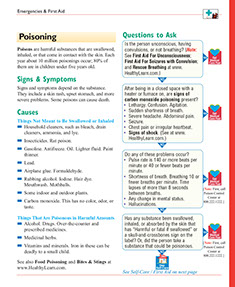
    Poisons are harmful substances that are swallowed, inhaled, or that come in contact with the skin. Each year about 10 million poisonings occur; 80% of them are in children under five years old.

    Signs & Symptoms

    Signs and symptoms depend on the substance. They include a skin rash, upset stomach, and more severe problems. Some poisons can cause death.

    Causes

    Things Not Meant to Be Swallowed or Inhaled

    *  Household cleaners, such as bleach, drain cleaners, ammonia, and lye.

    *  Insecticides. Rat poison.

    *  Gasoline. Antifreeze. Oil. Lighter fluid. Paint thinner.

    *  Lead.

    *  Airplane glue. Formaldehyde.

    *  Rubbing alcohol. Iodine. Hair dye. Mouthwash. Mothballs.

    *  Some indoor and outdoor plants.

    *  Carbon monoxide. This has no color, odor, or taste.

    Things That Are Poisonous in Harmful Amounts

    *  Alcohol. Drugs. Over-the-counter and prescribed medicines.

    *  Medicinal herbs.

    *  Vitamins and minerals. Iron in these can be deadly to a small child.

    Treatment

    Treatment depends on the poison and its effects. Information to give the Poison Control Center, emergency department, etc.:

    *  The name of the substance taken.

    *  The amount and when it was taken.

    *  A list of ingredients on the label.

    *  Age, gender, and weight of the person who took the poison. How the person is feeling and reacting. Any medical problems the person has.

    Prevention

    *  Buy household products, vitamins, and medicines in child-resistant packaging. Keep these and all poisons out of children’s reach.

    *  Put child-resistant latches on cabinet doors. Follow instructions for use and storage of pesticides, household cleaners, and other poisons.

    *  Keep products in original containers. Don’t transfer them to soft drink bottles, plastic jugs, etc.

    *  Teach children not to take medicine and vitamins unless an adult gives it to them. Don’t call these “candy” in front of a child.

    *  Wear protective clothing, masks, etc., when using chemicals that could cause harm if inhaled or absorbed by the skin.

    *  Install carbon monoxide detectors in your home and garage.

    Questions to Ask

    Self-Care / First Aid

    For Swallowed Poisons

    1.  If the person is unconscious, shout for help. Call 9-1-1!

    2.  For a conscious person, call the Poison Control Center (800.222.1222). Follow instructions. Do not give Syrup of Ipecac to induce vomiting unless the Poison Control Center tells you to. {Note: The American Academy of Pediatrics recommends that parents don’t give Syrup of Ipecac to children.}

    3.  Lay the person on his or her left side to keep the windpipe clear, especially if the person vomited. Keep a sample of the vomit and the poison container.

    For Inhaled Poisons

    1.  Protect yourself. Move the person to fresh air (outdoors if you can). Try not to breathe the fumes yourself.

    2.  Follow steps 1 and 2 above for Swallowed Poisons. Get medical care.

    For Chemical Poisons on Skin

    1.  Protect yourself. Flood the skin with water for 5 or more minutes. Remove clothing that was in contact with the person.

    2.  Gently wash the skin with soap and water. Rinse well. Get medical care.

    Healthier at Home book by the American Institute for Preventive Medicine. www.HealthyLife.com. All rights reserved.

    © American Institute for Preventive Medicine

  • Poison Ivy, Oak & Sumac

    Skin Conditions

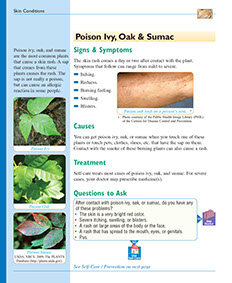
    Poison ivy, oak, and sumac are the most common plants that cause a skin rash. A sap that comes from these plants causes the rash. The sap is not really a poison, but can cause an allergic reaction in some people.

    Image of posion ivy leaf.
    Image of poison oak leaf.
    Image of poison sumac.

    Signs & Symptoms

    The skin rash comes a day or two after contact with the plant. Symptoms that follow can range from mild to severe.

    *  Itching.

    *  Redness.

    *  Burning feeling.

    *  Swelling.

    *  Blisters.

    Causes

    You can get poison ivy, oak, or sumac when you touch one of these plants or touch pets, clothes, shoes, etc. that have the sap on them. Contact with the smoke of these burning plants can also cause a rash.

    Treatment

    Self-care treats most cases of poison ivy, oak, and sumac. For severe cases, your doctor may prescribe medicine(s).

    Questions to Ask

    Self-Care / Prevention

    To Prevent Getting a Rash

    *  Know what these plants look like and avoid them.

    – Poison ivy and poison oak both have 3 leaflets per stem. This is why you may have heard the saying, “Leaflets three, let them be.”

    – Each branch of poison sumac has 7 to 13 leaflets on a reddish stem. A single leaf is on the end of the stem. The others are paired along each side of the stem. Poison sumac grows in wetlands.

    *  Use an over-the-counter lotion (IvyBlock), which blocks skin contact with the sap. Use it as directed.

    *  Wear pants and long-sleeved shirts.

    *  Use an over-the-counter product (e.g., Tecnu) that removes poison ivy sap.

    *  Rinse the affected area with water.

    *  To help prevent an allergic reaction, do the things listed below. Do them within 6 hours of contact with one of the plants.

    – Remove all clothes and shoes that have touched the plant.

    – Wash the skin area well with soap and water.

    – Use an over-the-counter product (e.g., Tecnu) that removes poison ivy sap.

    To Treat Poison Ivy, Oak, or Sumac

    *  Take a cold shower, put the rash area in cold water, or pour cold water over it. Use soap when you shower.

    *  To relieve itching, take an over-the-counter antihistamine, such as Benadryl. Follow the label’s directions.

    *  For weeping blisters, mix 2 teaspoons of baking soda in 4 cups of water. Dip squares of gauze in this mixture. Cover the blisters with wet gauze for 10 minutes, 4 times a day. Do not apply this to the eyes.

    *  Wash all clothes and shoes with hot water and a strong soap. Bathe pets that have come in contact with the plant. The sap can stay on pets for many days. Clean items used to wash clothing and pets. Wear rubber gloves when you do all these things.

    *  Keep your hands away from your eyes, mouth, and face.

    *  Do not scratch or rub the rash.

    *  Take baths with lukewarm water. Add an over- the-counter product called Aveeno colloidal oatmeal.

    *  Apply any of these to the skin rash:

    – Calamine (not Caladryl) lotion.

    – Over-the-counter hydrocortisone cream. Follow the directions on the label.

    – A paste of 3 teaspoons of baking soda and 1 teaspoon of water.

    Healthier at Home book by the American Institute for Preventive Medicine. www.HealthyLife.com. All rights reserved.

    © American Institute for Preventive Medicine

  • Pneumonia

    Respiratory conditions

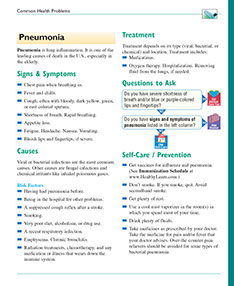
    Pneumonia is lung inflammation. It is one of the leading causes of death in the U.S., especially in the elderly.

    Signs & Symptoms

    *  Chest pain when breathing in.

    *  Fever and chills.

    *  Cough, often with bloody, dark yellow, green, or rust-colored sputum.

    *  Shortness of breath. Rapid breathing.

    *  Appetite loss.

    *  Fatigue. Headache. Nausea. Vomiting.

    *  Bluish lips and fingertips, if severe.

    Causes

    Viral or bacterial infections are the most common causes. Other causes are fungal infections and chemical irritants like inhaled poisonous gases.

    Risk Factors

    *  Having had pneumonia before.

    *  Being in the hospital for other problems.

    *  A suppressed cough reflex after a stroke.

    *  Smoking.

    *  Very poor diet, alcoholism, or drug use.

    *  A recent respiratory infection.

    *  Emphysema. Chronic bronchitis.

    *  Radiation treatments, chemotherapy, and any medication or illness that wears down the immune system.

    Treatment

    Treatment depends on its type (viral, bacterial, or chemical) and location. Treatment includes:

    *  Medications.

    *  Oxygen therapy. Hospitalization. Removing fluid from the lungs, if needed.

    Questions to Ask

    Self-Care / Prevention

    *  Get vaccines for influenza and pneumonia.

    *  Don’t smoke. If you smoke, quit. Avoid secondhand smoke.

    *  Get plenty of rest.

    *  Use a cool-mist vaporizer in the room(s) in which you spend most of your time.

    *  Drink plenty of fluids.

    *  Take medicines as prescribed by your doctor. Take the medicine for pain and/or fever that your doctor advises. Over-the-counter pain relievers should be avoided for some types of bacterial pneumonia.

    Healthier at Home book by the American Institute for Preventive Medicine. www.HealthyLife.com. All rights reserved.

    © American Institute for Preventive Medicine