Blog

  • Osteoporosis 3

    Bone & Muscle Problems

    Osteoporosis is a loss in bone mass and bone strength. Bones become less dense. This makes them weak and easier to break. Any bone can be affected. The hips, wrists, and spine are the most common sites.

    Signs & Symptoms

    Osteoporosis is a “silent disease.” It can occur without pain. You don’t see or feel changes taking place inside your bones. Often, the first sign is a fracture of the hip, wrist, or spine. When signs and symptoms occur, they include:

    *  Gradual loss of height

    *  Rounding of the shoulders

    *  Sudden back pain

    *  Stooped posture

    *  Dowager’s hump

    Causes & Risk Factors

    Bone is living tissue. It breaks down and is replaced with new bone. Osteoporosis occurs when new bone does not replace old bone fast enough.

    Risk Factors

    *  Being female. Women are more likely to develop osteoporosis than men.

    *  Low estrogen level. This occurs with menopause.

    *  Low testosterone level in men

    *  Aging

    *  A family history of osteoporosis or broken bones as adults

    *  Having a thin, small-framed body

    *  Lack of exercise, especially weight-bearing ones, such as walking and dancing

    *  Long-term bed rest

    *  Low calcium and vitamin D intake or absorption

    *  Smoking

    *  Drinking too much alcohol

    *  Long term use of some medicines, such as oral corticosteroids and antacids with aluminum

    *  Having certain health problems, such as anorexia nervosa, an over-active thyroid gland, and rheumatoid arthritis. Persons with Crohn’s disease, ulcerative colitis, and celiac disease are at an increased risk, too.

    Diagnosis

    There is no cure for osteoporosis. The focus is to:

    *  Prevent the disease

    *  Prevent further bone loss

    *  Build new bone

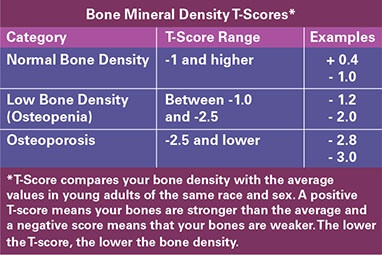
    *  All women 65 years of age and older should have a bone mineral density (BMD) screening test. Women who have had a fracture or are at a high risk for osteoporosis should get this test sooner than age 65, as advised by their doctors.

    *  Older men should have a BMD test if they have key risk factors for BMD-related fractures:

    – A past fracture, possibly due to osteoporosis

    – Low body weight. Physical inactivity.

    – Prolonged use of corticosteroid medications.

    {Note: Follow your doctor’s advice for when and how often to get screening tests for osteoporosis.}

    *  The most common test used to measure how dense bones are is a special X-ray known as a DXA or DEXA scan. You lie on a table and a technician moves a scanner above your spine, hip, or wrist. This safe and painless test takes about 10-20 minutes. Test results can identify persons who are at the highest risk for fractures.
    Medical Care

    Talk about your bone health with your doctor. Discuss:

    *  Your personal and family medical history

    *  Medications you take and have taken

    *  Falls or broken bones you have had as an adult

    *  Self-Care / Prevention measures you do already and ones you need help with

    Medical treatment may include:

    *  Treatment for problems that increase the risk for low bone mass and osteoporosis

    *  Evaluating your risk of falls. Tests for this include ones that check your balance, vision, blood pressure, muscle strength, and heart rhythm.

    *  An exercise program for your needs. Physical therapy may be prescribed.

    *  High doses of vitamin D if your blood level is very low. Your doctor needs to prescribe this.

    *  Medications:

    – Some slow down the breakdown of old bone. Two categories of these are bisphosphonates (biss-FOSS-fuh-nates) and anti-resorptive agents. Some of these medications are pills. Others are given in shots or through an IV.

    – Another one (teriparatide) helps the body make new bone faster than the old bone is broken down.

    Talk to your doctor about the benefits and risks of medications. Find out what side effects you should let him or her know about.

    Reasons to Contact Doctor/Provider

    *  You have any “Signs & Symptoms” of Osteoporosis.

    *  You want to find out about medicines and other ways to prevent and/or treat osteoporosis.

    *  You are a female age 65 or older and have not had a bone mineral density (BMD) test.

    *  You are a female age 50 and older; you have had a fracture or are at high risk for osteoporosis; and  you have not had a BMD test.

    *  You are an elderly male; you have risk factors for osteoporosis; and you need advice on getting a BMD test.

    *  After a fall, bump or strain, you have wrist, hip, or back pain.

    *  After a fall, you are not able to get up. Call or have someone call 9-1-1!

    Self-Care / Prevention

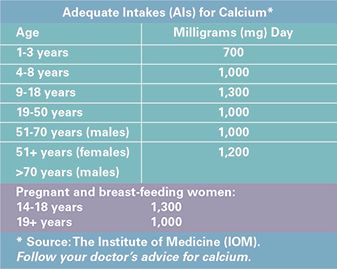
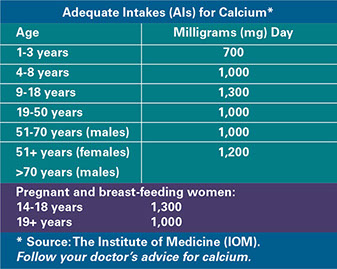
    Get Your Recommended Adequate Intake (AI) for Calcium Every Day

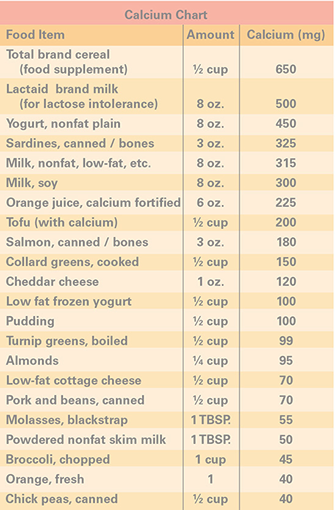
    *  Choose high-calcium foods daily. Examples are milk, yogurt, salmon, and green leafy vegetables.

    *  Take calcium supplements, as advised by your doctor. It is best to limit calcium to 500 milligrams at a time. Ask your doctor about taking Tums® to get calcium.

    *  Eat a balanced diet. Have at least 5 fruits and vegetables every day. These have many vitamins, minerals, and anti-oxidants that can benefit bone health, as well as overall health.

    *  Don’t smoke. If you smoke, quit! Get help from your doctor,www.smokefree.gov, and/or 1.800.QUIT.NOW (784.8669).

    *  Limit alcohol. Too much alcohol interferes with  the body’s need for calcium and vitamin D. It also increases the risk for falls.

    *  Take medications, as prescribed.

    Sources of vitamin D:

    *  Sun exposure (without sunscreen) on your skin. Fifteen minutes of midday sunshine may meet the daily need. {Note: You may not get vitamin D benefits from the sun: During winter months; if you have dark skin; and/or you are age 60 years and older.}

    *  Foods, such as fortified milks and cereals, egg yolks, saltwater fish, and liver.

    *  Vitamin D supplements, as advised by your doctor. The best source of vitamin D for bone health is vitamin D3.

    Use Fall Prevention Measures

    (Falling is what leads to broken bones for many people with osteoporosis.)

    *  Ask your doctor if any medications you take could cause you to fall and how to deal with this. Find out how to deal with vision and balance problems, too.

    *  Put salt or kitty litter on icy sidewalks. Or stay home during bad weather!

    *  Use grab bars and safety mats, etc. in your tub and shower.

    *  Use handrails on both sides of stairways.

    *  When you reach for things on the floor or pick things up, bend at your knees, not at your waist.

    *  Wear flat, sturdy, nonskid shoes.

    *  If you use throw rugs, use ones with nonskid backs. Or tack them down to the floor.

    *  Use a cane or walker, if necessary.

    *  Keep halls, stairways, and entrances well lit. Use night lights in hallways, bathrooms, etc.

    *  Keep a flashlight next to your bed.

    *  Practice proper posture.

    In the house, carry a cordless or cell phone with you, if you can. Doing this keeps you from rushing to answer the phone when it rings. You will also be able to call for help if you do fall.

    Be Physically Active

    Physical activity throughout life is important for bone health. Putting stress on your bones tells your body that your bones need to be made stronger.

    *  Do regular, weight-bearing exercise. Do this at least 3 or 4 times a week. Examples are walking, dancing, and step aerobics.*

    *  Do resistance exercises to strengthen muscles and build bone.* Examples are using weights and resistance bands.

    *  Do exercises that increase flexibility.* Examples are tai chi, yoga and stretching exercises.

    *  (Note: A person with osteoporosis should follow the exercise program outlined by his or her doctor.)

    Low bone mass and osteoporosis pose a major health threat.

    *  One out of every 2 women and one in 4 men over age 50 will have an osteoporosis-related fracture in his or her lifetime.

    *  After a fracture, persons are more likely to have chronic pain, a fear of falling, and depression. They lose independence and have a lower quality of life.

    *  One year after a hip fracture, 1 in 4 people dies, 1 can’t walk, and 2 of the 4 can walk but are less mobile than before the fracture.

    *  In the U.S., costs for osteoporosis and related fractures have been estimated to be about $14 billion a year.

    Resources

    National Osteoporosis Foundation

    800.231.4222

    www.nof.org

    NIH Osteoporosis and Related Bone Disease National Resource Center

    800.624.BONE (624.2663)
    www.bone.nih.gov

    Osteoporosis brochure by the American Institute for Preventive Medicine. www.HealthyLife.com. All rights reserved.

    © American Institute for Preventive Medicine
  • Osteoporosis 2

    Women’s Health

    Osteoporosis is a loss in bone mass and bone strength. Bones become less dense. This makes them weak and easier to break. Any bone can be affected. The hips, wrists, and spine are the most common sites. Peak bone mass is reached between the ages of 25 and 35. After age 35, bone mass starts to drop.

    Signs & Symptoms

    Osteoporosis is a “silent disease.” It can progress without any noticeable signs or symptoms. Often, the first sign is a fracture of the hip, wrist, or spine. When signs and symptoms occur, they include:

    *  Gradual loss of height.

    *  Rounding of the shoulders.

    *  Sudden back pain.

    *  Stooped posture.

    *  “Dowager’s hump.”

    Causes

    Osteoporosis occurs when new bone does not replace old bone fast enough.

    Risk Factors Include:

    *  Being female. Women are 4 times more likely to develop osteoporosis than men. Why?

    – Their bones are thinner and lighter.

    – They live longer on average than men.

    – They have rapid bone loss at menopause due to a sharp decline of estrogen. The risk also increases for women who: Go through menopause before age 45. This could be natural menopause or one that results from surgery which removes both ovaries. Experience a lack of or irregular menstrual flow.

    *  Having a thin, small framed body.

    *  Being Caucasian or Asian. African Americans and Hispanic Americans are at a risk, too.

    *  Lack of physical activity, especially walking, running, tennis, and other weight-bearing exercises.

    *  Long-term bed rest.

    *  Exercising too much to the point where menstrual periods cease.

    *  Low calcium and vitamin D intake or absorption.

    *  Family history of osteoporosis and/or bone fractures.

    *  Smoking cigarettes.

    *  Drinking too much alcohol, which may damage bones. Heavy drinkers often eat poorly, too. They are also more prone to fractures from falls.

    *  Taking certain medicines for a long time. Examples are: Corticosteroids; some antiseizure medicines; overuse of thyroid hormones; and antacids with aluminum.

    *  Having certain health problems, such as anorexia nervosa, an over-active thyroid gland, or rheumatoid arthritis.

    *  Persons with Crohn’s disease, ulcerative colitis, and celiac disease are at risk, too.

    Treatment

    There is no cure for osteoporosis. The focus of treatment is to prevent the disease, to prevent further bone loss, and build new bone. Special X-rays, such as one known as DEXA, can measure bone density in various sites of the body. These tests can help doctors decide if and what kind of treatment is needed. Treatment includes:

    *  Medications. There are different kinds. Your doctor will prescribe one(s) best suited for your needs.

    *  A balanced diet rich in calcium and vitamin D and taking supplements of these, as needed.

    *  Exercises, as advised by your doctor.

    *  Proper posture.

    *  Fall prevention measures:

    – Wear flat, sturdy, non-skid shoes.

    – Get regular vision exams. Wear corrective glasses, etc., as needed.

    – Ask your doctor if any medications you take could increase the risk of falls. Ask how to deal with this. Let your doctor know if your medicine(s) affect your vision, balance, etc.

    – Use grab bars and safety mats or nonskid tape in your tub and shower.

    – Use handrails on stairways.

    – Pick things up by bending your knees and keeping your back straight. Don’t stoop.

    – Use a cane or walker if necessary.

    – If you use throw rugs, use ones with nonskid backs.

    – See that halls, stairways, and entrances are well lit. Use night lights in hallways, bathrooms, etc.

    – Stay home if it is icy or slippery outside.

    Questions to Ask

    Self-Care / Prevention

    To Treat Osteoporosis

    *  Take medications, as prescribed.

    *  Do the daily exercises approved by your doctor.

    *  Practice good posture.

    To Treat, Slow, and Prevent Osteoporosis

    *  Eat a balanced diet.

    *  Get your daily calcium need.

    Choose High Calcium Foods Daily

    *  Skim and low-fat milks, yogurts, and cheeses. {Note: If you are lactose intolerant, you may need to use dairy products that are treated with the enzyme lactose or you can add this enzyme using over-the-counter drops or tablets.}

    *  Soy milks and yogurts with added calcium.

    *  Soft-boned fish and shellfish, such as cod, salmon, sardines, and shrimp.

    *  Vegetables, especially broccoli, kale, and collards.

    *  Beans and bean sprouts, as well as tofu (soy bean curd), if processed with calcium.

    *  Calcium-fortified foods, such as some orange juices, apple juices, and ready-to-eat cereals.

    *  Take calcium supplements, as advised by your doctor.

    Get Your Recommended Daily Need for Vitamin D.

    *  Choose nonfat and low-fat dairy products that are fortified with vitamin D, saltwater fish, liver, and egg yolks. You also get vitamin D from direct exposure of sunlight on your skin. Fifteen minutes of midday sun exposure (without sunscreen) may meet the daily need.

    *  Take vitamin D supplements, as advised by your doctor. The best source of vitamin D for bone health is vitamin D3.

    *  Do regular, weight-bearing exercises at least 3 or 4 times a week. Examples are walking and low-impact or non-impact aerobics. (If you have osteoporosis, follow the exercise program outlined by your doctor.)

    *  Do not smoke.

    *  Limit alcohol.

    *  Use fall prevention measures.

    Resources

    National Osteoporosis Foundation

    www.nof.org

    Women's Self-Care book by the American Institute for Preventive Medicine. www.HealthyLife.com. All rights reserved.

    © American Institute for Preventive Medicine
  • Osteoporosis

    Bone & Muscle Problems

    Nurse with older women holding a cane.

    Osteoporosis is a loss of bone mass and strength. This significantly increases the risk of fractures and falls.

    To help prevent osteoporosis, take medicines as prescribed by your doctor, do weight-bearing exercises, choose a balanced diet rich in calcium and vitamin D, and practice good posture.

    Often, the first sign of osteoporosis is a fracture of a wrist, hip, or spine.

    To help detect osteoporosis, have tests that measure bone density as advised by your doctor.

    If you have been diagnosed with osteoporosis or had a fracture from a fall at standing height, talk with your doctor about medication options. Also, learn how to fall-proof your home. Learn more about bone health and osteoporosis atnof.org.

    Health at Home Lifetime book by the American Institute for Preventive Medicine. www.HealthyLife.com. All rights reserved.

    © American Institute for Preventive Medicine
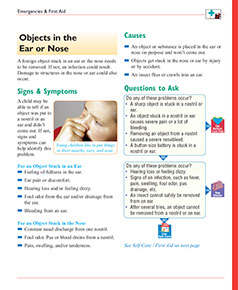
  • Objects In The Ear Or Nose

    First Aid

    A foreign object stuck in an ear or the nose needs to be removed. If not, an infection could result. Damage to structures in the nose or ear could also occur.

    Signs & Symptoms

    A child may be able to tell if an object was put in a nostril or an ear and didn’t come out. If not, signs and symptoms can help identify this problem.

    For an Object Stuck in an Ear

    *  Feeling of fullness in the ear.

    *  Ear pain or discomfort.

    *  Hearing loss and/or feeling dizzy.

    *  Foul odor from the ear and/or drainage from the ear.

    *  Bleeding from an ear.

    For an Object Stuck in the Nose

    *  Constant nasal discharge from one nostril.

    *  Foul odor. Pus or blood drains from a nostril.

    *  Pain, swelling, and/or tenderness.

    Causes

    *  An object or substance is placed in the ear or nose on purpose and won’t come out.

    *  Objects get stuck in the nose or ear by injury or by accident.

    *  An insect flies or crawls into an ear.

    Treatment

    Medical care is needed for foreign objects that can’t be removed with self-care. After an object is removed, an antibiotic may be needed if an infection is present. Small, button-sized batteries need to be removed to prevent burns.

    Questions to Ask

    Self-Care / Prevention

    To Remove an Insect from an Ear

    *  Kill the insect before you try to remove it. To do this, tilt the person’s head to put the ear with the insect in an upward position. Pour warm (not hot) mineral, olive, or baby oil into the ear. As you pour the oil, straighten the ear canal. In a child, pull the earlobe gently backward and downward; backward and upward in an adult.

    *  The goal is to suffocate the insect and cause it to float out.

    To Remove Objects Other Than Insects

    *  Don’t use oil.

    *  Tilt the head toward the side with the foreign object. Gently shake the head toward the floor to try to get the object out. Do not shake a baby. Gently pull the ear up and back.

    *  Don’t use a sharp tool, cotton swab, etc., to try to locate and remove the object. This risks pushing the object farther into the ear. Doing this could damage the middle ear.

    *  Remove the object with blunt tweezers if it is easily seen and can be grasped and pulled out.

    To Remove Objects in the Nose

    *  Don’t use a sharp tool, cotton swab, etc., to try to locate and remove the object.

    *  Breathe through the mouth until the object is removed.

    *  Apply gentle pressure to close the other nostril and gently try to blow the object out.

    *  Remove the object with blunt tweezers, if it is easily seen and can be grasped and pulled out.

    Healthier at Home book by the American Institute for Preventive Medicine. www.HealthyLife.com. All rights reserved.

    © American Institute for Preventive Medicine
  • Nutrition For Children

    Children’s Health

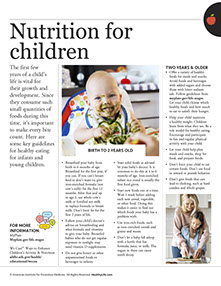
    Image of toddler eating a strawberry.

    Birth to 2 Years Old

    *  Breast-feed your baby from birth to 6 months of age. Breast-feed for the first year, if you can. If you can’t breast-feed or don’t want to, give iron-enriched formula (not cow’s milk) for the first 12 months. After that and up to age 2, use whole cow’s milk to replace formula or breast milk. Don’t limit fat for the first 2 years of life.

    *  Follow your child’s doctor’s advice on breast-feeding and what formula and vitamins to give your baby. Breast-fed babies who do not get regular exposure to sunlight may need vitamin D supplements.

    *  Start solid foods as advised by your baby’s doctor. It is common to do this at 4 to 6 months of age. Iron-enriched infant rice cereal is usually the first food given.

    *  Start new foods one at a time. Wait 1 week before adding each new cereal, vegetable, or other food. Doing this makes it easier to find out which foods your baby has a problem with.

    *  Use iron-rich foods, such as grains, iron-enriched cereals, and meats.

    *  Do not give honey to infants during the first 12 months of life.

    *  Don’t let a baby fall asleep with a bottle that has formula, juice, or milk. The sugars in these can cause tooth decay.

    Two Years and Older

    *  Give a variety of healthy foods for meals and snacks. Follow guidelines from theChooseMyPlate.gov/kidsWeb site. Let your child choose which healthy foods and how much to eat to satisfy his or her hunger.

    *  Help your child maintain a healthy weight. Give proper foods. Promote regular exercise. Lead by example. Children learn from what they see parents do, as well as, from what parents say. Eat with your children. Be a role model for good eating. Exercise, too.

    *  Let your child help plan meals and snacks, shop for food, and prepare foods.

    *  Don’t force your child to eat certain foods. Don’t use food to reward or punish behavior.

    *  Don’t give foods that can lead to choking, such as hard candies and whole grapes.

    *  Teach healthy behaviors in a fun way. For ideas to help get children to eat well and be more active, access the Web sites under “Resources”.

    Resources

    5-2-1-0 Let’s Go!

    www.letsgo.org

    ChooseMyPlate.gov

    www.choosemyplate.gov/kids/index.html

    We Can!™ Ways to Enhance Children’s  Activity & Nutrition

    www.nhlbi.nih.gov/health/educational/wecan

    Page from Healthier at Home book by the American Institute for Preventive Medicine. www.HealthyLife.com. All rights reserved.

    © American Institute for Preventive Medicine
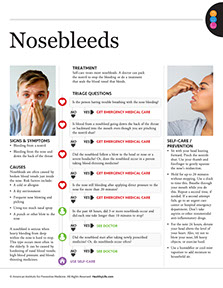
  • Nosebleeds

    Ear, Nose & Throat Conditions

    Signs & Symptoms

    *  Bleeding from a nostril.

    *  Bleeding from the nose and down the back of the throat.

    Causes

    Nosebleeds are often caused by broken blood vessels just inside the nose. Risk factors include:

    *  A cold or allergies.

    *  A dry environment.

    *  Frequent nose blowing and picking.

    *  Using too much nasal spray.

    *  A punch or other blow to the nose.

    A nosebleed is serious when heavy bleeding from deep within the nose is hard to stop. This type occurs most often in the elderly. It can be caused by: Hardening of nasal blood vessels; high blood pressure; and medicines that treat blood clots.

    Treatment

    Self-care treats most nosebleeds. A doctor can pack the nostril to stop the bleeding or do a treatment that seals the blood vessel that bleeds.

    Questions to Ask

    Self-Care / Prevention

    *  Sit with your head leaning forward. Pinch the nostrils shut. Use your thumb and forefinger to gently squeeze the nose’s midsection.

    *  Hold for up to 20 minutes without stopping. Use a clock to time this. Breathe through your mouth while you do this. Repeat a second time, if needed. If a second attempt fails, go to an urgent care center or hospital emergency department. Don’t take aspirin or other nonsteroidal anti-inflammatory drugs.

    *  For the next 24 hours, elevate your head above the level of your heart. Also, try not to blow your nose, lift heavy objects, or exercise hard.

    *  Use a humidifier or cool-mist vaporizer to add moisture to household air.

    Healthier at Home book by the American Institute for Preventive Medicine. www.HealthyLife.com. All rights reserved.

    © American Institute for Preventive Medicine

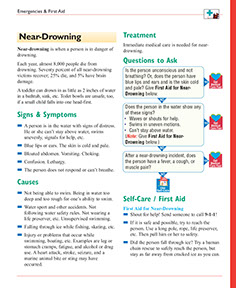
  • Near-Drowning

    First Aid

    Near-drowning is when a person is in danger of drowning. Each year, almost 8,000 people die from drowning. Seventy percent of all near-drowning victims recover; 25% die, and 5% have brain damage.

    A toddler can drown in as little as 2 inches of water in a bathtub, sink, etc. Toilet bowls are unsafe, too, if a small child falls into one head-first.

    Signs & Symptoms

    *  A person is in the water with signs of distress. He or she can’t stay above water, swims unevenly, signals for help, etc.

    *  Blue lips or ears. The skin is cold and pale.

    *  Bloated abdomen. Vomiting. Choking.

    *  Confusion. Lethargy.

    *  The person does not respond or can’t breathe.

    Causes

    *  Not being able to swim. Being in water too deep and too rough for one’s ability to swim.

    *  Water sport and other accidents. Not following water safety rules. Not wearing a life preserver, etc. Unsupervised swimming.

    *  Falling through ice while fishing, skating, etc.

    *  Injury or problems that occur while swimming, boating, etc. Examples are leg or stomach cramps, fatigue, and alcohol or drug use. A heart attack, stroke, seizure, and a marine animal bite or sting may have occurred.

    Prevention

    For Children

    *  Never leave an infant or child alone in any type of bathtub. Supervise young children in the bathroom.

    *  Never leave a child alone near water, swimming pools, etc. Lock gates to keep children from getting near swimming pools.

    *  Have a phone near outdoor pools, etc.

    *  Teach children to swim. Tell them not to swim alone and not to swim too far from shore without a lifeguard or other adult swimmer.

    *  Put a personal floatation device on each child when near the water or on a boat.

    *  Tell children to check the depth of water before diving in. It should be at least 9 feet deep.

    *  Do not allow children to go on untested ice.

    *  Take CPR and water safety courses.

    For Adults

    *  Learn to swim. Never swim alone at the beach or in a swimming pool. A lifeguard or other adult swimmer should be nearby in case you suffer a leg cramp or other problem.

    *  Wear a personal floatation device when you are on a boat, when you fish, etc.

    *  Check the depth of the water before diving in. It should be at least 9 feet deep. Never dive into an above-ground pool.

    *  Do not use a hot tub or jacuzzi if you’ve had any alcoholic drinks. You could fall asleep, slip under the surface, and drown.

    *  Take CPR and water safety courses.

    Questions to Ask

    Self-Care / First Aid

    First Aid for Near-Drowning

    *  Shout for help! Send someone to call 9-1-1!

    *  If it is safe and possible, try to reach the person. Use a long pole, rope, life preserver, etc. Then pull him or her to safety.

    *  Did the person fall through ice? Try a human chain rescue to safely reach the person, but stay as far away from cracked ice as you can.

    *  If you must swim to the person, be sure you are strong and capable enough. Take a flotation device with you. Approach the person from behind in a calm manner. Grab a piece of the person’s clothing. Or, cup one hand under the person’s chin.

    *  When getting the person out of the water, support the head and neck. (Suspect a neck injury, especially with diving or water sports.)

    *  CHECK for a response. Give Rescue Breaths and CPR, as needed. If you suspect a spinal injury, use jaw thrust instead of chin-lift for rescue breaths.

    *  Once out of the water, keep checking the person for a response. Give first aid, as needed.

    *  Put the person in the Recovery Position. Immobilize the person as much as possible. If the person is vomiting, clear his or her mouth of it.

    *  Remove cold, wet clothes. Cover the person with a blanket, etc.

    Healthier at Home book by the American Institute for Preventive Medicine. www.HealthyLife.com. All rights reserved.

    © American Institute for Preventive Medicine
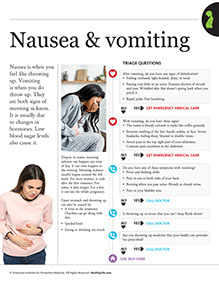
  • Nausea And Vomiting

    Pregnancy & Prenatal Care

    Nausea is when you feel like throwing up. Vomiting is when you do throw up. They are both signs of morning sickness. It is usually due to changes in hormones. Low blood sugar levels also cause it.

    Despite its name, morning sickness can happen any time of day. It can even happen in the evening. Morning sickness usually begins around the 6th week. For most women, it ends after the first trimester. For some, it lasts longer. For a few, it can last the whole pregnancy.

    Upset stomach and throwing up can also be caused by:

    *  A virus in the intestines. Diarrhea can go along with this.

    *  Spoiled food

    *  Eating or drinking too much

    Questions to Ask

    Self-Care / Prevention

    *  Keep crackers or dry cereal by your bed. Eat a few crackers or a handful of dry cereal in bed. Do this before you lift your head up in the morning.

    *  Get up and out of bed slowly. If you can, sit in bed for a half-hour before you get up.

    *  Use these tips to keep your blood sugar from getting too low:

    – Eat small regular meals and snacks through the day. Focus on foods high in carbohydrates. Examples: whole grain breads and cereals, potatoes, pasta. More examples: rice, beans and other legumes, vegetables, fruits.

    – Have a good source of protein at each meal. Examples: low-fat milk, yogurt, low-fat cheese, dry beans, dry peas.

    – Have a snack before you go to bed at night. Have one if you wake up at night.

    – Avoid foods with high sugar content.

    – Don’t drink alcohol.

    *  Don’t smoke.

    *  Don’t eat fried or greasy foods. These foods have a lot of fat. Fat stays in the stomach for a long time. This can lead to nausea.

    *  Don’t eat spicy foods.

    *  Don’t take any medicine without your health care provider’s okay.

    *  Take your prenatal vitamins (vitamin pills) with meals. This helps prevent stomach upset. Your doctor may prescribe PremesisRx®. This is a vitamin that helps nausea.

    *  Ask your health care provider about taking ginger and in what form.

    *  Write down the times when your stomach is upset and when you throw up. These may happen only after you eat certain foods. Or they may happen with certain smells. Once you know what they are, you can avoid them.

    *  Stay away from smoke and smoky rooms. Even stay away from cooking smells.

    *  Get plenty of rest.

    *  Discuss any home remedies with your health care provider. Do this to make sure they are safe.

    *  Ask your health care provider about a relief band. That’s a wrist band that helps with an upset stomach and throwing up.

    *  If the Self-Care Tips bring no relief, call your health care provider. He or she can prescribe medicines. Sometimes, IV fluids are needed.

    *  To get rid of cooking smells and odors:

    – Open the windows.

    – Run fans in the house. Use the exhaust fan on the stove.

    – Use a portable air cleaner or air purifier.

    Prenatal Self-Care book by the American Institute for Preventive Medicine. www.HealthyLife.com. All rights reserved.

    © American Institute for Preventive Medicine
  • Debunking The Myth Of Senility

    Mature Health: Over Age 50

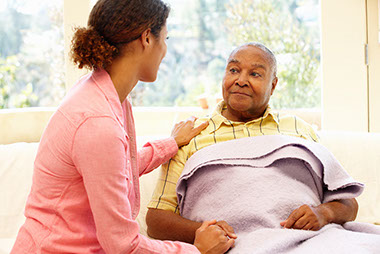
    Image of mature male with a family member holding his hand in comfort.

    Don’t think that you’re getting senile just because you forget someone’s name or can’t remember where you parked your car. Everyone forgets occasionally. The truth is, most people do not become senile. Senility (or senile dementia) is a state of confusion and forgetfulness triggered by mental decline. Almost 100 different conditions mimic the symptoms of senility. (Alzheimer’s disease is the most common. Poor nutrition, hormone disorders, and use of certain medications can also cause confusion and forgetfulness. Even then, senility is misdiagnosed up to 20 percent of the time. So don’t assume that you or anyone else is senile without a thorough medical exam.

    A Year of Health Hints book by the American Institute for Preventive Medicine. www.HealthyLife.com. All rights reserved.

    © American Institute for Preventive Medicine

  • Multiple Sclerosis

    Brain & Nervous System

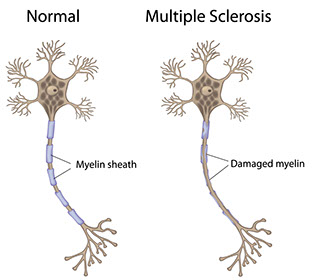
    Multiple Sclerosis (MS) is a chronic disease of the brain and spinal cord. With MS, a covering that protects nerves (myelin) and the nerves are damaged or destroyed. Over time, scar tissue forms along the damaged myelin. Nerves can’t send signals like they should. As a result, movement, sensation, etc. are impaired or lost.

    Illustration showing multiple sclerosis.

    Signs & Symptoms

    *  Fatigue.

    *  Feelings of pins and needles. Numbness. Leg stiffness.

    *  Poor coordination. Unsteady gait. Impaired movement.

    *  Bladder problems.

    *  Blurred vision. Double vision. Loss of vision in one eye.

    *  Depression. Mild problems with memory, learning, etc.

    *  Swallowing problems.

    Early signs and symptoms may be mild and present for years before MS is diagnosed.

    Symptoms vary from person to person. They may last for hours or weeks. They can vary from day to day and can come and go with no set pattern.

    Some persons have only a few symptoms over the course of the disease. For others, symptoms continue and/or worsen with time. Most persons with MS get symptom flare-ups (relapses) that are followed by partial or complete recoveries (remissions).

    Causes

    The exact cause of MS is not known. It may be due to a number of factors. These include: A virus, genetics, and an immune system problem. Toxins, trauma, poor nutrition, and other factors may also play a role. Things known to come before the onset of MS include: Overwork; fatigue, the postpartum period for women; acute infections; and fevers. Multiple sclerosis is more common in:

    *  Women than in men.

    *  Caucasians than in Hispanics or African Americans. It is rare among Asians and certain other ethnic groups.

    *  Adults between the ages of 20 and 50. Young children, teens, and older adults can also have MS.

    *  People who are born and live up to at least age 15 years old in places farther from the equator. These include North America, Europe, and Southern Australia.

    Treatment

    There is no cure yet for MS, but most people with it live a normal life span. Treatment for MS includes:

    *  Prescribed medication to lessen the number and severity of flare-ups and to slow the progression of the disease. Research favors early treatment with this type of medicine.

    *  Short-term courses of IV or oral corticosteroids. These reduce inflammation during MS flare-ups.

    *  Medications to control and treat MS symptoms. Treating infections, when present.

    *  Physical and occupational therapy.

    *  Counseling. Support groups.

    *  Clinical trails. Accesswww.clinicaltrials.gov.

    Questions to Ask

    Self-Care / Prevention

    *  Follow your doctor’s guidelines for home care.

    *  Maintain a normal routine at work and at home. Avoid activities that lead to fatigue or put too much physical stress on the body. Get plenty of rest.

    *  Manage emotional stress.

    *  Avoid the heat and sun. Don’t take hot showers or baths. Increased body temperature can cause symptoms. Cool baths or swimming in a pool may improve symptoms by lowering body temperature.

    *  Have body massages to help maintain muscle tone.

    *  Treat a fever as soon as it occurs.

    *  Get regular exercise. Physical therapy may be helpful.

    *  Get counseling, if needed.

    *  Get a seasonal flu shot every year and other vaccines as advised.

    *  If you smoke, quit!

    Resources

    Multiple Sclerosis Foundation

    888.MS.FOCUS (673.6287)

    www.msfocus.org

    National Multiple Sclerosis Society

    800.FIGHT.MS (344.4867)www.nationalmssociety.org

    Healthier at Home book by the American Institute for Preventive Medicine. www.HealthyLife.com. All rights reserved.

    © American Institute for Preventive Medicine