Blog

  • Learn Cpr. It Could Help Save A Life!

    First Aid

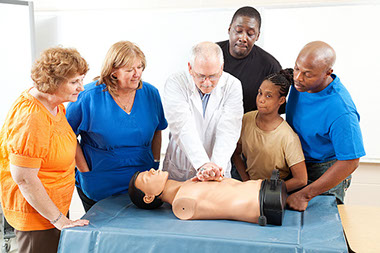
    An image of a class learning CPR.

    Knowing how to perform cardiopulmonary resuscitation (CPR) can mean the difference between life and death. CPR can restore the flow of oxygen to the brain if the heart has stopped beating due to heart attack, drowning, electrical shock, suffocation, or a drug overdose. Learn to perform CPR correctly. Take a CPR training course to learn:

    *  How to contact emergency medical help.

    *  How to use an automated external defribrillator (AED).

    *  How to give rescue breaths, compress the person’s chest and when and how to do chest-compression only CPR. (It is important to push hard and push fast, giving 100 compressions a minute in cycles of 30 compressions for every 2 breaths.) {Note: Guidelines for CPR may change. Get updates for CPR and find out where you can learn how to perform it from the American Heart Association atwww.americanheart.org.}

    You can also call your local chapter of the Red Cross or your local hospital to find out where you can learn CPR.

    A Year of Health Hints book by the American Institute for Preventive Medicine. www.HealthyLife.com. All rights reserved.

    © American Institute for Preventive Medicine

  • Laryngitis

    Ear, Nose & Throat Conditions

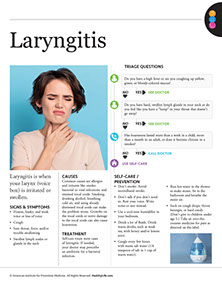
    Laryngitis is when your larynx (voice box) is irritated or swollen.

    Signs & Symptoms

    *  Hoarse, husky, and weak voice or loss of voice.

    *  Cough.

    *  Sore throat, fever, and/or trouble swallowing.

    Causes

    Common causes are allergies and irritants like smoke; bacterial or viral infections; and strained vocal cords. Smoking, drinking alcohol, breathing cold air, and using already distressed vocal cords can make the problem worse. Growths on the vocal cords or nerve damage to the vocal cords can also cause hoarseness.

    Treatment

    Self-care treats most cases of laryngitis. If needed, your doctor may prescribe an antibiotic for a bacterial infection.

    Questions to Ask

    Self-Care / Prevention

    *  Don’t smoke. Avoid secondhand smoke.

    *  Don’t talk if you don’t need to. Write notes, instead.

    *  Use a cool-mist humidifier in your bedroom.

    *  Drink a lot of fluids. Drink warm drinks, such as weak tea, with honey and/or lemon juice.

    *  Gargle every few hours with warm salt water (1/4 teaspoon of salt in 1 cup of warm water).

    *  Run hot water in the shower to make steam. Sit in the bathroom and breathe the moist air.

    *  Suck on cough drops, throat lozenges, or hard candy. (Don’t give to children under age 5.) Take an over-the-counter medicine for pain as directed on the label.

    Resources

    American Academy of Otolaryngology –

    Head and Neck Surgery

    www.entnet.org

    Healthier at Home book by the American Institute for Preventive Medicine. www.HealthyLife.com. All rights reserved.

    © American Institute for Preventive Medicine

  • Lactose Intolerance

    Abdominal & Urinary Conditions

    Image of various of different dairy products.

    Lactose is the natural sugar in milk. A person with lactose intolerance lacks enough of the enzyme, lactase, to digest this sugar.

    Signs & Symptoms

    *  Nausea.

    *  Cramps.

    *  Bloating.

    *  Gas.

    *  Diarrhea.

    These symptoms start about 30 minutes to 2 hours after you eat or drink foods with lactose.

    Causes

    *  The body can’t make the enzyme lactase. This can occur from birth or over time.

    *  Digestive diseases.

    *  Injury to the small intestine.

    Asian Americans, African Americans, and American Indians are more prone to lactose intolerance.

    Treatment

    Symptoms can be controlled with self-care measures.

    Questions to Ask

    Self-Care / Prevention

    *  Eat fewer dairy foods. Some people with lactose intolerance can tolerate dairy foods if they have small amounts at a time.

    *  Have lactose-free dairy products. Have ones that reduce lactose with bacterial cultures. Examples are buttermilk, yogurt, and acidophilus milks.

    *  Take over-the-counter drops or pills that have the enzyme lactase when you have dairy foods.

    *  If the above measures don’t help, don’t have products with milk, milk solids, and dairy whey. Have soy milk instead. Products marked “parve” are milk free.

    *  Read food labels. Many food products contain small amounts of lactose. These include bread and other baked goods, instant mashed potatoes, breakfast and diet drinks and bars, and mixes for biscuits, cookies, and pancakes.

    Healthier at Home book by the American Institute for Preventive Medicine. www.HealthyLife.com. All rights reserved.

    © American Institute for Preventive Medicine

  • Labor And Delivery

    Pregnancy & Prenatal Care

    There are two ways a baby may be born:

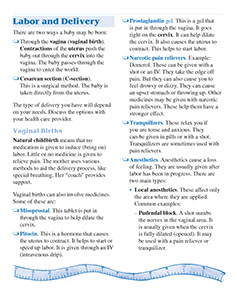
    *  Through the vagina (vaginal birth). Contractions of the uterus push the baby out through the cervix into the vagina. The baby passes through the vagina to enter the world.

    *  Cesarean section (C-section). This is a surgical method. The baby is taken directly from the uterus.

    The type of delivery you have will depend on your needs. Discuss the options with your health care provider.

    Vaginal Births

    Natural childbirth means that no medication is given to induce (bring on) labor. Little or no medicine is given to relieve pain. The mother uses various methods to aid the delivery process, like special breathing. Her “coach” provides support.

    Vaginal births can also involve medicines. Some of these are:

    *  Misoprostal. This tablet is put in through the vagina to help dilate the cervix.

    *  Pitocin. This is a hormone that causes the uterus to contract. It helps to start or speed up labor. It is given through an IV (intravenous drip).

    *  Prostaglandin gel. This is a gel that is put in through the vagina. It goes right on the cervix. It can help dilate the cervix. It also causes the uterus to contract. This helps to start labor.

    *  Narcotic pain relievers. Example: Demerol. These can be given with a shot or an IV. They take the edge off pain. But they can also cause you to feel drowsy or dizzy. They can cause an upset stomach or throwing up. Other medicines may be given with narcotic pain relievers. These help them have a stronger effect.

    *  Tranquilizers. These relax you if you are tense and anxious. They can be given in pills or with a shot. Tranquilizers are sometimes used with pain relievers.

    *  Anesthetics. Anesthetics cause a loss of feeling. They are usually given after labor has been in progress. There are two main types:

    *  General anesthesia. This puts the mother to sleep. It is used most often for emergency C-sections. But it can be used in a vaginal birth when the baby is in a breech position. That’s when the baby’s bottom or one or both feet reach the cervix before the head does.

    *  Local anesthetics. These affect only the area where they are applied. Common examples:

    – Pudendal block. A shot numbs the nerves in the vaginal area. It is usually given when the cervix is fully dilated (opened). It may be used with a pain reliever or tranquilizer.

    – Epidural block. This is the most popular anesthetic used for labor. The mother lies on her left side or she sits up and leans forward. A shot is given in the back to numb the area. A thin plastic tube is put into the epidural space of the spine. Medicine is given through the tube. This causes some loss of feeling from the waist down. How much numbness occurs depends on the drug and dose used. An epidural block can have other effects. It can lower the mother’s blood pressure. It can make her unable to pass urine on her own. In that case, a tube called a Foley catheter is used to empty urine from the bladder. An epidural block can also increase the chance that forceps will be used at delivery. {Note: Just pain medicine can be given through the tube. It does not cause a loss of feeling from the waist down. If this is done, the mother may be able to get out of bed and walk. But an adult should be with her.}

    Whether or not pain medicine is used is not what matters most. The goal in labor and delivery is to have a healthy baby and a healthy mother.

    Cesarean Births

    A C-section requires anesthetics. Either an epidural block or spinal is used. General anesthesia is rarely used. C-sections are usually done with a low, left-to-right incision (cut) near the line of pubic hair. This is called a lower-segment incision or a “bikini” cut. An up-and-down incision is rare these days. But it may be used in an emergency. The type of incision in the skin may be different from the one made in the uterus.

    C-sections may or may not be planned. Here are some reasons for doing one:

    *  The baby (or babies) or mother is not doing well

    *  The baby is too big for the mother’s pelvis

    *  The mother has placenta previa or placenta abruptio.

    *  The mother had a past C-section with an up-and-down incision on the uterus.

    *  The baby is lying in a way that makes it hard to deliver.

    *  The mother has an active outbreak of genital herpes.

    *  Labor does not progress the way it should.

    *  The umbilical cord is wedged between the cervix and the baby. This cuts off blood flow to the baby.

    *  The mother is not strong enough for a vaginal delivery.

    *  The mother has health problems, like diabetes, high blood pressure, kidney disease, or preeclampsia.

    *  The baby is more than 2 weeks late and the placenta does not nourish the baby well.

    Vaginal Births after C-Section (VBAC)

    Some pregnant women have already had a C-section delivery. Of this group, some might be able to have a safe vaginal delivery. Some might not for the next baby.

    A vaginal delivery after a C-section may be possible if:

    *  The incision for the C-section was the left-to-right, lower-segment type.

    *  Your pelvis is normal size.

    *  Reasons for the past C-section are not present now. Examples:

    – Breech baby

    – Separation of the placenta (placenta abruptio)

    – More than one baby

    – Baby in distress

    Signs of Prelabor

    Prelabor is the period just before labor begins. Call your health care provider if any of these signs of prelabor happen more than one month before your due date:

    *  The baby begins to settle into your pelvis. It looks and feels as if the baby has “dropped.” This process is called lightening and engagement. It’s easier for you to breathe after it happens.

    *  You feel more pressure on the pelvis and rectum (rear end). The pressure can cause a dull ache in the pelvic area or lower back. It feels like menstrual cramps.

    *  Vaginal discharge may increase and thicken.

    *  Your energy level changes. Some women feel less energy. Others feel more. They want to clean the whole house. The “nesting instinct” is a way of getting ready for the new baby.

    *  You lose the mucus plug. That’s a blob of thick stuff that blocks the cervix. You can lose it several days before labor starts. Or you can lose it just as labor starts.

    *  You may see the bloody show. When the cervix opens, small blood vessels often break. The blood colors the mucus plug pink. Or it may streak the mucus plug with red. When the mucus plug falls out, you may see the blood. You may pass a big clump that looks like a wet cotton ball. Some women don’t notice the bloody show. Bloody show usually means that labor will start within 24 hours. But sometimes labor could still be a few days away.

    *  You have diarrhea. Some women get this just before labor starts.

    *  The “bag of waters” (or your “water”) breaks. That’s the sac inside the uterus. It holds the amniotic fluid. The baby grows there. About 15 percent of the time, the water breaks before labor starts. More often, this happens during labor. The fluid can come out in a gush or a slow trickle. Call your provider right away if this happens.

    1st Stage of Childbirth

    The First Stage of Childbirth: Labor

    Labor has three parts:

    *  The first part is called early or latent labor. This is usually the longest part. It’s usually the least painful, too.

    – Real contractions begin. Contractions are when the muscles of the uterus tighten and then relax. The feelings usually start in the lower back and travel to the belly. Some contractions are felt only in your back. Others are felt only in your belly. Contractions usually start about 15 to 20 minutes apart and last 30 to 45 seconds.

    – The cervix dilates to open 3 centimeters across. That’s about the size of a silver 50¢ piece. It gets thinner. This can happen over a period of days or weeks. You may not even be aware of it. Or it can happen with stronger contractions over a period of 2 to 6 hours. Rarely, it could take up to 24 hours with the stronger contractions.

    – Call your health care provider during the first part of labor. Your provider may tell you to go to the hospital or birthing center. Make sure you’re packed!

    *  The second part is called active labor. This part of labor is usually shorter than the first part. On average, it lasts 2 to 3  hours. But its length can vary greatly. If you’re not already at the hospital or birthing center, you should get there early in this part of labor. Signs of this part of labor:

    – Contractions are stronger. They come more often, usually every 3 to 4 minutes. They last longer, from 40 to 60 seconds each.

    – The cervix dilates to 7 centimeters. That’s about the size of the rim of a coffee mug.

    *  The third part is called advanced active labor or transition. It is the most tiring part. But it is also the shortest. The average length is 15 to 60 minutes. Here are signs that you are in transition:

    – Contractions are even stronger. They come every 2 to 3 minutes. Each lasts 60 to 90 seconds.

    – The cervix dilates fully. It opens 7 to 10 centimeters. That’s about the size of a small grapefruit.

    2nd Stage of Childbirth

    The Second Stage of Childbirth: Delivery

    During delivery, you push the baby down the birth canal and out into the world.

    *  Contractions continue. They are usually more regular than before. They come less than two minutes apart. Each lasts about 60 to 90 seconds. You only push when you have contractions. Your health care provider will tell you when to push.

    *  Most babies come out head first. Then the shoulders. After this, the rest of the baby’s body slips out with ease. Your baby may be placed on your tummy.

    *  The umbilical cord is clamped and cut.

    *  The time for this stage varies greatly. It can take from 10 minutes to 3 hours or more.

    3rd Stage of Childbirth

    The Third Stage of Childbirth: Delivery of the Placenta

    Delivery of the placenta usually lasts from about 5 to 30 minutes. Delivery takes place through mild contractions. You might not even feel them. One more push from you can help the placenta come out. Or a nurse or your health care provider may gently press down on your abdomen. This, too, can help the placenta come out.

    {Note: The total time for labor varies from woman to woman. It also varies from pregnancy to pregnancy for the same woman. First babies tend to take longer than later ones. This is not always the case, though.}

    During Labor

    Things Your Health Care Provider May Do During Labor

    Your health care provider and his or her staff may do any of the things below during labor. What they will do depends on your special needs. But find out ahead of time which ones the provider is sure to do.

    *  Do a physical exam.

    – Your provider feels your belly. This helps the provider know how big the baby is. It helps the provider to know how the baby is lying.

    – Your provider gives you a pelvic exam. This shows how open and thin your cervix is. Your “bag of waters” could break by itself during this exam.

    *  Put an IV (intravenous drip) in a hand or arm vein. Here are reasons why this may be done:

    – To give you fluids. This keeps you from getting dehydrated (dried out or without enough body fluids).

    – To give you glucose. Glucose is a type of sugar. It gives you energy. This will help if you have a long labor.

    – To provide a way to give you medicine quickly, if you need it.

    *  Use a fetal monitor to check the baby. This small machine can check your baby’s heartbeat before the baby is born. It can also record your contractions. There are 2 kinds of fetal monitors:

    – External monitor. This kind has two wide straps. The straps go over your belly. One strap picks up your baby’s heartbeat by ultrasound. The other connects to a pressure gauge. The gauge records your contractions on a printout.

    – Internal monitor. This kind has a small tube that goes inside the uterus. The “bag of waters” must be broken before this monitor can be used. It gets there through the vagina and cervix. A small electrode goes on the baby’s head. This monitor gives more detail than the external one. It is used when the baby doesn’t seem to be doing well. It may also be used when the external monitor is not giving an accurate reading. This can happen if the baby is very active. It can happen when the mother is obese.

    *  Break your “bag of waters.” Your provider pricks the “bag of waters” with a small tool. The tool enters through the opened cervix. The provider looks at the color of the fluid. Clear is a good sign. Yellow or green could signal a problem.

    *  Use forceps to help the delivery. Forceps are metal tongs. They are cradled around the baby’s head. They help ease the baby out of the birth canal if the mother can’t push.

    *  Use vacuum extraction to help the delivery. A suction cup is put on the baby’s head in the birth canal. This helps the baby come out if the mother can’t push. The suction cup is attached to a vacuum pump. Your doctor uses this to pull the baby gently with each contraction. Many doctors prefer this method to forceps. {Note: Forceps and vacuum extraction are not used until the baby’s head can be seen at the vaginal opening.}

    *  Do an episiotomy. This is a surgical cut. It is made in the skin between the vagina and the anus just before the baby is born. The purpose is to widen the vaginal opening. That helps the baby come out. It also helps keep the skin in the vaginal area from tearing. After the baby is born, the cut is stitched.

    How long you stay in the hospital or birthing center will depend on:

    *  The type of delivery you have and where you give birth. You may go home within 12 to 24 hours in a birthing center. You may be able to stay in a hospital for up to two days. Both of these are with normal vaginal deliveries without problems. C-section stays vary. They usually last 2 to 3 days.

    *  Your health insurance. Find out what your insurance pays for.

    *  Your medical needs. You or your baby may need to stay in the hospital longer than usual if you have special medical needs. Sometimes you and your baby get home health care. Your hospital or health insurance may provide this.
    Prenatal Self-Care book by the American Institute for Preventive Medicine. www.HealthyLife.com. All rights reserved.

    © American Institute for Preventive Medicine

  • Know Your Health Numbers

    General Health Conditions

    Stethoscope shaped into a heart.

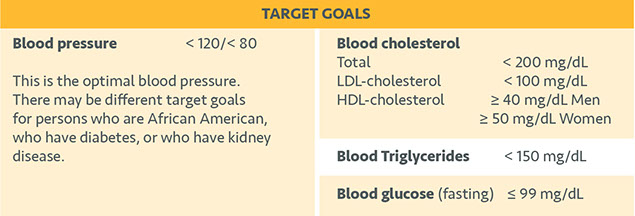
    Track and control your blood pressure and blood levels for cholesterol, triglycerides, and glucose. Discuss with your doctor what your target numbers should be based on your personal health and risk factors.

    Health at Home Lifetime book by the American Institute for Preventive Medicine. www.HealthyLife.com. All rights reserved.

    © American Institute for Preventive Medicine

  • Kidney Stones

    Abdominal & Urinary Conditions

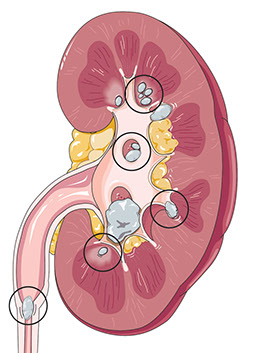
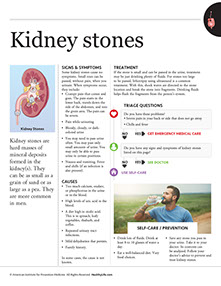
    Kidney stones are hard masses of mineral deposits formed in the kidney(s). They can be as small as a tiny pebble or an inch or more across. They are more common in men.

    Illustration of kidney stones.

    Kidney Stones

    Signs & Symptoms

    Some kidney stones cause no symptoms. Small ones can be passed, without pain, when you urinate. When symptoms occur, they include:

    *  Crampy pain that comes and goes. The pain starts in the lower back, travels down the side of the abdomen, and into the groin area. The pain can be severe.

    *  Bloody, cloudy, or dark-colored urine.

    *  You may need to pass urine often. You may pass only small amounts of urine. You may only be able to pass urine in certain positions.

    *  Nausea and vomiting. Fever and chills (if an infection is also present).

    Causes

    *  Too much calcium in the urine or in the blood.

    *  High levels of uric acid in the blood.

    *  A diet high in oxalic acid. This is in spinach, leafy vegetables, rhubarb, and coffee.

    *  Repeated urinary tract infections.

    *  Mild dehydration that persists.

    *  Family history of kidney stones.

    *  Living in certain parts of the U.S. Areas of the southeast have the highest rates.

    In some cases, the cause is not known.

    Treatment

    If the stone is small and can be passed in the urine, treatment may be just drinking plenty of fluids. For stones too large to be passed, lithotripsy using ultrasound is a common treatment. With this, shock waves are directed to the stone location and break the stone into fragments. Drinking fluids helps flush the fragments from the person’s system.

    Questions to Ask

    Self-Care / Prevention

    *  Drink lots of fluids. Drink at least 8 to 10 glasses of water a day.

    *  Eat a well-balanced diet. Vary food choices.

    *  Save any stone you pass in your urine. Take it to your doctor. Its contents can be analyzed. Follow your doctor’s advice to prevent and treat kidney stones.

    Healthier at Home book by the American Institute for Preventive Medicine. www.HealthyLife.com. All rights reserved.

    © American Institute for Preventive Medicine

  • Jock Itch

    Men’s Health

    Jock itch is an infection of the skin on the groin and upper inner thigh areas.

    Signs & Symptoms

    *  Redness.

    *  Itching.

    *  Raised red rash with borders. Center areas of the rash are dry with small scales.

    Causes

    Jock itch is usually caused by a fungus. It can also result from garments that irritate the skin. Jock itch is more likely to occur after taking antibiotics or steroids, or in persons who have diabetes or a weakened immune system.

    Treatment

    Over-the-counter antifungal creams treat most cases of jock itch. Stronger creams or an oral medicine can be prescribed, if needed.

    Questions to Ask

    Self-Care / Prevention

    To Treat Jock Itch

    *  Use over-the-counter antifungal cream, powder, or lotion for jock itch. Follow package directions.

    To Prevent Jock Itch

    *  Don’t wear tight, close-fitting clothing. Wear boxer shorts, not briefs. Put socks on before underwear. Fungus on the feet, such as from athlete’s foot can transfer to the groin. Change underwear often, especially after tasks that leave you hot and sweaty.

    *  Bathe or shower right after a workout. Don’t use antibacterial soaps. Dry the groin area well.

    *  Apply talc or other powder to the groin area to help keep it dry. If you sweat a lot or are very overweight, use a drying powder with miconazole nitrate.

    *  Wash workout clothes after each wearing. Don’t store damp clothing in a locker or gym bag.

    *  Sleep in the nude or in a nightshirt.

    *  Don’t share towels or clothes that have come in contact with the rash.

    Healthier at Home book by the American Institute for Preventive Medicine. www.HealthyLife.com. All rights reserved.

    © American Institute for Preventive Medicine

  • Eye Irritations & Injuries

    Eye Conditions

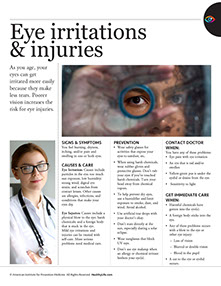
    As you age, your eyes can get irritated more easily because they make less tears. Poorer vision increases the risk for eye injuries.

    Signs & Symptoms

    You feel burning, dryness, itching, and/or pain and swelling in one or both eyes.

    Causes

    For Eye Irritation:

    Causes include particles in the eye; too much sun exposure, low humidity; strong wind; and scratches from contact lenses. Other causes are allergies, infections, and conditions that make your eyes dry.

    For Eye Injuries:

    Causes include a physical blow to the eye; harsh chemicals; and a foreign body that is stuck in the eye.

    Mild eye irritations and injuries can be treated with self-care. More serious problems need medical care.

    Treatment

    *  Wear safety glasses for activities that expose your eyes to sawdust, etc.

    *  When using harsh chemicals, wear rubber gloves and protective glasses. Don’t rub your eyes if you’ve touched harsh chemicals. Turn your head away from chemical vapors.

    *  To help prevent dry eyes, use a humidifier and limit exposure to smoke, dust, and wind. Avoid alcohol.

    *  Use artificial tear drops with your doctor’s okay.

    *  Don’t stare directly at the sun, especially during a solar eclipse.

    *  Wear sunglasses that block UV rays.

    *  Don’t use eye makeup when an allergy or chemical irritant bothers your eye(s).

    Self-Care / Prevention

    To Ease the Discomfort of Dry Eyes:

    With your doctor’s okay, use over-the-counter artificial tear drops, such as Ocu-Lube. Read the label. Refrigerate the solution, if needed. Wash your hands before using.

    To Treat an Insect Bite Without a Severe Allergic Reaction:

    *  Wash the eye(s) with warm water.

    *  Take an antihistamine if okay with your doctor.

    To Remove a Foreign Particle On the White of the Eye or Inside the Eyelids:

    *  Do not remove an object imbedded in the eye, a metal chip, or a foreign body over the colored part of the eye. (See “First Aid for Foreign Body Sticking Into the Eye” on this page.)

    *  Wash your hands.

    *  If the foreign object is under the upper lid, have the person look down and pull the upper lid away from the eyeball by gently grabbing the eyelashes. Press a cotton-tipped swab down on the skin surface of the upper eyelid and pull it up and toward the brow. The upper lid will invert. Touch and remove the debris with the tip of the tissue.

    *  Twist a piece of tissue, moisten the tip with tap water (not saliva) and gently try to touch the speck with the tip. Carefully pass the tissue over the speck, which should cling to the tip.

    *  Do not rub the eye or use tweezers or anything sharp to remove a foreign object.

    *  Gently wash the eye with cool water.

    To Treat a Bruise from a Minor Injury that Surrounds the Eye but Does Not Damage the Eye Itself:

    *  Put a cold compress over the injured area right away. Keep doing this for 15 minutes, every hour, for 48 hours.

    *  Take an over-the-counter medicine

    *  After 48 hours, put a warm compress over the injured area.

    *  Seek medical attention if these measures do not help.

    First Aid for Foreign Body Sticking Into the Eye Before Immediate Care:

    *  Do not remove the object.

    *  Don’t press on, touch, or rub the eye.

    *  Cover the injured eye with a paper cup or other clean object that will not touch the eye or the foreign object. Hold the paper cup in place with tape without putting pressure on the eye or the foreign object.

    *  Gently cover the uninjured eye with a clean bandage and tape, too, to keep the injured eye still.

    First Aid for Harmful Chemicals in the Eye(s) Before Immediate Care:

    *  Flush the eye(s) with water immediately!

    *  Hold the injured eye open with your thumb and forefinger.

    *  At the faucet or with a pitcher or other clean container, flush the eye with a lot of water. Start at the inside corner and pour downward to the outside corner. This lets the water drain away from the body and keeps it from getting in the other eye.

    *  Keep pouring the water for 10 to 30 or more minutes. Flush the eye with water until you get medical help.

    *  If both eyes are injured, pour water over both eyes at the same time or quickly alternate the above procedure from one eye to another. Or, place the victim’s face in a sink or container filled with water. Tell the victim to move his or her eyelids up and down and remove the face from the water at intervals in order to breathe. Use this method on yourself if you are the victim and are alone.

    *  Loosely bandage the eye with sterile cloth and tape. Don’t touch the eye.

    When to Seek Medical Care

    Contact Doctor When:

    You have any of these problems:

    *  Eye pain with eye irritation

    *  An eye that is red and/or swollen

    *  Yellow-green pus is under the eyelid or drains from the eye.

    Get Immediate Care When:

    *  Harmful chemicals have gotten into the eye(s). {Note: Before you get immediate care, give “First Aid for Harmful Chemicals in the Eye(s) Before Immediate Care” on this page.}

    *  A foreign body sticks into the eye. {Note: See “First Aid for Foreign Body Sticking Into the Eye Before Immediate Care” on this page.}

    *  A cut to the eye or eyelid occurs.

    *  Any of these problems occurs with a blow to the eye or other eye injury:

    – Loss of vision

    – Blurred or double vision

    – Blood in the pupil

    Healthier at Home book by the American Institute for Preventive Medicine. www.HealthyLife.com. All rights reserved.

    © American Institute for Preventive Medicine

  • Insomnia 2

    General Health Conditions

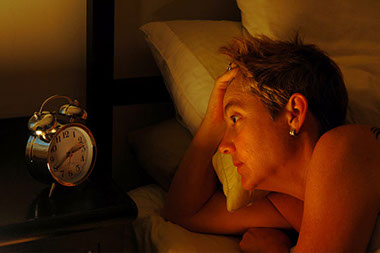
    Image of woman in bed awake at 2:40am.

    Do You Have Insomnia?

    Answer these questions:

    1. Do you have trouble falling asleep?

    2. Do you have problems staying asleep?

    3. Do you wake up too early and can’t get back to sleep?

    4. Do any of these problems last at least 3 weeks?

    If you answered yes to number 4, answer these questions about problems that occur when you are awake:

    5. Do you feel like you do not get enough refreshing sleep?

    6. Do you yawn and feel tired?

    7. Do you lack energy or have fatigue?

    8. Do you have a hard time concentrating?

    9. Do you feel depressed and/or cranky?

    If you answered yes to question number 4 and yes to any question from number 5 through 9, you could have insomnia.

    Why You Need Sleep

    Getting enough sleep and good quality sleep helps you maintain good health and function your best during the day. You need sleep to:

    *  Have energy.

    *  Think clearly.

    *  React quickly.

    *  Be productive.

    *  Learn and remember things.

    *  Help your immune system fight infections.

    According to the National Sleep Foundation, about 50% of adults in the U.S. have problems with sleep at least a few nights a week. And recent studies find that the average person gets less than 6 hours of sleep per night. (On average, adults need at least 7 to 8 hours of sleep each night.)

    A lack of sleep or getting poor quality sleep can lead to a wide range of health problems.

    Health Problems from a Lack of Sleep

    *  Anxiety, depression, and alcohol abuse.

    *  Obesity.

    *  Heart disease.

    *  High blood pressure.

    *  Diabetes.

    *  Stroke.

    *  Gum disease.

    *  Accidents and an increased risk for injury and death. About 20% of all serious car crashes are linked to driver sleepiness. Also, workers with severe insomnia make 2½ times more serious work errors than persons who get proper sleep.

    Getting enough, quality sleep is as vital to good heath and long life as are healthy eating and regular exercise.

    Do’s & Don’ts for Insomnia

    Do’s

    *  Do regular exercise daily. Physical activity releases muscle tension, relieves anger, and improves mood.

    *  Do mild exercises four or more hours before bedtime.

    *  Do relaxation exercises as needed throughout the day and before you go to bed.

    *  Follow a regular daily schedule for meals and snacks.

    *  Choose larger meals at breakfast and lunch than at dinner. At each meal, have complex carbohydrate foods, such as whole-grain breads and cereals, fruits and vegetables.

    *  Limit caffeine to 300 milligrams (mgs.) a day. More than 500 to 600 mgs. a day may cause you to be anxious, nervous, and makes it harder to sleep well.

    *  Cut down on caffeine gradually. Daily usage of caffeine can result in physical dependence. If caffeine is stopped abruptly, withdrawal symptoms can occur. These include headache, feeling down, having a hard time concentrating, and fatigue.

    Don’ts

    *  Don’t do vigorous exercise within six hours of going to bed.

    *  Don’t have large meals near bedtime. These may keep you awake, especially if you have heartburn or a similar problem.

    *  Don’t have caffeine for 6 hours before bedtime.

    HealthyLife SleepWell by the American Institute for Preventive Medicine. www.HealthyLife.com. All rights reserved.

    © American Institute for Preventive Medicine

  • Insomnia

    Women’s Health

    Insomnia is having trouble falling asleep. It can last from a single night to a few weeks. It can occur from time to time or be a chronic problem.

    Signs & Symptoms

    *  Waking up during the night and not being able to get back to sleep.

    *  Waking up too early.

    *  Not getting enough sleep or getting poor quality sleep.

    *  Fatigue or feeling drowsy during the day because of lack of sleep.

    Causes

    *  Too much caffeine or having it before bedtime.

    *  Changes in sleep/wake schedules, such as work shift changes and jet lag.

    *  Going to bed with a full bladder or any problem that causes you to urinate or have a bowel movement during the night.

    *  Too much noise when you fall asleep. This includes a snoring partner.

    *  Menopausal symptoms, such as hot flashes.

    *  A lack of physical exercise.

    *  Lack of a sex partner.

    *  Side effects of some medicines, such as decongestants, corticosteroids, and stay-awake pills.

    *  Emotional stress. Depression. Anxiety.

    *  Posttraumatic Stress Disorder (PTSD).

    *  Fibromyalgia.

    *  Any condition, illness, injury, or surgery that causes pain and/or discomfort which interrupts sleep.

    *  Asthma, allergies, and early-morning wheezing.

    *  An overactive thyroid gland.

    *  Heart or lung conditions that cause shortness of breath when lying down.

    Treatment

    *  Self-care and prevention measures.

    *  Treating the problem.

    *  Prescribed short-acting sleeping pills.

    Questions to Ask

    Self-Care / Prevention

    *  Avoid caffeine for 8 hours before bedtime. Caffeine is in coffee, tea, chocolate, colas, and some other soft drinks. Check labels for caffeine content in over-the-counter medicines.

    *  Avoid long naps during the day.

    *  Have no more than 1 alcoholic drink with or after dinner. Even though alcohol is a sedative, it can disrupt sleep. Check with your doctor about using any alcohol if you are taking medicines.

    *  An hour or two before going to bed, dim the lights in the house.

    *  Before you go to bed, have food items rich in the amino acid L-tryptophan, such as milk, turkey, or tuna fish. Do not take L-tryptophan supplements, though. Eating foods with carbohydrates, such as cereal, breads, and fruits, may help as well.

    *  Do regular exercise, but not within a few hours of going to bed.

    *  Before bedtime, take a warm bath or read a book or do some type of repetitive, calm activity. Avoid things that hold your attention, such as watching a suspense movie.

    *  Keep your bedroom quiet, dark, and comfortable. Use clean, fresh sheets and pillows. Keep the room temperature neither too warm nor too cool.

    *  Ban worry from the bedroom. Don’t rehash the mistakes of the day as you toss and turn.

    *  Follow a regular bedtime routine. Lock or check doors and windows, brush your teeth, etc.

    *  Count sheep! Picturing a repeated image may bore you to sleep.

    *  Listen to recordings that help promote sleep. Look for them at a library or bookstore.

    *  If you’ve tried to fall asleep, but are still awake after 30 minutes, get out of bed. Read a relaxing book or sit quietly in the dark. Do this for about 20 minutes. Then go back to bed. Repeat this as many times as you need to until you are able to fall asleep.

    *  Take over-the-counter sleep aids (e.g., melatonin, Tylenol PM, etc.) as advised by your doctor. Don’t take anyone else’s sleeping pills.

    Resources

    National Center on Sleep Disorders Research

    www.nhlbi.nih.gov/about/ncsdr

    National Sleep Foundation

    www.sleepfoundation.org

    Women's Self-Care book by the American Institute for Preventive Medicine. www.HealthyLife.com. All rights reserved.

    © American Institute for Preventive Medicine