Blog

  • Heart Health Basics

    Heart & Circulation Problems

    Risk Factors

    Risk Factors You Can’t Change

    *  You have had a heart attack or stroke.

    *  Being male 45 years+ or female 55 years+

    *  Heart disease in a father or brother before age 55; in a mother or sister before age 65

    *  African Americans, Mexican Americans, and American Indians have a higher risk than Caucasians.

    Risk Factors You Can Control

    *  Cigarette smoking. Secondhand smoke.

    *  Blood pressure ≥ 140/90 mm Hg or you take medicine to lower high blood pressure

    *  High risk levels for LDL (bad) cholesterol, HDL (good) cholesterol, and/or triglycerides

    *  Diabetes

    *  Being overweight. Lack of exercise.

    *  Other artery diseases (abdominal aortic aneurysm, carotid artery disease; peripheral artery disease)

    *  Metabolic syndrome. This is having 3 or more of these problems:

    – Waist size ≥ 40 inches for men; ≥ 35 inches for women

    – Blood pressure ≥ 130 mm Hg systolic and/or ≥ 85 mm Hg diastotic or you take medicine to lower blood pressure

    – A fasting blood sugar ≥ 100 mg/dL or you have diabetes

    – Triglycerides ≥ 150 mg/dL

    – HDL-cholesterol < 40 mg/dL for men; < 50 mg/dL for women

    Heart Conditions

    Coronary Artery Disease (CAD)

    Heart disease is a common term for coronary artery disease (CAD). It is the leading cause of death in the U.S. for both men and women. With heart disease, arteries that supply blood to the heart become clogged with deposits called plaque. Cholesterol is part of the plaque. Over time, the buildup of plaque restricts blood flow to the heart. This can cause the problems that follow.

    Illustration of a healthy artery vs a clogging artery.

    Heart Failure (HF)

    With this, the heart itself doesn’t fail. It “fails” to supply enough blood and oxygen for the body’s needs. This develops over time. It becomes a chronic problem.

    Symptoms of Heart Failure

    *  Shortness of breath

    *  Feeling very tired or weak

    *  Swelling in the lower legs, ankles and feet. Shoes can feel too tight all of a sudden.

    *  Rapid weight gain

    *  Dry cough or one with pink, frothy mucus

    *  Fast heartbeat

    Angina

    With this, the heart muscle does not get enough blood and oxygen needed for a given level of work. Symptoms include:

    *  Pain, discomfort or a squeezing pressure in the chest

    *  Aching in a tooth, an arm, a jaw, or in the neck

    Symptoms may come when you get angry or excited. They are more likely to come when you exert yourself (climb a hill, run to catch a bus, etc.). They usually go away with rest and/or nitroglycerin. This is medicine a doctor prescribes.

    {Note: Angina symptoms can also be signs of a heart attack. (See the next panel.) A heart attack damages the heart muscle. Angina does not.}

    Heart Attack

    With this, the heart doesn’t get enough blood for a period of time. Part or all of the heart muscle dies. A heart attack can occur with heavy activity. It can occur at rest or during sleep, too. Heart attack warning signs are given on this page.

    Heart Attack Warning Signs

    For any heart attack warning sign, call 9-1-1 or your local EMS.

    Common Heart Attack Warning Signs

    *  Feeling of pain (may spread to the arm, neck, jaw, tooth, or back), tightness, burning, squeezing, fullness, or heaviness in the chest that lasts more than a few minutes or goes away and comes back

    *  Chest discomfort with fainting, shortness of breath, lightheadedness, nausea, or sweating. Unusal chest, abdominal, or stomach pain.

    *  Dizziness, nausea, trouble breathing, or arm or jaw pain without chest pain

    *  Fast or uneven heartbeat or pulse; sweating for no reason; or pale, gray, or clammy skin
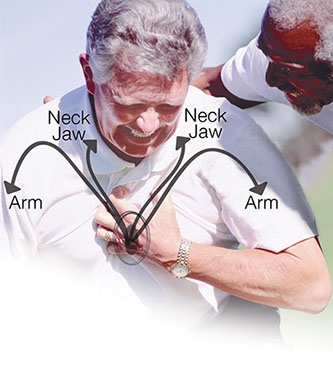
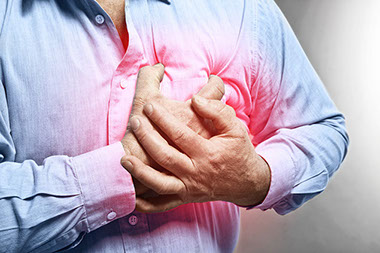
    Image of a man having a heart attack.

    Signs More Likely to Occur in Women

    *  An uneasy feeling in the chest with any problem listed above or with: Unexplained or extreme anxiety; unusual fatigue or weakness; fluttering hearbeats; or severe indigestion that does not go away with an antacid

    Heart Health Tips

    *  Get regular medical checkups. Get your blood pressure checked at each office visit or at least   every 2 years. Get your blood cholesterol tested at least every 5 years (yearly if you have heart disease or diabetes).

    *  Don’t smoke. If you smoke, quit.

    *  Get to or stay at a healthy body weight.

    *  Take medicines as prescribed.

    *  Ask your doctor about taking a low dose of aspirin (e.g., 1 baby aspirin) daily.

    *  If you have diabetes, follow your treatment plan. If you don’t have diabetes, learn how to prevent and detect it fromwww.diabetes.org.

    *  Manage anger, anxiety, depression, and stress.

    *  Nurture your heart with healthy emotions and a strong support system from family and friends.

    Tips to Deal With Stress

    Stress makes the heart work harder. Stress raises blood cholesterol. Also, people who respond to stress in a hostile, angry way tend to suffer more heart attacks.

    *  Learn ways to relax, like deep breathing.

    *  Balance work and play.

    *  Control negative thinking.

    *  Don’t let emotions get “bottled up.”

    *  Laugh more.

    *  Avoid needless quarrels.

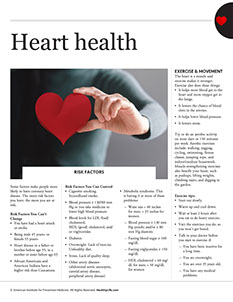
    Exercise

    Aim to do an aerobic activity at least 20 minutes a day. Do this 5 or more days a week. The goal during an aerobic workout is to reach your target heart rate. Even moderate levels of exercise will be good for the heart.

    Body builders work out to make muscles in their bodies stronger. The heart is a muscle. Exercise makes it stronger, too. Exercise also does these things:

    *  It helps more blood get to the heart and more oxygen get to the lungs.

    *  It lowers the chance of blood clots in the arteries.

    *  It helps lower blood pressure.

    *  It lowers stress.

    The best exercise for the heart is one that makes it beat faster and helps the lungs take in more oxygen. This is called aerobic exercise. Aerobic exercises include:

    *  Walking fast

    *  Step aerobics

    *  Jumping rope

    *  Cross country skiing

    *  Jogging

    Target Heart Rate

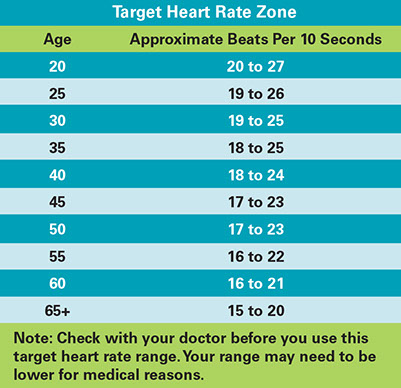
    This is 60-80% of your maximum heart rate. If you reach your target heart rate during the

    aerobic part of your workout, your pace is good.*

    To find out if you reach your target heart rate, check your pulse. Check it 10 minutes after you start your workout.

    *  Place your fingers (not your thumbs) on one side of your neck below your jawbone. Or, check it on the inside of your wrist.

    *  Count the number of tiny beats you feel in 10 seconds.

    *  Find the line with your age (or the closest one to it) in the “Target Heart Rate Zone” box.

    *  Is the number of beats you counted in 10 seconds in the range of numbers on the line next to your age? If so, you have reached your target heart rate.
    Resources

    American Heart Association

    800.242.8721

    www.heart.org/HEARTORG

    National Heart, Lung, and Blood Institute
    www.nhlbi.nih.gov

    Heart Health brochure by the American Institute for Preventive Medicine. www.HealthyLife.com. All rights reserved.

    © American Institute for Preventive Medicine
  • Heart Health & The Health Of The Earth

    Heart & Circulation Problems

    Man checking heart rate on smart watch.

    *  Lowering your risk for heart disease isn’t just about eating healthy. To reduce your risk of a heart attack (and stroke), the EPA recommends that you:

    – Avoid secondhand smoke and reduce your exposure to traffic exhaust and air pollution.

    – Avoid carbon monoxide poisoning by properly venting your gas stove, furnace, dryer and other appliances.

    – Never leave a car running in a closed garage.

    – Reduce your use of household chemicals. When you do use them, make sure your work area is well-ventilated.

    *  Eat less meat and more plant-based foods.

    *  Buy and eat whole, unprocessed foods and from local growers whenever you can. Energy and water are needed (and waste is created) to make, package, and distribute packaged and processed foods. Most often, these foods cost more and also have excess salt, which can increase the risk for high blood pressure.

    Health at Home Lifetime book by the American Institute for Preventive Medicine. www.HealthyLife.com. All rights reserved.

    © American Institute for Preventive Medicine

  • Heart Failure

    Heart & Circulation Problems

    The heart is the body’s pump. When it can’t pump well enough to meet the body’s needs, it is called heart failure (HF). The heart itself doesn’t fail, but “fails” to supply the body with enough blood and oxygen. The pumping action of the heart decreases. Blood flow slows down. This causes excess fluid (edema) in tissues throughout the body. The term congestive heart failure, used in the past, is due to the excess fluid or congestion. Heart failure needs a doctor’s diagnosis and care!

    Signs & Symptoms

    *  Shortness of breath.

    *  Feeling very tired or weak.

    *  Dry cough or a cough with pink, frothy mucus.

    *  Swelling of the lower legs, ankles, and feet. Your shoes can suddenly feel too tight.

    *  Decreased appetite and nausea.

    *  Rapid weight gain over several days or weeks without an increase in food intake. You could gain up to 1 pound a day.

    *  A fast heartbeat. Sometimes the heartbeat is irregular.

    *  Feeling anxious or restless.

    *  A feeling of suffocation. This is caused by fluid that collects in the lungs. It can be difficult to lie flat. You may need to sleep on 2 or more pillows. You may wake up suddenly from sleep feeling short of breath.

    Causes

    Anything that damages the heart muscle or makes it work too hard can cause heart failure. This includes:

    *  One or more heart attacks. This is the number 1 cause.

    *  Advanced coronary artery disease.

    *  High blood pressure that is not controlled.

    *  High blood pressure in the lungs (pulmonary hypertension).

    *  Alcohol and/or drug abuse.

    *  Severe or chronic lung disease (e.g., emphysema).

    *  Diabetes, especially if it is poorly controlled.

    *  Pericarditis. This is a swelling or thickening of the lining that surrounds the heart. This can restrict the heart’s pumping action.

    *  Abnormal heart valves. Causes include rheumatic heart disease and heart defects present at birth.

    *  Abnormal heart rhythm.

    *  A viral infection. This is rare and happens only if the infection affects the heart and causes cardiomyopathy, a muscle disease of the heart.

    Diagnosis

    Ways to Diagnose Heart Failure:

    *  A medical history and physical exam. Blood and urine tests.

    *  A chest X-ray to see if the heart is enlarged and if the lungs are congested.

    *  An ECG (also called EKG) to look for an enlarged heart, heart muscle damage, and abnormal heart rhythms.

    *  An echocardiogram. This test uses sound waves to show the heart’s size, shape, and movement.

    *  An exercise stress test.

    *  A cardiac catheterization. This test diagnoses coronary artery disease and checks for past heart attacks.

    Self-Care / Prevention

    Some causes of heart failure can be prevented. These include heart attacks, coronary artery disease, high blood pressure, rheumatic fever, and substance abuse.

    To Prevent Heart Attacks and Coronary Artery Disease:

    *  Don’t smoke. If you smoke, quit!

    *  Have regular medical checkups. Get your blood pressure checked at each office visit or at least every 2 years. Get your blood cholesterol tested as advised by your doctor.

    *  Take all medicines as prescribed. These include ones for high blood pressure, etc.

    *  Ask your provider about taking a low dose of aspirin (e.g., 1 baby aspirin) daily.

    *  Get to or stay at a healthy body weight.

    *  Strictly limit or avoid alcohol.

    *  Do regular physical activity. {Note: Talk to your health care provider before you start an exercise program. This is important if you have been inactive for a long period of time, are overweight, are over age 35, or have any medical problems.}

    *  Get a test to screen for diabetes as advised by your doctor. Having diabetes and high blood cholesterol increase the risk for heart disease.

    Self-Care

    *  Weigh yourself daily to check for excess fluid weight gain. Keep a record of what you weigh. Take it with you when you visit your health care provider. Call your provider, though, if your weight increases suddenly (3 or more pounds in 1 day).

    *  Limit sodium (part of salt) to about 2,000 milligrams per day.

    *  Limit fluids as advised by your health care provider.

    *  Have 5 to 6 small (instead of 3 large) meals a day.

    *  Stay as active as you can.

    *  Do not have more than one alcoholic drink a day, if at all. One drink equals 4 to 5 oz. of wine; 12 oz. of beer; or 1-1⁄2 oz. of 80 proof liquor.

    *  Eat healthy.

    *  Exercise on a regular basis as advised by your health care provider.

    *  Modify your daily activities as needed so you don’t place too heavy a demand on your heart. Alternate activity with periods of rest.

    *  Sit up when you rest, if this makes breathing easier. Sleep on 2 or more pillows and/or raise the head of your bed 6 inches when you sleep.

    *  Don’t smoke. If you do, quit!

    *  Lose weight if you are overweight.

    *  Follow your health care provider’s treatment program. Take your medication(s) as prescribed.

    Medical Care

    Call Health Care Provider For:

    *  A new onset of shortness of breath or fatigue when you do your normal activities or lie down.

    *  A new onset of swelling in the ankles and feet and it is harder to breathe when you lie down flat.

    *  Coughing up pink or frothy mucus with mild shortness of breath.

    *  An unexplained weight gain of 3 to 5 pounds.

    *  Having heart failure and you have symptoms of a cold or flu. These may add stress to your heart.

    *  Having heart failure and your symptoms worsen.

    Get Immediate Care For:

    *  Severe shortness of breath (you are too short of breath to say a few words) with or without wheezing (a high pitched whistling sound).

    *Heart Attack Warning Signs

    Resources

    American Heart Association

    800.242.8721

    www.heart.org/HEARTORG

    National Heart, Lung, and Blood Institute

    www.nhlbi.nih.gov

    Heart Failure brochure by the American Institute for Preventive Medicine. www.HealthyLife.com. All rights reserved.

    © American Institute for Preventive Medicine

  • Heart Disease

    Heart & Circulation Problems

    Heart disease is a common term for coronary artery disease (CAD). It is the number one cause of death in the U.S. in both men and women. With heart disease, arteries that supply blood to the heart become hardened and narrowed. Heart disease can lead to these problems:

    *  Angina. With this, the heart muscle does not get as much blood and oxygen as it needs for a given level of work. A heart attack damages the heart muscle. Angina does not. It is a warning sign that a heart attack could occur, though.

    *  Heart attack.

    *  Heart failure (HF). With this, the heart “fails” to supply the body with enough blood and oxygen for its needs. This develops slowly. It becomes chronic.

    Signs & Symptoms

    *  Symptoms of angina are pain, discomfort, or a squeezing pressure in the chest. Aching in a tooth, jaw, or neck can also occur. Symptoms usually go away with rest and/or nitroglycerin. Angina attacks may occur with anger, excitement, or exertion, such as walking up a hill.

    *  Symptoms of a heart attack.

    *  Symptoms of heart failure are: Shortness of breath; feeling very tired or weak; swelling in the lower legs, ankles, and feet; dry cough or one with pink, frothy mucus; rapid weight gain; and a fast heart beat.

    Causes

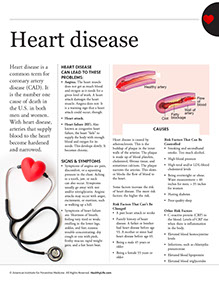
    Illustration of healthy artery vs a clogging artery.

    Heart disease is caused by atherosclerosis. This is the buildup of plaque in the inner walls of the arteries. The plaque is made up of blood platelets, cholesterol, fibrous tissue, and sometimes calcium. The plaque narrows the arteries. This slows or blocks the flow of blood to the heart.

    Some factors increase the risk of heart disease. The more risk factors; the higher the risk.

    Risk Factors That Can’t Be Changed

    *  A past heart attack or stroke.

    *  Being a male 45 years or older.

    *  Being a female 55 years or older.

    *  Family history of heart disease:

    – A father or brother had heart disease before age 55.

    – A mother or sister had heart disease before age 65.

    Risk Factors That Can Be Controlled

    *  High blood pressure.

    *  High-risk blood cholesterol levels.

    *  Smoking.

    *  Being overweight or obese.

    *  Lack of physical activity.

    *  Having diabetes and high total and/or LDL (bad) cholesterol.

    *  Using cocaine or amphetamines.

    *  Metabolic syndrome.

    Other Factors that May Play a Role in Heart Disease

    *  Waist measurement > 40 inches for men; > 35 inches for women.

    *  C-reactive protein (CRP) in the blood. Levels of CRP rise when there is inflammation in the body.

    *  Elevated blood homocysteine levels.

    *  Infections, such as chlamydia pneumoniae.

    *  Elevated blood lipoprotein (a).

    *  Elevated blood triglycerides.

    Treatment

    The goals of treatment are to relieve symptoms, control or reduce risk factors, stop or slow further damage to the arteries, and prevent and treat cardiac events. Treatment includes:

    *  Self-Care / Prevention measures on this page.

    *  Medications.

    *  Procedures to open blocked or narrowed arteries or bypass them.

    *  Cardiac rehabilitation (rehab).

    Questions to Ask

    Self-Care / Prevention

    *  Have regular medical checkups. Get your blood pressure checked at each office visit or or as advised by your doctor. Get your blood cholesterol tested regularly, as advised by your doctor.

    *  Don’t smoke. If you smoke, quit.

    *  Get to or stay at a healthy weight.

    *  Take all medications as prescribed.

    *  If you are 50 to 69 years old, ask your doctor about the benefits and harms of aspirin therapy (e.g., 1 low-dose aspirin daily) to help prevent cardiovascular disease.

    *  See your doctor if you have any of the Signs & Symptoms of Diabetes.

    *  Follow a diet low in saturated fats, trans fats, and cholesterol. Limit sodium to 1,500 to 2,400 milligrams per day. Follow theDASH Eating Plan.

    *  Get regular exercise. Follow your doctor’s advice.

    *  Manage stress. Practice relaxation techniques.

    *  If you drink alcohol, do so in moderation. Too much alcohol can raise the risk for high blood pressure, heart disease, stroke, and other health problems. Moderate drinking, may be linked to a lower risk of coronary heart disease in some persons. Moderation means no more than 2 drinks a day for men; 1 drink a day for women and persons age 65 and older. One drink = 5 oz. of wine; 12 oz. of beer; or 1-1/2 oz. of 80-proof liquor.

    *  Ask your doctor how much, if any, alcohol you should drink.

    *  Get your doctor’s advice about taking vitamins, minerals, and herbal products.

    Metabolic Syndrome

    Metabolic Syndrome is having at least three of these five conditions:

    1.  Abdominal obesity. Waist measurement for this varies according to sex and ethnic group. Ask your doctor.

    2.  High triglycerides:* ≥ 150 mg/dL

    3.  Low HDL-cholesterol:* < 40 mg/dL for males; < 50 mg/dL for females

    4.  High blood pressure:* ≤ 140 mm Hg systolic and/or ≤ 90 mm Hg diastolic

    5.  High fasting glucose:* ≥ 100 mg/dL

    * Or taking medication to treat this condition.

    Resources

    The American Heart Association

    800.AHA.USA1 (242.8721)

    www.heart.org/HEARTORG

    National Heart, Lung, and Blood Institute (NHLBI)

    www.nhlbi.nih.gov

    Healthier at Home book by the American Institute for Preventive Medicine. www.HealthyLife.com. All rights reserved.

    © American Institute for Preventive Medicine
  • Heart Attack

    First Aid

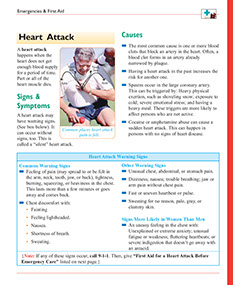
    A heart attack happens when the heart does not get enough blood supply for a period of time. Part or all of the heart muscle dies.

    Signs, Symptoms & Causes

    Close up image of man holding chest in pain.

    A heart attack may have warning signs. It can occur without signs, too. This is called a “silent” heart attack.

    Causes

    *  The most common cause is one or more blood clots that block an artery in the heart. Often, a blood clot forms in an artery already narrowed by plaque.

    *  Having a heart attack in the past increases the risk for another one.

    *  Spasms occur in the large coronary artery. This can be triggered by: Heavy physical exertion, such as shoveling snow; exposure to cold; severe emotional stress; and having a heavy meal. These triggers are more likely to affect persons who are not active.

    *  Cocaine or amphetamine abuse can cause a sudden heart attack. This can happen in persons with no signs of heart disease.

    Warning Signs

    Note: If any of these signs occur, call 9-1-1.

    Common Warning Signs

    *  Feeling of pain (may spread to or be felt in the arm, neck, tooth, jaw, or back), tightness, burning, squeezing, or heaviness in the chest. This lasts more than a few minutes or goes away and comes back.

    *  Chest discomfort with:

    – Fainting

    – Feeling lightheaded.

    – Nausea.

    – Shortness of breath.

    – Sweating.

    Other Warning Signs

    *  Unusual chest, abdominal, or stomach pain.

    *  Dizziness; nausea; trouble breathing; jaw or arm pain without chest pain.

    *  Fast or uneven heartbeat or pulse.

    *  Sweating for no reason, pale, gray, or clammy skin.

    Signs More Likely in Women Than Men

    An uneasy feeling in the chest with: Unexplained or extreme anxiety; unusual fatigue or weakness; fluttering heartbeats; or severe indigestion that doesn’t go away with an antacid.

    Treatment

    A heart attack is a medical emergency! Treatment works best when it is given within 1 to 2 hours after symptoms start. Treatment includes:

    *  Medicine(s) to keep blood from clotting.

    *  “Clot busters” to dissolve blood clots in heart arteries.

    *  Tests to diagnose the status of the heart and arteries.

    *  Angioplasty, stents, or bypass surgery, if needed.

    Prevention

    *  Follow prevention measures in Heart Disease.

    *  Take medications, as prescribed.

    *  Don’t shovel snow or carry heavy objects, especially if you are not physically fit.

    *  Don’t use amphetamines and/or cocaine.

    Questions to Ask

    Self-Care / Prevention

    Call 9-1-1 or your local rescue squad right away! Call when warning signs start. Don’t wait to see if the pain goes away.

    First Aid for a Heart Attack Before Emergency Care

    *  CHECK for a response. Do CPR, as needed.

    *  If the person uses and has nitroglycerin, place one tablet under the tongue. Give as many as 3 tablets in 10 minutes.

    *  Give the person a regular (325 mg.) aspirin or 4 children’s chewable aspirins (81 mg. each) to chew on. Give the aspirin after calling 9-1-1. Ask the 9-1-1 dispatcher if aspirin should be taken.

    {Note: Don’t use aspirin if the person is allergic to it or has a condition that makes using it risky.}

    *  If you can’t call 9-1-1, drive the person to the hospital right away. If you are having heart attack signs, don’t drive yourself unless you have no other choice.

    *  Loosen clothing around the neck, chest, and waist. Don’t let the person lie down, especially if he or she has breathing problems. A half-sitting position is better. Put the legs up. Bend them at the knees. Put a pillow or rolled towel under the knees. Support the back.

    *  Reassure the person that you have called for medical help and will stay with him or her until it arrives.

    *  After a heart attack, follow the doctor’s treatment plan.

    Healthier at Home book by the American Institute for Preventive Medicine. www.HealthyLife.com. All rights reserved.

    © American Institute for Preventive Medicine
  • Hearing Loss

    Ear, Nose & Throat Conditions

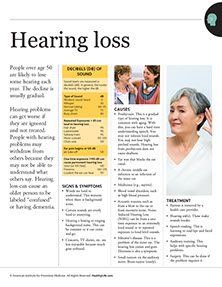
    People over age 50 are likely to lose some hearing each year. The decline is usually gradual. About 30% of adults age 65 through 74 and about 50% of those age 85 and older have hearing problems.

    Hearing problems can get worse if they are ignored and not treated. People with hearing problems may withdraw from others because they may not be able to understand what others say. Hearing loss can cause an older person to be labeled “confused” or “senile.”

    Signs & Symptoms

    *  Words are hard to understand. This worsens when there is background noise.

    *  Certain sounds are overly loud or annoying.

    *  Hearing a hissing or ringing background noise. This can be constant or it can come and go.

    *  Concerts, TV shows, etc. are less enjoyable because much goes unheard.

    Causes

    Presbycusis (prez-bee-KU-sis). This is a gradual type of hearing loss. It is common with aging. With this, you can have a hard time understanding speech. You may not tolerate loud sounds. You may not hear high pitched sounds. Hearing loss from presbycusis does not cause deafness.

    *  Ear wax that blocks the ear canal.

    *  A chronic middle ear infection or an infection of the inner ear.

    *  Medicines (e.g., aspirin).

    *  Blood vessel disorders, such as high blood pressure.

    *  Acoustic trauma, such as from a blow to the ear or from excessive noise. Noise-Induced Hearing Loss (NIHL) can be from a one-time exposure to an extremely loud sound or to repeated exposure to loud level sounds.

    *  Ménière’s disease. This is a problem of the inner ear. The hearing loss comes and goes. Dizziness is also a symptom.

    *  Small tumors on the auditory nerve. Brain tumor (rarely).

    Treatment

    *  Earwax is removed by a health care provider.

    *  Hearing aid(s). These make sounds louder.

    *  Speech reading. This is learning to read lips and facial expressions.

    *  Auditory training. This helps with specific hearing problems.

    *  Surgery. This can be done if the problem requires it.

    Questions to Ask

    Self-Care / Prevention

    For Gradual, Age-Related Hearing Loss

    *  Ask people to speak clearly, distinctly, and in a normal tone.

    *  Look at people when they are talking to you. Watch their expressions.

    *  Try to limit background noise when speaking with someone.

    *  In a church or theater, sit in the 3rd or 4th row with people sitting around you.

    *  Install a flasher or amplifier on your phone, door chime, and alarm clock.

    To Hear Sounds Better

    *  Use a hearing aid. There are many kinds. Examples are ones worn:

    – In-the-Ear (ITE).

    – Behind-the-Ear (BTE).

    – In-the-Canal (ITC).

    *  To find the hearing aid that works best for you, see an audiologist. Ask him or her about a trial period with different hearing aids to find one you are comfortable with.

    *  Use devices and listening systems that help you hear better when you use your telephone, mobile phone, TV, stereo, etc.

    To Clear Earwax

    Use only if the eardrum is not ruptured. Check with your doctor if you are not sure.

    *  Lie on your side. Using a syringe or medicine dropper, carefully squeeze a few drops of lukewarm water into your ear (or have someone else do this). Let the water remain there for 10 to 15 minutes and then shake it out. Now, squeeze a few drops of hydrogen peroxide, mineral oil, or an over-the-counter cleaner, such as Debrox, into the ear. Let the excess fluid flow out of the ear.

    *  After several minutes, put warm water in the ear again. Let it stay there for 10 to 15 minutes. Tilt the head to allow it to drain out of the ear.

    Repeat this entire procedure again in 3 hours if the earwax has not cleared.

    Resources

    American Speech-Language Hearing Association

    800.638.8255

    www.asha.org

    Better Hearing Institute

    800.EAR.WELL (327.9355)

    www.betterhearing.org

    Healthier at Home book by the American Institute for Preventive Medicine. www.HealthyLife.com. All rights reserved.

    © American Institute for Preventive Medicine

  • Planning A Healthy  Pregnancy

    Pregnancy & Prenatal Care

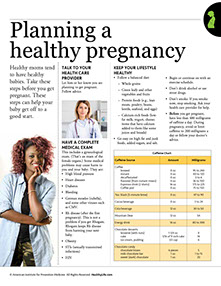
    Healthy moms tend to have healthy babies. Take the steps below before you get pregnant. These steps can help your baby get off to a good start:

    *  Talk to your health care provider. Let him or her know you are planning to get pregnant. Follow his or her advice.

    *  Have a complete medical exam. This includes a gynecological exam. (That’s an exam of the female organs.) Some medical problems may cause harm to you and your baby. They are:

    – High blood pressure

    – Heart diseases

    – Diabetes

    – Bleeding

    – German measles (rubella), and some other viruses such as CMV

    – Rh disease (after the first pregnancy). This is not a problem if you get Rhogam. Rhogam keeps Rh disease from harming your next baby.

    – Obesity

    – STDs (sexually transmitted diseases)

    – HIV

    *  Keep your lifestyle healthy.

    *  Follow a balanced diet. Eat plenty of: Whole grains; Green leafy and other vegetables; Fruits; Calcium-rich foods (low-fat milk, yogurt, cheese; items that have calcium added to them like some juices and breads)

    *  Go easy on: High-fat and junk foods; Refined sugars. Don’t load up on Kool-Aid, for example.; Salt

    *  Before you get pregnant, stop using or have less than 400 milligrams of caffeine a day. After you get pregnant, follow your doctor’s advice.

    *  Begin or keep on with an exercise schedule.

    *  Don’t drink alcohol or use street drugs.

    *  Don’t smoke. If you smoke now, stop smoking. Ask your health care provider for help.

    *  All females who plan to get pregnant or are able to get pregnant should take   400 to 800 micrograms (mcg) of folic acid every day. Folic acid is a B-vitamin. It may prevent certain birth defects, such as spina bifida. For this effect, you take it before conception and during the early months of pregnancy. Ask your health care provider which vitamin pills you should take to get the folic acid and other vitamins and minerals you need.

    *  Do you use an IUD or “the pill”? Change your birth control method. Do this 1 to 2 months before you try to get pregnant. Let 1 to 2 normal periods happen. Your cycle needs to return to normal. Use another form of birth control during this time. Condoms or a diaphragm are good choices.

    *  Use condoms if you think your partner may have sex with others.

    *  Check that all your immunizations are up-to-date. These protect you from disease. Ask your health care provider about them.

    *  Also, ask your health care provider before you take any medicines. That’s even for ones you can buy without a prescription.

    *  Seek prenatal care. Do this as soon as you think you are pregnant.

    *  Take care of medical problems.

    – Do you have a chronic one? That’s a problem that lasts a long time, or comes back often. If so, ask your health care provider how it could affect your pregnancy.

    – Do you take any medications? Ask your health care provider if you have to stop taking any medications before you get pregnant. Follow his or her advice. Don’t stop taking a prescription medication on your own.

    *  Consider genetic tests or genetic counseling. These are a good idea if:

    – You or your partner has a family history of genetic health problems. These are problems that are passed down through families. Examples are sickle cell anemia and cystic fibrosis.

    – You are 35 or older

    – Your partner is 50 or older

    Prenatal Self-Care book by the American Institute for Preventive Medicine. www.HealthyLife.com. All rights reserved.

    © American Institute for Preventive Medicine
  • Healthy Pregnancy Checklist

    Pregnancy & Prenatal Care

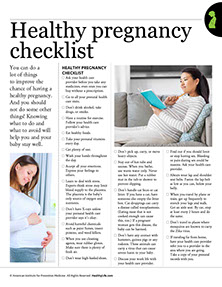
    You can do a lot of things to improve the chance of having a healthy pregnancy. And you should not do some other things! Knowing what to do and what to avoid will help you and your baby stay well.

    *  Ask your health care provider before you take any medicines, even ones you can buy without a prescription.

    *  Go to all your prenatal health care visits.

    *  Don’t drink alcohol, take drugs, or smoke. When you drink alcohol, smoke, or take drugs, your baby does, too!

    *  Have a routine for exercise. Follow your health care provider’s advice.

    *  Eat healthy foods.

    *  Take your prenatal vitamins (vitamin pills) every day. These also supply the minerals you need.

    *  Get plenty of rest.

    *  Wash your hands throughout the day.

    *  Accept all your emotions. Express your feelings to others.

    *  Learn to deal with stress. Experts think stress may limit blood supply to the placenta. The placenta is the baby’s only source of oxygen and nutrients.

    *  Don’t have X-rays unless your prenatal health care provider says it’s okay.

    *  Avoid harmful chemicals such as paint fumes, insect poisons, and weed killers. Ask your health care provider what else you should avoid.

    *  When you use cleaning agents, wear rubber gloves. Make sure there is plenty of fresh air.

    *  Don’t wear high-heeled shoes.

    *  Don’t pick up, carry, or move heavy objects.

    *  Stay out of hot tubs and saunas. When you bathe, use warm water only. Never use hot water. Put a rubber mat in the tub or shower to prevent slipping.

    *  Don’t handle cat feces or cat litter. If you have a cat, have someone else empty the litter box. Cat droppings can carry a disease called toxoplasmosis. (Eating meat that is not cooked enough can cause this, too.) If a pregnant woman gets this disease, the baby can be harmed. It’s okay to pet your cat.

    *  Don’t have any contact with hamsters, guinea pigs or any rodents. These animals can carry a virus that can cause severe harm to your baby.

    *  Discuss your work life with your health care provider. Find out if it is healthy for you and your baby.

    *  Find out if you should limit or stop having sex. Bleeding or pain during sex could be reasons. Ask your health care provider.

    *  Always wear lap and shoulder seat belts when you ride in a vehicle. Fasten the lap belt as low as you can, below your belly.

    *  Are you going far from home late in your pregnancy? Have your health care provider refer you to a provider in the area where you are going. Take a copy of your prenatal records with you.

    *  When you travel:

    – By plane or train, get up and walk around every now and then. Get an aisle seat.

    – By car, stop at least every 2 hours and do the same.

    Prenatal Self-Care book by the American Institute for Preventive Medicine. www.HealthyLife.com. All rights reserved.

    © American Institute for Preventive Medicine
  • Healthy Eating Tips

    Children’s Health

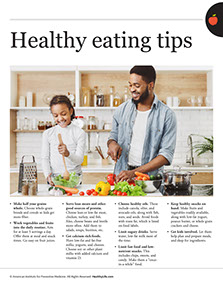
    Image of young boy eating oranges.

    *  Make half your grains whole. Choose whole-grain food, like whole-wheat bread, oatmeal, and brown rice more often.

    *  Vary your veggies. Go dark green and orange with your vegetables. Eat spinach, broccoli, carrots and sweet potatoes.

    *  Focus on fruits. Eat them at meals. Eat them at snack times, too. Choose fresh, frozen, canned or dried fruits. Go easy on fruit juices.

    *  Go lean with protein. Eat lean or low-fat meat, chicken, turkey, and fish. Also, choose dry beans and peas more often. Add chick peas, nuts, or seeds to a salad. Add pinto beans to a burrito. Add kidney and/or other beans to soup.

    *  Get calcium-rich foods. Have low-fat and fat-free milks, yogurts, and cheeses. If you have soy milks and yogurts, choose ones with calcium. Have broccoli, kale and collard greens. Calcium helps to build strong bones.

    *  Change your oil. Get yours from fish, nuts, and liquid oils, like canola, corn, olive, and soybean. Avoid foods with trans fat. Read food labels.

    *  Don’t sugarcoat it. Choose foods and beverages that do not list sugar, corn syrup and other sugars as one of the first ingredients. Added sugars give calories, but have few, if any, nutrients.

    Page from Children's Self-Care book by the American Institute for Preventive Medicine. www.HealthyLife.com. All rights reserved.

    © American Institute for Preventive Medicine
  • Healthy Aging

    Mature Health: Over Age 50

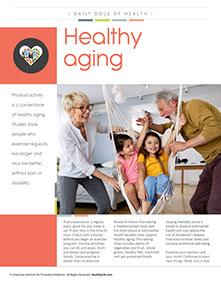
    Grandparents playing with 2 young grandkids.

    Physical activity is a cornerstone of healthy aging. Studies show people who exercise regularly live longer and may live better, without pain or disability.

    If you exercise on a regular basis, good for you! Keep it up! If not, now is the time to start. Check with a doctor before you begin an exercise program. Choose activities you can do and enjoy. Start out slowly and progress slowly. Some exercise is better than no exercise.

    Research shows that eating a Mediterranean-style diet has both physical and mental health benefits that support healthy aging. This eating style includes plenty of vegetables and fruit, whole grains, healthy fats, more fish and less processed foods.

    Staying mentally active is linked to physical and mental health and may reduce the risk of Alzheimer’s disease. Find ways to lower stress and increase emotional well-being.

    Exercise your memory and your mind. Continue to learn new things. Read. Join a club.

    Health at Home Lifetime book by the American Institute for Preventive Medicine. www.HealthyLife.com. All rights reserved.

    © American Institute for Preventive Medicine