Blog

  • First Aid Checklist

    First Aid

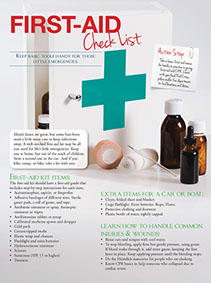
    Keep basic tools handy for those little emergencies.

    Mom’s kisses are great, but some boo-boos need a little more care to keep infections away. A well-stocked first-aid kit may be all you need for life’s little emergencies. Keep one at home, but out of the reach of children. Store a second one in the car. And if you hike, camp, or bike, take a kit with you.

    First-aid kit items:

    The first-aid kit should have a first-aid guide that includes step-by-step instructions for each item.

    *  Acetaminophen, aspirin, or ibuprofen

    *  Adhesive bandages of different sizes. Sterile gauze pads, a roll of gauze, and tape.

    *  Antibiotic ointment or spray. Antiseptic ointment or wipes.

    *  Antihistamine tablets or syrup

    *  Calibrated medicine spoon and dropper

    *  Cold pack

    *  Cotton-tipped swabs

    *  Elastic wrap and closures

    *  Flashlight and extra batteries

    *  Hydrocortisone ointment

    *  Scissors

    *  Sunscreen (SPF 15 or higher)

    *  Tweezers

    Extra items for a car or boat:

    *  Clean, folded sheet and blanket

    *  Large flashlight. Extra batteries. Rope. Flares.

    *  Protective clothing and footwear

    *  Plastic bottle of water, tightly capped

    Learn how to handle common injuries & wounds:

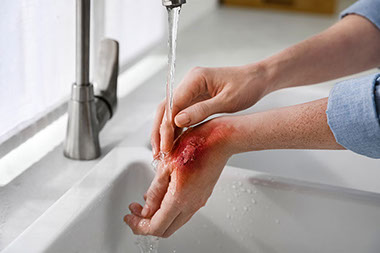
    *  Rinse cuts and scrapes with cool water.

    *  To stop bleeding, apply firm but gentle pressure, using gauze. If blood soaks through it, add more gauze, keeping the first layer in place. Keep applying pressure until the bleeding stops.

    *  Do the Heimlich maneuver for people who are choking.

    *  Know CPR basics to help someone who collapsed due to cardiac arrest.

    Action Step

    Take a basic first-aid course for hands-on practice in giving first aid and CPR. Check with your local Red Cross, police and/or fire department to find locations and dates.

    Ways to Well-Being book by the American Institute for Preventive Medicine. www.HealthyLife.com. All rights reserved.

    © American Institute for Preventive Medicine

  • Fire & Burn Awareness

    First Aid

    Dental hygiene products, tooth brush, tooth paste, mouth wash, etc.

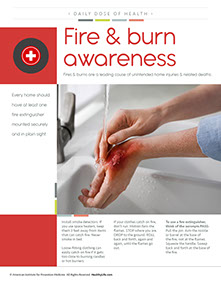
    Fires & burns are a leading cause of unintended home injuries & related deaths.

    Every home should have at least one fire extinguisher mounted securely and in plain sight.

    Install smoke detectors. If you use space heaters, keep them 3 feet away from items that can catch fire. Never smoke in bed.

    Loose-fitting clothing can easily catch on fire if it gets too close to burning candles or hot burners.

    If your clothes catch on fire, don’t run. Motion fans the flames. STOP where you are. DROP to the ground. ROLL back and forth, again and again, until the flames go out.

    To use a fire extinguisher, think of the acronym PASS:

    Pull the pin. Aim the nozzle or barrel at the base of the fire, not at the flames. Squeeze the handle. Sweep back and forth at the base of the fire.

    Health at Home Lifetime book by the American Institute for Preventive Medicine. www.HealthyLife.com. All rights reserved.

    © American Institute for Preventive Medicine

  • What Your Fingernails Reveal About Your Health

    Skin Conditions

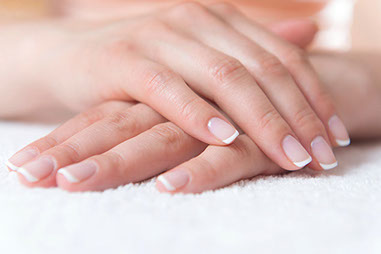
    Image of fingernails.

    You may see your hands hundreds of times a day, but do you ever examine them? Probably not. Yet taking a closer look – especially at our fingernails – may not be a bad idea. They’re a good indicator of overall health.

    Spoon-shaped nails, for example, may simply be an inherited trait – or they can be a clue to a thyroid deficiency or iron deficiency anemia. Nails that have no “moon” or white crescent at the base and are thin and brittle might indicate an underactive thyroid. Still other changes – like brittleness or pitting – may be signs of other nutritional deficiencies or injury to the nail bed. While no one can diagnose a health problem on the basis of nail irregularities only, the table on next page may tip you off to possible health problems. (Consult your doctor if you see any significant changes in your nails.)

    Barring any medical explanation for nail problems, the following tips can help your nails look healthier and more attractive.

    *  Eat a well-balanced diet that includes plenty of fresh fruits and vegetables, whole grains, lean meats, and low-fat dairy products.

    *  Wear gloves when you do household chores or hobbies to avoid contact with detergents or harsh chemicals that can dry or damage nails.

    *  Clean nails with a nail brush, especially if you garden or work with messy materials. Clip cuticles and rough skin to prevent tears. File nails in one direction only. Use an emery board, not a metal nail file.

    *  Don’t use your nails as tools, such as to remove staples. If you polish your nails, use polish remover sparingly.

    Nail Symptoms and What They Could Mean

    Brittleness: Frequent immersion in hot water; generally poor health; impaired circulation; possible deficiency of vitamins A, C, B6, or niacin, deficiency of calcium or iron; thyroid deficiency

    Clubbing: Chronic lung disease or lung cancer; congenital heart disease; congenital or hereditary defect

    Pitting (may be normal): Eczema; psoriasis; trauma

    Ridges: Emphysema; heredity; kidney failure; old age; rheumatoid arthritis, traumas

    Separation (when nail plate lifts off nail bed): Allergy to nail lacquer and hardeners; fungal infection; iron deficiency anemia; pregnancy; psoriasis; trauma

    Splitting at top edge: Immersion in water for long periods, nail polish removers

    Spoon shaped: Thyroid deficiency; iron deficiency anemia

    A Year of Health Hints book by the American Institute for Preventive Medicine. www.HealthyLife.com. All rights reserved.

    © American Institute for Preventive Medicine

  • Fibromyalgia

    Bone & Muscle Problems

    Fibromyalgia is a chronic, arthritis-like illness. It affects the muscles, not the joints.

    Signs & Symptoms

    *  Chronic widespread pain on both sides of the body. This lasts for at least 3 months. It is not due to any other problem. Muscle pain can be severe.

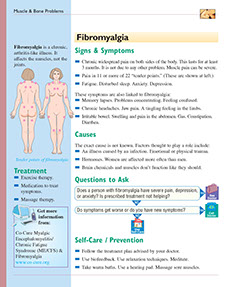
    *  Pain in 11 or more of 22 “tender points.” (These are shown at right.)

    *  Fatigue. Disturbed sleep. Anxiety. Depression.

    These symptoms are also linked to fibromyalgia:

    *  Memory lapses. Problems concentrating. Feeling confused.

    *  Chronic headaches. Jaw pain. A tingling feeling in the limbs.

    *  Irritable bowel. Swelling and pain in the abdomen. Gas. Constipation. Diarrhea.

    Causes

    The exact cause is not known. Factors thought to play a role include:

    *  An illness caused by an infection. Emotional or physical trauma.

    *  Hormones. Women are affected more often than men.

    *  Brain chemicals and muscles don’t function like they should.

    Treatment

    *  Exercise therapy.

    *  Medication to treat symptoms.

    *  Massage therapy.

    Questions to Ask

    Self-Care / Prevention

    *  Follow the treatment plan advised by your doctor.

    *  Use biofeedback.

    *  Use relaxation techniques. Meditate.

    *  Take warm baths.

    *  Use a heating pad.

    *  Massage sore muscles.

    Resources

    National Institute of Arthritis and Musculoskeletal and Skin Diseases (NIAMS)

    www.niams.nih.gov

    Healthier at Home book by the American Institute for Preventive Medicine. www.HealthyLife.com. All rights reserved.

    © American Institute for Preventive Medicine

  • Fibroids

    Women’s Health

    Fibroids are benign (not cancerous) tumors made mostly of muscle tissue. They are found in the wall of the uterus and sometimes on the cervix. They can range in size from as small as a pea to more than 6 inches wide. With larger fibroids, a woman’s uterus can grow to the size of a pregnancy more than 20 weeks along. About 20% to 25% of women over the age of 35 get fibroids.

    Signs & Symptoms

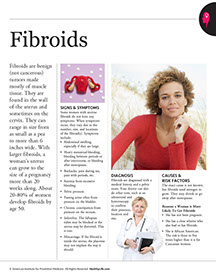
    Some women with uterine fibroids do not have any symptoms. When symptoms occur, they vary due to the number, size, and locations of the fibroid(s). Symptoms include:

    *  Abdominal swelling, especially if they are large.

    *  Heavy menstrual bleeding, bleeding between periods or after intercourse, or bleeding after menopause.

    *  Backache, pain during sex, pain with periods, etc.

    *  Anemia from excessive bleeding.

    *  Pelvic pressure.

    *  Passing urine often from pressure on the bladder.

    *  Chronic constipation from pressure on the rectum.

    *  Infertility. The fallopian tubes may be blocked or the uterus may be distorted.

    *  Miscarriage. If the fibroid is inside the uterus, the placenta may not implant the way it should.

    Diagnosis

    Fibroids are diagnosed with a medical history and a pelvic exam. Your doctor can also do other tests, such as an ultrasound and hysteroscopy to confirm their presence, location, and size.

    Causes & Risk Factors

    Reasons a Woman is More Likely To Get Fibroids

    *  She has not been pregnant.

    *  She has a close relative who also had or has fibroids.

    *  She is African American. The risk is three to five times higher than it is for Caucasian women.

    The exact cause is not known, but fibroids need estrogen to grow. They may shrink or go away after menopause.

    Treatment

    “Watchful waiting”

    Your doctor will “watch” for any changes and may suggest “waiting” for menopause, since fibroids often shrink or disappear after that time. If you have problems during this “waiting” period, you may decide that you do not want to “wait” for menopause, but choose to have something done to treat your fibroids. Problems include: Too much pain; too much bleeding; an abdomen that gets too big; the need to take daily iron to prevent anemia; and other abdominal problems.

    Medication

    One type is called GnRH agonists. These block the production of estrogen by the ovaries. This shrinks fibroids in some cases, but is not a cure. The fibroids return when the medicine is stopped. Shrinking the fibroids might allow a minor surgery (with less blood loss) to be done instead of a major one. GnRH agonists are taken for a few months, but not more than six, because their side effects mimic menopause and may lead to osteoporosis. In some cases, GnRH agonists can be used longer with “Add Back Therapy.” This uses low dose estrogen to make side effects milder.

    Surgery Methods Include:

    *  Myomectomy. The fibroids are removed. The uterus is not. This can be done using a laparoscope and a laser (laparoscopy). The fibroids could also be cut out using a resectoscope (hysteroscopy). Fibroids can be removed under direct vision during abdominal surgery (laparotomy). Myomectomy methods may allow fibroids to grow back. The more fibroids there are to begin with, the greater the chance they will grow back.

    *  Procedures to destroy the uterine lining. These do not remove fibroids or the uterus, but stop or lighten menstrual flow from then on. The uterine lining can be destroyed using a laser, heat, or ultra cold.

    *  Uterine artery embolization. A catheter is inserted in a large blood vessel in the groin and sent to the level of the uterine arteries. A substance is given that blocks blood flow to the uterine arteries that nourish the fibroids. This treatment shrinks the fibroids.

    *  Hysterectomy. This surgery removes the uterus and the fibroids with it. This method is advised when the fibroid is very large or when other treatments don’t stop severe bleeding. It is the only way to get rid of fibroids for sure. A women can no longer get pregnant after the surgery. This treatment is also advised if the fibroid is cancerous. This rarely occurs.

    Questions to Ask

    Self-Care / Prevention

    *  Take medications as advised.

    *  Maintain a healthy body weight. Follow a diet low in fat. The more body fat you have, the more estrogen your body is likely to have. This promotes fibroid growth.

    *  Do regular exercise. This may reduce your body’s fat and estrogen levels.

    Resources

    National Women’s Health Information Center

    www.womenshealth.gov
    Women's Self-Care book by the American Institute for Preventive Medicine. www.HealthyLife.com. All rights reserved.

    © American Institute for Preventive Medicine

  • Fever In Children

    Children’s Health

    How do you know when your child has a fever?

    *  Your child’s chest or forehead may feel hot.

    *  He or she may sweat or feel sick.

    *  Your child’s temperature is:

    – Higher than 99.5ºF by mouth or ear. (Higher than 100.5ºF with a pacifier thermometer.)

    – Higher than 100.4ºF by rectum.

    – Higher than 89.5ºF under the armpit.

    Signs, Symptoms & Causes

    Fever is a sign of another problem. Your child may have an infection. Exercise, hot weather, and shots like DTaP and MMR can also make your child’s temperature go up.

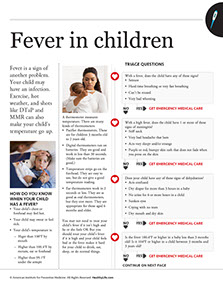
    A thermometer measures temperature. There are many kinds of thermometers:

    *  Pacifier thermometers. These are for children 3 months old to 2 years old.

    *  Digital thermometers run on batteries. They are good and work in less than 30 seconds. (Make sure the batteries are good.)

    *  Temperature strips go on the forehead. They are easy to use, but do not give a good temperature reading.

    *  Ear thermometers work in 2 seconds or less. They are as good as oral thermometers, but they cost more.

    You may not need to treat your child’s fever if it isn’t high and he or she feels O.K. But you should treat your child’s fever if it is high and your child feels bad or the fever makes it hard for your child to drink, eat, sleep, or do normal things.

    You can take your child’s temperature by mouth, armpit, ear, or rectum. (The rectum is the opening where you pass solid waste.) A rectal reading is better than a mouth reading. It is 1°F higher than a mouth reading. An armpit reading is 1°F lower than a mouth reading, but does not give as good a reading.

    Questions to Ask

    Self-Care

    *  Make sure your child drinks a lot of fluids. Give fruit juice, water, and other cool drinks.

    *  Dress your child in light clothing.

    *  Have your child rest.

    *  For a high fever, sponge your child with warm (not cold or cool) water. Don’t use rubbing alcohol. Don’t let your child shower. Showering can make the fever go up.

    *  Give your child acetaminophen or ibuprofen. Make sure you give the right kind and dose for his or her weight. (Note: Do not give aspirin. Aspirin and other medicines that have salicylates have been linked to Reye’s Syndrome.)

    *  A fever can occur with other health problems. They include:

    – Chickenpox.

    – Coughs.

    – Croup.

    – Cuts, Scrapes & Punctures.

    – Diarrhea.

    – Earaches.

    – Flu.

    – Headaches.

    – Seizures.

    – Sore Throats.

    – Swollen Glands.

    – Wheezing.

    Children's Self-Care book by the American Institute for Preventive Medicine. www.HealthyLife.com. All rights reserved.

    © American Institute for Preventive Medicine

  • Fever

    General Health Conditions

    The average normal temperature is about 98.6°F (37°C).

    Signs & Symptoms

    A fever means that body temperature is higher than:

    *  99°F (37.2°C) under the arm.

    *  99.5°F (37.5°C) by mouth or ear.

    *  100.4°F (38°C) by rectum. Rectal temperatures are advised for infants.

    Don’t use a glass mercury thermometer. If it breaks, droplets of toxic mercury can be released. If this happens, don’t use a vacuum or broom to clean up the mercury. Call your local health or fire department to find out what to do.

    Causes

    Fever is usually a sign of another problem, such as an infection.

    Body temperature changes during the day. It is usually lowest in the morning and highest in the late afternoon and evening. Other factors can increase body temperature. These include:

    *  Wearing too much clothing.

    *  Exercise.

    *  Hot, humid weather.

    *  Taking a temperature by mouth after drinking a hot liquid, like tea.

    Treatment

    Treatment includes self-care measures and treating the cause.

    Questions to Ask

    Self-Care / Prevention

    *  Drink lots of fluids, such as fruit juice, water, etc.

    *  Take a sponge bath with warm (about 70ºF) water. Don’t use cold or cool water. Don’t use rubbing alcohol.

    *  Take the right dose of an over-the-counter medicine to reduce fever, as directed.

    *  Rest.

    *  Don’t do heavy exercise.

    *  Don’t wear too many clothes. Don’t use too many blankets.

    Healthier at Home book by the American Institute for Preventive Medicine. www.HealthyLife.com. All rights reserved.

    © American Institute for Preventive Medicine

  • Seizures

    Children’s Health

    And How to Keep Your Child From Getting Fever Seizures

    Signs, Symptoms & Causes

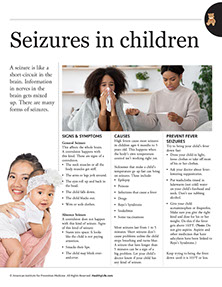
    A seizure is like a short-circuit in the brain. Information in nerves in the brain gets mixed up. There are many forms of seizures.

    A general seizure. This affects the whole brain. A convulsion happens with this kind. These are signs of a convulsion.

    *  The neck muscles or all the body muscles get stiff.

    *  The arms or legs jerk around.

    *  The eyes roll up and back in the head.

    *  The child falls down.

    *  The child blacks out.

    *  The child wets or soils his or her clothes.

    An absence seizure. A convulsion does not happen with this kind of seizure. These are signs of this kind of seizure:

    *  The child stares into space. It looks like the child is not paying attention.

    *  The child smacks his or her lips.

    *  The child may blink over-and-over.

    Seizures that come with a high fever.

    In fact, high fevers cause most seizures in children ages 6 months to 5 years old. This happens when the body’s own temperature control isn’t working just right yet.

    Sicknesses that make a child’s temperature go up fast can bring on seizures. Here are some other causes of seizures:

    *  Epilepsy.

    *  Poisons.

    *  Infections that cause a high fever.

    *  Drugs.

    *  Reye’s Syndrome.

    *  Snakebites.

    *  Some vaccinations.

    Most seizures last from 1 to 5 minutes. Short seizures don’t cause problems unless the child stops breathing and turns blue. But a seizure that lasts longer than 5 minutes can be a sign of a big problem. Let your child’s doctor know if your child has any kind of seizure.

    How to Keep Your Child From Getting Fever Seizures

    Keep trying to bring the fever down until it is 101ºF or less. Try to bring your child’s fever down fast:

    *  Dress your child in light, loose clothes or take off most of his or her clothes.

    *  Ask your doctor about fever-lowering suppositories.

    *  Put washcloths rinsed in lukewarm (not cold) water on your child’s forehead and neck. Don’t use rubbing alcohol.

    *  Give your child acetaminophen or ibuprofen. Make sure you give the right kind and dose for his or her weight. Do this if the fever gets above 103°F. (Note: Do not give aspirin. Aspirin and other medicines that have salicylates have been linked to Reye’s Syndrome.)

    Questions to Ask

    Self-Care

    Don’t panic! A fever seizure will stop by itself in a few minutes. The two things you can do are:

    *  Try to keep your child from getting hurt during the seizure.

    *  Lower his or her fever.

    Follow these tips during the seizure:

    *  Protect your child from falling and hitting his or her head. (Watch out for tables and sharp things.)

    *  Make sure your child can breathe:

    – Roll the child on his or her side so spit can drain from the mouth.

    – Gently pull on the jaw and bend the neck back. (This opens up the throat.)

    *  Don’t put anything in your child’s mouth. Children hardly ever bite their tongues during a fever seizure.

    *  Don’t give your child any medicine, food, or drink by mouth.

    Follow these tips after the seizure:

    *  If the seizure was from a fever, start lowering the fever. Sponge your child’s body with lukewarm water. Don’t use rubbing alcohol. Don’t put the child in a bathtub. Don’t use an ice pack. It drops the temperature too fast.

    *  Your child will probably be sleepy after the seizure. He or she may not remember anything. This is O.K.

    *  Dress the child in light, loose clothes. Put him or her to sleep in a cool room.

    *  Let your child’s doctor know about the seizure.

    Children's Self-Care book by the American Institute for Preventive Medicine. www.HealthyLife.com. All rights reserved.

    © American Institute for Preventive Medicine

  • Fatigue

    General Health Conditions

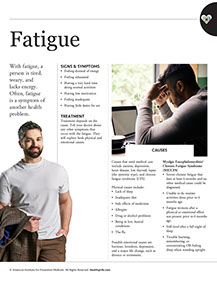
    With fatigue, a person is tired, weary, and lacks energy. Often, fatigue is a symptom of another health problem.

    Signs & Symptoms

    *  Feeling drained of energy.

    *  Feeling exhausted.

    *  Having a very hard time doing normal activities.

    *  Having low motivation.

    *  Feeling inadequate.

    *  Having little desire for sex.

    Causes

    Causes that need medical care include anemia, depression, heart disease, low thyroid, lupus (the systemic type), and chronic fatigue syndrome (CFS).

    Other physical causes include: Lack of sleep; poor diet; side effects of medicines; allergies; drug or alcohol problems; being in hot, humid conditions; and the flu.

    Possible emotional causes are burnout, boredom, and a major life change, such as divorce or retirement.

    Treatment

    Treatment depends on the cause. Tell your doctor about any other symptoms that occur with the fatigue. He or she will explore both physical and emotional causes.

    Questions to Ask

    Self-Care / Prevention

    *  If fatigue is due to a medical problem, follow your doctor’s or health care provider’s guidelines for rest, diet, medication, etc.

    *  Get regular physical activity. Exercise can give you more energy, especially if you sit all day at work. Exercise can calm you, too.

    *  Cool off. Working or playing in hot weather can drag you down. Rest in a cool, dry place as often as you can. Drink plenty of water.

    *  Avoid too much caffeine and alcohol.

    *  Don’t use illegal drugs.

    *  Lighten your work load. Assign tasks to others when you can, both at work and at home. Ask for help when you need it from family and friends. Hire help if you need to.

    *  Change your routine. Try to do something new and that you want to do every day.

    *  If you do too much, make time for some peace and quiet.

    *  Do something for yourself. Plan time to do things that meet only your needs, not just those of others.

    Resources

    Treating Chronic Fatigue Syndrome & Fibromyalgia

    www.treatcfsfm.org

    Healthier at Home book by the American Institute for Preventive Medicine. www.HealthyLife.com. All rights reserved.

    © American Institute for Preventive Medicine

  • Fatigue & Autoimmune Diseases

    Women’s Health

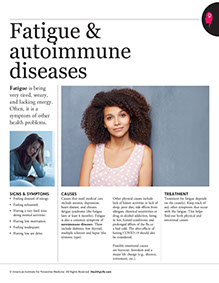
    Fatigue is being very tired, weary, and lacking energy. Often, it is a symptom of other health problems.

    Signs & Symptoms

    *  Feeling drained of energy.

    *  Feeling exhausted.

    *  Having a very hard time doing normal activities.

    *  Having low motivation.

    *  Feeling inadequate.

    *  Having little desire for sex.

    Causes

    Causes that need medical care include anemia, depression, heart disease, and chronic fatigue syndrome (the fatigue lasts at least 6 months). Fatigue is also a common symptom of autoimmune diseases. These include diabetes, low thyroid, multiple sclerosis, and lupus (the systemic type).

    Other physical causes include lack of leisure activities or lack of sleep; poor diet; side effects from allergies, chemical sensitivities or drug or alcohol addiction; being in hot, humid conditions; and prolonged effects of the flu or a bad cold.

    Possible emotional causes are burnout, boredom, and a major life change (e.g., divorce, retirement, etc.).

    Treatment

    Treatment for fatigue depends on the cause(s). Keep track of any other symptoms that occur with the fatigue. This helps find out both physical and emotional causes.

    Questions to Ask

    Self-Care / Prevention

    If fatigue is due to a medical condition, follow your doctor’s or health care provider’s guidelines for rest, diet, medication, etc.

    *  Get regular physical activity. Exercise can give you more energy, especially if you sit all day at work. Exercise can calm you, too.

    *  Cool off. Working or playing in hot weather can drag you down. Rest in a cool, dry place as often as you can. Drink plenty of water.

    *  Rest and relax. Get a good night’s sleep. Relax during the day if you can, too. Practice deep breathing or meditation.

    *  Eat well. Eating too much and “crash dieting” are both hard on your body. Don’t skip breakfast. Limit high-fat and/or rich, sugary foods. Eat whole-grain breads and cereals and fruits and vegetables every day. Have 5 to 6 light meals a day, instead of 3 large ones. Take vitamin and mineral supplements, as advised by your doctor.

    *  Change your routine. Do something interesting each day. If you do too much, plan for some quiet time.

    *  Lighten your work load. Assign tasks to others when you can. Ask for help when you need it.

    *  Do something for yourself. Plan time to do things that meet only your needs.

    *  Avoid too much caffeine and alcohol. Don’t use illegal drugs. These trigger fatigue.

    Resources

    Chronic Fatigue Syndrome & Fibromyalgia Information Exchange Forum (Co-Cure)

    www.co-cure.org

    Women's Self-Care book by the American Institute for Preventive Medicine. www.HealthyLife.com. All rights reserved.

    © American Institute for Preventive Medicine