Blog

  • Fainting

    Women’s Health

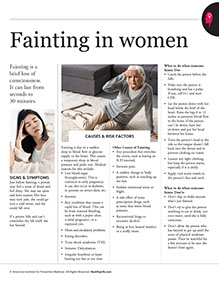
    Fainting is a brief loss of consciousness. It can last from seconds to 30 minutes.

    Signs & Symptoms

    Just before fainting, a person may feel a sense of dread and feel dizzy. She may see spots and have nausea. Her face may turn pale, she could go into a cold sweat, and she could fall over.

    If a person falls and can’t remember the fall itself, she has fainted.

    Causes

    Fainting is due to a sudden drop in blood flow or glucose supply to the brain. This causes a temporary drop in blood pressure and pulse rate. Medical reasons for this include:

    *  Low blood sugar (hypoglycemia). This is common in early pregnancy. It can also occur in diabetes, in persons on severe diets, etc.

    *  Anemia.

    *  Any condition that causes a rapid loss of blood. This can be from internal bleeding, such as with a peptic ulcer, a tubal pregnancy, or a ruptured cyst.

    *  Heart and circulatory problems, such as abnormal heart rhythm, heart attack, or stroke.

    *  Eating disorders.

    *  Toxic shock syndrome (TSS).

    *  Seizures.

    Other Causes of Fainting

    *  Any procedure that stretches the cervix, such as having an IUD inserted.

    *  Extreme pain.

    *  A sudden change in body position, such as standing up too fast.

    *  Sudden emotional stress or fright.

    *  A side effect of some prescription drugs, such as some that lower blood pressure.

    *  Recreational drugs or excessive alcohol.

    *  Being in hot, humid weather or being in a stuffy room.

    Know what to do when someone faints.

    Dos

    *  Catch the person before she falls.

    *  Lie the person down with her head below the level of the heart. Raise the legs 8 to 12 inches to promote blood flow to the brain. If the person can’t lie down, have her sit down, bend forward, and put her head between her knees.

    *  Turn the person’s head to the side so the tongue doesn’t fall back into the throat and to prevent choking on vomit.

    *  Loosen any tight clothing, but keep the person warm, especially if the surroundings are chilly.

    *  Apply moist towels to the person’s face and neck.

    Don’ts

    *  Don’t slap or shake anyone who’s just fainted.

    *  Don’t try to give the person anything to eat or drink, not even water, until she is fully conscious.

    *  Don’t allow the person who’s fainted to get up until the sense of physical weakness passes. Then be watchful for a few minutes to be sure she doesn’t faint again.

    Questions to Ask

    Self-Care / Prevention

    *  When you feel faint, lie down and elevate both legs. Or, sit down, bend forward and put your head between your knees.

    *  Get up slowly from bed or from a sitting position.

    *  Follow your doctor’s advice to treat any condition which may lead to fainting. Take prescribed medicines, but tell your doctor about any side effects, so he or she can monitor your condition.

    *  Don’t wear tight clothing around your neck.

    *  Avoid turning your head suddenly.

    *  Stay out of stuffy rooms and hot, humid places. If you can’t, use a fan.

    *  If you have fainting spells often, avoid activities that can put lives in danger, such as driving a car.

    *  Drink a lot of fluids, but drink alcoholic ones in moderation, if at all. Eat small, frequent meals.

    When Pregnant

    *  Get out of bed slowly.

    *  Keep crackers at your bedside and eat a few before getting out of bed.

    *  Eat small, frequent meals instead of a few large ones. With each meal, have a good source of protein, such as lean meat, low-fat cheese, milk, etc. Avoid sweets. Don’t skip meals or go for a long time without eating. Drink plenty of fluids.

    *  Don’t sit for long periods of time. Elevate your legs when you sit.

    *  When you stand, as in a line, move your legs to pump blood up to your heart.

    *  Take vitamin and mineral supplements, as your doctor prescribes.

    *  Don’t lay on your back during the 2nd and 3rd trimesters of your pregnancy. Lie on your left side. When you can’t, lie on your right side.
    Women's Self-Care book by the American Institute for Preventive Medicine. www.HealthyLife.com. All rights reserved.

    © American Institute for Preventive Medicine
  • Fainting & Unconsciousness

    First Aid

    Signs & Symptoms

    Fainting is a brief loss of consciousness. It can last from seconds to 30 minutes. Just before fainting, a person may feel a sense of dread, feel dizzy, see spots, and have nausea.

    If a person falls and can’t remember the fall itself, he or she has fainted.

    An unconscious person is hard to rouse and can’t be made aware of his or her surroundings. The person is unable to move on his or her own.

    Causes

    Fainting is due to a sudden drop in blood flow or glucose supply to the brain. This causes a temporary drop in blood pressure and pulse rate. Medical reasons for this include:

    *  Low blood sugar (hypoglycemia). This can occur in diabetics, in early pregnancy, in persons on severe diets, etc.

    *  Anemia. Eating disorders.

    *  Conditions which cause rapid loss of blood.

    *  Abnormal heart rhythm. Heart attack. Stroke.

    *  Head injury. Heat stroke. Heat exhaustion.

    Other things that can lead to feeling faint or fainting include:

    *  A sudden change in body position like standing up too fast. This is called postural hypotension.

    *  A side effect of some medicines. Drinking too much alcohol.

    *  Anxiety or sudden emotional stress or fright.

    *  Being in hot, humid weather or in a stuffy room. Standing a long time in one place.

    *  Extreme pain.

    Treatment

    Treatment depends on the cause.

    Questions to Ask

    Self-Care / Prevention

    For Unconsciousness

    *  Check for a response. Call 9-1-1! Give Rescue Breaths and CPR, or treat for Shock, as needed.

    *  Check for a medical alert tag or information. Call the emergency number if there is one. Follow instructions given.

    *  Don’t give the person anything to eat or drink, not even water.

    For Fainting

    *  Catch the person before he or she falls.

    *  Lie the person down with the head below heart level. Raise the legs 8 to 12 inches to promote blood flow to the brain. If the person can’t lie down, have him or her sit down, bend forward, and put the head between the knees.

    *  Loosen any tight clothing.

    *  Don’t slap or shake a person. Don’t give anything to eat or drink.

    *  Check for a medical alert tag. Respond as needed.

    To Reduce the Risk of Fainting

    *  Follow your doctor’s advice to treat any medical problem which may lead to fainting. Take medicines as prescribed. Let the doctor know about any side effects.

    *  Get up slowly from bed or from a chair.

    *  Avoid turning your head suddenly.

    *  Wear loose-fitting clothing around the neck.

    *  Don’t exercise too much when it is hot and humid. Drink a lot of fluids when you exercise.

    *  Avoid stuffy rooms and hot, humid places. When you can’t do this, use a fan.

    *  If you drink alcohol, do so in moderation.

    For a Low Blood Sugar Reaction

    *  Have a sugar source, such as: One half cup of fruit juice or regular (not diet) soda; 6 to 7 regular (not sugar free) hard candies; 3 glucose tablets; or 6 to 8 ounces of milk.

    *  If you don’t feel better after 15 minutes, take the same amount of sugar source again. If you don’t feel better after the second dose, call your doctor.

    Healthier at Home book by the American Institute for Preventive Medicine. www.HealthyLife.com. All rights reserved.

    © American Institute for Preventive Medicine
  • Eyestrain From Computer Use

    Eye Conditions

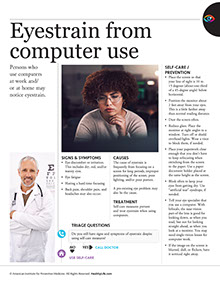
    Persons who use computer video display terminals (VDTs) at work and/or at home may notice eyestrain.

    Signs & Symptoms

    *  Eye discomfort or irritation. This includes dry, red, and/or watery eyes.

    *  Eye fatigue.

    *  Having a hard time focusing.

    *  Back pain, shoulder pain, and headaches may also occur.

    Causes

    The cause of eyestrain is most likely from conditions that surround the VDT, not the VDT itself. These include improper positioning of the VDT and supplies, poor lighting, and/or poor posture.

    A pre-existing eye problem may also be the cause.

    Treatment

    Self-care measures prevent and treat eyestrain when using VDTs.

    Questions to Ask

    Self-Care / Prevention

    *  Place the screen so that your line of sight is 10 to 15 degrees (about one-third of a 45-degree angle) below horizontal.

    *  Position the VDT screen about 2 feet away from your eyes. This is a little farther away than normal reading distance.

    *  Dust the screen often.

    *  Reduce glare. Place the VDT at right angles to a window. Turn off or shield overhead lights. Wear a visor to block them, if needed.

    *  Place your paperwork close enough that you don’t have to keep refocusing when switching from the screen to the paper. Use a paper document holder placed at the same height as the VDT screen.

    *  Blink often to keep your eyes from getting dry. Use “artificial tear” eyedrops, if needed.

    *  Tell your eye specialist that you use a VDT. Glasses and contacts worn for other activities may not be good for VDT work. With bifocals, the near-vision part of the lens is good for looking down, as when you read, but not for looking straight ahead, as when you look at a video display screen. You may need single-vision lenses for VDT work.

    *  If the image on the VDT screen is blurred, dull, or flickers, have it serviced right away.

    Resources

    Prevent Blindness America

    www.preventblindness.org

    Healthier at Home book by the American Institute for Preventive Medicine. www.HealthyLife.com. All rights reserved.

    © American Institute for Preventive Medicine
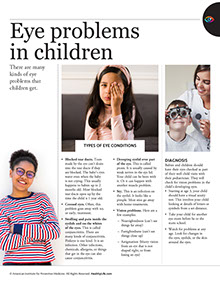
  • Eye Problems

    Children’s Health

    Signs, Symptoms & Causes

    There are many kinds of eye problems that children get. Here are some of them:

    *  Blocked tear ducts. Tears made by the eye can’t drain into the tear ducts if they are blocked. The baby’s eyes water even when the baby is not crying. This usually happens to babies up to 2 months old. Most blocked tear ducts open up by the time the child is 1 year old.

    *  Crossed eyes. Often, this problem goes away with no treatment.

    *  Swelling and pain inside the eyelids and on the whites of the eyes. This is called conjunctivitis. There are many kinds of conjunctivitis. Pinkeye is one kind. It is an infection. Other infections, chemicals, allergens, or things that get in the eye can also cause conjunctivitis.

    *  Drooping eyelid over part of the eye. This is called ptosis. It is usually caused by weak nerves in the eye lid. Your child can be born with it. Or it can happen with another muscle problem.

    *  Sty. This is an infection on the eyelid. It looks like a pimple. Most sties go away with home treatments.

    *  Vision problems. Here are a few examples:

    – Nearsightedness (can’t see things far away).

    – Farsightedness (can’t see things close up).

    – Astigmatism (blurry vision from an eye that is not shaped right, or from losing an eye).

    It’s hard to know if your child has vision problems until he or she is 3 years old. (The eye is still developing until then.)

    *  Take your child for their first  eye exam at 3 years old.

    *  Take your child for another eye exam before he or she starts school.

    *  Watch for problems at any age. Look for changes in the eyes, eyelids, or the skin around the eyes.

    Questions to Ask

    Self-Care

    A doctor should treat a hurt or infected eye. But you can treat some eye problems at home.

    *  For a blocked tear duct:

    1. Wash your hands.

    2. Press gently on the inner corner of the eye with a cotton swab. Press up, not down, for a few seconds to a few minutes.

    *  For dry eyes, try over-the-counter “tears.” Some kinds are Ocu-Lube®, Refresh®, or Liquifilm®. Wash your hands before you put drops in the eyes. If your child’s eyes don’t get better, take him or her to the doctor.

    *  To help with an insect bite, gently wash the eyes with warm water.

    *  To help the pain of a hurt eye that is not infected:

    – Put a warm (not hot), wet wash cloth on the eye for 5 minutes. Do this 2 or 3 times a day.

    – Use over-the-counter eye drops.

    – Don’t  let your child wear contact lenses or makeup until the eye is better.

    *  If the eye is infected:

    – Wash your hands and your child’s hands every time you touch the eye. (Pinkeye is very easy to catch.)

    – Don’t  share a towel with someone who has pinkeye.

    – Keep your child away from light if he or she got pinkeye from the measles.

    – Don’t  cover the eye. This can make the infection worse.

    *  Here’s how to get something out of your child’s eye: (Make sure you can see the speck before you try to get it out.)

    1. Wash your hands.

    2. Drip clean water into the eye to rinse it.

    3. Twist a piece of tissue at each end. Wet the tip with tap water, not spit. Gently touch the speck with the tip. The speck should stick to the tip.

    – Tell your child to look down if the speck is under the upper lid. Pull the upper lid away from the eye. Do this by gently pulling on the eyelashes. When you can see the speck, try to touch it with the tissue.

    – Don’t  rub the eye. And never use anything sharp to touch your child’s eye.

    4. Gently wash the eye with cool water.

    *  To help with pain from a sty:

    – Put a warm (not hot), wash cloth on the sty 3 or 4 times a day for 5 or 10 minutes each time.

    – Keep your child away from dust and dirt that can get in his or her eyes.

    – Don’t poke or squeeze the sty!

    Children's Self-Care book by the American Institute for Preventive Medicine. www.HealthyLife.com. All rights reserved.

    © American Institute for Preventive Medicine
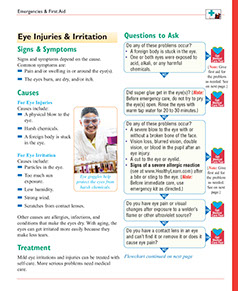
  • Eye Injuries & Irritation

    First Aid

    Signs & Symptoms

    Signs and symptoms depend on the cause. Common symptoms are:

    *  Pain and/or swelling in or around the eye(s).

    *  The eyes burn, are dry, and/or itch.

    Causes

    For Eye Injuries

    *  A physical blow to the eye.

    *  Harsh chemicals.

    *  A foreign body is stuck in the eye.

    For Eye Irritation

    *  Particles in the eye.

    *  Too much sun exposure.

    *  Low humidity.

    *  Strong wind.

    *  Scratches from contact lenses.

    Other causes are allergies, infections, and conditions that make the eyes dry. With aging, the eyes can get irritated more easily because they make less tears.

    Treatment

    Mild eye irritations and injuries can be treated with self-care. More serious problems need medical care.

    Questions to Ask

    Self-Care / Prevention

    For a Foreign Body Sticking Into the Eye

    *  Do not remove the object.

    *  Don’t press on, touch, or rub the eye.

    *  Cover the injured eye with a clean object, such as a paper cup that will shield, but not touch the eye or the foreign object. Use tape to hold the cup in place without putting pressure on the eye or the foreign object.

    *  Gently cover the uninjured eye with a clean bandage and tape, too. This helps to keep the injured eye still. Get Immediate Care!

    For Harmful Chemicals in the Eye(s)

    *  Flush the eye(s) with water immediately!

    *  Hold the injured eye open with your thumb and forefinger. At the faucet or with a pitcher or other clean container, flush the eye with a lot of water. Start at the inside corner and pour downward to the outside corner. This lets the water drain away from the body and keeps it from getting in the other eye.

    *  Keep pouring the water for 10 to 30 or more minutes. Flush the eye with water until you get medical help.

    *  If both eyes are injured, pour water over both eyes at the same time. Or, flush one eye at a time with water. Switch back and forth quickly to treat both eyes. Or, place the face in a sink or container filled with water. Tell the person to move his or her eyelids up and down and remove the face from the water to take breaths. Use this method if chemicals get in your eyes and you are alone.

    *  Loosely bandage the eye with sterile cloth and tape. Don’t touch the eye. Get Medical Care Right Away!

    For a Bruise from a Minor Injury that Surrounds the Eye, But Does Not Damage the Eye Itself

    *  Put a cold compress over the injured area right away. Do this for 15 minutes, every hour, for 48 hours.

    *  Take an over-the-counter medicine for the pain and swelling.

    *  After 48 hours, put a warm compress over the injured area.

    *  Seek medical care if these measures do not help.

    To Remove a Foreign Particle On the White of the Eye or Inside the Eyelids

    *  Do not remove an object stuck in the eye, a metal chip, or a foreign body over the colored part of the eye.

    *  Wash your hands.

    *  If the foreign object is under the upper lid, look down and pull the upper lid away from the eyeball by gently grabbing the eyelashes. Press a cotton-tipped swab down on the skin surface of the upper eyelid and pull it up and toward the brow. The upper lid will invert.

    *  Twist a piece of tissue. Moisten the tip with tap water (not saliva). Gently try to touch the speck with the tip. Carefully pass the tissue over the speck which should cling to the tip.

    *  Do not rub the eye or use tweezers or anything sharp to remove a foreign object.

    *  Gently wash the eye with cool water.

    For Dry, Irritated Eyes

    With your doctor’s okay, use over-the-counter artificial tear drops, such as Ocu-Lube. Refrigerate the solution, if needed. Wash your hands before using.

    For an Insect Bite Without a Severe Allergic Reaction

    *  Wash the eye(s) with warm water.

    *  Take an antihistamine if okay with your doctor.

    Prevention

    *  Wear safety glasses when your eyes are exposed to sawdust, etc. Wear sunglasses that block UV rays.

    *  When using harsh chemicals, wear rubber gloves and protective glasses. Don’t rub your eyes if you’ve touched harsh chemicals. Turn your head away from chemical vapors.

    *  To help prevent dry eyes, use a humidifier. Limit exposure to smoke, dust, and wind. Don’t drink alcohol.

    *  Use artificial tear drops with your doctor’s okay.

    *  Don’t stare directly at the sun, especially during a solar eclipse.

    *  Don’t use eye makeup when an allergy or chemical irritant bothers your eye(s).

    *  Don’t allow a child to stick his or her head out of the window of a moving car, etc. Sand, insects, and other flying objects can strike the eye and irritate or damage the cornea.

    *  Don’t let children play with or near sparklers, bottle rockets, and other fireworks.

    Healthier at Home book by the American Institute for Preventive Medicine. www.HealthyLife.com. All rights reserved.

    © American Institute for Preventive Medicine

  • Eye Health At Work

    Eye Conditions

    Man wearing protective eye and hearing gear while using machinery.

    Follow your workplace’s safety rules to protect your eyes. Wear safety glasses, goggles, face shields, etc. Keep your safety eyewear clean and in good condition.

    More than 700,000 persons in the U.S. have eye injuries at work a year. Most of these could have been prevented.

    Find out if and what type of eyewear is required for your job. Ask loved ones if they wear required safety eyewear at work.

    Persons who walk through work areas that have eye hazard areas need to wear protective eyewear.

    When you visit a worksite that poses a risk of eye injuries, ask for protective eyewear if it is not provided.

    Glasses and contact lenses used for other activities may not be effective when working with computer screens.

    Let your eye doctor know if you work at a computer so they can prescribe the proper eyewear for you to use.

    Health at Home Lifetime book by the American Institute for Preventive Medicine. www.HealthyLife.com. All rights reserved.

    © American Institute for Preventive Medicine

  • Eye Care – Glaucoma

    Eye Conditions

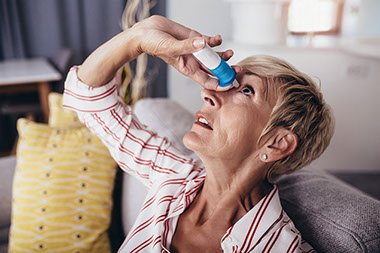
    Older women using eye drops.

    Regular eye exams can help detect vision, as well as medical problems.

    With glaucoma, the pressure of the liquid in the eye gets too high. Ask your eye doctor about your glaucoma risk, such as family history or certain health conditions. Testing for glaucoma may begin at age 40.

    Chronic (open-angle) glaucoma occurs gradually. The first signs can be loss of side (peripheral) vision and blurred vision.

    See your eye doctor as soon as you get signs of this kind of glaucoma. Eye drops and oral medicines can be prescribed.

    Acute (angle-closure) glaucoma is a medical emergency! Signs of this are: Severe eye pain, redness in the eye, swollen upper eyelid, blurred vision, seeing halos around lights, and severe headache that throbs.

    If you have these signs, get to a hospital emergency department right away!

    Health at Home Lifetime book by the American Institute for Preventive Medicine. www.HealthyLife.com. All rights reserved.

    © American Institute for Preventive Medicine

  • Ectopic Pregnancies

    Pregnancy & Prenatal Care

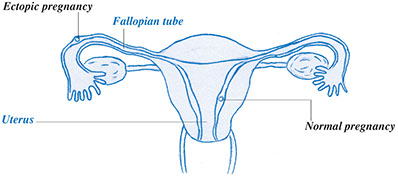
    An ectopic pregnancy is when an embryo starts to develop outside the uterus. (Ectopic means out of place.) This happens less than 2 percent of the time.

    In normal pregnancies, an egg travels from a woman’s ovary to the uterus. It travels down the fallopian tube to get there. Somewhere along the way, the egg gets fertilized by a male sperm. Once inside, the egg attaches to the wall of the uterus. It becomes an embryo and then a fetus. Nine months later, a baby is born.

    In ectopic pregnancies, the fertilized egg does not reach the uterus. It starts to grow somewhere else. Most often, that’s in the fallopian tube.

    The embryo can’t survive for long outside the uterus. But it can put the mother in danger if it gets too big. It can rupture an organ or cause internal bleeding. Medical steps must be taken right away.

    Symptoms

    Some women may have no symptoms. They may not even know that they are pregnant. When there are symptoms, they usually come within 8 weeks of conception. Symptoms may include:

    *  Pain in the lower belly

    *  Pain on one side of the body

    *  Vaginal spotting and bleeding

    *  Pain in the rectum (rear end) or shoulder

    *  Feeling like throwing up

    *  Throwing up

    *  Feeling weak

    *  Fainting

    Diagnosis

    Ultrasound can sometimes locate the embryo. Laparoscopy is another option. That’s when a tiny camera with a light is put in the mother’s body. It goes in through a very small incision (cut).

    Illustration of normal vs ectopic pregnancy.

    Causes

    There are many causes for ectopic pregnancies:

    *  Damage to the ovary or fallopian tube

    *  Scarring of the ovary or fallopian tube. Scarring can result from endometriosis, pelvic inflammatory disease or an STD.

    Also, the risk for an ectopic pregnancy is higher for women who:

    *  Have had an ectopic pregnancy in the past

    *  Have had fallopian tube surgery

    *  Have had problems getting pregnant

    *  Have used an IUD for birth control

    These women should call their health care provider when they miss a menstrual period.

    Treatment

    Medicines may be used. But if some time has passed, surgery may be needed. The embryo is removed. Any damage to the mother’s body is repaired. In some rare cases, a fallopian tube or ovary must be removed. But women have another set of these. So the mother may become pregnant again.

    Questions to Ask

    Self-Care / Prevention

    Tips to Lower the Risk of an Ectopic Pregnancy

    *  Talk to your health care provider about your risks for damage to your fallopian tubes from:

    – STDs

    – Pelvic Inflammatory Disease

    – Endometriosis

    *  Ask if you need to get tested for these and how often. Find out, too, if your health plan pays for these tests.

    *  Schedule any tests needed with your health care provider.

    Prenatal Self-Care book by the American Institute for Preventive Medicine. www.HealthyLife.com. All rights reserved.

    © American Institute for Preventive Medicine
  • Smart Ways To Exercise During Pregnancy

    Pregnancy & Prenatal Care

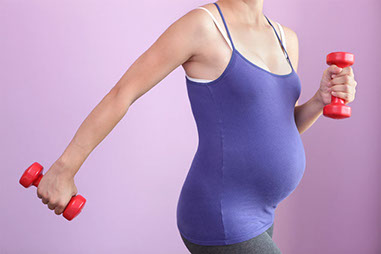
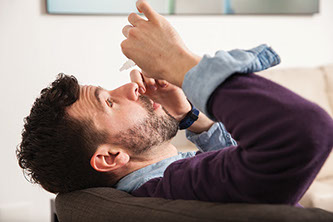
    Image of pregnant women exercising with dumb bells.

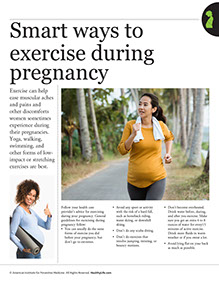
    Exercise can help ease muscular aches and pains and other discomforts women sometimes experience during their pregnancies. Yoga, walking, swimming, and other forms of low-impact or stretching exercises are best.

    Follow your health care provider’s advice for exercising during your pregnancy. General guidelines for exercising during pregnancy follow:

    *  You can usually do the same forms of exercise you did before your pregnancy, but don’t go to extremes.

    *  Check your pulse when you exercise. In general, your heart rate should stay below 140 beats a minute.

    *  Avoid any sport or activity with the risk of a hard fall, such as horseback riding and water skiing.

    *  Don’t do exercises that involve jumping, twisting, or bouncy motions.

    *  Don’t become overheated. Drink water before, during, and after you exercise. Make sure you get an extra 4 to 8 ounces of water for every 15 minutes of active exercise. Drink more fluids in warm weather or if you sweat a lot.

    *  After the 20th week of pregnancy, avoid exercises in which you lie flat on your back.

    A Year of Health Hints book by the American Institute for Preventive Medicine. www.HealthyLife.com. All rights reserved.

    © American Institute for Preventive Medicine