Blog

  • Save For More Than Just A Rainy Day

    Financial Health

    Invest in your future.

    Money doesn’t grow on trees, but it can grow when you save and invest it wisely. First, identify what you want to save for:

    *  Emergency funds? (Plan for three to six months of expenses.) Holiday expenses? Vacations? A house? College for your kids? Retirement?

    *  Rank order your goals.

    Invest, but do not put all your eggs in one basket.

    Diversify with stocks, bonds, mutual funds, IRAs, real estate, and commodities, such as gold and silver. Find out more about investing fromwww.mymoney.gov. Things you can do on your own:

    *  If your employer has a retirement plan, such as a 401(k), have as much deducted from your pay as possible, especially if your employer matches some or all of the amount you contribute.

    *  Get resources on planning for retirement and long-term care fromwww.csrees.usda.gov/fsll.

    *  Check out “529” prepaid tuition and savings plans for college fromwww.collegesavings.org. These offer tax-saving advantages.

    *  Get professional investment advice from employer sponsored programs or from your financial planner. Find a certified professional from the Association for Financial Counseling and Planning Education atwww.afcpe.org.

    Revisit your budget:

    *  Pay off credit card or high interest debts first. Then use some or all of the payment money for your savings plan.

    *  Put aside whatever you can in savings accounts, checking accounts, and certificates of deposit.

    *  Look for additional ways to save fromhttp://investor.gov/sites/default/files/Saving-and-Investing.pdf

    *  Decide the best ways you are likely to save money.

    – Have your paycheck automatically deposited in your bank and have some go directly into one or more savings accounts.

    – Save money you get from tax refunds, work bonuses, and extra income.

    Action Step

    Beware of investments that promise high returns with little or no risk. If it sounds too good to be true, it usually is.

    Ways to Well-Being. Published by the American Institute for Preventive Medicine.

    © American Institute for Preventive Medicine

  • Save By Staying Healthy. Prevention Is Worth More Than A Pound Of Cure.

    Medical Care

    Couple play dueling in the kitchen, laughing.

    *  Choose healthy foods. Control portion sizes. Maintain a healthy weight. Obesity raises the risk of type 2 diabetes, heart disease, and other chronic diseases, which can be very expensive to treat. Persons who are obese may be charged more for life and health insurance.

    *  Be fit at little or no cost. Walk with a friend.  Join a mall walkers program.

    *  If you smoke, quit! You’ll save money on cigarettes, health care, and insurance. Get free help from 800.QUIT. NOW orsmokefree.gov.

    *  Take part in health risk assessments and health and wellness offerings at work.

    *  Wash your hands often to lessen the chance of picking up germs.

    *  Brush and floss your teeth daily. Get a dental checkup once or twice a year. Doing these help prevent periodontal (gum) disease. Not only is it expensive to treat, it is associated with heart disease and pneumonia.

    *  Get at least 6 to 8 hours of sleep a night. Manage stress.

    A Year of Health Hints book by the American Institute for Preventive Medicine. www.HealthyLife.com. All rights reserved.

    © American Institute for Preventive Medicine

  • Save By Staying Healthy

    Medical Care

    An ounce of prevention is worth more than a pound of cure. The healthier you are, the less you will need to pay for medical care. Also, the state of your health is one of the main factors in setting the cost of health and life insurance.

    Don’t send money up in smoke.

    Cigarette smoking is bad for your health. It’s bad for your wallet, too. A person who smokes two packs a day spends over $3,000 a year just on cigarettes. Hundreds of dollars more are spent on extra dental and medical costs. The cost of health, life, and disability insurance is about 30% higher for persons who smoke.

    Weight does matter.

    Obesity is a leading cause of preventable death. Losing weight can lower the risk for type 2 diabetes, heart disease, and other chronic diseases. These can cost you and your employer a lot of money to treat. Obese persons who buy health insurance on their own may have to pay more. Insurance companies may even turn them down.

    Be fit at little or no cost.

    Take part in fitness programs at work. Join a mall walkers program. Walk with a friend. Follow along with fitness programs on TV. Or, if you have a stationary bike, ride it while you watch TV. Being active every day is a huge investment in your health.

    Look at your genes.

    Find out what health problems both sides of your family have or had. Start with your parents, brothers, and sisters. Then find out about ones your grandparents, uncles, aunts, and first cousins have or had. Once you know what health problems run in your family, talk with your doctor. He/she can suggest ways to lower your risk of getting them.

    Don’t back quacks.

    Find out about products and treatments that don’t work or could cause harm fromwww.quackwatch.organdwww.fda.gov. Don’t waste money on things that don’t help.

    Be savvy about AD-vice.

    Check with your doctor before you follow advice from Web sites and ads that promote products. Many are costly and give little or no benefit.

    Detect to protect.

    Have screening tests and exams that can help detect health problems in early stages when they are easier and less costly to treat. Follow your doctor’s advice.

    Money well spent.

    If you have no health insurance or your health plan does not pay for screening tests or doctor visits, it is still important to have them. Paying for these now could save you thousands in medical costs in the future. Tests may cost less than you think.

    Know thy “health self.”

    The more you know about your health problems, the easier it is to make informed choices about how to take care of them. Find out what you need to do from your doctor. Get reliable facts, too, from trusted sources.

    Follow your doctor’s treatment plan.

    This helps to improve your health. It helps keep problems from getting worse. For example, keeping blood pressure under control can reduce the risk of having a stroke or a heart attack.

    A shot in the arm for your health.

    Get vaccines, as needed, to prevent illnesses. This applies to children, as well as adults. The Centers for Disease Control and Prevention give guidelines for vaccines every year. Find out what they are atwww.cdc.gov/vaccines. Also, if you plan to travel to other countries, find out what vaccines you should get. Find out fromwww.cdc.gov/travel.

    Know about the Vaccines for Children (VFC) Program.

    Your children may be able to get free or low-cost vaccines. Find out fromwww.cdc.gov/vaccines/programs/vfc/default.htm.

    Cover image to the Healthy Savings book by the American Institute for Preventive Medicine. www.HealthyLife.com. All rights reserved.

    © American Institute for Preventive Medicine

  • Save By Keeping Medical Andbilling Errors In Check

    Medical Care

    Female doctor on her computer.

    *  Check credentials of doctors, hospitals, and other health care providers. Get a complete list of how to get quality care fromahrq.gov.

    *  Protect yourself from medical errors. Be your own watchdog. Take an active role in every decision about your health care. If needed, have a family member or friend oversee your care.

    *  Get all of your medications from the same pharmacy to avoid harmful interactions. Make sure each doctor who prescribes medicine for you knows about any allergies and adverse reactions you have had to medicines and to foods, such as shrimp.

    *  To avoid getting a serious infection while you are in the hospital, ask all persons who give you care to wash or sanitize their hands.

    *  Keep lists of hospital and medical services. Ask for itemized bills. Compare your lists to the bills to make sure you were only charged for services that you received. Notify the billing department and your health plan of mistakes.
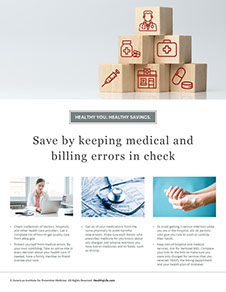
    A Year of Health Hints book by the American Institute for Preventive Medicine. www.HealthyLife.com. All rights reserved.

    © American Institute for Preventive Medicine

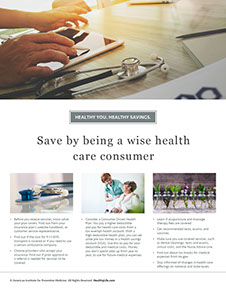
  • Save By Being A Wise Health Care Consumer

    Medical Care

    Close up of hand using a tablet.

    *  Before you receive services, know what your plan covers. Find out from your insurance plan’s website handbook, or customer service representative.

    *  Find out if the cost for 9-1-1 EMS transport is covered or if you need to use a certain ambulance company.

    *  Choose providers who accept your insurance. Find out if prior approval or a referral is needed for services to be covered.

    *  Consider a Consumer Driven Health Plan. You pay a higher deductible and pay for health care costs from a tax-exempt health account. With a high-deductible health plan, you can set aside pre-tax money in a health savings account (HSA). Use this to pay for your deductible and medical costs. Money you don’t spend adds up from year to year, to use for future medical expenses.

    *  Learn if acupuncture and massage therapy fees are covered.

    *  Get recommended tests, exams, and vaccines.

    *  Make sure you use covered services, such as dental cleanings, tests and exams, virtual visits, and the Nurse Advice Line.

    *  Find out about tax breaks for medical expenses fromirs.gov.

    *  Stay informed of changes in health care offerings on national and state levels.

    A Year of Health Hints book by the American Institute for Preventive Medicine. www.HealthyLife.com. All rights reserved.

    © American Institute for Preventive Medicine
  • Save By Being A Wise Consumer

    Medical Care

    What price, health care?

    It is more common to know the price of a car than the price of health care services. It is also more common to take more time looking for a car than a doctor. To be prepared to take care of your health and health care costs, plan ahead:

    *  Don’t wait until you get sick to find a doctor. Having a doctor can save the expense of having to go to an urgent care center or emergency room.

    *  Know what costs your health plan covers and what you need to pay.

    *  Post a list of places your health plan approves for treatment. When you need care, use them instead of out-of-plan ones, which could cost you extra money.

    *  If you have a yearly deductible, budget for this with the rest of your bills.

    Check credentials.

    You can’t afford to trust your health to just anyone. Find out about doctors from:

    *  American Board of Medical Specialties (ABMS) at 866.ASK.ABMS (275.2267) orwww.abms.org.

    *  DocFinder atwww.docboard.org/docfinder.html.

    *  The Federation of State Medical Boards at 888.ASK.FCVS (275.3287) orwww.fsmb.org.

    *  Health Grades atwww.healthgrades.com.

    Look for quality.

    Check out the track records of health plans, hospitals, and doctors. Contact the Agency for Health Care Research and Quality atwww.ahrq.gov.

    Protect yourself from medical errors.

    These could cost extra money and can even cost you your life. Be your own watch dog. Take an active role in every decision about your health care. If needed, have a family member or friend oversee your care.

    Know about tax breaks.

    Medical and dental expenses are tax deductible if they exceed 7.5% of your adjusted gross income. If you are self-employed, you may be allowed to deduct 45% of the cost of your health insurance premium. Find out fromwww.irs.gov.

    Cover image to the Healthy Savings book by the American Institute for Preventive Medicine. www.HealthyLife.com. All rights reserved.

    © American Institute for Preventive Medicine
  • Safety Matters For You & The Environment

    Home Safety

    Worker wearing safety gear while at work.

    *  Follow safety advisories for foods that are contaminated with harmful substances, such as methylmercury in fish and harmful bacteria in produce, etc. You can find out about these fromepa.gov.

    *  Use seatbelts and safety-approved car seats when riding in vehicles.

    *  Keep poisons and other harmful items locked and out of reach of children.

    *  Install smoke alarms and carbon monoxide detectors in your home and garage.

    *  Don’t run cars and lawn mowers in the garage. Don’t use gas ranges for heat.

    *  See that Halloween costumes do not obstruct vision. Use non-toxic makeup instead of masks. Do not leave lighted candles exposed. In the dark, wear light-colored clothing or reflective tape on clothing to be visible.

    *  Get more safety tips from the National Safety Council atnsc.org.

    A Year of Health Hints book by the American Institute for Preventive Medicine. www.HealthyLife.com. All rights reserved.

    © American Institute for Preventive Medicine

  • A Safer Way To Shovel Snow

    Personal Safety

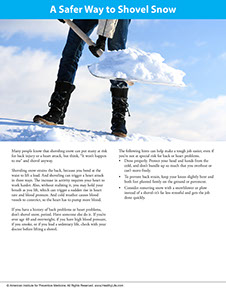
    Image of a person shoveling snow.

    Many people know that shoveling snow can put many at risk for back injury or a heart attack, but think, “It won’t happen to me” and shovel anyway.

    Shoveling snow strains the back, because you bend at the waist to lift a load. And shoveling can trigger a heart attack in three ways. The increase in activity requires your heart to work harder. Also, without realizing it, you may hold your breath as you lift, which can trigger a sudden rise in heart rate and blood pressure. And cold weather causes blood vessels to constrict, so the heart has to pump more blood.

    If you have a history of back problems or heart problems, don’t shovel snow, period. Have someone else do it. If you’re over age 40 and overweight, if you have high blood pressure, if you smoke, or if you lead a sedentary life, check with your doctor before lifting a shovel.

    The following hints can help make a tough job easier, even if you’re not at special risk for back or heart problems.

    *  Dress properly. Protect your head and hands from the cold, and don’t bundle up so much that you overheat or can’t move freely.

    *  To prevent back strain, keep your knees slightly bent and both feet planted firmly on the ground or pavement.

    *  Consider removing snow with a snowblower or plow instead of a shovel-it’s far less stressful and gets the job done quickly.

    A Year of Health Hints book by the American Institute for Preventive Medicine. www.HealthyLife.com. All rights reserved.

    © American Institute for Preventive Medicine

  • Cam Safe Use

    Alternative Medicine

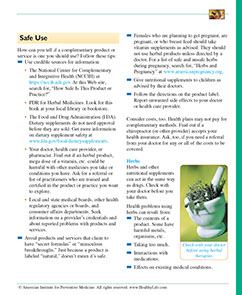
    Image of using CAM safely.

    How can you tell if a complementary product or service is one you should use? Follow these tips:

    *  Use credible sources for information:

    – The National Center for Complementary and Integrative Health (NCCIH) athttps://nccih.nih.gov. At this Web site, search for, “How Safe Is This Product or Practice?”

    – PDR for Herbal Medicines. Look for this book at your local library or bookstore.

    – The Food and Drug Administration (FDA). Dietary supplements do not need approval before they are sold. Get more information on dietary supplement safety atwww.fda.gov/food/dietarysupplements.

    – Your doctor, health care provider, or pharmacist. Find out if an herbal product, mega dose of a vitamin, etc. could be harmful with other medicines you take or conditions you have. Ask for a referral or list of practitioners who are trained and certified in the product or practice you want to explore.

    – Local and state medical boards, other health regulatory agencies or boards, and consumer affairs departments. Seek information on a provider’s credentials and about reported problems with products and services.

    *  Avoid products and services that claim to have “secret formulas” or “miraculous breakthroughs.” Just because a product is labeled “natural,” doesn’t mean it’s safe.

    *  Females who are planning to get pregnant, are pregnant, or who breast-feed should take vitamin supplements as advised. They should not use herbal products unless directed by a doctor. For a list of safe and unsafe herbs during pregnancy, search for, “Herbs and Pregnancy” atwww.americanpregnancy.org.

    *  Give nutritional supplements to children as advised by their doctors.

    *  Follow the directions on the product label. Report unwanted side effects to your doctor or health care provider.

    Consider costs, too. Health plans may not pay for complementary methods. Find out if a chiropractor (or other provider) accepts your health insurance. Ask, too, if you need a referral from your doctor for any or all of the costs to be covered.

    Herbs

    Herbs and other nutritional supplements can act in the same way as drugs. Check with your doctor before you take them.

    Health problems using herbs can result from:

    *  The contents of a product. Some have harmful metals, organisms, etc.

    *  Taking too much.

    *  Interactions with medications.

    *  Effects on existing medical conditions.

    Page from the Healthier at Home book by the American Institute for Preventive Medicine. www.HealthyLife.com. All rights reserved.

    © American Institute for Preventive Medicine

  • Safe Use Of Medications

    Medication

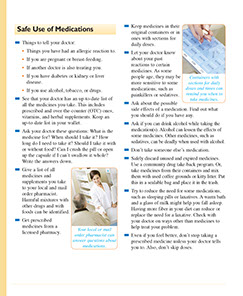
    Image of man picking up medications.

    *  Things to tell your doctor:

    – Things you have had an allergic reaction to.

    – If you are pregnant or breast-feeding.

    – If another doctor is also treating you.

    – If you have diabetes or kidney or liver disease.

    – If you use alcohol, tobacco, or drugs.

    *  See that your doctor has an up-to-date list of all the medicines you take. This includes prescribed and over-the-counter (OTC) ones, vitamins, and herbal supplements. Keep an up-to-date list in your wallet.

    *  Ask your doctor these questions: What is the medicine for? When should I take it? How long do I need to take it? Should I take it with or without food? Can I crush the pill or open up the capsule if I can’t swallow it whole? Write the answers down.

    *  Give a list of all medicines and supplements you take to your local and mail order pharmacist. Harmful mixtures with other drugs and with foods can be identified.

    *  Get prescribed medicines from a licensed pharmacy.

    *  Keep medicines in their original containers or in ones with sections for daily doses.

    *  Let your doctor know about your past reactions to certain medicines. As some people age, they may be more sensitive to some medications, such as painkillers or sedatives.

    *  Ask about the possible side effects of a medication. Find out what you should do if you have any.

    *  Ask if you can drink alcohol while taking the medication(s). Alcohol can lessen the effects of some medicines. Other medicines, such as sedatives, can be deadly when used with alcohol.

    *  Don’t take someone else’s medication.

    *  Safely discard unused and expired medicines. Use a community drug take-back program. Or, take medicines from their containers and mix them with used coffee grounds or kitty litter. Put this in a sealable bag and place it in the trash.

    *  Try to reduce the need for some medications, such as sleeping pills or laxatives. A warm bath and a glass of milk might help you fall asleep. Having more fiber in your diet can reduce or replace the need for a laxative. Check with your doctor on ways other than medicines to help treat your problem.

    *  Even if you feel better, don’t stop taking a prescribed medicine unless your doctor tells you to. Also, don’t skip doses.

    Resources

    U.S. Food and Drug Administration

    www.fda.gov

    Page from the Healthier at Home book by the American Institute for Preventive Medicine. www.HealthyLife.com. All rights reserved.

    © American Institute for Preventive Medicine