Blog

  • Canker Sores

    Dental & Mouth Concerns

    Canker sores are small, round mouth sores in the lining of the mouth or on the tongue, gums, or lips. You can have one canker sore or a group of them.

    Signs & Symptoms

    *  A burning or tingling feeling before the sore appears

    *  Red-rimmed, shallow sores in the mouth

    *  Discomfort when you eat and talk

    Causes, Risk Factors & Care

    Canker sores may be caused by any tear in the mouth’s lining, from an uneven tooth, rough tooth brushing, a burn from a hot drink, etc. Vitamin/mineral deficiencies, emotional stress, and family traits may also trigger canker sores.

    Canker sores heal within 1 to 2 weeks. Self-care can help with symptoms and speed up healing. If needed, a mouthwash with tetracycline and/or an oral paste (amelxanox) can be prescribed.

    Self-Care / Prevention

    To Relieve Pain:

    *  Mix 1/2 cup salt in 1 cup of warm water. Rinse the mouth with an ounce of this mixture 4 times a day. Don’t swallow the water.

    *  Put ice on the canker sore or suck on a frozen popsicle.

    *  Avoid spicy foods and acidic drinks, like citrus juices.

    *  Use over-the-counter products, like Anbesol, Blistex, and aloe vera gel.

    *  Swish Mylanta or milk of magnesia around the mouth to coat the sore. Then spit the medicine out.

    *  Put the gel from a vitamin E capsule on the sore several times a day.

    *  Take an over-the-counter pain medicine.

    Prevention

    *  Avoid things that irritate the mouth, such as hot drinks and sharp objects.

    *  Use a toothbrush with soft bristles and a toothpaste without sodium lauryl sulfate. Don’t brush too hard.

    *  Take a daily vitamin/mineral supplement as advised by your doctor.

    Medical Care

    Contact Doctor When:

    *  You have any of these problems with the canker sore:

    – Fever and/or swollen glands

    – Severe pain

    – A sore on the roof of the mouth or white spots in the mouth that do not heal in 1 to 2 weeks

    *  A canker sore disturbs your sleep or does not allow you to eat.

    *  A canker sore appears only after you start a new medicine.

    *  A canker sore has not healed after 3 weeks.

    Healthier at Home book by the American Institute for Preventive Medicine. www.HealthyLife.com. All rights reserved.

    © American Institute for Preventive Medicine

  • Cancer Of The Mouth Area Warning Signs

    Dental & Mouth Concerns

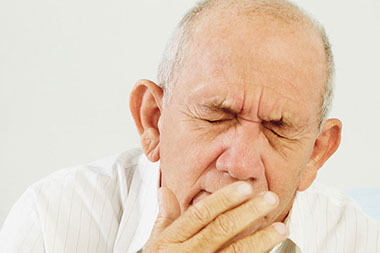
    Image of man experiencing mouth pain.

    See a doctor or dentist if you have any of these signs for 2 weeks or longer:

    *  A sore in the mouth that does not heal

    *  A lump or thickening in the cheek

    *  A white or red patch on the gums, tongue, or lining of the mouth

    *  Soreness or a feeling that something is caught in the throat

    *  A hard time chewing or swallowing or a hard time moving the jaw or tongue

    *  Numbness of the tongue or other area of the mouth; swelling of the jaw that causes dentures to fit poorly or become uncomfortable

    Any of these signs may be caused by oral cancer or by other, less serious problems. Don’t wait for something to hurt. Pain is not usually an early symptom of oral cancer.

    Health at Home Lifetime book by the American Institute for Preventive Medicine. www.HealthyLife.com. All rights reserved.

    © American Institute for Preventive Medicine

  • Cancer Awareness

    Cancer

    Smiling female going through cancer.

    Cancer is the 2nd leading cause of death in the U.S.

    Many cancers can be cured if detected and treated early. Along with avoiding tobacco products, a healthy weight, regular physical activity and eating a healthy diet greatly lowers cancer risk.

    Get screening tests for cancer (e.g., breast, colon, prostate, etc.) as advised by your doctor. Do cancer self-exams, too.

    Eat plenty of veggies, fruit, whole grains, beans, and lentils. Limit processed and sugary foods. Stay active and maintain a healthy weight.

    Avoid or limit alcohol.

    The most common type of cancer in the U.S. is skin cancer. To help prevent skin cancer, limit sun exposure and use a sunscreen with a sun protection factor (SPF) of 15 or higher.

    Learn about all types of cancer from the National Cancer Institute at 800.4.CANCER (422.6237) orcancer.gov.

    Health at Home Lifetime book by the American Institute for Preventive Medicine. www.HealthyLife.com. All rights reserved.

    © American Institute for Preventive Medicine

  • Burns

    First Aid

    Signs & Symptoms

    First-degree burns affect only the outer skin layer. The skin area appears dry, red, and mildly swollen. First-degree burns are painful and sensitive to touch. They should feel better in 1 to 2 days. They heal in about a week.

    Second-degree burns affect the skin’s outer and lower layers. The skin is painful, swollen, red, and has blisters. The skin also has a weepy, watery surface.

    Third-degree burns affect the outer and deeper skin layers and organs below the skin. The skin appears black-and-white and charred. It swells. Tissue under the skin is often exposed. Third-degree burns may have less pain than first-degree or second-degree burns. Why? No pain is felt where nerve endings are destroyed. Pain may be felt around the margin of the burn, though.

    Causes

    Burns can result from dry heat (fire), moist heat (steam, hot liquids), electricity, chemicals, or from radiation, including sunlight. The longer the skin is exposed to the burn source, the worse the burn can be.

    Treatment

    Third-degree burns always need emergency care. A second-degree burn needs immediate care if it is on the face, hands, feet, genitals, a joint, or if the burn affects a large area.Self-Care/First Aidtreats most first-degree burns and second-degree burns.

    Questions to Ask

    Self-Care / Prevention

    For Severe Burns Before Emergency Care

    *  Remove the person from the source of heat. Call 9-1-1! Keep the person’s airway open. Treat for Shock.

    *  Remove hot or burned clothes that come off easily, not if they are stuck to the skin.

    *  Cover the burns loosely with clean cloths. Use direct pressure to control bleeding. Don’t rub.

    *  Stay with the person until medical care arrives.

    *  If lye or a dry chemical gets on the skin, brush off the powder. Then flush with clean water for at least 20 minutes or until EMS arrives. Remove glasses, but not contacts, before treating the eyes.

    For First-Degree and Second-Degree Burns (that are less than 3” in diameter)

    *  Use cold water or cloths soaked in cold water on burned areas for 15 minutes or until the pain subsides. Do not use ice at all. Doing this could result in frostbite.

    *  Cover the area loosely with a dry cloth, such as sterile gauze. Hold it in place by taping only the edges of the gauze. Change the dressing the next day and every 2 days after that.

    *  Don’t use ointments. Aloe vera can be applied over closed skin 3 to 4 times a day. For a more severe burn less than 3” x 2”, use Second Skin Moisture Pads, etc.

    *  Don’t break blisters. If they break on their own, apply an antibacterial spray or ointment or treatment prescribed by your doctor. Keep the area loosely covered with a sterile dressing.

    *  Prop the burned area higher than the rest of the body, if you can.

    Resources

    National Safety Council

    www.nsc.org

    Healthier at Home book by the American Institute for Preventive Medicine. www.HealthyLife.com. All rights reserved.

    © American Institute for Preventive Medicine

  • Breast Lumps & Breast Cancer

    Women’s Health

    For Breast Lumps

    Feeling a lump in a breast can be scary. For a lot of women, the first thought is cancer. The good news is that 80% to 90% of breast lumps are not cancer.

    Signs, Symptoms, and Causes

    *  Solid tumors. These include:

    – Lipomas. These are fatty tumors that can grow very large. They are usually benign.

    – Fibroadenomas. These lumps are round, solid, and movable and are usually benign.

    – Cancerous lumps. Often, these are firm to hard masses that do not move when felt. They are often an irregular shape.

    *  Cysts. (These can be very small and diffuse, as in fibrocystic breast disease). These cysts:

    – Are fluid filled sacs.

    – Are painful and feel lumpy or tender.

    – Can occur near the surface of the skin of the breast and/or be deep within the breast. This second type may need to be tested with a biopsy to make sure it is benign.

    *  Nipple-duct tumors. These tumors occur within the part of the nipple that milk flows through. They cause a discharge from the nipple. These tumors should be removed by surgery.

    *  In rare cases, a bloody discharge from the nipple could be a sign of cancer.

    Treatment

    Tests can be done to help diagnose whether or not a breast lump is benign.

    *  Mammogram. This X-ray of the breast can detect breast problems before they can be felt.

    *  Ultrasound. This tells whether the lump is fluid-filled (usually harmless) or solid.

    *  Needle aspiration. With this, a needle is put into the lump to remove fluid or cells.

    *  Biopsy. There are many types. With these, a sample of the breast tissue is taken and examined.

    *  Ductal lavage. Fluid is sent through a catheter to the milk ducts. Cells inside the milk ducts are collected and checked for the risk of breast cancer.

    Benign breast lumps may go away if you breast-feed for many months or take a low-dose birth control pill. Prescribed medicines can get rid of severe breast lumps. These have side effects, though.

    For Breast Cancer

    Signs & Symptoms

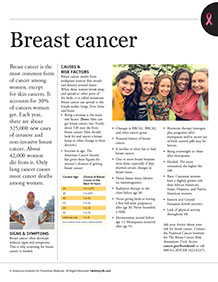
    Breast cancer is the most common form of cancer among women. It accounts for 30% of cancers women get. Each year, there are about 227,000 new cases of breast cancer. About 49,500 women die from it. Only lung cancer causes more cancer deaths among women.

    Breast cancer often develops without signs and symptoms. This is why screening for breast cancer is needed.

    Causes & Risk Factors

    Breast cancer results from malignant tumors that invade and destroy normal tissue. When these tumors break away and spread to other parts of the body, it is called metastasis. Breast cancer can spread to the lymph nodes, lungs, liver, bone, and brain.

    *  Being a women is the main risk factor. {Note: Men can get breast cancer, too. Yearly, about 410 men die from breast cancer. Men should look for and report a breast lump or other change to their doctors.}

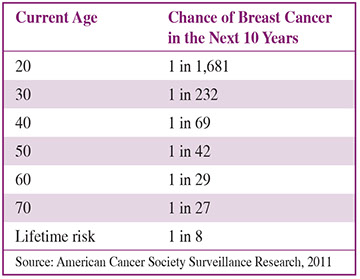
    *  Increase in age. The American Cancer Society has given these figures for women’s chances of getting breast cancer:
    *  Changes in BRCA1, BRCA2, and other cancer genes.

    *  Personal history of breast cancer.

    *  A mother or sister has or had breast cancer.

    *  One or more breast biopsies were done, especially if they showed certain changes in breast tissue.

    *  Dense breast tissue (shown on mammograms).

    *  Radiation therapy to the chest before age 30.

    *  Never giving birth or having a first full-term pregnancy after age 30. Never breast-fed a child.

    *  Menstruation started before age 12. Menopause occurred after age 55.

    *  Hormone therapy (estrogen plus progestin) after menopause and/or recent use of birth control pills may be factors.

    *  Being overweight or obese after menopause.

    *  Alcohol. The more consumed, the higher the risk.

    *  Race. Caucasian women have a slightly greater risk than African American, Asian, Hispanic, and Native American women.

    *  Eastern and Central European Jewish ancestry.

    *  Lack of physical activity throughout life.

    Ask your doctor about your risk for breast cancer. Contact the National Cancer Institute for The Breast Cancer Risk Assessment Tool. Accesswww.cancer.gov/bcrisktoolor call 800.4.CANCER (422.6237).

    Detection

    *  Breast exams by a doctor or nurse and mammograms. Have mammograms at facilities that are accredited by the American College of Radiology (ACR). Call The National Cancer Institute 800.4.CANCER (422.6237) to find ones in your area.

    *  Ultrasound exam.

    *  Magnetic resonance imaging (MRI).

    *  Noticing problems in your breasts.

    If you find a change in a breast or a lump, call your doctor. Additional tests can check for cancer. Most lumps that are found and tested are not cancer.

    Treatment

    Finding and treating the cancer early is vital. Treatment is based on the type, size, and location of the tumor. It also depends on the stage of the disease and individual factors you may have.

    One or More of These Treatment Methods are Used

    *  Surgery.

    *  Sentinal lymph node biopsy and surgery.

    *  Chemotherapy.

    *  Radiation therapy.

    *  Targeted therapy. This kills cancer cells but not normal cells.

    *  Hormone therapies.

    *  Stem cell or bone marrow transplant.

    *  Clinical trials.

    Questions to Ask

    Self-Care / Prevention

    For Cystic Breasts

    *  Get to and stay at a healthy body weight.

    *  Follow a low saturated fat diet. Eat soy foods.

    *  Do regular exercise. This can promote blood flow to your breasts.

    *  Limit or have no caffeine.

    *  Limit salt and sodium intake. This helps prevent fluid buildup in the breasts.

    *  Don’t smoke. Don’t use nicotine gum or patches.

    *  Take an over-the-counter pain reliever.

    *  Take vitamin E, as advised by your doctor.

    *  Wear a bra that provides good support. You may want to wear it while you sleep, too.

    For Breast Pain and/or Swelling without Lesions or Redness

    *  For pain due to trauma or surgery, apply cold packs for the first 48 hours. Do this every 2 to 4 hours for 10 to 15 minutes at a time. After 48 hours, apply heat, such as a hot water bottle. Do this 4 times a day for 10 to 15 minutes at a time.

    *  For pain not due to trauma or injury, apply warm heat. Use a heating pad set on low or a hot water bottle. Do this for 30 minutes. Then apply an ice pack for 10 minutes. Repeat as often as needed.

    *  Take vitamins, as advised by your doctor.

    *  Take an over-the-counter medicine for pain and swelling, as directed.

    To Reduce the Risk for Breast Cancer

    *  If you are at a high risk for breast cancer, ask  your doctor about taking prescribed medicine, such as raloxifene.

    *  Avoid X-rays that are not needed. Wear a lead  apron when you get dental and other X-rays not of the chest.

    *  Eat a variety of fruits and vegetables and whole-grain breads and cereals.

    *  Get to and stay at a healthy body weight.

    *  Do 30 or more minutes of moderate activity most days of the week. Daily is better.

    *  Limit alcohol intake to 1 drink per day, if any.

    *  Breast-feed your babies.

    Breast Self-Exam

    Breast observance is being aware of how your breasts normally look and feel and checking for changes. You can do this while you shower or get dressed. A breast self-exam (BSE) is a step-by-step method to examine your breasts. Beginning at age 20, ask your health care provider about the pros and cons of doing a BSE. If you choose to do a BSE, use the steps given on this page. At your next health exam, show your health care provider how you do a BSE.

    BSE Steps

    Examine your breasts during times of the month when they are not normally tender or swollen. For example, if you menstruate, the best time may be within 3 days after your period stops.

    1.  Lie down. Place a pillow under your right shoulder and put your right hand behind your head.

    2.  Move the pads of your left hand’s 3 middle fingers, held flat, in small, circular motions as you start to feel your right breast tissue.

    3.  Use this circular motion in an up and down pattern as you check the entire breast area. This includes the area from as high up as your collarbone to as low as the ribs below your breast; and from your right side (imagine a line straight down from under your arm) across the breast to the middle of your chest bone.

    Feel every part of the entire area you check with 3 different levels of pressure:

    *  Light – Feel the tissue closest to the skin.

    *  Medium – Feel a little deeper than the skin.

    *  Firm- Feel the tissue closest to your chest and ribs.

    4.  Squeeze the nipple gently. Check for a clear or bloody discharge.

    5.  Repeat steps 1 to 4 for the left breast using the finger pads of your right hand.

    6.  Stand in front of a mirror. Press your hands firmly on your hips. Look for:

    – Any changes in the size, shape, or contour of your breasts

    – Puckering, scaling, or redness of the skin

    – Nipple changes or discharge

    7.  Sit or stand. Raise your arm slightly. Examine each underarm area for lumps or changes.

    If you a find a lump or any change in the way your breasts normally look or feel, let your health care provider know right away. Most lumps that are found and tested are not cancer.

    Resources

    National Cancer Institute

    800.4.CANCER (422.6237)

    www.cancer.gov

    www.clinicaltrials.gov

    National Breast and Cervical Cancer Early Detection Program (NBCCEDP)

    800.CDC.INFO (232.4636)

    www.cdc.gov/cancer/nbccedp
    Women's Self-Care book by the American Institute for Preventive Medicine. www.HealthyLife.com. All rights reserved.

    © American Institute for Preventive Medicine

  • Bruises

    Skin Conditions

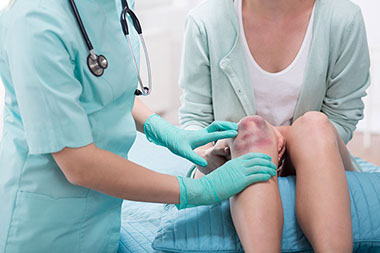
    Image of nurse examing patient bruise on knee.

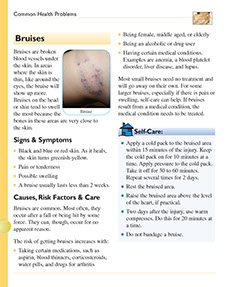
    Bruises are broken blood vessels under the skin. In areas where the skin is thin, like around the eyes, the bruise will show up more. Bruises on the head or shin tend to swell the most because the bones in these areas are very close to the skin.

    Signs & Symptoms

    *  Black and blue or red skin. As it heals, the skin turns greenish-yellow.

    *  Pain or tenderness

    *  Possible swelling

    *  A bruise usually lasts less than 2 weeks.

    Causes, Risk Factors & Care

    Bruises are common. Most often, they occur after a fall or being hit by some force. They can, though, occur for no apparent reason. The risk of getting bruises increases with:

    *  Taking certain medications, such as aspirin, blood thinners, corticosteroids, water pills, and drugs for arthritis

    *  Being female, middle aged, or elderly

    *  Being an alcoholic or drug user

    *  Having certain medical conditions. Examples are anemia, a blood platelet disorder, liver disease, and lupus.

    Most small bruises need no treatment and will go away on their own. For some larger bruises, especially if there is pain or swelling, self-care can help. If bruises result from a medical condition, the medical condition needs to be treated.

    Self-Care

    *  Apply a cold pack to the bruised area within 15 minutes of the injury. Keep the cold pack on for 10 minutes at a time. Apply pressure to the cold pack. Take it off for 30 to 60 minutes. Repeat several times for 2 days.

    *  Rest the bruised area.

    *  Raise the bruised area above the level of the heart, if practical.

    *  Two days after the injury, use warm compresses. Do this for 20 minutes at a time.

    *  Do not bandage a bruise.

    When to Seek Medical Care

    Contact Doctor When:

    *  You have any of these problems with a bruise:

    – Vision problems with a bruise near the eye

    – Signs of infection (fever; increased pain; redness, and/or swelling; pus)

    – Nosebleeds or excessive bleeding from cuts

    – Loss of weight and appetite

    – Joint pain, fever, or swollen lymph nodes

    *  You have any of these problems:

    – Bruising on the hip after a fall

    – Bruises appear often and easily.

    – Bruises take longer than 2 weeks to go away.

    – Over a year’s time, more than 2 or 3 bruises appear for no apparent reason.

    Health at Home Lifetime book by the American Institute for Preventive Medicine. www.HealthyLife.com. All rights reserved.

    © American Institute for Preventive Medicine

  • Bronchitis

    Respiratory conditions

    Acute bronchitis is swelling of the air passages of the lung. Chronic bronchitis is swelling of the air passages of the lung that persists for a long time or occurs again and again.

    Acute Bronchitis

    Signs & Symptoms

    *  A cough starts out dry. Then mucus or phlegm come with the cough. Hoarseness or a sore throat can also occur.

    *  Chills. Fever less than 102ºF.

    *  Feeling of pressure behind the breastbone or a burning feeling in the chest.

    These symptoms can last from 3 days to 3 weeks. They go away when the acute episode is over.

    Causes

    *  A viral or bacterial infection.

    *  Pollutants, such as smog.

    These attack the mucus membranes within the windpipe or air passages in your respiratory tract leaving them red and inflamed. Acute bronchitis often develops after a cold or other respiratory infection.

    Treatment

    Most of the time, this type is caused by a virus and goes away without treatment. Sometimes, a doctor may prescribe:

    *  Bronchodilators. These medicines open up air passages in the lungs.

    *  An antibiotic if you smoke, are older than age 40, or if you have a condition or take medication that makes it hard for you to fight infections.

    Chronic Bronchitis

    Signs & Symptoms

    *  A cough with mucus or phlegm for 3 or more months at a time. This occurs for more than 2 years in a row.

    *  Shortness of breath with exertion (in early stages).

    *  Shortness of breath at rest (in later stages).

    Many people, most of them smokers, develop emphysema (destruction of the air sacs) with chronic bronchitis. This is chronic obstructive pulmonary disease (COPD).

    Causes

    *  Cigarette smoking. This is the most common cause.

    *  Air pollution.

    *  Repeated infections of the air passages in the lungs.

    Chronic bronchitis causes permanent damage to the respiratory tract. It can make you more prone to respiratory infections like acute bronchitis and pneumonia. Chronic bronchitis is not contagious.

    Treatment

    *  Not smoking. Avoiding secondhand smoke.

    *  Avoiding or reducing exposure to air pollution, chemical irritants, and cold, wet weather.

    *  Medical treatment as needed, for airway infections and heart problems.

    *  Oxygen, as prescribed.

    Questions to Ask

    Self-Care / Prevention

    *  Don’t smoke. Avoid secondhand smoke.

    *  Reduce your exposure to air pollution. Use air conditioning, air filters, and a mouth and nose filter mask if you have to. Stay indoors during episodes of heavy air pollution.

    *  Rest. Drink plenty of liquids.

    *  Breathe air from a cool-mist vaporizer. Bacteria grows in vaporizers, so clean your unit after each use. Breathing in mist with bacteria can make bronchitis worse. Use distilled (not tap) water in the vaporizer.

    *  Take an over-the-counter medicine for fever, pain, and/or inflammation as directed.

    *  Instead of cough suppressants, use expectorants.

    *  Use bronchodilators and/or take antibiotics as prescribed by your doctor.

    Resources

    American Lung Association

    800.LUNG.USA (586.4872)

    www.lungusa.org

    Healthier at Home book by the American Institute for Preventive Medicine. www.HealthyLife.com. All rights reserved.

    © American Institute for Preventive Medicine

  • Broken Or Knocked-Out Tooth

    Dental & Mouth Concerns

    Signs & Symptoms

    *  Loss of a tooth or part of a tooth.

    *  Nicked or chipped tooth or teeth.

    Causes

    An injury or a strain on a tooth, such as from biting on a hard object can cause a broken, knocked-out, or chipped tooth.

    Treatment

    When a tooth gets knocked out, go to the dentist as soon as possible. Keep the tooth moist until you get to the dentist. Follow up treatment is also needed.

    Questions to Ask

    Self-Care / Prevention

    For a Knocked-Out Tooth

    *  If you find the tooth, pick it up by the crown. Avoid contact with the root.

    *  Rinse off the rest of the tooth with clear water. Do not scrub the tooth or remove any tissue that is attached to the tooth.

    *  If possible (and if you’re alert), gently put the tooth back in its socket or hold it under your tongue. Otherwise, put the tooth in a glass of milk, cool salt water, or a wet cloth. Don’t let the tooth dry out.

    *  If the gum is bleeding, hold a gauze pad or a clean tissue tightly in place over the wound.

    *  Try to get to a dentist within 30 minutes of the accident. If the dentist is not available, go to a hospital emergency department. Take the tooth with you.

    For a Broken Tooth

    *  To reduce swelling, apply a cold compress to the area.

    *  Save any broken tooth fragments. Put them in a wet cloth or milk. Take them to the dentist.

    To Protect Teeth From Damage and Injury

    *  Don’t chew on ice, pens, pencils, etc.

    *  Don’t use your teeth to pry things open.

    *  If you smoke a pipe, don’t bite down on the stem.

    *  If you grind your teeth at night, ask your dentist if you should be fitted or a bite plate.

    *  If you play contact sports like football or hockey, wear a protective mouthguard. Mouthguards may also be useful for noncontact sports, such as gymnastics. Discuss the need of using a mouthguard with your dentist.

    *  Always wear a seat belt when riding in a car.

    *  Don’t suck on lemons or chew aspirin or vitamin C tablets. Acids in these wear away tooth enamel.

    Healthier at Home book by the American Institute for Preventive Medicine. www.HealthyLife.com. All rights reserved.

    © American Institute for Preventive Medicine

  • Broken Bones / Dislocations

    First Aid

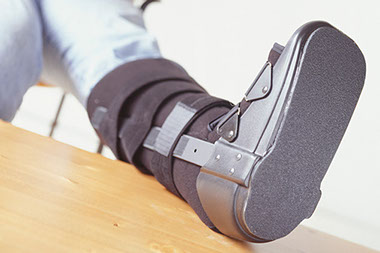
    Image of person wearing a foot brace boot.

    For Broken Bones

    Signs & Symptoms

    Symptoms of broken bones are pain, swelling, bruising, and loss of function or feeling. The injured area looks crooked, misshaped, or deformed.

    Below the injured site, numbness and tingling can occur. The skin can be pale, blue, purple, or gray. It feels colder than the skin on the uninjured limb.

    Causes

    *  Injuries from falls and accidents.

    *  Osteoporosis.

    *  Too much or repeated stress on a bone.

    Treatment

    The bone may need to be reset. A splint or cast may need to be worn. {Note: Broken fingers, toes, and ribs don’t need a cast.} Muscles and joints near the fracture site need to be exercised.

    For Dislocations

    Signs & Symptoms

    A dislocation is a separation of the end of a bone and the joint it meets. The bone is displaced from its proper position. A dislocated joint is swollen, misshaped, very painful, and discolored.

    Dislocations can cause damage to the membrane lining the joint, tears to nearby muscles and ligaments, and nerve damage.

    The shoulders are especially prone to dislocation injuries. The elbow is a common site in toddlers. Fingers, hips, ankles, elbows, jaws, and even the spine can be dislocated. A dislocated vertebrae in the spine often damages the spinal cord and can paralyze body parts lower than the injury site.

    Causes

    *  Injuries from contact sports or falls. Over stretching bones that touch in joints.

    *  Joints weakened by previous injury.

    *  Suddenly jerking a toddler’s hand or arm. Force applied in the wrong direction can snap the ball of the upper arm bone out of the shoulder socket.

    Treatment

    Medical care is needed to put a dislocated bone back into its socket. With this, the dislocated joint should function within 24 to 48 hours. Limited activity for 4 to 6 weeks allows enough time for the injury to heal.

    Questions to Ask

    Self-Care / First Aid

    For an Open Fracture

    *  Monitor for signs of shock.

    *  Control bleeding with direct pressure. Do not press on or move a bone that sticks out. Do not reset the bone.

    *  Immobilize the wound with a splint. Use a firm material, such as a folded newspaper or broom handle. Secure the splint above and below the injury or tie the injured part to an uninjured part. Use shoe laces, belts, etc. to hold the splint in place. Do not tie too tightly. Check the area below the splint to make sure that the skin is warm and pink in color. If not, loosen the ties.

    For Fractures to Limbs

    *  To make an arm splint, put padding between the arm and the body. If an elbow is not involved, place the arm across the chest and wrap a cloth around the entire body. If the elbow is involved, place the arm straight or slightly bent against the body. Wrap the cloth around the body and arm.

    *  Make a sling with a triangular piece of cloth. Place the largest part under the arm and tie the ends at the neck.

    *  Make a splint for a leg or tie the injured leg to the other leg. Place padding in between the legs. Do not tie the splint too tightly. This could interfere with blood flow.

    *  Use cold packs on the injured site. Do not use ice next to the skin. This can cause frostbite.

    *  For pain, take an over-the-counter pain reliever as directed. Don’t use aspirin if you have bleeding.

    For Dislocations

    Dislocations need medical care. The longer they are out, the harder it is to get them back in.

    *  Immobilize the injured area above and below the injured joint.

    *  Don’t try to straighten a bone or joint that is misshaped. Don’t try to put a joint back in its socket.

    *  Apply cold packs to relieve pain and swelling.

    *  Follow your doctor’s instructions.

    *  Take an over-the-counter medicine for pain as directed.

    Resources

    National Institute of Arthritis and Musculoskeletal and Skin Diseases (NIAMS)

    www.niams.nih.gov

    Healthier at Home book by the American Institute for Preventive Medicine. www.HealthyLife.com. All rights reserved.

    © American Institute for Preventive Medicine