Blog

  • Bleeding 2

    First Aid

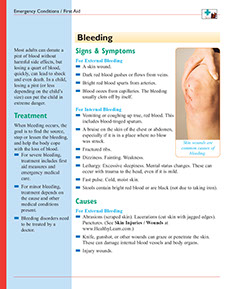
    Most adults can donate a pint of blood without harmful side effects, but losing a quart of blood, quickly, can lead to shock and even death. In a child, losing a pint (or less depending on the child’s size) can put the child in extreme danger.

    Signs & Symptoms

    For External Bleeding

    *  A skin wound.

    *  Dark red blood gushes or flows from veins.

    *  Bright red blood spurts from arteries.

    *  Blood oozes from capillaries. The bleeding usually clots off by itself.

    For Internal Bleeding

    *  Vomiting or coughing up true, red blood. This includes blood-tinged sputum.

    *  A bruise on the skin of the chest or abdomen, especially if it is in a place where no blow was struck.

    *  Fractured ribs.

    *  Dizziness. Fainting. Weakness.

    *  Lethargy. Excessive sleepiness. Mental status changes. These can occur with trauma to the head, even if it is mild.

    *  Fast pulse. Cold, moist skin.

    *  Stools contain bright red blood or are black (not due to taking iron).

    Causes

    For External Bleeding

    *  Abrasions (scraped skin). Lacerations (cut skin with jagged edges). Punctures.

    *  Knife, gunshot, or other wounds can graze or penetrate the skin. These can damage internal blood vessels and body organs.

    *  Injury wounds.

    For Internal Bleeding

    *  A bruise. This is bleeding from and damage to tissues beneath the skin.

    *  Damage to blood vessels and/or internal structures. This includes a blunt injury that does not break the skin, a bleeding ulcer, and an aneurysm.

    *  Bleeding disorders.

    Taking blood-thinning drugs can result in both internal and external bleeding.

    Treatment

    When bleeding occurs, the goal is to find the source, stop or lessen the bleeding, and help the body cope with the loss of blood.

    *  For severe bleeding, treatment includes first aid measures and emergency medical care.

    *  For minor bleeding, treatment depends on the cause and other medical conditions present.

    *  Bleeding disorders need to be treated by a doctor.

    Questions to Ask

    Self-Care / First Aid

    For Severe Bleeding

    *  Without delay, apply direct pressure to the wound using a sterile dressing or clean cloths. {Note: If the cut is large and the edges of it gape open, pinch the edges of the wound while you apply pressure.}

    *  Call 9-1-1 or take the person to nearest hospital emergency department.

    *  Do not remove an object that is stuck in a wound. Pack it in place with padding. Put tape around the padding so it doesn’t move.

    *  If bleeding continues before getting medical help, put extra cloths, etc. on top of existing ones. Keep putting pressure on the wound until bleeding stops or until medical help takes over.

    *  The most important thing to do is to apply direct pressure on the bleeding site. Some health experts advise to do these things, too, if needed:

    – Elevate the wounded area higher than heart level while applying pressure. Do this if no bone is broken.

    – Apply pressure to a “pressure point” if bleeding still continues after 15 to 20 minutes of direct pressure. Use the pressure point closest to the bleeding site that is between the wound and the heart. (See Pressure Points.)

    *  Don’t apply a tourniquet except to save a life.

    *  While giving first aid for bleeding, keep looking for signs of shock.

    For an Amputation

    *  Control bleeding.

    *  Wrap the severed part in a clean, dry (not wet) cloth or sterile gauze. Place the wrapped part in a plastic bag or other waterproof container. Put these on a bed of ice. Do not submerge the severed part in cold water or ice.

    For Bleeding from the Scalp

    *  Use a ring pad to apply pressure around the edges of the wound, not on the wound. Make a ring pad (shaped like a doughnut) with a bandage of narrow, long strips of cloth. Start with one end of the narrow bandage and wrap it around all four fingers on one hand until you form a loop. Leave a long strip of the bandage material to weave in and around the loop so it doesn’t unravel.
    Healthier at Home book by the American Institute for Preventive Medicine. www.HealthyLife.com. All rights reserved.

    © American Institute for Preventive Medicine
  • Bleeding

    Pregnancy & Prenatal Care

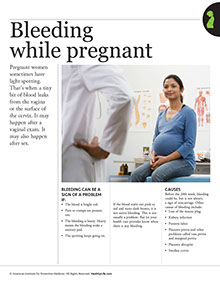
    Pregnant women sometimes have light spotting. That’s when a tiny bit of blood leaks from the vagina or the surface of the cervix. It may happen after a vaginal exam. It may also happen after sex. If the blood starts out pink or red and turns dark brown, it is not active bleeding. This is not usually a problem. But let your health care provider know when there is any bleeding. He or she will decide what to do. Bleeding can be a sign of a problem if:

    *  The blood is bright red.

    *  Pain or cramps are present, too.

    *  The bleeding is heavy. Heavy means the bleeding soaks a sanitary pad.

    *  The spotting keeps going on.

    Causes

    Before the 20th week, bleeding could be, but is not always, a sign of miscarriage. Other causes of bleeding include:

    *  Loss of the mucus plug

    *  Kidney infection

    *  Preterm labor

    *  Placenta previa and other problems called vasa previa and marginal previa

    *  Placenta abruptio

    *  Swollen cervix

    Placenta Previa

    The placenta carries oxygen and food to the baby. In most pregnancies, the placenta attaches high in the uterus. In placenta previa, it attaches low, over the cervix. The lower uterus stretches during late pregnancy. Parts of the placenta tear from the wall. That causes bleeding.

    Placenta previa is rare. It happens in only 1 in 200 pregnancies. Its cause is not known. Falls and injuries are not factors. Symptoms of placenta previa are:

    *  Bright red vaginal bleeding. This could start as early as the 24th week. Often, it starts during the 34th or 35th week.

    *  Usually, there is no pain or cramping.

    A woman may not know that she has placenta previa until bleeding happens. Then an ultrasound test can show the problem.

    Women with placenta previa have to spend a lot of time in bed. Bed rest may last late into the pregnancy. Bed rest gives the baby time to grow. It prevents stress to the uterus. The goal is to keep blood loss down. A lot of blood loss means danger for both mother and baby. In severe cases, the mother may have to go to the hospital for treatment.

    In some cases, the bleeding stops, but the placenta blocks the cervix. The mother will need a Cesarean section (C-section) delivery if the placenta completely blocks the cervix. The mother may need a C-section if the placenta only partly blocks the cervix. When this happens, the mother may have more bleeding after she delivers the baby.

    {Note: Some pregnant women may have a “low lying placenta.” This means the placenta lies at the bottom of the uterus (not higher where it should be). An ultrasound can show a “low lying” placenta. If it is found before the 24th week, the placenta can move upward and out of the way of the cervix. If so, there is no longer a problem.}

    Placenta Abruptio

    There is a right time for delivery of the placenta. That’s after the baby is born. But sometimes it happens another way. The placenta starts to leave the wall of the uterus too early. It starts before the baby is born. This can happen whether the placenta is attached high or low.

    Placenta abruptio happens in about 1 in 200 pregnancies. Some cases are more serious than others. Causes might be high blood pressure or a serious blow to the belly. An older mother may be more apt to have placenta abruptio. So are women who use cocaine during pregnancy. Symptoms of placenta abruptio are:

    *  Bright red vaginal bleeding

    *  Severe pain in the abdomen. The pain lasts. It doesn’t come and go.

    There are no tests for placenta abruptio. Even ultrasound may not show it. Regular prenatal visits help. The health care provider looks for blood in the mother’s vagina. The provider finds out if the uterus is tender.

    Women with placenta abruptio need to go to the hospital right away. Some women can have a vaginal delivery. That’s if labor begins on its own and the baby is healthy. Otherwise, a C-section is done. The mother may be given blood.

    Questions to Ask

    Self-Care / Prevention

    *  Watch closely for bleeding. If you see any, call your health care provider.

    *  Rest in bed for light bleeding.

    *  Avoid doing things that could injure you. Examples: heavy lifting, hard exercise. Don’t do work, sports, or exercises that could give you a blow to the belly.

    *  Wear a special seat belt when you drive. You can get one that protects a pregnant woman’s belly.

    *  Don’t smoke.

    *  Don’t be exposed to other people’s smoke.

    *  Follow your health care provider’s advice about sex. You may be told to:

    – Avoid sex.

    – Use extra caution during sex:

    – Your partner can focus on more gentle touching.

    – Limit how deeply the penis enters the vagina. Use positions that help control the depth.

    Prenatal Self-Care book by the American Institute for Preventive Medicine. www.HealthyLife.com. All rights reserved.

    © American Institute for Preventive Medicine

  • Alternatives To Baldness

    Men’s Health

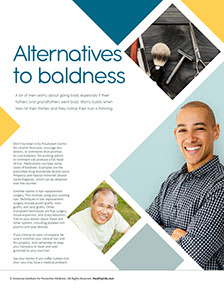
    Image of mature man with thinning hair.

    A lot of men worry about going bald, especially if their fathers and grandfathers went bald. Worry builds when men hit their thirties and they notice their hair is thinning.

    Don’t be taken in by fraudulent claims for vitamin formulas, massage oils, lotions, or ointments that promise to cure baldness. No existing potion or ointment will produce a full head of hair. Medications can help some cases of baldness. Examples are the prescribed drug finasteride (brand name Propecia) and minoxidil (brand name Rogaine), which can be prescribed or obtained over-the-counter.

    Another option is hair replacement surgery. This involves using your existing hair. Techniques in hair replacement surgery include punch grafts; mini-grafts; micro-grafts; slit-grafts, and strip grafts. Other transplant techniques are flap surgery, tissue expansion; and scalp reduction. Talk to your doctor about these options.

    If you choose to wear a hairpiece, be sure it matches your natural hair and fits properly. And remember to keep your hairpiece as clean and well- groomed as your own hair.

    See your doctor if you suffer sudden hair loss-you may have a medical problem.

    A Year of Health Hints book by the American Institute for Preventive Medicine. www.HealthyLife.com. All rights reserved.

    © American Institute for Preventive Medicine
  • Bites & Stings

    First Aid

    For Bites

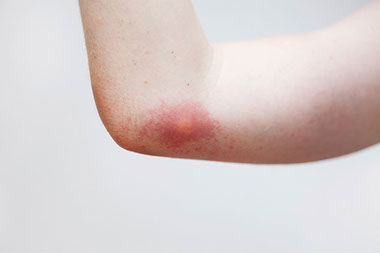
    Image of arm with an insect bite mark.

    Signs & Symptoms

    *  Swelling. Redness. Pain. Itching.

    *  Bleeding.

    *  Tissue loss, if the wound is severe.

    *  Skin rash.

    *  Lockjaw. This is a painful, persistent stiffness of the jaw due to a toxin. Tetanus shots can prevent this.

    *  Allergic reaction, such as with insect bites.

    Causes

    *  Dog, cat, and human bites are the most common animal bites in the U.S.

    *  Deer tick bites can cause Lyme disease, a bacterial infection.

    *  Bed bug bites cause redness, swelling, and large, red welts or raised areas on the skin.

    *  Black widow and brown recluse spider bites can cause severe reactions.

    *  Less common, but more dangerous, are bites from skunks, raccoons, bats, and other animals that live in the wild. These animals can have rabies – a serious viral infection. It can be fatal. Most house pets are vaccinated for rabies. It’s unlikely they carry the virus.

    *  Mosquito bites can cause West Nile virus if the mosquito is infected with it.

    *  Snake bites can be fatal if the bite is from a poisonous snake (e.g., rattlesnakes, cotton mouths, copperheads, and coral snakes).

    *  Shark bites are a potential problem when swimming in shark-infested waters.

    Treatment

    Self-care can be used for dog and cat bites that cause scratches on the skin and for insect bites that do not cause a severe allergic reaction. All human bites that break the skin should be checked by a doctor due to the high risk for infection.

    A series of rabies shots can prevent the spread of rabies to humans. The shots should begin soon after a bite from an infected animal.

    Antivenom can be given for poisonous snake bites at emergency medical facilities. It should be given within 4 hours of the bite.

    For Stings

    Signs & Symptoms

    *  Quick, sharp pain.

    *  Swelling, itching, and redness at the sting site. These can occur beyond the sting site.

    *  Raised bump (with or without pus).

    *  Signs of a severe allergic reaction.

    Causes

    *  Insect stings.

    *  Marine animals that sting include jellyfish, Portuguese Man-of-War, and sea nettles.

    Treatment

    Self-care treats mild reactions to stings. A severe allergic reaction needs immediate care. Symptoms of a severe allergic reaction usually happen soon after or within an hour of the sting.

    Persons with a severe allergic reaction to a sting in the past should carry an emergency kit, prescribed by a doctor. A medical alert tag should be worn to let others know of the allergy. Persons who have had severe reactions to bee or wasp stings should ask their doctors about allergy shots.

    Questions to Ask

    Self-Care / First Aid

    For Poisonous Snake Bites Before Medical Care

    *  Carefully move the person away from the snake. Calm the person. Have him or her rest. Moving about can help spread the venom.

    *  Gently wash the bite area with soap and water. Keep the limb of the bite site level with the heart (or just below this). Apply a splint to the limb of the bite site to keep it from moving.

    *  Being careful, note, if you can, the shape of the snakes eyes, pupils, and head, the colors it is, and if it has rattles.

    *  Don’t try to kill the snake, cut the fang mark, or suck out the venom.

    *  Don’t apply a tourniquet, a bandage, or ice to the bite.

    For Non-Poisonous Snake Bites

    *  Gently wash the site with soap and water.

    *  Treat the bite as a minor wound.

    *  If you notice signs of an infection, call your doctor.

    For Poisonous Spider Bites Until Emergency Care Arrives

    *  Perform rescue breathing, if needed.

    *  If you can, keep the bitten area lower than the level of the heart.

    *  Calm the person and keep him or her warm.

    *  Gently clean the site of the bite with soap and water or rubbing alcohol.

    *  Put an ice pack over the bite site for pain relief.

    *  If you can, catch the spider in a closed container to show what kind it is.

    For Poisonous Spider and Scorpion Bites Before Medical Care

    *  Do rescue breathing, if needed.

    *  If you can, keep the bitten area lower than the level of the heart.

    *  Calm the victim and keep him or her warm.

    *  Gently clean the site of the bite with soap and water or rubbing alcohol.

    *  Put an ice pack over the bite site to relieve pain.

    *  If you can, catch the spider in a closed container to show the doctor. n Get emergency care!

    For Human Bites Before Medical Care

    *  Wash the wound area with soap and water for at least 5 minutes. Don’t scrub hard. Rinse with running water or with an antiseptic solution, such as Betadine.

    *  Cover the wound area with sterile gauze. Tape only the ends of the gauze in place. Then get medical care.

    For Deer Tick Bites

    *  Remove any ticks found on the skin. Use tweezers to grasp the tick(s) as close to the skin as you can. Pull gently and carefully in a steady upward motion at the point where the tick’s mouthpart enters the skin. Try not to crush the tick. The secretions released may spread disease.

    *  After you remove the ticks, wash the wound area and your hands with soap and water. Apply rubbing alcohol to help disinfect the area.

    *  Use an ice pack over the bite area to relieve pain.

    *  Save one tick in a closed jar with rubbing alcohol to show the doctor.

    For Dog and Cat Bites

    *  Wash the bite area right away with soap and warm water for 5 minutes. If the bite is deep, flush the wound with water for 10 minutes. Dry the wound with a clean towel. Then get medical care.

    *  If the wound is swollen, apply ice wrapped in a towel for 10 minutes.

    *  Get a tetanus shot, if needed.

    *  If the bite hurts, take an over-the-counter (OTC) medicine for pain.

    *  Report the incident to the animal control department. If a pet’s immunizations are not current, arrange with the animal control department for the pet to be observed for the next 10 days to check for rabies.

    *  Observe the wound for a few days. Look for signs of infection. Often, cat bite wounds need an antibiotic.

    For a Stingray Bite

    *  Remove the person from the water.

    *  Apply a local pressure bandage for a wound that bleeds a lot.

    *  Immerse the wound area in hot water for 30 to 90 minutes. Make sure the water is not hot enough to burn the skin.

    *  Scrub the wound area well with soap and water.

    *  Unless the wound is a slight one in only one limb, get medical help right away.

    For Stings from Jellyfish or Sea Nettles, etc.

    *  Remove the person from the water. Don’t touch the sting area with bare hands.

    *  Rinse the sting area with salt (not fresh) water right away. Don’t put ice on the skin. If you can, put vinegar or rubbing alcohol on the area several times for 30 or more minutes until the pain is relieved.

    *  Apply dry or moist heat to the sting area until the pain subsides. You can mix one part ammonia with 3 parts salt water and apply this to the sting area.

    *  Wear gloves when you remove stingers. Use a towel to wipe the stingers or the tentacles off. Use tweezers to lift large tentacles. Don’t scrape or rub them.

    *  To relieve itching, apply OTC calamine lotion or 1% hydrocortisone cream to the affected area as directed on the label.

    *  Contact your doctor for any signs of infection.

    Healthier at Home book by the American Institute for Preventive Medicine. www.HealthyLife.com. All rights reserved.

    © American Institute for Preventive Medicine
  • Hospital / Birthing Center Checklist

    Pregnancy & Prenatal Care

    What to Pack For Labor

    *  A watch with a second hand. This will help you time your contractions.

    *  Hard candies or lollipops. These will help keep your mouth moist.

    *  Lip balm. This will keep your lips moist.

    *  A small paper bag. This will help if you hyperventilate. You or your coach should let your health care provider know if you hyperventilate during labor.

    *  Warm socks

    *  Hair tie. This is helpful if you have long hair.

    *  Mouthwash. You might need this to freshen your mouth.

    Your Coach Needs to Pack

    *  Hand-held massager and lotions to massage you with

    *  Hairbrush. Your coach can soothe you by brushing your hair.

    *  Snacks

    *  Phone numbers of the people you want called after the baby is born

    *  Tape player and tapes or a radio. Music could help you relax during labor.

    *  Camera, tape recorder, video camera. These may or may not be allowed. You may or may not want to use them.

    What to Pack For After Delivery

    *  Nightgown(s). If you plan to nurse, take nightgowns that open in the front.

    *  Underpants, nursing bras, and nursing pads

    *  Robe or bed jacket

    *  Slippers

    *  Toothbrush and toothpaste

    *  Comb, barrettes, hair bands, and other items you use for your hair

    *  Shampoo

    *  Soap in a soap dish or plastic bag

    *  Skin lotion

    *  Deodorant

    *  Makeup, perfume, powder

    *  Hand held mirror

    *  Any other toilet items you use

    *  Sanitary napkins

    *  Clothes to wear home. Maternity clothes will still fit best.

    *  Pen and paper

    *  Address book with phone numbers for people you may want to call.

    *  Enough money to pay for small hospital services. Examples: TV, newborn pictures, newspapers, and magazines.

    *  Snacks like fresh fruit, dried fruit, and whole wheat crackers. You’ll be doubly glad to have snacks around if you are nursing.

    For Taking the Baby Home:

    *  An outfit of clothes. Example: an undershirt, a one-piece sleeper with legs, and a newborn diaper.

    *  Outer wear. Example: a cap, booties, receiving blanket(s), and a warm blanket if the weather is cold.

    *  An approved infant car seat. Do you already have one? If not, ask the hospital or birthing center where you can borrow or rent one.

    Prenatal Self-Care book by the American Institute for Preventive Medicine. www.HealthyLife.com. All rights reserved.

    © American Institute for Preventive Medicine
  • Birth Defects

    Pregnancy & Prenatal Care

    Pregnant women standing in open field.

    In the U.S., about one out of 33 babies is born with a birth defect. This includes cystic fibrosis, Down syndrome, heart defects, sickle cell disease, spina bifida, and Tay-Sachs disease.

    A baby’s neural tube starts to develop about 3 weeks after conception (before many women know they are pregnant).

    Females of childbearing age should take a daily supplement with 400 micrograms of folic acid (a B vitamin). Women who have had a baby with a neural tube defect should follow their doctor’s advice about folic acid for future pregnancies.

    Learn about birth defects from the March of Dimes atmarchofdimes.com.

    Health at Home Lifetime book by the American Institute for Preventive Medicine. www.HealthyLife.com. All rights reserved.

    © American Institute for Preventive Medicine
  • Birth Control Options

    Women’s Health

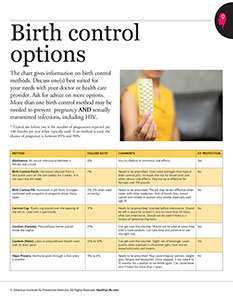
    Women's hand holding up birth control pack.

    This page gives information on birth control methods. Discuss one(s) best suited for your needs with your doctor or health care provider. Ask for advice on more options. More than one birth control method may be needed to prevent  pregnancy AND sexually transmitted infections, including HIV.

    * Typical use failure rate is the number of pregnancies expected per 100 females per year when typically used. If no method is used, the chance of pregnancy is between 85% and 90%.

    Abstinence

    No sexual intercourse between a female and a male.

    Has no medical or hormonal side effects.

    Failure Rate*

    0%

    HIV / STI Protection

    Yes

    Birth Control Patch

    Hormones released from a skin patch worn on the skin weekly for 3 weeks. It is not worn the 4th week.

    Needs to be prescribed. Gives more estrogen than typical birth control pills. Increases the risk for blood clots and other serious side effects. May not be as effective for females over 198 pounds.

    Failure Rate*

    7%

    HIV / STI Protection

    No

    Birth Control Pill

    Hormones in pill form. Estrogen combined with progestin or progestin alone. Many types.

    Needs to be prescribed. The pill may be less effective when taken with other medicines. Risk of blood clots, breast cancer and strokes in women who smoke, especially over age 35.

    Failure Rate*

    3% (1% when used correctly)

    HIV / STI Protection

    No

    Cervical Cap

    Plastic cap placed over the opening of the cervix. Used with a spermicide.

    Needs to be prescribed. Inserted before intercourse. Should be left in place for at least 8, but no more than 48 hours after last intercourse. Should not be used if there is a history of abnormal Pap tests.

    Failure Rate*

    17%

    HIV / STI Protection

    No

    Condom (Female)

    Polyurethane barrier placed inside the vagina.

    Can get over-the-counter. Should not be used at same time with a male condom. Can take time and patience to use the right way.

    Failure Rate*

    21%

    HIV / STI Protection

    Yes

    Condom (Male)

    Latex or polyurethane sheath worn over an erect penis.

    Can get over-the-counter. Slight risk of breakage. Loses quality when exposed to ultraviolet light, heat, and oil-based lubricants and creams.

    Failure Rate*

    13% to 18%

    HIV / STI Protection

    Yes

    Depo-Provera

    Hormone given through a shot every 3 months.

    Needs to be prescribed. May cause irregular periods, weight gain, fatigue and headaches. Once stopped, it can take 4 to 18 months for a woman to be fertile again. Can cause bone loss if taken for more than 2 years.

    Failure Rate*

    4% to 6%

    HIV / STI Protection

    No

    Diaphragm

    Reusable, thin, soft, cap (plastic or silicon) that covers the cervix. Used with a spermicide.

    Needs to be prescribed. Should be checked for leaks. Size may need to be changed with weight changes. May dislodge during intercourse. Should be left in place at least 6, but no more than 24 hours, after last intercourse.

    Failure Rate*

    6% to 16%

    HIV / STI Protection

    No

    Emergency Contraception Pills

    High-dose birth control pills that need to be taken up to 5 days after unprotected intercourse. Called “morning after pill.”

    Progestin-only pills are available over-the-counter without age restrictions. Other types, such as ella®, are available by prescription only for all ages. Most require a single dose but some are taken as 2 doses, 12 hours apart. Can cause nausea, vomitting, breast tenderness and changes in menstrual periods.

    Failure Rate*

    11% to 25% (the sooner used, the more effective)

    HIV / STI Protection

    No

    Emergency IUD Insertion

    Needs to be done within 5 days of unprotected intercourse.

    Needs to be done by a health care professional. Used as an emergency contraception method.

    Failure Rate*

    Less than 1%

    HIV / STI Protection

    No

    FemCap®

    Silicone rubber device. Fits snugly over the cervix.

    Needs to be prescribed. Should be left in place for at least 6, but no more than 48 hours, after last intercourse.

    Failure Rate*

    17% to 23%; less effective if gave birth

    HIV / STI Protection

    No

    Nexplannon®

    Thin plastic implant about the size of a match stick. Releases a low dose of the hormone progestin for up to 3 years.

    Needs to be inserted and removed by a health care professional. Can cause irregular menstrual bleeding, mostly fewer and lighter periods, or no periods.

    Failure Rate*

    Less than 1%

    HIV / STI Protection

    No

    Intrauterine Device (IUD)

    ParaGard. Small copper device inserted into uterus. {Note: An IUD does not prevent an ectopic pregnancy. With this, an embryo starts to grow outside the uterus.}

    Needs to be inserted and removed by health care professional. Can be left in place for up to 10 years. May become dislodged. Risk of infection and piercing of the uterus. Need to check that the 2 strings hang from the bottom so the IUD is in the correct position.

    Failure Rate*

    Less than 1%

    HIV / STI Protection

    No

    Intrauterine System (IUS)

    Mirena®. T-shaped device placed in uterus. Releases low dose of hormones every day for 5 years.

    Needs to be inserted and removed by a health care professional. May lessen menstrual cramps. Needs to be replaced every 5 years.

    Failure Rate*

    Less than 1%

    HIV / STI Protection

    No

    Lea’s Shield®

    Silicone cup with an air valve and a loop (aids in removal) that fits snugly over the cervix. Used with a spermicide.

    Needs to be prescribed. Should be left in place at least 8, but no more than 48 hours, after last intercourse.

    Failure Rate*

    15%

    HIV / STI Protection

    No

    Natural Family Planning

    Ovulation signs need to be checked for and tracked.

    Sexual intercourse must be limited to “safe” days. Takes training, time and record keeping to work right. Method for planning a pregnancy, too.

    Failure Rate*

    2% to 23%

    HIV / STI Protection

    No

    NuvaRing®

    A soft, flexible ring that a female inserts deep into the vagina. Contains hormones.

    Needs to be prescribed. A new Ring is inserted once and kept in place for 3 weeks. It is removed the week of menstrual period. May cause increased risk for vaginal problems.

    Failure Rate*

    7% to 9%

    HIV / STI Protection

    No

    Spermicides (Foams, Jellies, Creams)

    Chemicals inserted into the vagina kill sperm before it enters the uterus.

    Can get over-the-counter. More reliable when used with condoms, diaphragms, etc. Inserted between 5 and 90 minutes before intercourse. Need to reapply for repeated acts of intercourse.

    Failure Rate*

    21% to 28%

    HIV / STI Protection

    No

    Today’s Sponge®

    Polyurethane barrier that contains spermicide.

    Can get over-the-counter. Must be left in place for 6 hours after last intercourse, but should not be worn for more than 24 hours after sex.

    Failure Rate*

    12% to 24%

    HIV / STI Protection

    Some

    Sterilization (Female)

    Tubal ligation (having the tubes tied). This surgery burns, cuts, blocks or ties off the fallopian tubes. Another type, tubal implants (Essure®), is not surgery. A device is inserted through the vagina and uterus into each fallopian tube. This causes scar tissue to grow and plug the tubes.

    Permanent form of birth control. Should be used only when no more children are desired. Surgery usually needs general anesthesia. Essure® is no longer sold in the U.S. but women who are using it to prevent pregnancy can continue to use it. Women who suspect they may be having symptoms related to the device, such as pain, should talk to their doctor about what steps may be appropriate for them to take.

    Failure Rate*

    Less than 1%

    HIV / STI Protection

    No

    Sterilization (Male)

    Vasectomy. The tubes through which sperm travels from the testes are cut.

    Permanent form of birth control. Done in an outpatient setting with local anesthesia. Not effective right away. Sperm can still be present for 20 ejaculations.

    Failure Rate*

    Less than 1%

    HIV / STI Protection

    No

    Withdrawal

    The penis is removed before ejaculation.

    Have to control ejaculation. Sperm can leak before this occurs.

    Failure Rate*

    Up to 27%

    HIV / STI Protection

    No

    Women's Self-Care book by the American Institute for Preventive Medicine. www.HealthyLife.com. All rights reserved.

    © American Institute for Preventive Medicine

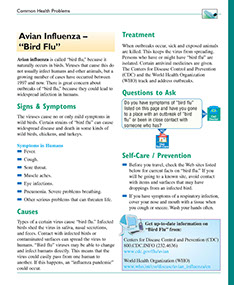
  • Avian Influenza – “Bird Flu”

    Respiratory conditions

    Avian influenza is called “bird flu,” because it naturally occurs in birds. Viruses that cause this do not usually infect humans and other animals, but sporadic human infections with avian influenza have occurred. Outbreaks of “bird flu” could lead to widespread infection in humans.

    Signs & Symptoms

    The viruses usually cause no or only mild symptoms in wild birds. Certain strains of “bird flu” can cause widespread disease and death in some kinds of wild birds, chickens, and turkeys.

    Symptoms in Humans

    *  Fever.

    *  Cough.

    *  Sore throat.

    *  Muscle aches.

    *  Eye infections.

    *  Pneumonia. Severe problems breathing.

    *  Other serious problems that can threaten life.

    Causes

    Avian influenza A viruses cause “bird flu.” Infected birds shed the virus in saliva, nasal secretions, and feces. Contact with infected birds or contaminated surfaces can spread the virus to humans. “Bird flu” viruses may be able to change and infect humans directly. This means that the virus could easily pass from one human to another. If this happens, an “influenza pandemic” could occur.

    Treatment

    When outbreaks occur, sick and exposed animals are killed. This keeps the virus from spreading. Persons who test positive for or might have “bird flu” are isolated. Certain antiviral medicines are given. The Centers for Disease Control and Prevention (CDC) and the World Health Organization (WHO) track and address outbreaks.

    Questions to Ask

    Self-Care / Prevention

    *  Check the Web sites listed below for current facts and possible vaccines for “bird flu” viruses. Avoid direct or close contact with wild birds and infected domestic birds and their droppings.

    *  Take antiviral medicines, as prescribed.

    *  Eat properly cooked poultry.

    Resources

    Centers for Disease Control and Prevention (CDC)

    800.CDC.INFO (232.4636)

    www.cdc.gov/flu

    World Health Organization (WHO)

    www.who.int/csr/disease/avian_influenza/en

    Healthier at Home book by the American Institute for Preventive Medicine. www.HealthyLife.com. All rights reserved.

    © American Institute for Preventive Medicine

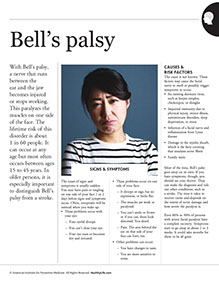
  • Bell’S Palsy

    Brain & Nervous System

    With Bell’s palsy, a nerve that runs between the ear and the jaw becomes inflamed. This paralyzes the muscles on one side of the face. Bell’s palsy occurs in about 1 in 2,000 people each year. It can occur at any age. In older persons, it is especially important to distinguish Bell’s palsy from a stroke.

    Signs & Symptoms

    The onset of signs and symptoms is usually sudden. You may have pain or tingling on one side of your face 1 or 2 days before signs and symptoms occur. Often, symptoms will be noticed when you wake up.

    *  These problems occur on one side of your face:

    – It droops or sags, has no expression, or looks flat.

    – The muscles are weak or paralyzed.

    – You can’t smile or frown or if you can, these look distorted. You drool.

    – Pain. The area behind the ear on that side of your face can hurt, too.

    *  These problems occur with your eye:

    – Your eyelid droops.

    – You can’t close your eye.

    – Your eye tears.

    *  Other problems can occur:

    – You have changes in taste.

    – You are more sensitive to noise.

    Causes, Risk Factors & Care

    The cause is not known. These factors may cause the facial nerve to swell:

    *  A virus, such as shingles

    *  A physical blow that damages the facial nerve

    *  Decrease in blood flow and pressure on the facial nerve. This could be due to circulation problems.

    *  Family traits

    Most of the time, Bell’s palsy goes away on its own. If you have symptoms, though, you should see your doctor. He or she can make the diagnosis and rule out other conditions, such as a stroke. The time it takes to recover varies and depends on the extent of nerve damage and how severe the paralysis is. Even 80% to 90% of persons with severe facial paralysis have a complete recovery. Symptoms start to go away in about 2 to 3 weeks. It could take months for them to be all gone.

    Self-care can help with the discomfort. For severe cases, a doctor may prescribe:

    *  Nerve conduction tests of the facial nerves

    *  Physical and/or speech therapy

    *  Corticosteroid medicine to reduce swelling of the affected nerve

    *  Eye drops to comfort and protect the affected eye

    *  Electric stimulation to the affected muscle

    *  Surgery, on occasion, to reduce pressure on the facial nerve

    *  Plastic surgery may be done in rare cases, if the face remains paralyzed.

    Self-Care

    Try to be patient. Bell’s palsy is a cause for distress, but is not dangerous. The goal of self-care is to ease symptoms and to prevent damage to the eye.

    For Pain:

    *  Take an over-the-counter medicine for pain.

    *  Cover or close your eye. Apply a heating pad (set on low) to the painful area. Do this for 15 minutes at a time, 2 times a day.

    *  Soak a washcloth in hot water. Wring it out. Close your eye and place it on the closed eye for 15 minutes.

    If You Cannot Close Your Eye:

    *  Wear wraparound goggles during the day to protect your eyes from dust, dirt, and dryness. Wear an eye patch at night to help hold the eyelid shut.

    *  Exercise the affected facial muscles as advised by your doctor or physical therapist. Do a facial massage for 15 to 20 minutes a day. With an oil or a cream, massage the muscles of your forehead, cheek, lips, and eye area.

    *  Use over-the-counter artificial tears as advised by your doctor.

    *  Keep up with your normal activities.

    *  Eat soft foods, if you need to.

    When to Seek Medical Care

    Contact Doctor When:

    *  You have no improvement in symptoms 3 weeks after you have been diagnosed with Bell’s palsy.

    *  You have any of these problems after a diagnosis of Bell’s palsy:

    –  Symptoms get worse.

    –  The numbness or weakness appear to be spreading or affect an area or body part not affected before.

    –  Your eye gets very red or irritated.

    –  Fever

    –  Severe pain

    –  Swelling or a lump in front of the ear

    Get Immediate Care When:

    You have signs of a stroke.

    {Note: Immediate care is advised because the initial symptoms of Bell’s palsy are similar to ones of a stroke. This is especially true for older persons.}

    Health at Home Lifetime book by the American Institute for Preventive Medicine. www.HealthyLife.com. All rights reserved.

    © American Institute for Preventive Medicine

  • Being Ready For Medical Emergencies

    First Aid

    *  Learn basic first-aid skills. Take courses in CPR and first aid. These give hands-on practice in giving first aid and CPR the right way. Find out about them from your local Red Cross, police and/or fire department, etc.

    *  Find out what services your health plan covers and what steps you have to take to get emergency costs paid for.

    *  Carry the following information with you at all times:

    – Your name, address, phone number, and the person to contact if you need emergency care.

    – Your health insurance information.

    – Important medical information. This could be on a medical alert tag, on a wallet card, or on the back of your driver’s license. Have a list of medications, their dosages, and things you are allergic to.

    – Emergency telephone numbers. (Post these near phones, too.)

    First-Aid Kit

    Keep first-aid supplies handy, but out of children’s reach. Carry a first-aid kit in the car (or boat, wrapped in a waterproof container), as well as in the house. Campers, bikers, hikers, and persons who spend time in remote areas should take a first-aid kit with them. Once a year, check supplies for expiration dates. Restock items when they are used up or when expiration dates have passed.

    First-Aid Supplies & Medicines

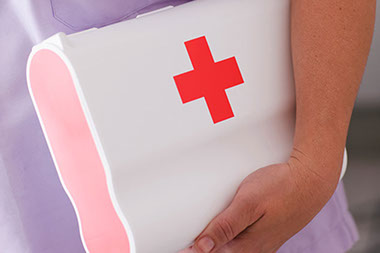
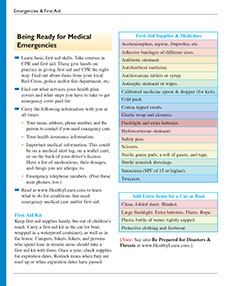
    Image of person holding first aid kit.

    *  Acetaminophen, aspirin, ibuprofen, etc.

    *  Adhesive bandages of different sizes.

    *  Antibiotic ointment.

    *  Antidiarrheal medicine.

    *  Antihistamine tablets or syrup.

    *  Antiseptic ointment or wipes.

    *  Calibrated medicine spoon & dropper (for kids).

    *  Cold pack.

    *  Cotton-tipped swabs.

    *  Elastic wrap and closures.

    *  Flashlight and extra batteries.

    *  Hydrocortisone ointment.

    *  Safety pins.

    *  Scissors.

    *  Sterile gauze pads, a roll of gauze, and tape.

    *  Sterile nonstick dressings.

    *  Sunscreen (SPF of 15 or higher).

    *  Tweezers.

    Add Extra Items for a Car or Boat

    *  Clean, folded sheet. Blanket.

    *  Large flashlight. Extra batteries. Flares. Rope.

    *  Plastic bottle of water, tightly capped.

    *  Protective clothing and footwear.

    Healthier at Home book by the American Institute for Preventive Medicine. www.HealthyLife.com. All rights reserved.

    © American Institute for Preventive Medicine