Blog

  • Bedsores

    Skin Conditions

    Image of older man sitting on bed.

    Bedsores, also called pressure ulcers, are painful ulcers on the skin. Common sites are the head, back, buttocks, tailbone, knees, and ankles.

    Signs & Symptoms

    *  The skin may feel sore in areas where a bone is close to the skin. There may be no feeling at all.

    *  The skin gets irritated and red and then turns purple.

    *  The skin cracks and an open sore appears. The skin area can become infected.

    Causes & Risk Factors

    Bedsores are caused by constant pressure on the skin or frequent rubbing in one area. Factors that increase the risk of bedsores include:

    *  Being confined to a bed or chair

    *  Urinary incontinence; poor bowel control

    *  Poor blood circulation and loss of sensation due to a stroke or spinal cord injury

    Infected sores require antibiotics. Chronic or deep sores may also require antibiotics. If infected sores are left untreated too long, a blood infection that threatens life can result. This is rare, though. Bedsores may also need special dressings.

    Self-Care / Prevention

    A caregiver may need to assist with these.

    *  Change position every 2 hours if confined to a bed and every hour if confined to a chair or as often as advised by your health care provider.

    *  Check the skin daily for early signs of bedsores. Use mirrors for hard to see places. {Note: Redness is usually the earliest sign. Once the skin cracks or breaks down, seek medical care.}

    *  Use a foam or sheepskin mattress cover.

    *  Use a waterbed or a bed with an air filled mattress, such as a ripple bed. This type of airbed has a small motor that creates a rippling effect by pumping air in and out of the mattress.

    *  If incontinent, wear absorbent pads or briefs.

    *  Keep the skin clean and dry. Clean it right away if there is contact with urine or stool. Use soft cloths, sponges, and mild soaps. Avoid hot water. Do not rub the skin.

    *  Apply cornstarch to the skin.

    *  Lift (do not drag or slide) an immobile person.

    *  Don’t sit on donut-shaped cushions.

    *  Put pillows between knees and ankles so they don’t touch.

    *  Use sheepskin under heels and buttocks.

    *  Don’t massage bony body parts.

    *  Eat well and get adequate fluids.

    *  Ask your doctor about taking a vitamin C supplement.

    *  Handle a person with bedsores gently.

    *  Apply topical medication, as advised.

    When to Seek Medical Care

    Contact Doctor When:

    *  The skin is cracked.

    *  Sores show signs of infection (fever; redness; pain; heat; pus; swelling).

    *  Sores have not improved after 2 weeks of self-care.

    Health at Home Lifetime book by the American Institute for Preventive Medicine. www.HealthyLife.com. All rights reserved.

    © American Institute for Preventive Medicine

  • Bed-Wetting

    Children’s Health

    Passing urine during sleep is called “bed-wetting” when it occurs after age 5 or 6. Children are usually expected to have nighttime bladder control by this age. Bed-wetting is a very common problem. In the U.S., 5 to 7 million children have it.

    Enuresis is a medical term for bed-wetting. {Note: Bed-wetting itself, can’t be prevented, but damage to a child’s self- image can. Explain that bed-wetting is not his or her fault and that it will get better in time.}

    Causes

    Children don’t wet the bed on purpose. These are causes of bed-wetting:

    *  A lot of urine is made in the evening and during the night. A full bladder does not wake the child up.

    *  A child’s small bladder does not hold urine for an entire night.

    *  Other conditions, such as a urinary tract infection and diabetes. (Daytime wetting and other symptoms occur with these conditions.)

    *  For children who have been dry at night for 6 or more months, sometimes, emotional upsets and major changes can cause bed-wetting. An example is having a new baby in the house.

    *  Children are more likely to wet the bed if both parents did when they were children.

    Treatment

    Most of the time, children outgrow bed-wetting. Until then, self-care measures help with the problem. Medication can be prescribed when no other treatment works.

    Questions to Ask

    Self-Care / Prevention

    Be patient and give your child lots of support. Children who wet the bed can’t help it. Getting angry only makes the problem worse.

    Until Your Child Outgrows Bed-Wetting

    *  Do not blame or punish your child for wetting the bed.

    *  Limit fluids in the evening, especially 2 hours before bedtime. Ask your child’s doctor how much your child should drink. Don’t give drinks with caffeine, such as colas.

    *  Have your child urinate in the toilet right before getting into bed.

    *  See that your child can easily get to the toilet during the night. Keep the path clear. Use night lights, etc. If needed, put a portable potty close to your child’s bed. Assign a place the potty can be moved to for daytime, if your child wants to do this.

    *  Tell other members of the household that “teasing” about bed-wetting is not allowed. Respect your child’s privacy and feelings.

    *  You may want your child to use pull-up (training) pants when he or she sleeps away from home, camps, etc. On a regular basis, encourage your child to wake up to use the toilet.

    *  Keep a change of pajamas, a flannel covered pad, clean sheets, dry towels, etc., near your child’s bed. Show your child how to use these when he or she wets the bed. Include your child in the clean-up process.

    *  Have your child rehearse getting up from bed and using the toilet. Do this at bedtime. Do it during the day when your child gets the urge to urinate. Have your child lay down in his or her bed, wait a few minutes, and then get up to urinate in the toilet.

    *  If your child is 5 years old or older and he or she agrees to it, get a bed-wetting alarm. The child wears the alarm on his or her underwear. The first drop makes the alarm buzz. This wakes the child up. After awhile, the child learns to wake up when he or she has to urinate. Some of these alarms help prevent wet beds 85 to 90 percent of the time.

    Resources

    National Kidney Foundation

    888.WAKE.DRY (925.3379)

    www.kidney.org

    Healthier at Home book by the American Institute for Preventive Medicine. www.HealthyLife.com. All rights reserved.

    © American Institute for Preventive Medicine

  • Bad Breath

    Dental & Mouth Concerns

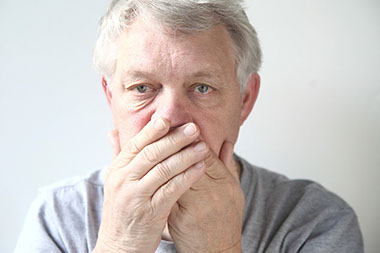
    Image of man holding hands over mouth.

    Bad breath (halitosis) is a social concern. It can be a health issue, too.

    Signs & Symptoms

    *  A bad odor from the mouth. To detect this, wipe the back of your tongue with a piece of white, sterile gauze. After 5 minutes, smell the gauze for an odor.

    *  An unpleasant taste is in the mouth.

    *  You are told you have bad breath.

    Causes

    Bacteria on the tongue, dry mouth, and strong odors of food, such as garlic and onions, are common causes of bad breath. Other causes are smoking, alcohol, ill-fitting dentures, and infections of the gums or teeth. Less often, bad breath is due to another problem, such as a sinus infection or indigestion.

    Treatment

    TheSelf-Care/Preventionitems listed on this page treat most cases of bad breath. If not, your dentist can prescribe:

    *  A special toothpaste.

    *  A mouth rinse.

    *  A special brush.

    *  A tongue scraper.

    *  An antimicrobial solution.

    Questions to Ask

    Self-Care / Prevention

    *  Practice good oral hygiene.

    *  If you wear dentures, clean and care for them as advised by your dentist.

    *  Don’t smoke. Limit or avoid alcohol.

    *  To prevent dry mouth, drink plenty of water and other liquids.

    *  Use a baking soda toothpaste. Brush your teeth and tongue. Do this after all meals, if you can. If not, rinse your mouth with water, chew parsley, mint leaves, celery, or carrots after meals.

    *  Don’t rely on mouthwash or mints. They mask bad breath and help cause it, because they dry out the mouth. Try chlorophyll tablets.

    *  Eat at regular times. Eat nutritious foods. Limit sugary foods.

    *  Chew sugarless gum or suck on lemon or other citrus drops. These help make saliva. Saliva helps deal with bacteria on the teeth and washes away food particles.

    Healthier at Home book by the American Institute for Preventive Medicine. www.HealthyLife.com. All rights reserved.

    © American Institute for Preventive Medicine

  • Backaches

    Pregnancy & Prenatal Care

    Causes

    Pregnant women get backaches because:

    *  The growing uterus and extra weight pull the body forward. Standing this way can strain the back muscles.

    *  Hormones are released during pregnancy. These make the ligaments soften and stretch. Ligaments are tissues that surround and support the joints.

    *  Joints in the lower back get sore from pressure. This happens to joints in the pelvic area, too. The baby is growing in size and weight.

    *  The baby presses against the tailbone.

    Prevention

    Do exercises your health care provider tells you to do. Use good posture, too. Keep your spine straight when you are standing. Have a friend check your back for curving: Stand with your heels against a wall. Ask your friend to look at your back. Tell him or her to let you know if it curves. Center your weight over the pelvic area. Be careful when you bend over, too. Bending wrong can give you a backache.

    Back Labor

    Most women have some back pain during labor. Some women have it through their whole labor. This is called back labor. It is caused by the way the baby is lying. The back of the baby’s head presses against the tailbone. Or it may press slightly to one side of it. Back labor can occur in preterm labor, too.

    Questions to Ask

    Self-Care

    Tips for Good Posture

    When you stand:

    *  Stand straight.

    *  Tuck in your bottom.

    *  Don’t hollow your back.

    *  Don’t tighten your shoulders or hold them back. Keep them dropped.

    *  If you have to stand for a long time: Stretch your feet and shift your weight. Rest one foot and then the other on a footstool or telephone book.

    When you sit:

    *  Sit on a straight chair with a high back.

    *  Rest your back against the chair’s back.

    *  Put a pillow at the small of your back.

    *  Rest one or both feet on a footstool.

    *  Don’t sit too long. It strains your lower back. Get up and walk around.

    When you bend:

    *  To pick something up, squat down on your heels and bend your knees. Keep your upper body straight. Don’t lean over from the waist. Use the strength from your legs, not your back.

    *  To do something down low, kneel or squat. Or get down on all fours. That way, you help take the baby’s weight off your spine.

    When you lie down or sleep:

    *  Use a firm mattress. If you don’t have one, have someone help you place a board under your mattress. Or have someone put your mattress on the floor.

    *  Lie on your left side with your knees bent. Bend the upper knee more than the lower knee. Leave a lot of space between your legs.

    *  Put a pillow under your upper knee and leg.

    Other Self-Care Tips

    *  Don’t gain too much weight.

    *  Wear shoes with low (but not flat) heels.

    *  On a long car ride, stop every two hours. Get out and walk around.

    *  Don’t take medicine for pain. Ask your health care provider first.

    *  Don’t lift objects over 15 pounds.

    *  Don’t do exercises where you lift both legs at the same time.

    *  Do exercises for stronger back and belly muscles. Ask your health care provider for these.

    *  Do relaxation and deep breathing exercises. Do yoga.

    *  Have someone massage your lower back. Massage won’t cure a backache. It can loosen tight muscles, though.

    *  Apply warm, moist heat to your back. Use a hot water bottle or warm wash cloth.

    *  Ask your health care provider if you should wear a back support girdle, a back brace, or a special elastic sling.

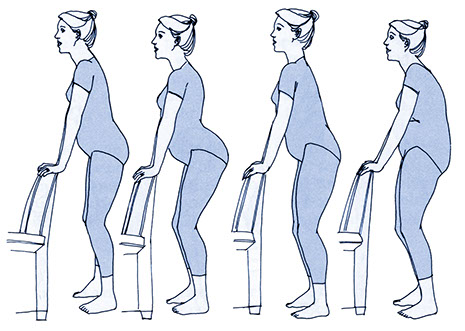
    *  Do an exercise called the “pelvic rock”. This exercise helps your lower back be more flexible. It helps make the muscles in your belly stronger.

    You can stand to do the pelvic rock.

    Step 1

    *  Stand 2 feet away from the back of a chair.

    *  Put your hands on the chair’s back. Keep your elbows straight.

    *  Bend a little forward from your hips.

    Step 2

    *  Push your hips backward and relax the muscles in your belly. Relax your back.

    *  Bend your knees a little.

    Step 3

    *  Slowly pull your hips forward.

    *  Tuck your buttocks under as if someone were pushing you from behind.

    Step 4

    *  Repeat steps 1, 2, and 3.

    Illustration of pregnant women doing the pelvic rock exercise while standing.

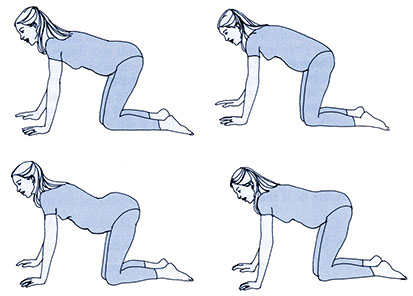
    You can do the pelvic rock on your hands and knees.

    Step 1

    Get down on all fours. Have your knees slightly apart. Have your back and elbows straight.

    Step 2

    Breathe in. As you breathe in, relax your back. Use the muscles in your lower belly.

    Step 3

    Breathe out. As you breath out, let your back relax down to a flat position. Do not let your back sag.

    Step 4

    Repeat steps 1, 2, and 3.

    {Note: Tell your health care provider if you get pain when you do the pelvic rock. Ask for help if you have a problem doing the pelvic rock.}

    Illustration of pregnant women doing the pelvic rock on hands and knees.
    Prenatal Self-Care book by the American Institute for Preventive Medicine. www.HealthyLife.com. All rights reserved.

    © American Institute for Preventive Medicine

  • Back Pain

    Bone & Muscle Problems

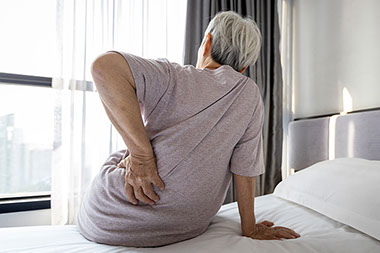
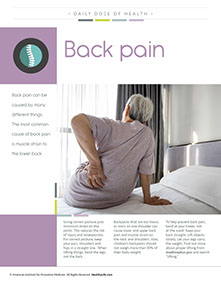
    Back side of older person holding lower back in pain.

    Back pain can be caused by many different things. The most common cause of back pain is muscle strain to the lower back.

    Using correct posture puts minimum stress on the joints. This reduces the risk of injury and osteoporosis. For correct posture, keep your ears, shoulders and hips in a straight line.  When lifting things, bend the legs, not the back.

    Backpacks that are too heavy or worn on one shoulder can cause lower and upper back pain and muscle strain on the neck and shoulders. Also, children’s backpacks should not weigh more than 10% of their body weight.

    To help prevent back pain, bend at your knees, not at the waist. Keep your back straight. Lift objects slowly. Let your legs carry the weight. Find out more about proper lifting frommedlineplus.govand search “lifting.”

    Health at Home Lifetime book by the American Institute for Preventive Medicine. www.HealthyLife.com. All rights reserved.

    © American Institute for Preventive Medicine

  • Back Care

    Bone & Muscle Problems

    Back pain can be sharp, dull, acute, or chronic. It can be felt on one or both sides of the back.

    Causes

    Low Back Problems

    Back pain occurs most often in the lower back. That is where the human body absorbs the most weight and stress. About half of working age adults have low back problems. Having an acute low back problem means lower back or back-related leg symptoms for less than 3 months. About 90 percent of persons with acute low back problems resume normal activity within a month with or without medical treatment. Often, acute low back pain goes away on its own in a few days or weeks.

    Sprains and Strains

    A sprain is an injury to a ligament (fibrous tissue that connects bones). A strain is an injury to a muscle or tendon (tissue that connects muscle to bone). Most backaches come from strained muscles in the lower back or from sprained ligaments that support the spine.

    Poor Posture

    People who slouch put strain on their backs. Poor posture can cause back pain and limit recovery efforts. The back has three natural curves: one at the neck, one at the middle back, and one at the lower back. A healthy spine and flexible muscles support the spine and keep the body in proper alignment. With good posture, all three curves are balanced and the ears, shoulders, and hips are aligned.

    Lack of Exercise

    Muscles that aren’t worked out regularly are more prone to injury. Do whole body exercises, such as swimming and/or walking. Do exercises that stretch and strengthen your back, too.

    Excess Weight

    Ten extra pounds of body weight puts 30 pounds of strain on the lower back. Being very overweight increases the weight on the spine, putting increased pressure on the discs in the spine. The discs allow the vertebrae to move more smoothly.

    Stress

    Stress can worsen back pain that already exists. Back spasms may even be caused by worries and fatigue. These exercises can help reduce stress:

    *  Sit comfortably. Breathe deeply. Tighten and relax each muscle of your body from head to toe. Hold each muscle tight for five seconds and then relax.

    *  Picture relaxing scenes and go there in your mind.

    Other Causes of Back Pain

    *  Arthritis

    *  Back injury, such as from a fall or an accident

    *  Fibromyalgia

    *  Kidney stones

    *  Infections (bladder, kidney, lung, etc.)

    *  Osteoporosis

    *  Ruptured disc or other mechnical problem in the spine

    *  Sciatica. This is inflammation of the sciatic nerve. This nerve starts in the lower spine and goes down the back of the legs.

    Prevention

    When You Lift Things

    Do’s

    *  Wear good shoes (not sandals) with low heels.

    *  Stand close to the object.

    *  Plant your feet squarely, shoulder width apart.

    *  Bend at the knees, not at the waist. As you lift, slowly straighten your knees.

    *  Hold the object close to your body.

    *  Lift slowly. Let your legs carry the weight.

    *  Get help or use a dolly to move something that is too big or very heavy.

    Don’ts

    *  Don’t lift an item that is too heavy. Get help or use a mechanical lifting device.

    *  Don’t lift anything heavy if you’re not steady on your feet.

    *  Don’t bend at the waist to pick something up.

    *  Don’t arch your back when you lift or carry.

    *  Don’t lift too fast or with a jerk.

    *  Don’t twist your back when you are holding something. Turn your whole body, from head to toe.

    *  Don’t lift something heavy with one hand and something light with the other.

    *  Don’t try to lift one thing while you hold something else. For example, don’t pick up a child while you are holding a grocery bag. Put the bag down and lift the bag and the child together.

    When You Reach for Things

    Do’s

    *  Get close to the object you are reaching for.

    *  Use a sturdy step stool or a ladder to reach higher than your shoulders. Or use a tool made for reaching things.

    *  Tighten your stomach muscles.

    *  Let your arms and legs do the work.

    *  Turn your whole body to move the object.

    Don’ts

    *  Don’t stretch your back or overstretch your arms to reach an object.

    *  Don’t twist your upper body.

    When You Sit

    Do’s

    *  Sit on chairs that are low enough so both of your feet are flat on the floor or use a footrest. Keep your knees level with your hips.

    *  Sit against the back of the chair.

    *  Use a lumbar support or rolled towel for lower back support.

    *  Take frequent mini-breaks to walk, stretch, and change your activity.

    Don’ts

    *  Don’t slouch.

    *  Don’t lean forward and arch your back in a chair that’s too high or too far from your desk.

    When You Sleep

    Do’s

    *  Sleep on a firm mattress or surface.

    *  Get comfortable when you lie down or sleep.

    *  If you sleep on your back, keep your upper back flat, but your hips and knees bent. Keep your feet flat on the bed. Tip your hips down until you find the best spot. Put a pillow under your knees if that feels good to you.

    *  If you sleep on your side, keep your knees bent. Put a pillow between your knees.

    *  When you get up from bed, move slowly, roll on your side and swing your legs to the floor. Push off the bed with your arms.

    Don’ts

    *  Avoid soft, sagging mattresses.

    *  Don’t sleep on your stomach.

    When You Walk or Stand

    Do’s

    *  When standing for long periods, prop one foot up.

    *  Shift your weight from one foot to the other.

    *  When standing and walking, keep all 3 curves of the back balanced and the ears, shoulders, and hips aligned.

    *  Wear low-heeled, comfortable shoes.

    *  Use proper posture. (Head high, chin tucked, and toes straight ahead.)

    Don’ts

    *  Don’t stay in one position too long.

    *  Don’t bend forward when your legs are straight.

    *  Don’t walk with poor posture.

    *  Avoid high-heeled or platform shoes.

    When You Drive

    Do’s

    *  Keep your knees level with your hips. Adjust the car seat forward, if you need to.

    *  Sit up straight and keep both hands on the wheel.

    *  Use a lumbar support or rolled towel for lower back support.

    Don’ts

    *  Don’t sit too far from the wheel. Stretching for the pedals and steering wheel strains the back.

    If you are overweight, lose weight.

    *  Get regular physical activity.

    *  Stretch before and after you exercise or work.

    *  Don’t smoke. If you smoke, quit. Smoking increases the risk of osteoporosis. It also slows the healing of damaged disks of the spine.

    *  Reduce emotional stress that causes muscle tension. Learn to deal with stress.

    – Several times a day, do a “body check” for tensed muscles and let them relax.

    – Balance work and play. Plan some “me” time.

    – Do relaxation and deep breathing exercises. Do yoga, tai chi, or meditate.

    – Seek professional help for stress, if needed.

    Back Exercises

    You can help improve a bad back, maintain a healthy back, and decrease your risk of back injury by exercising your back. Contact your doctor or health care provider before you start a new exercise program. Start slowly. Stop if pain increases.

    Ask your health care provider about other back exercises. Ask, too, about an aerobic exercise program, such as walking, running, swimming, or biking.

    Do back exercises for 15 minutes a day, 3 to 5 times a week.

    Pelvic Tilt

    This strengthens front and back muscles and helps prevent swayback. Lie on your back with knees bent. Keep your feet flat on the floor. Breathe slowly and deeply. Rest your arms at your sides. Get comfortable and relaxed. Tighten your stomach muscles so the small of your back is flat on the floor. Next, begin to tighten the buttock muscles. Tilt the hips or pelvis upward, and relax. Hold for a count of 5. Repeat 5 times.

    Knee-to-Chest Raise

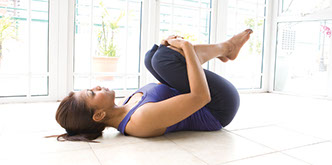
    Image of women doing a knee-to-chest raise.

    This limbers up a stiff back. Lie on your back with knees bent, feet flat on the floor. Breathe deeply. Get comfortable and relaxed. Raise your right knee to your chest and grasp it with both arms. Hug your knee in order to feel a slight stretching in the lower back region. Hold for a count of 5. Do this 5 times. Repeat with your left leg. Repeat with both legs. Be careful not to arch your back. Don’t use your arms to lift your legs.

    Image of women doing a spinal stretch.

    Spinal Stretch

    This increases flexibility of the spinal column. Stand erect and raise both hands over your head. Stretch towards the ceiling. Focus on your upper body. Use your arms, hands, and fingers to reach upward as though you were being pulled upward. Keep your feet flat on the floor. Hold for a count of 5.

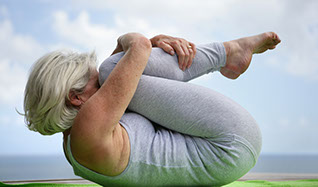
    Curl Up

    Image of women doing a curl up.

    This strengthens the lower back. Lie on your back while on a firm surface. Slowly bring both knees to your chest and bring your chin forward to your chest. Your arms should be extended straight at your sides. Hold for a count of 5. Gradually return to your starting position.

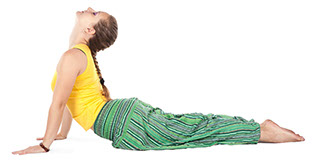
    Elbow Props

    These strengthen low back muscles and help maintain the normal curve of the lower back. Lie on your stomach. Turn your head to one side. Relax your arms at your sides. Relax like this for 3 minutes. Prop up on your elbows with your head facing forward. Keep your lower back completely relaxed and flat. Hold this position for 2 minutes. Return to the starting position for 1 minute. Repeat 3 times.

    Sitting Hamstring Stretch

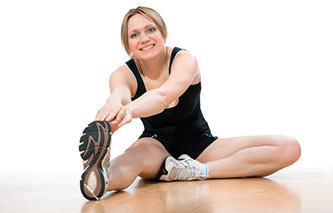
    Image of a women doing a sitting hamstring stretch.

    This warms up and limbers the back muscles and stretches the hamstring muscles. Sitting on the floor, stretch your right leg out directly in front of you. Place your left foot under your right knee. The toes of your right leg should be pointed upward. Slowly reach forward to grasp the tips of your right toes. Be careful to bend over from the hip. Hold for a count of 10. Repeat 5 times. Then switch leg positions.

    Treatment for Low Back Pain

    Continue your regular activities as much as you can. Back muscles can get weak if you don’t use them. Rest your back, if you must, but don’t rest in bed for more than 1 to 2 days, even if your back hurts a lot. Bed rest should only be used for persons with severe limitations (due mostly to leg pain).

    {Note: Before you seek treatment for back pain on your own, check with your doctor or health care provider. Discuss the benefits and risks for treatments, such as spinal manipulation, different forms of massage, and herbal remedies.}

    Medication

    *  Over-the-counter (OTC) pain relievers. Examples are acetaminophen, aspirin, ibuprofen, ketoprofen, and naproxen sodium. These relieve back pain, but only for a short time. All but acetaminophen also reduce swelling and are called NSAIDs+. This stands for nonsteroidal anti-inflammatory drugs.

    *  Prescribed NSAIDs+ and other medicines, such as muscle relaxants.

    + NSAIDs can cause stomach upset, indigestion, and ulcers in the stomach and intestines. Discuss the benefits and risks of taking NSAIDs, as well as other medicines, with your doctor.

    Cold Treatment

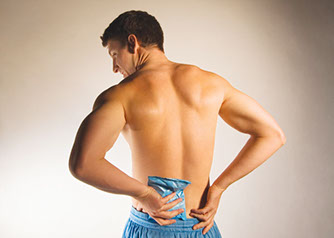
    Image of man holding a cold pack on lower back.

    Injury to the back can cause blood vessels to tear. This leaves a bruise. Cold inhibits bruising and swelling and numbs pain. Cold packs, like crushed ice wrapped in a towel, can help. Apply a cold pack for 5 to 10 minutes at a time, several times a day. For best results, lie on your back with your knees bent and place the ice pack under your lower back. Start right after a back strain. Do this for 10 minutes every 2 hours for the first 48 hours.

    Heat Treatment

    Image of women in a hot tub.

    Unlike cold, heat increases blood flow to the affected area. This promotes healing. Wait at least 48 hours after back symptoms start to apply heat. If heat is  used sooner, the increased blood flow can add to the swelling. Heat can be applied with moist heating pads,  hot-water bottles, hot compresses, hot tubs, and hot baths or showers. Use heat for 10 minutes at a time. Do this several times a day.

    Massage

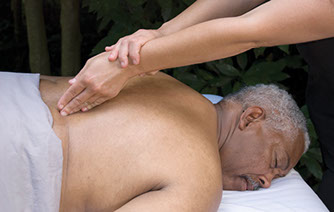
    Image of a man getting a massage.

    Massage won’t cure a backache. It can increase blood flow to tight muscles and loosen them.

    Braces or Corsets

    Braces and corsets support the back and keep you from moving it too much. They won’t make your back stronger, though.

    Medical Care

    Reasons to Get Immediate Medical Care

    *  Back pain spreads to the chest, neck, arm, or lower jaw.

    *  The pain started in the chest and moved to the upper back.

    *  The pain follows a fall or impact injury to the back.

    *  Back pain occurs with passing out, lightheadedness, or difficulty with balance or coordination.

    *  You can’t move due to the pain or it is hard to move an arm or a leg after a fall or back injury.

    *  A new loss of bowel or bladder control occurs with back pain.

    *  Back pain occurs with severe abdominal or pelvic pain.

    *  A “tearing” type of pain is felt in the back or a pulsating mass is felt in the abdomen.

    *  Loss of sensation is felt in the rectal area.

    Reasons to Contact a Doctor

    *  Severe back pain occurs for more than 7 days or the pain travels down a leg below a knee.

    *  Weakness, numbness, or tingling in the feet or toes occurs with back pain.

    *  Back pain occurs with: Pain, burning, or itching when you urinate; increased urge to urinate;  urinating often; foul-smelling urine; or blood in the urine.

    *  An unusual discharge from the vagina or urethra occurs with back pain.

    *  A sharp pain is felt in a buttock and may spread to the thigh, knee, or foot.

    *  Back pain occurs with: A fever; nausea or vomiting; a skin rash; or mild to moderate abdominal or pelvic pain.

    *  Pain increases with moving, coughing, lifting, or straining.

    Resources

    National Institute of Arthritis and Musculoskeletal and Skin Diseases (NIAMS)

    877.22.NIAMS (226.4267)

    www.niams.nih.gov

    Back Care brochure by the American Institute for Preventive Medicine. www.HealthyLife.com. All rights reserved.

    © American Institute for Preventive Medicine

  • “Baby Blues” After Delivery

    Pregnancy & Prenatal Care

    It is very special to have a baby! Having a baby brings much joy! It also brings many changes. Your moods are apt to be very strong for the first few weeks after your baby is born. It is common to feel angry or worried. It is also common to feel sad. It is also common to feel like crying and to cry. This is known as the “baby blues”.

    The “baby blues” usually start about 3 days after the baby is born. They usually last up to a week or so. This is a normal part of having a baby. Hormone changes are a big part of this. Being tired can be a part of it, too.

    Some women get a bad case of the “baby blues.” Their sad feelings are very strong. They don’t go away after a week or even two. These women may have postpartum depression. This is an illness that needs medical care. It doesn’t mean the mother has failed.

    Let your health care provider know if you have any of these signs and symptoms:

    *  Thoughts of harming your baby or yourself.

    *  “Baby blues” that don’t go away after 2 weeks.

    *  Strong feelings of sadness and anger that start 1 to 3 months (or even as long as a year) after the baby comes.

    *  Feeling helpless, hopeless, or guilty. These feelings get stronger each week. They keep you from doing normal daily tasks.

    *  Sleeping most of the time. Or not being able to sleep even when you are tired.

    *  A big change in how you normally eat. You eat too much. Or you eat too little.

    *  Little or no interest in your baby or your family. Or you worry too much about your baby.

    *  Panic attacks. With a panic attack, you breathe fast. Your heart beats fast. Your hands sweat. It seems like you can’t breathe. You may think you are having a heart attack or are going to die. You feel out of control.

    Postpartum depression can happen after the baby comes or after you stop breast-feeding. The good news is that it can be treated. If it does happen, don’t wait to get help. Call your health care provider right away.

    Prenatal Self-Care book by the American Institute for Preventive Medicine. www.HealthyLife.com. All rights reserved.

    © American Institute for Preventive Medicine

  • Athlete’S Foot

    Skin Conditions

    Athlete’s foot is a fungal infection. It usually affects the skin between the toes.

    Signs & Symptoms

    *  Moist, soft, red or gray- white scales on the feet, especially between the toes.

    *  Cracked, peeling, dead skin areas.

    *  Itching.

    *  Sometimes small blisters on the feet.

    Causes

    People usually pick up the fungus from walking barefoot over wet floors, around swimming pools and locker rooms, and in public showers.

    Treatment

    Self-care treats most cases of athlete’s foot.

    Questions to Ask

    Self-Care / Prevention

    *  Wash your feet twice a day, especially between your toes. Dry the area thoroughly. Don’t use antibacterial soaps.

    *  Use an over-the-counter antifungal powder, cream, or spray between your toes and inside your socks and shoes.

    *  Wear clean socks made of natural fibers (cotton or wool). Change your socks during the day to help your feet stay dry. Wear shoes, such as sandals or canvas loafers, that allow ventilation.

    *  Alternate shoes daily to let each pair dry out.

    Resources

    American Academy of Dermatology

    866.503.SKIN (503.7546)

    www.aad.org

    Healthier at Home book by the American Institute for Preventive Medicine. www.HealthyLife.com. All rights reserved.

    © American Institute for Preventive Medicine

  • Asthma For Children

    Children’s Health

    Signs & Symptoms

    A lot of children get asthma. Asthma cuts down the air flow in the lungs. This makes it hard to breathe. These are all symptoms of asthma:

    *  Chronic coughing.

    *  Trouble breathing.

    *  Tight feeling in the chest.

    *  Wheezing.

    (Note: Other things can cause wheezing, too. Something may be stuck in the throat or there may be an infection. Always tell the doctor if your child is wheezing.)

    Asthma symptoms come and go. An asthma “attack” can be big or small. Asthma can get worse when your child is upset or worried. But it’s a real physical problem. A doctor should treat your child if he or she has asthma. Asthma runs in families. Children who have eczema or hay fever often have asthma, too. Asthma may be more common in children who live in houses with pets and tobacco smoke.

    Causes

    Asthma attacks can come on with:

    *  Colds, flu, and other infections in the throat and lungs.

    *  Breathing pollen from plants, mold, animal dander, dust, or smoke.

    *  Sulfites. These are additions in some foods.

    *  Taking some medicines, like aspirin.

    *  Breathing cold air.

    *  Exercising too hard.

    *  Getting upset, angry, or “stressed out.”

    Treatment

    The right asthma treatment depends on how bad the attacks are. It’s hard to treat asthma with medicines you buy without a prescription. Your child’s doctor should keep track of how your child is doing. The doctor may prescribe one or more medicines for your child’s asthma. Some kinds of medicines are for your child to take during an asthma attack. Other kinds are taken daily or as prescribed to help prevent asthma attacks. Medicines include:

    *  Bronchodilators. These drugs open up the airways in the body. They come either as a spray or as something you swallow.

    *  Drugs to help with swelling of the airways in the body. They come either as a spray, or as pills you swallow.

    *  Drugs to help with chronic swelling of the airways in the body. They come as pills.

    *  Peak flow meter. This is a device to monitor your child’s asthma at home.

    *  Flu vaccine. This is given once a year.

    Questions to Ask

    Self-Care / Prevention

    *  Don’t smoke or let your child smoke. Don’t allow smoking in the house.

    *  Have your child drink a lot of water, juice, and other fluids. (Ask your child’s doctor how much fluid your child should have each day.)

    *  Find out what triggers your child’s asthma. Get rid of things that bother your child at home, at school, and where he or she plays.

    *  If you don’t have a dog, cat, or other pet, don’t get one. If you have a pet, keep it outside if you can. If not, don’t let it in your child’s bedroom.

    *  Keep things your child is allergic to out of his or her bedroom.

    *  Have your child sleep with no pillow or the kind the doctor says is O.K.

    *  Cover your child’s mattress and pillow with a plastic cover or one that says allergen-free. Wash mattress pads in hot water every week.

    *  Use throw rugs that can be washed often instead of carpets. Pollen, pet dander, mold, and dust mites collect in carpets. Use blinds and curtains that can be washed often, too.

    *  Try not to have stuffed animals kept in your child’s bedroom. Or have only one that can be washed. Wash it in hot water once a week.old, and dust mites collect in carpets. Use blinds and curtains that can be washed often, too.

    *  If you can, use a vacuum with a HEPA filter and double-thickness bags. When you vacuum, have your child wear a filter mask over his or her nose and mouth.

    *  Use air filters with your furnace and air-conditioning unit. Or use portable air cleaners to keep the air clean. Change or wash filters often. Keep the humidifier filter clean, if you use one. Use distilled (not tap) water in humidifiers and vaporizers.

    *  Don’ t hang sheets and blankets outside to dry. Pollen can get on them.

    *  It’s good for your child to do sports like swimming. But tell your child to stop exercising if he or she starts to wheeze.

    *  When outdoors in cold weather, have your child wear a scarf around his or her mouth and nose. The scarf warms the air before your child breathes it in.

    *  Don’t let your child eat foods or medicines that have sulfites. Shellfish, for example, often have sulfites. They bother many people with asthma.

    *  Have your child sit up during an asthma attack. Don’t let your child lie down.

    *  Don’t run out of your child’s asthma medicine. Keep the medicine handy. Have your child take it as soon as he or she starts to feel an attack.

    *  Don’t give your child aspirin! Some people with asthma are allergic to aspirin. Use acetaminophen instead.

    (Note: Aspirin and other medicines that have salicylates have been linked to Reye’s Syndrome, a condition that can kill.)

    Children's Self-Care book by the American Institute for Preventive Medicine. www.HealthyLife.com. All rights reserved.

    © American Institute for Preventive Medicine

  • Asthma

    Respiratory conditions

    Asthma is a chronic disease that causes the airways to narrow. Airflow is limited due to inflammation in the airways.

    General Information

    Symptoms

    *  A cough lasts more than a week. Coughing may be the only symptom. It often occurs at night or early in the morning.

    *  Shortness of breath. Breathing gets harder and may hurt. It is harder to breathe out than in.

    *  Wheezing (high pitched whistling sound)

    *  Tightness in the chest

    Causes & Risk Factors

    *  Genetic Factors. You are more likely to have asthma if other members of your family have or had it.

    *  Environmental Factors. Being exposed to certain things can set off an immune system response for asthma to develop. Examples are house-dust mites and viral respiratory infections.

    Diagnosis

    A doctor diagnoses asthma from:

    *  Your medical history

    *  Your family’s medical history

    *  Your symptoms

    *  A physical exam

    *  Lung function tests in persons age 5 years and older

    *  Other tests to check for conditions that have symptoms of asthma, but are not asthma

    Asthma Attack Triggers

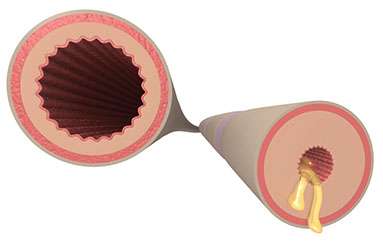
    People with asthma have very sensitive airways. Exposure to triggers causes a response in the airways called an asthma attack or an asthma episode.

    With an asthma attack:

    *  Air becomes trapped in the lungs.

    *  The lining of the airways becomes inflamed.

    *  The muscles around the air tubes tighten.

    *  Thick mucus clogs the airways.

    Illustration of airway.

    (The last three things cause the airways to narrow.)

    Problems That Make It Harder to Manage Asthma

    *  Reflux of stomach acids which cause heartburn, belching, or spitting up

    *  Being overweight or obese

    *  Allergic rhinitis or sinusitis

    *  Sleep apnea that obstructs breathing

    *  Stress and depression

    Treating these problems may help improve asthma control.

    Common Asthma Attack Triggers

    *  Respiratory infections (colds, flu, bronchitis, etc.)

    *  Tobacco smoke

    *  Dust mites

    *  Animal dander (small pieces of skin, hair, or feathers from warm-blooded animals, such as dogs, cats, birds, etc.)

    *  Cockroach droppings

    *  Molds (indoor and outdoor)

    *  Strong odors and sprays from paints, new carpet, perfumes, etc.

    *  Air pollution

    *  Cold air and changes in temperature and humidity. Weather changes can also affect how much pollen and mold are in the air.

    *  Having strong feelings (laughing, crying, etc.)

    *  Sulfites. These are additives in wine and some foods, such as processed potatoes and dried fruits. Shellfish packed in ice that has sulfites can pick up the sulfites from the ice.

    *  Aspirin and other nonsteroidal anti-inflammatory drugs (NSAIDs), such as ibuprofen

    *  Beta blocker medicines. These are prescribed for heart disease, high blood pressure, and migraine headaches.

    When to Seek Medical Care

    Reasons to Call Doctor

    Call your doctor when you feel the first change in your asthma status. Deal with a problem early to help prevent a severe problem.

    *  You have asthma and have a cold or a fever.

    *  You cough up mucus that is bloody-colored, green, or yellow.

    *  An asthma attack does not respond to your medication.

    *  Medication is not helping like it used to.

    *  Your peak expiratory flow (PEF) numbers are in the yellow zone.

    *  You have a harder time breathing or you are short of breath more often than before.

    *  You breathe faster than usual.

    *  Your asthma attacks are coming more often or are getting worse.

    *  You use your rescue medication more than 2 times a week.

    Reasons to Get Medical Care Fast

    *  Your peak expiratory flow (PEF) numbers are in the red zone.

    *  You have a fever with heavy breathing.

    *  You have extreme shortness of breath. It may feel as if you can’t breathe at all. Or, you can’t say 4 or 5 words because you are so short of breath. Call 911!

    *  You cough so much that you can’t take a breath. Call 911!

    *  Your lips or fingernails are bluish in color. Call 911!

    Focus on breathing slow and easy until you get medical care. Sit upright. Try to remain as calm and relaxed as you can.

    Peak Flow Meters

    These devices measure peak expiratory flow (PEF). PEF is the amount of air blown out after taking a deep breath. Your PEF readings can tell you and your health care provider:

    *  About asthma triggers

    *  If an asthma attack is starting. PEF is decreased with an asthma attack.

    *  If your medicine plan is working

    *  When to add or stop medicine

    *  How severe your asthma is

    Use your peak flow meter, as directed by your doctor or health care provider.

    Find Your Personal Best Peak Flow Number

    Your personal best peak flow number is the highest peak flow number you can get over a 2-week period when your asthma is under good control. Good control is when you feel good and do not have any asthma symptoms.

    Take peak flow readings:

    *  Twice a day for 2 weeks – when you wake up and  about 10 to 12 hours later

    *  Before and after taking an inhaled beta2-agonist (if you take this medicine)

    *  As advised by your doctor or health care provider

    The Peak Flow Zone System

    Once you know your personal best peak flow number, your health care provider will give you the numbers that tell you what to do. The peak flow numbers are put into zones that are set up like a traffic light.

    Green Zone (80 to 100 percent of your personal best number). This signals all clear. No asthma symptoms are present, and you may take your medicines as usual.

    Yellow Zone (50 to 80 percent of your personal best number). This signals caution. You may need to take more of your asthma medicine(s) to treat your asthma. Or, your overall asthma may not be under control, and the doctor may need to change your asthma action plan.

    Red Zone (below 50 percent of your personal best number). This signals a medical alert. You must take an inhaled beta2-agonist right away and call your doctor without delay if your peak flow number does not return to the Yellow or Green Zone and stay in that zone.

    Treatment

    The goals of treatment are to:

    A. Prevent asthma attacks and control or treat asthma symptoms as they occur

    B. Allow normal daily activities, including exercise

    C. Promote restful sleep, free from waking up with asthma symptoms

    D. Do A, B, and C with few or no side effects from asthma medications

    E. Have no need for emergency medical care or to be hospitalized due to asthma

    Treatment for asthma varies on how severe it is and how well it is controlled. Since a person’s asthma can change over time and the response to medications may be age-related, asthma treatment guidelines are given for three different age groups:

    *  0-4 years

    *  5-11 years

    *  12 years and older

    A good way to help you manage your asthma is to follow a written action management plan that you develop with your doctor or health care provider. Your plan should include:

    *  What to do daily to avoid and deal with your asthma triggers and what to do when you have an asthma attack

    *  Names and doses of medicines to take daily and when you have specific symptoms

    *  Reasons to contact your doctor or to get medical care fast

    *  Your plan should be tailored for your needs.

    Keep a journal of your asthma symptoms. Include:

    *  When you had symptoms and what may have caused them. What you did to treat the symptoms. List the medicines you took, how you took them, and how much you took.

    *  Your peak flow meter readings. Record these before and after treatment steps.

    *  Results of the treatment steps you took

    Self-Care

    *  Know your warning signs and peak flow zones so you can begin treatment early. Monitor your peak expiratory flow rates. (See “Peak Flow Meters”.)

    *  Keep your asthma rescue medicine handy.

    *  Get a yearly flu vaccine, as advised.

    During an asthma attack:

    *  Sit up. Don’t lie down.

    *  RELAX. Keep calm. Focus on breathing slow and easy. Remove yourself from any stressors.

    *  Take the right amount of medicine, as prescribed in your asthma control plan. Call your doctor if you need to take more medicine than prescribed.

    Avoid your asthma triggers

    *  Do not smoke. Do not allow smoking in your home, car, or around you. Avoid air pollution.

    *  Use bedding, flooring, paint, vaccum cleaners, toys, and other products that are “Certified Asthma & Allergy Friendly™.” (Search for items fromwww.asthmaandallergyfriendly.com.) It is especially helpful to use these products in your bedroom and/or:

    – Sleep with no pillow or one your doctor suggests. Use a “dust-mite proof” cover to enclose your mattress and pillow (if you use one). Wash all bedding in hot water every week.

    – Try not to keep stuffed animals in the bedroom. If you must, have only one that can be washed. Wash it in hot water once a week.

    – Use curtains and rugs that can be washed often. Avoid carpeting, bed ruffles, and throw pillows.

    – Get someone else to vacuum and dust once or twice a week. Use a vacuum with a HEPA filter or double-thickness bags. If you dust or vaccum, wear a dust mask.

    – Reduce clutter in your bedroom. Store items in plastic containers with lids.

    – It is best not to keep a TV, DVD-player, etc. in your bedroom. These, too, can collect dust.

    *  Put an air filter on your furnace or use a portable air purifier, such as one with a HEPA filter.

    *  Stay out of the cold weather as much as you can.

    *  Change and/or wash furnace and air conditioner filters on a regular basis. Keep indoor humidity below 60 percent.

    *  When you are outside in cold weather, wear a scarf around your mouth and nose to warm the air as you breathe in.

    *  Stop exercising if you start to wheeze.

    *  If you are sensitive to sulfites, don’t take foods or medicines that have them. Sulfites are in wine, some processed potatoes and dried fruits. Shellfish packed in ice that has sulfites can pick up the sulfites from the ice.

    *  Drink plenty of liquids (2-3 quarts a day) to keep secretions loose.

    *  Don’t take over-the-counter medications unless cleared first with your doctor or health care provider.

    – Antihistamines dry nasal secretions and can cause airways to plug up by making secretions thicker. Antihistamines are also found in some cold remedies, so check labels.

    – Some ulcer drugs increase the effects of some bronchodilators.

    – Aspirin can trigger an attack in 3-5 percent of persons with asthma who have nasal polyps. Acetaminophen doesn’t have this effect.

    Medications

    Some medications are to be taken with an asthma attack. Other kinds are taken daily (or as prescribed) to help prevent asthma attacks.

    Long-Term Control Medicines

    These are taken daily (or as prescribed) to help prevent asthma attacks. Examples are:

    *  Corticosteroids. These help with the swelling in the airways that cause asthma symptoms. They can prevent, reduce, and/or reverse the swelling.

    – Inhaled corticosteroids (ICSs). These are the most effective long-term medicines that control asthma. These are not the same as anabolic steroids that athletes may abuse.

    – Oral corticosteroids. An example is prednisone. These are usually given for a short time, when a person’s asthma is not being controlled. Long-term use of these may be prescribed for persons with severe asthma that persists.

    *  Cromolyn sodium and nedocromil. These help prevent swelling in the airways when exposed to asthma triggers. They treat mild asthma that persists.

    *  LABAs (long acting beta2-agonists). These are bronchodilators. They relax the muscles of the airways. They are usually taken with ICSs to help control moderate and severe asthma and to help prevent symptoms during the night.

    *  Leukotriene modifiers. These prevent swelling in the airways and decrease mucus in the lungs. They treat mild asthma that persists or are combined with ICSs to treat moderate or severe asthma.

    *  Theophyllines. These are mild to moderate bronchodilators that may have mild anti-inflammatory effects.

    *  Medicines that modify the body’s immune response.

    Quick-Relief Medicines

    These are used to treat symptoms of an asthma attack. They help stop asthma symptoms before they get worse. They may be prescribed for use at other times, too, such as before exercising. Examples are:

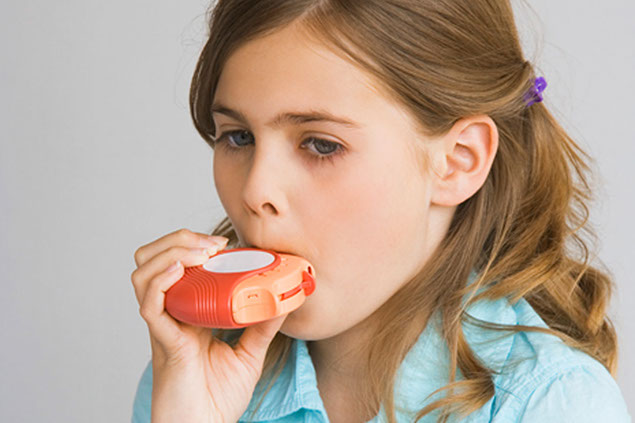
    *  SABAs (short-acting beta-agonists). These are bronchodilators. They work quickly to relax the muscles of the airways and open up the air passages in the lungs and are the treatment of choice to relieve acute symptoms. They are usually taken in an inhaled form.

    *  Anticholinergics. These help prevent airway muscles from tightening and help keep mucus from forming. These are usually taken in an inhaled form.

    With proper treatment and monitoring of symptoms, asthma can be controlled. People with asthma can live active and healthy lives.

    Resources

    The Asthma and Allergy Foundation of America

    800.7.ASTHMA (727.8462)

    www.aafa.org

    National Heart, Lung, and Blood Institute

    301.592.8573

    www.nhlbi.nih.gov

    Asthma brochure by the American Institute for Preventive Medicine. www.HealthyLife.com. All rights reserved.

    © American Institute for Preventive Medicine