Blog

  • A Routine Checkup

    Medical Exams

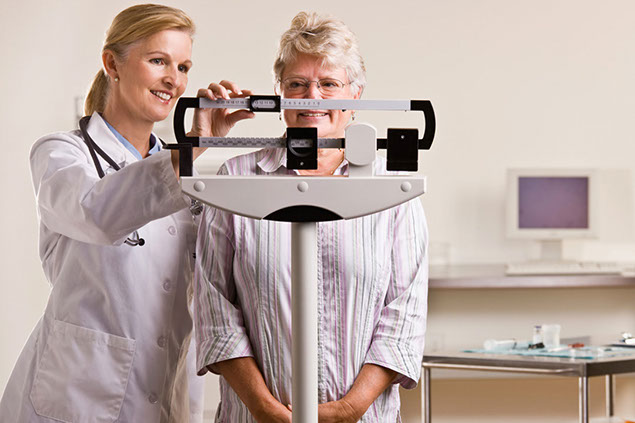
    A routine checkup from a doctor or health care provider is a way to find out your health status. It allows you to ask questions, too. It also helps you find out if you have a health problem you don’t know about. Some diseases, such as high blood pressure and some cancers, may not have symptoms in the early stages. Tests and exams can help detect these.

    The Basic Parts of a Checkup

    *  A complete medical history. This includes family health history, past illnesses, and current problems.

    *  A check on how well your eyes, ears, heart, bowels, etc. function.

    *  A check of your blood pressure, pulse, temperature, etc.

    *  A medical exam.

    *  Possible routine tests for your conditions, gender, or age, such as blood tests or X-rays.

    *  A check of specific health concerns.

    *  Vaccinations, as needed.

    Page from the Healthier at Home book by the American Institute for Preventive Medicine. www.HealthyLife.com. All rights reserved.

    © American Institute for Preventive Medicine

  • Review Your Patient Chart

    Medical Care

    Guess what every patient in a hospital has? No, we’re not speaking of those less-than-attractive hospital gowns or the plastic ID bracelets. The answer is a patient chart. Although the chart is legally the property of the hospital and generally kept at a nursing station, the patient should be aware of its content. Ask your doctor for an explanation. The chart may contain the following:

    *  Your medical history.

    *  Hospital laboratory results.

    *  Lists of medications (doses and schedules).

    *  Special treatments or therapy.

    *  Dietary restrictions or recommendations (low-sodium diet, for example).

    *  Scheduled diagnostic procedures (such as X-rays).

    *  Surgical notes (length of operation, assisting medical staff, type of anesthesia administered, recovery notes).

    If you suspect a problem or error-in how often you are being given medication, for instance-ask a nurse or your doctor to show you your chart and explain what is written there.

    Page from A Year of Health Hints book by the American Institute for Preventive Medicine. www.HealthyLife.com. All rights reserved.

    © American Institute for Preventive Medicine

  • Resolve To Get Ready For Retirement

    Financial Health

    It’s never too early or too late.

    Whether you are in your 30s, 40s, 50s, or even your 60s, plan for your retirement. Research shows that people who think about and plan for retirement save more than those who don’t.

    Add up all sources of monthly income.

    *  Social Security. Find out how much you will get, monthly, from the Social Security. This depends on your work history and if you choose to start getting benefits at age 62 or your full retirement age (65, 66, or 67) or wait until age 70. A yearly statement mailed to you gives this information. Or, find out from Social Security benefit calculators atwww.socialsecurity.gov/retire2/index.htmandwww.socialsecurity.gov/planners/index.htm#a0=1. Do the same for a partner who will also receive Social Security benefits. In general, the amount you receive for Social Security retirement accounts for about 40 percent of your pre-retirement earnings.  $____

    *  Private pensions from all employers  $____

    *  Personal savings. This includes money you have  in the bank and earnings on 401(k)s, 403(b)s,  traditional and Roth IRAs, and other investments:  $____

    *  Cash value life insurance. These are whole life or variable life policies.  $____

    *  Part-time income you and/or your partner expect to make.   $____

    Total monthly sources of income:   $____

    You do the math:

    Total monthly income needed:  $______

    Subtract total monthly sources of income:  – $______

    How much you’ll need to make up for each retirement month:  = $______

    Plan, now, ways to earn and/or save more for retirement.

    Figure out how much you’ll need.

    According to the Employee Benefit Research Institute, 56 percent of workers have no idea how much they need to save for retirement. On average, people need at least 70 percent of their yearly pre-retirement income. This can vary, depending on your age and needs. You will need more if you need to pay for your medical care. To estimate how much you might need, use a tool atwww.choosetosave.org/ballpark. Other calculators to help you plan can be found atwww.choosetosave.org/calculators. Include estimates for health care and other costs, such as a new car and home repairs. {Note: It will be easier to get a car loan if you buy the car while you are still employed.}

    Total monthly income needed:  $____

    Action Step

    Make an appointment with a financial planner at work or on your own to discuss retirement saving options that best meet your needs.

    Ways to Well-Being book by the American Institute for Preventive Medicine. www.HealthyLife.com. All rights reserved.

    © American Institute for Preventive Medicine

  • Relationship / Marital Problems

    Mental Health

    Signs & Causes

    Few, if any, relationships are perfect. Problems are bound to occur. The problems most often linked with marriage and other relationships include:

    *  Failures in communicating

    *  Misunderstandings

    *  Negative feelings, such as being hurt, put down, ignored, abused and/or lonely

    *  Power struggles

    *  Acting out to get attention. Ways to do this include pouting, whining, nagging and complaining

    *  Addictive behaviors

    Other problems arise when partners have different needs in a relationship. Common differences include:

    *  Money

    *  Sex

    *  Work

    *  Child-rearing

    *  “In-law” or other family problems

    *  Time and how it is spent (i.e., studying, partying, golfing, watching TV)

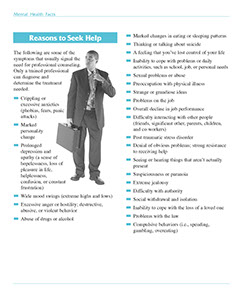
    Most of the time, these problems can be worked out by the persons involved. Professional help should be sought, though, if any of the following apply:

    *  The problems are severe

    *  The problems keep you from doing your daily tasks

    *  You cannot resolve the problems on your own

    *  You want to strengthen your relationship(s)

    Questions to Ask

    Self-Help

    Ways to Improve Communication

    *  Avoid blaming the other person. This puts him or her on the defensive and prevents communication. When blaming starts, listening stops.

    *  Take 51% of the responsibility for listening to what is being said. Ask questions to clear up what you don’t understand.

    *  Be sincere, honest, and show concern in your conversation. Don’t be sarcastic or make fun of the other person.

    *  Try to let go. Before getting into an argument, ask yourself if the issue can simply be “let go.” Ask the other person, too. If you both say yes, drop it and don’t let it re-surface at a later time.

    *  It’s alright to discuss problem issues, but be certain that you focus on how to solve the problem, not placing blame for it.

    *  Put yourself in the other person’s shoes. Try to see his or her point of view.

    *  Remind each other of the many positive strengths of the relationship. Build on these strong points. Don’t dwell on the negative ones.

    *  Don’t bring up old issues, disputes or grudges. When past problems enter in, the  conversation can get out of hand.

    *  Timing is critical. Ask yourself if it is the right time to bring up an issue. If the other person is undergoing problems with work, school, kids, health and/or family, adding yet another problem to their burden is not likely to solve the issue. It may serve to cause them more anguish. If possible, wait until the other person’s burden has lightened to bring up yet another problem.

    *  Don’t approach an issue with the idea of changing the other person’s mind or convey an attitude that you’re right and he or she is wrong.

    *  Share the issue. The problem belongs to both you and the other person. Work to understand your partner’s position first, then to have him or her understand your position.

    *  Omit distractions. Don’t attempt to discuss an issue while driving a car, taking care of children, doing a household chore or doing anything that will take your attention away from the issue and the other person.

    *  Make sure you know your own position and   be ready to state it clearly to the other person.

    *  Communicate in an assertive way.

    – State your position in terms of what your feelings about the issue are.

    – Don’t make demands of the other person or put them down.

    – Use “I” rather than “you” messages. For example, if you are upset by the fact that the other person has begun to neglect their appearance, instead of saying “You look like a slob,” it would be better to state “I like it better when your appearance is neat.”

    *  Listen with your heart. Hear what the other person is saying regardless of how they say it. Allow him or her to be comfortable while they are stating their position. Don’t take an “attack” position and wait tensely for your turn to talk. Don’t interrupt them while they are speaking.

    *  Make a plan. This should consist of what you can do to solve the issue and what you are willing to do. Knowing these things in advance can speed the solution and reconciliation process.

    *  Go in peace. Let the discussion of a problem run its course and end in peace with both of you at ease. Don’t continue to “stew” over who said what, the decisions that came out of the argument and whether the other person gained more than you did in the bargaining session. If you still feel uncomfortable with the solutions, re-state your position and try again. Be aware, however, that some issues may not be able to be changed. For example, in the case of differing sexual desires/needs, forcing or asking that your partner engage in sexual activity beyond their desire for it will not benefit you or your partner and will only cause more tension.

    Jealousy

    *  If you experience abnormal jealousy in relation to situations or persons in your life, the following suggestions may be helpful:

    *  Admit your jealousy. Pretending there is no problem or that it is not a serious problem only compounds the issue.

    *  Look for the cause of the jealousy. Some of the causes may be:

    – Your present or a past partner cheated on you which has caused you to feel insecure. Your partner seems to pay more attention to others, work or social friendships. Members of the opposite sex find your partner attractive and pay a lot of attention to him or her. You fear your partner may one day lose interest in you and seek another partner.

    *  Express your fears and concerns to your partner.

    *  Learn about jealousy. Read books on the subject, talk to people who live with jealous persons to get an idea of what it’s like to experience a partner’s jealous responses. Or, talk to other people who experience extreme jealous feelings themselves.

    *  Communicate. Talk to your spouse/partner about your feelings. Perhaps they are doing something they are not aware of that is causing you distress.

    *  Talk to a counselor if you cannot curb your jealous responses on your own.

    *  If you are the victim of someone’s abnormal jealousy or if you know someone who is abnormally jealous, the following suggestions may help you deal with them:

    – Be supportive. Recognize that your partner has a problem and encourage them to work on their behavior. Give them positive feedback as they progress.

    – Hold your ground. If your partner questions you, state your explanation clearly and without anger.

    – Be objective. Try to see the situation from your jealous partner’s point of view when possible. Avoid doing things that may be causing their jealousy and spend quality time together as a couple.

    – Don’t provoke jealousy. If you know your partner is prone to certain jealous reactions, don’t flirt with people in their presence, don’t ridicule, antagonize or tease your spouse/partner about their jealousy. Don’t leave “fake clues” to an alleged infidelity.

    – Don’t isolate yourself. Do not withdraw or avoid other social relationships. This can be the consequence of dealing with a violent or  otherwise abusive jealous person.

    *  Seek professional help. If you and your partner cannot work out your jealousy problems through communication, companionship and trying to create an otherwise satisfying relationship, consult a counselor.

    Sex

    *  Discuss your sexual needs with your partner.

    *  Ask your partner about his or her sexual needs.

    *  Develop areas where both you and your partner have compatible needs/desires.

    Money Matters

    *  Set financial goals. Decide together what you want to accomplish within a certain time (example: 6 months, 5 years, throughout life). Continue to review and modify your plans, if necessary.

    *  Organize financial records. Keep track of statements, check stubs and receipts. These can help monitor spending.

    *  Establish a credit history in both partners’ names.

    *  Limit the number of credit cards you have, how much you charge on them or get rid of them entirely. Opt for credit cards with the lowest interest rates, if you use them.

    *  Get professional help from an accountant, financial planner or other specialist if you need help managing your money.

    *  Develop a realistic budget. You can do this in one of two ways:

    – Single Fund – Both partners have a joint account and agree that “what’s mine is yours.” This works if both of you can agree on a budget and spending practices.

    – Separate Finances – This works well if both partners work. Each person is responsible for an agreed-on portion of the household costs. They are then free to do whatever  they wish with the rest of their money with no resentments from the other partner.
    Minding Your Mental Health Book. Published by the American Institute for Preventive Medicine. www.HealthyLife.com. All rights reserved.

    © American Institute for Preventive Medicine

  • Reducing Presurgery Jitters

    Medical Care

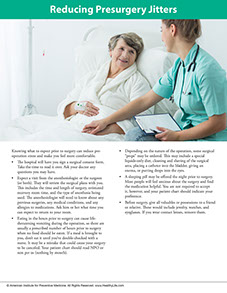
    Image of older women looking nervous.

    Knowing what to expect prior to surgery can reduce pre-operation stress and make you feel more comfortable.

    *  The hospital will have you sign a surgical consent form. Take the time to read it over. Ask your doctor any questions you may have.

    *  Expect a visit from the anesthesiologist or the surgeon (or both). They will review the surgical plans with you. This includes the time and length of surgery, estimated recovery room time, and the type of anesthesia being used. The anesthesiologist will need to know about any previous surgeries, any medical conditions, and any allergies to medications. Ask him or her what time you can expect to return to your room.

    *  Eating in the hours prior to surgery can cause life-threatening vomiting during the operation, so there are usually a prescribed number of hours prior to surgery when no food should be eaten. If a meal is brought to you, don’t eat it until you’ve double-checked with a nurse. It may be a mistake that could cause your surgery to be canceled. Your patient chart should read NPO or non per os (nothing by mouth).

    *  Depending on the nature of the operation, some surgical “preps” may be ordered. This may include a special liquids-only diet, cleaning and shaving of the surgical area, placing a catheter into the bladder, giving an enema, or putting drops into the eyes.

    *  A sleeping pill may be offered the night prior to surgery. Most people will feel anxious about the surgery and find the medication helpful. You are not required to accept it, however, and your patient chart should indicate your preference.

    *  Before surgery, give all valuables or possessions to a friend or relative. These would include jewelry, watches, and eyeglasses. If you wear contact lenses, remove them.

    Page from A Year of Health Hints book by the American Institute for Preventive Medicine. www.HealthyLife.com. All rights reserved.

    © American Institute for Preventive Medicine

  • Reduce Indoor Air Pollution For A Healthier Home

    Home Safety

    Women tending to her plants.

    *  Do not smoke. Do not allow smoking in your house.

    *  Open windows as much as you can to let fresh outdoor air in.

    *  Live clean and green. Use baking soda, vinegar, plain soap, etc. and/or 100 percent biodegradable products that do not have chlorine, phosphates, and dyes. Paint with zero-or low volatile organic (VOC) compound paints. Use products with the EPA’s “Design for the Environment (DfE)” on the label. Find out more fromepa.gov/dfe.

    *  Have green houseplants, such as Boston ferns and spider plants. These absorb indoor air pollutants.

    *  Choose energy-efficient products, such as ones with an ENERGY STAR. Find out about these fromenergystar.gov.

    *  To help eliminate gases, odors, chemicals and particles, put an air filter or electronic air cleaner on your furnace. Or use a portable air purifier and/or a vacuum that has a HEPA filter.

    *  To limit mold growth, keep your house clean, dry, and well ventilated.

    A Year of Health Hints book by the American Institute for Preventive Medicine. www.HealthyLife.com. All rights reserved.

    © American Institute for Preventive Medicine

  • Rate Your Doctor

    Medical Care

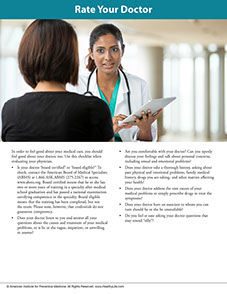
    In order to feel good about your medical care, you should feel good about your doctor, too. Use this checklist when evaluating your physician.

    *  Is your doctor ‘board certified” or ‘board eligible?” To check, contact the American Board of Medical Specialists (ABMS) at 1.866.ASK.ABMS (275.2267) or accesswww.abms.org. Board certified means that he or she has two or more years of training in a specialty after medical school graduation and has passed a national examination certifying competence in the specialty. Board eligible means that the training has been completed, but not the exam. Please note, however, that credentials do not guarantee competency.

    *  Does your doctor listen to you and answer all your questions about the causes and treatment of your medical problems, or is he or she vague, impatient, or unwilling to answer?

    *  Are you comfortable with your doctor? Can you openly discuss your feelings and talk about personal concerns, including sexual and emotional problems?

    *  Does your doctor take a thorough history, asking about past physical and emotional problems, family medical history, drugs you are taking, and other matters affecting your health?

    *  Does your doctor address the root causes of your medical problems or simply prescribe drugs to treat the symptoms?

    *  Does your doctor have an associate to whom you can turn should he or she be unavailable?

    *  Do you feel at ease asking your doctor questions that may sound

    Page from A Year of Health Hints book by the American Institute for Preventive Medicine. www.HealthyLife.com. All rights reserved.

    © American Institute for Preventive Medicine

  • Protect Yourself From Identity Theft

    Financial Health

    Manage and minimize misuse of your personal information

    Consumers lose billions of dollars every year to crooks who steal their identity and money through fraud. Avoid becoming a victim.

    Keep your personal information safe and secure:

    *  Put your Social Security card, Medicare card, military ID, and passport in a secure place, unless you need to use them. Memorize your social security number (SSN). Lock your purse or wallet in a safe place at work. Or carry your wallet with you.

    *  Shred or cut up bank statements, checks, credit card applications, expired charge cards, medical and insurance forms, and prescription labels you no longer need before throwing them away. Otherwise, keep them locked up. You can opt out of credit card offers received in the mail atwww.optoutprescreen.comor by calling (888) 567-8688.

    *  Use passwords and PIN numbers to protect your credit card and bank accounts, your smartphone, and all computer devices. Choose passwords with upper and lower case letters, numbers, and symbols. Nix using common items like your house numbers, phone number, and last four digits of your SSN.

    *  Install and regularly update anti-virus and anti-spyware on your smartphone and computer devices.

    *  Use only secure sites online when you need to give financial or personal information. These have Web addresses with “https” or “shttp” or show a lock symbol.

    *  When you are away, have someone you trust pick up your mail or have the post office hold it for you.

    Avoid scams:

    *  Do not give your social security number or bank account numbers to persons in emails or on the phone.

    *  Don’t wire money to strangers, to sellers who insist on wire transfers for payment, or to anyone who claims to be a relative or family friend in an emergency who wants to keep the request a secret.

    *  Check your credit card, medical bill, and bank statements when you receive them in the mail or online. Report charges you did not make to the company right away.

    *  To help avoid ATM theft, use machines inside banks and ones you are familiar with. Don’t use machines that have extra items, even brochure holders, that could be cameras or that say they are “card cleaners.”

    Action Step

    Request a free copy of your credit report once every 12 months from three nationwide consumer reporting companies – Equifax, Experian, and TransUnion. Call (877) 322-8228. Check the reports for accuracy.

    Ways to Well-Being book by the American Institute for Preventive Medicine. www.HealthyLife.com. All rights reserved.

    © American Institute for Preventive Medicine

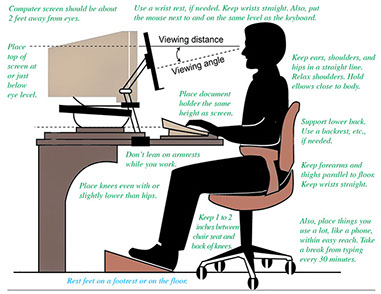
  • Proper Position And Support For Computer Users

    Work Life

    Proper position for computer users chart.
    Healthier at Home book by the American Institute for Preventive Medicine. www.HealthyLife.com. All rights reserved.

    © American Institute for Preventive Medicine