Blog

  • Overhauling Your Medicine Cabinet

    Medication

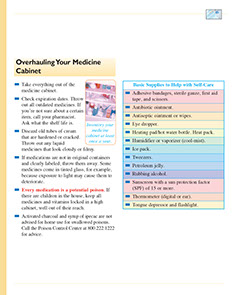
    Take everything out of the medicine cabinet.

    *  Check expiration dates. Throw out all outdated medicines. If you’re not sure about a certain item, call your pharmacist. Ask what the shelf life is.

    *  Discard old tubes of cream that are hardened or cracked. Throw out any liquid medicines that look cloudy or filmy.

    *  If medications are not in original containers and clearly labeled, throw them away. Some medicines come in tinted glass, for example, because exposure to light may cause them to deteriorate.

    *  Every medication is a potential poison. If there are children in the house, keep all medicines and vitamins locked in a high cabinet, well out of their reach.

    *  Activated charcoal and syrup of ipecac are not advised for home use for swallowed poisons. Call the Poison Control Center at 800.222.1222 for advice.

    Page from the Healthier at Home book by the American Institute for Preventive Medicine. www.HealthyLife.com. All rights reserved.

    © American Institute for Preventive Medicine
  • Over-The-Counter Medication Safety

    Medication

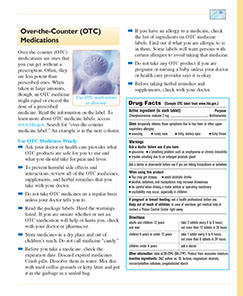
    Over-the-counter (OTC) medications are ones that you can get without a prescription. Often, they are less potent than prescribed ones. When taken in large amounts, though, an OTC medicine might equal or exceed the dose of a prescribed medicine. Read the information on the label. To learn more about OTC medicine labels, accesswww.fda.gov. Search for “over-the-counter medicine label.”

    Use OTC Medicines Wisely

    *  Ask your doctor or health care provider what OTC products are safe for you to use and what you should take for pain and fever.

    *  To prevent harmful side effects and interactions, review all of the OTC medicines, supplements, and herbal remedies that you take with your doctor.

    *  Do not take OTC medicines on a regular basis unless your doctor tells you to.

    *  Read the package labels. Heed the warnings listed. If you are unsure whether or not an OTC medication will help or harm you, check with your doctor or pharmacist.

    *  Store medicines in a dry place and out of children’s reach. Do not call medicine “candy.”

    *  Before you take a medicine, check the expiration date. Discard expired medicines. Crush pills. Dissolve them in water. Mix this with used coffee grounds or kitty litter and put it in the garbage in a sealed bag.

    *  If you have an allergy to a medicine, check the list of ingredients on OTC medicine labels. Find out if what you are allergic to is in them. Some labels will warn persons with certain allergies to avoid taking that medicine.

    *  Do not take any OTC product if you are pregnant or nursing a baby unless your doctor or health care provider says it is okay.

    *  Before taking herbal remedies and supplements, check with your doctor.

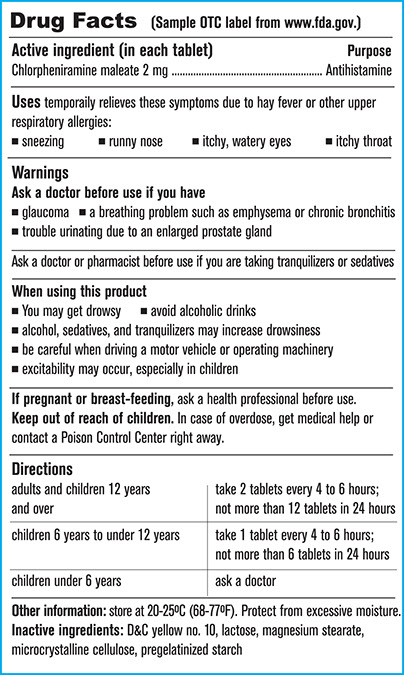
    Drug fact chart.

    Resources

    U.S. Food and Drug Administration

    www.fda.gov

    Page from the Healthier at Home book by the American Institute for Preventive Medicine. www.HealthyLife.com. All rights reserved.

    © American Institute for Preventive Medicine
  • Over-The-Counter Drugs: Reducing The Risks Of Self-Prescribing

    Medication

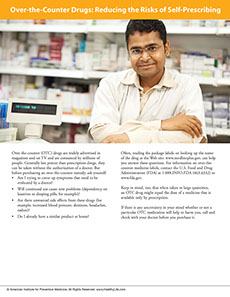
    Image of male pharmacist.

    Over-the-counter (OTC) drugs are widely advertised in magazines and on TV and are consumed by millions of people. Generally less potent than prescription drugs, they can be taken without the authorization of a doctor. But before purchasing an over-the-counter remedy, ask yourself:

    *  Am I trying to cover up symptoms that need to be evaluated by a doctor?

    *  Will continued use cause new problems (dependency on laxatives or sleeping pills, for example)?

    *  Are there unwanted side effects from these drugs (for example, increased blood pressure, dizziness, headaches, rashes)?

    *  Do I already have a similar product at home?

    Often, reading the package labels-or looking up the name of the drug at the Web site:www.medlineplus.gov, can help you answer these questions. For information on over-the-counter medicine labels, contact the U.S. Food and Drug Administration (FDA) at 1.888.INFO.FDA (463.6332) orwww.fda.gov.

    Keep in mind, too, that when taken in large quantities, an OTC drug might equal the dose of a medicine that is available only by prescription.

    If there is any uncertainty in your mind whether or not a particular OTC medication will help or harm you, call and check with your doctor before you purchase it.

    Page from A Year of Health Hints book by the American Institute for Preventive Medicine. www.HealthyLife.com. All rights reserved.

    © American Institute for Preventive Medicine
  • Only You Can Prevent Christmas Tree Fires

    Home Safety

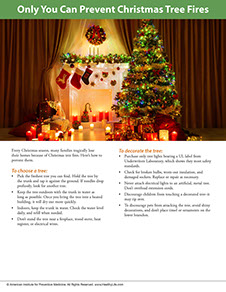
    Image of Christmas tress in front of fire place.

    Every Christmas season, many families tragically lose their homes because of Christmas tree fires. Here’s how to prevent them.

    To choose a tree:

    *  Pick the freshest tree you can find. Hold the tree by the trunk and tap it against the ground. If needles drop profusely, look for another tree.

    *  Keep the tree outdoors with the trunk in water as long as possible. Once you bring the tree into a heated building, it will dry out more quickly.

    *  Indoors, keep the trunk in water. Check the water level daily, and refill when needed.

    *  Don’t stand the tree near a fireplace, wood stove, heat register, or electrical wires.

    To decorate the tree:

    *  Purchase only tree lights bearing a UL label from Underwriters Laboratory, which shows they meet safety standards.

    *  Check for broken bulbs, worn-out insulation, and damaged sockets. Replace or repair as necessary.

    *  Never attach electrical lights to an artificial, metal tree. Don’t overload extension cords.

    *  Discourage children from touching a decorated tree-it may tip over.

    *  To discourage pets from attacking the tree, avoid shiny decorations, and don’t place tinsel or ornaments on the lower branches.

    A Year of Health Hints book by the American Institute for Preventive Medicine. www.HealthyLife.com. All rights reserved.

    © American Institute for Preventive Medicine
  • Never Cycle Without A Helmet

    Personal Safety

    (and Other Tips for Safer Biking)

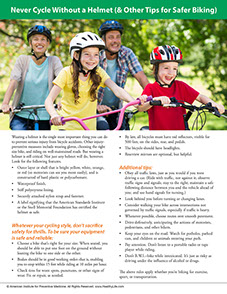
    Image of family riding bikes with helmets on.

    Wearing a helmet is the single most important thing you can do to prevent serious injury from bicycle accidents. Other injury-preventive measures include wearing gloves, choosing the right size bike, and riding on well- maintained roads. But wearing a helmet is still critical.

    Not just any helmet will do, however. Look for the following features.

    *  Outer layer or shell that is bright yellow, white, orange, or red (so motorists can see you more easily), and is constructed of hard plastic or polycarbonate.

    *  Waterproof finish.

    *  Stiff polystyrene lining.

    *  Securely attached nylon strap and fastener.

    *  A label signifying that the American Standards Institute or the Snell Memorial Foundation has certified the helmet as safe.

    Whatever your cycling style, don’t sacrifice safety for thrills. To be sure your equipment is safe and reliable:

    *  Choose a bike that’s right for your size. When seated, you should be able to put one foot on the ground without leaning the bike to one side or the other.

    *  Brakes should be in good working order-that is, enabling you to stop within 15 feet while riding at 10 miles per hour.

    *  Check tires for worn spots, punctures, or other signs of wear. Fix or repair, as needed.

    *  By law, all bicycles must have red reflectors, visible for 500 feet, on the sides, rear, and pedals.

    *  The bicycle should have headlights.

    *  Rearview mirrors are optional, but helpful.

    Additional tips every bicyclist should bear in mind:

    *  Obey all traffic laws, just as you would if you were driving a car. (Ride with traffic, not against it; observe traffic signs and signals; stay to the right; maintain a safe following distance between you and the vehicle ahead of you; and use hand signals for turning.)

    *  Look behind you before turning or changing lanes.

    *  Consider walking your bike across intersections not governed by traffic signals, especially if traffic is heavy.

    *  Whenever possible, choose routes over smooth pavement.

    *  Drive defensively, anticipating the actions of motorists, pedestrians, and other bikers.

    *  Keep your eyes on the road. Watch for potholes, parked cars, and children or animals entering your path.

    *  Pay attention. Don’t listen to a portable radio or tape player while riding.

    *  Don’t B.W.I.-bike while intoxicated. It’s just as risky as driving under the influence of alcohol or drugs.

    The above rules apply whether you’re biking for exercise, sport, or transportation.

    A Year of Health Hints book by the American Institute for Preventive Medicine. www.HealthyLife.com. All rights reserved.

    © American Institute for Preventive Medicine

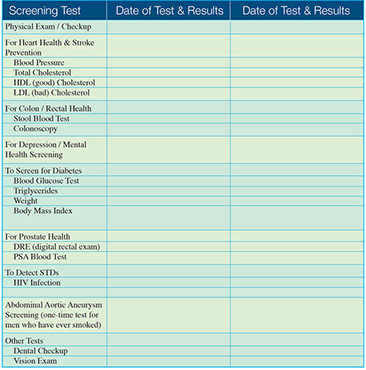
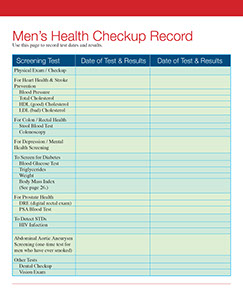
  • Men’s Health Checkup Record

    Medical History

    Use this page to record test dates and results.

    Men's health checkup record chart.
    Men's and Women's Self-Care Book. Published by the American Institute for Preventive Medicine.

    © American Institute for Preventive Medicine
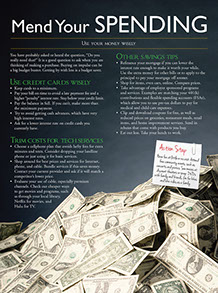
  • Mend Your Spending

    Financial Health

    Use your money wisely.

    You have probably asked or heard the question, “Do you really need that?” It is a good question to ask when you are thinking of making a purchase. Buying on impulse can be a big budget buster. Getting by with less is a budget saver.

    Use credit cards wisely:

    *  Keep cards to a minimum.

    *  Pay your bill on time to avoid a late payment fee and a higher “penalty” interest rate. Stay below your credit limit.

    *  Pay the balance in full. If you can’t, make more than the minimum payment.

    *  Try to avoid getting cash advances, which have very high interest rates.

    *  Ask for a lower interest rate on credit cards you currently have.

    Trim costs for tech services:

    *  Choose a cellphone plan that avoids hefty fees for extra minutes and texts. Consider dropping your landline phone or just using it for basic services.

    *  Shop around for best prices and services for Internet, phone, and cable. Bundle services if this saves money. Contact your current provider and ask if it will match a competitor’s lower price.

    *  Evaluate your use of cable, especially premium channels. Check out cheaper ways to get movies and programs, such as through your local library, Netflix for movies, and Hulu for TV.

    Other savings tips:

    *  Refinance your mortgage if you can lower the interest rate enough to make it worth your while. Use the extra money for other bills or to apply to the principal to pay your mortgage off sooner.

    *  Shop for items, even cars, online. Compare prices.

    *  Take advantage of employer sponsored programs and services. Examples are matching your 401(k) contributions and flexible spending accounts (FSAs), which allow you to use pre-tax dollars to pay for medical and child care expenses.

    *  Clip and download coupons for free, as well as reduced prices on groceries, restaurant meals, retail items, and home improvement services. Send in rebates that come with products you buy.

    *  Eat out less. Take your lunch to work.

    Action Step

    Have fun at little or no cost. Attend free community events, such as concerts and picnics. See movies at discount theaters or swap DVDs with family and friends. Go for hikes and bike rides as a family.

    Ways to Well-Being book by the American Institute for Preventive Medicine. www.HealthyLife.com. All rights reserved.

    © American Institute for Preventive Medicine