Medical Care
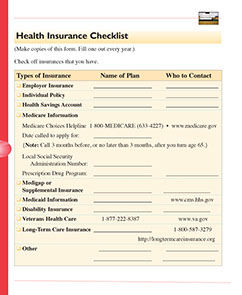
(Make copies of this form. Fill one out every year.) Check off insurances that you have.
© American Institute for Preventive Medicine
Medical Care
(Make copies of this form. Fill one out every year.) Check off insurances that you have.
© American Institute for Preventive Medicine
Medical Care
Health care fraud is stealing:
* It steals money from health insurance companies.
* It steals money from taxpayer programs, such as Medicare and Medicaid.
* It steals money from you.
The stealing is done on purpose when someone submits false information to get paid for health care benefits. Health care fraud is a big problem. It occurs every day across the U.S. Persons from all ages, races, and incomes are victims of it.
Types of Fraud
Ways Medical Providers Commit Health Care Fraud
* They bill for services and/or supplies that were not given. A provider may use real patient information to fabricate an entire claim. Or, a claim can be padded with charges for services, etc. that did not take place.
* They bill for services that cost more than the ones that were given. This is called “upcoding.” For example, a provider may submit a claim for an extended office visit when the patient was seen only briefly. On the claim, the provider uses the code number for the extended visit, not for a brief visit, which costs less. Often, the provider “inflates” the patient’s diagnosis to justify billing for the more costly service.
* They charge more than once for the same service. This is double billing.
* They give services and/or order tests that are not medically needed. This is done just to get the insurance payment. The provider may even give a false diagnosis to justify doing this.
* They claim a non-covered treatment as one that is a covered expense. For example, a cosmetic surgery, such as a “tummy tuck,” is billed as a hernia repair.
* They bill separate claims for services that should be billed together as one. For example, surgery on four fingers done at the same time is billed as four claims, not one.
* They waive co-pays. This means they don’t collect money that patients should pay for out of their pockets. When patients don’t have to pay anything, they are more likely to agree to have services that aren’t medically needed. Also, health care providers use this practice as a way to misrepresent their “usual” fees to insurance companies and bill them for more than they should.
* They take money in exchange for patient referrals.
* They let an unlicensed person provide services and bill for them.
Ways Patients Commit Health Care Fraud
* They submit claims for services, medicines, etc. that they didn’t get.
* They let another person use their health insurance card. They use someone else’s card.
* They change or forge bills, prescriptions, or receipts.
* They give wrong information on purpose to receive benefits.
* They fail to give information to the insurance company.
* They try to add someone who is not legally a dependent to their insurance plan. To do this, they lie about their marital status, paternity, etc.
* They don’t let the insurance plan know about a divorce. They do this on purpose to keep coverage for the ex-spouse and/or step children who are no longer eligible for coverage under the plan.
* They fail to disclose other insurance coverage. This could be worker’s compensation for an on-the-job- injury. It could be auto accident insurance payment for health care costs.
* They take money or other perks from a provider for receiving services.
Ways Others Commit Health Care Fraud
* Identity theft. Health insurance card(s) or number(s) are taken and used to bill insurance programs for treatment not given.
* Mobile labs. Diagnostic labs in trailers, etc. give fake or needless procedures to consumers. Then, they bill insurance programs for costly procedures.
Affects of Fraud
Health Care Fraud Costs You Money
* It makes you pay more for health insurance. Your premiums go up. You pay more for out- of-pocket costs. Your co- pays and deductibles cost more.
* It increases the cost for Medicare and Medicaid. As a result, you may need to pay more taxes. Also, tax dollars spent on health care fraud leaves less money for other taxpayer programs, such as education.
* It increases costs in general. To cover increased costs for employee health benefits, companies need to charge more for products. Things you buy, such as cars, clothes, computers, etc. end up costing more money.
Health Care Fraud Can Affect Your Health
* It can cause harm. Scam providers may order treatments that you don’t need. This includes heart surgery, which can threaten your life. They do this just to make money from your insurance company.
* It can use up lifetime caps or other limits of your benefits. Money used for false claims and needless treatments count toward your lifetime or other limits.
* It could cause injury and even death. This can occur in auto accidents that are staged to collect insurance money.
Detect Fraud
Ways To Detect It
Fighting health care fraud is a priority for companies, insurers, and the government. They are using many measures to do this. These include:
* Computer software programs that help detect fraud. One kind analyzes data for trends or ratios that are unusual or not expected. Another kind quickly sorts data to get certain information, such as:
– False billings.
– Billing too much.
– Billing too little.
– Unusual patterns for paying vendors, etc.
Software can also “rebundle” claims. This allows the insurance company to see if services performed at the same time were billed for as ones done at different times. These software programs don’t detect all types of fraud. Nothing about the coding or payment would signal fraud. For example, the software would not detect billing for an extended office visit when a brief visit was done.
* Special Investigation Units (SIUs). These include trained professionals in accounting, health care, law enforcement, nursing, etc.
* Fraud bureaus. These were created by state insurance regulators. They are found in most states.
* Employee training.
* Fraud hotlines.
What You Can Do
Ways To Help Prevent Health Care Fraud
* Learn about your health insurance. Read about your benefits. This can be in a booklet. It can be on the insurance company’s Web site.
* Find out what the plan does and does not pay for. Find out what you pay. Learn what the plan’s limits are. If you have more than one health plan, find out which expenses are covered by each plan. This prevents more than one plan from paying for the same service. Would you want an item you charge on a credit card to be billed on two credit cards?
* Ask questions about proposed treatment, tests, etc. Are these needed and why? What do they cost? Get a second opinion if surgery is proposed.
* Fill out, sign, and date one claim form at a time. I Keep a record of your medical care. Note the following:
– Dates and places of care.
– Services received.
– Names of persons who treated you.
– Medicines, supplies, and equipment you received.
– Tests and other services that were ordered and if they were done.
* Don’t sign blank claim forms.
* If your health insurance company was not yet billed for services, give the provider your insurance information.
* Read the Explanation of Benefits (EOB) statements you get. An EOB is a report from your insurance company. It shows what it paid for and what it did not pay for. It is not a bill.
– Compare the dates of services, procedures, tests, etc. with your medical bills. Do they match?
– If you don’t understand the EOB form, contact your insurance company.
* Compare your medical bills and the EOB statements. Contact your provider and your insurance company to report errors.
* Protect your health insurance ID card. It represents your benefits. In general, be careful about giving out your insurance information.
* Don’t buy health insurance online
* Don’t buy health insurance from persons who sell it door-to-door or on the phone.
* Be wary of persons who offer cash or free items or services to get you to buy insurance.
* Read all medical bills you get from your doctor, hospital, etc.
– Check the date(s) of service. Are these correct?
– Look for errors.
– Check to make sure that you received the services you are being billed for.
– If the bill just lists a total charge, ask for an itemized bill. {Note: Ask for an itemized bill when you leave a hospital.} Ask for one that lists services in words you can understand, not just code numbers. Why? When providers bill for services, they use code numbers for diagnoses and procedures, such as ones called ICD-9-CM Codes. If necessary, ask what the code numbers stand for.
– Check to see if you were billed more than once for the same service. Double-billing is a common error.
– If a bill lists “miscellaneous” charges, find out all the items this includes.
– If you don’t understand a bill, call the number on the statement. Call your insurance company, too. Get problems resolved before you pay for a bill or have the insurance company send payment.
* Know about the “qui tam” part of The False Claims Act. This allows a person to bring a civil case against persons who submitted false claims to the government, such as to Medicaid. If the lawsuit results in a court judgment, the “whistle blower” can get part of the money made.
Is health care fraud a crime?
Yes, it is a very serious crime. For the Department of Justice, health care fraud and abuse is the number two priority after violent crime. Persons convicted of health care fraud can go to prison. They can pay hefty fines. If the fraud they commit causes someone to die, they could be sentenced to life in prison.
The cost of health care fraud is huge.
* Some estimates by government and law enforcement groups say it costs as much as $180 billion dollars a year!
* Medicare and Medicaid are big targets. One out of every seven dollars spent on Medicare is due to fraud and abuse.
Resources
BNA Health Care Fraud Report
www.bna.com/products/health/hfra.htm
Coalition Against Insurance Fraudwww.insurancefraud.org
National Fraud Information Center/Internet Fraud Watch
National Health Care Anti-Fraud Association (NHCAA)
© American Institute for Preventive Medicine
Home Safety
Healthy eating starts with preparation.
Your body will know if you’ve eaten harmful bacteria, because it can make you mildly to very sick. Bacteria spread easily onto hands, cutting boards, utensils, and countertops – all things that come into contact with food. To avoid problems, cook foods to proper temperatures and follow some simple steps.
Clean: Wash your hands and surfaces often.
* Wash your hands with warm water and soap for at least 20 seconds before and after handling food or touching other surfaces.
* Wash cutting boards, dishes, utensils, and countertops with hot soapy water after preparing each food item.
* Rinse fruits and vegetables with running tap water.
Separate: Don’t cross-contaminate.
* Keep raw meat, poultry, seafood and eggs separate from other foods.
* Use one cutting board for fruits and vegetables and another for meat, poultry, seafood, or eggs.
* Never place cooked food on a plate that held raw food.
Chill: Refrigerate perishable foods.
* Refrigerate or freeze meat, poultry, eggs, and other perishables as soon as you get home from shopping for foods.
* Don’t let raw meat, poultry, eggs, cooked food, or cut fruits or vegetables sit at room temperature more than two hours.
* Defrost foods in the refrigerator or cold water. Use the microwave on the defrost setting if you are cooking the food right away.
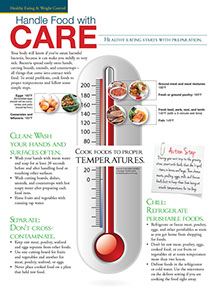
Cook foods to proper temperatures.
Eggs: 160ºF (Scrambled eggs should not be runny; whites and yolks should be firm.)
Casseroles and leftovers: 165ºF
Ground meat and meat mixtures: 160ºF
Fresh or ground poultry: 165ºF
Fresh beef, pork, veal, and lamb: 145ºF (with a 3-minute rest time)
Fish: 145ºF
Action Step
During your next trip to the grocery store, start with foods that don’t spoil − items in boxes and bags. Then choose meats, poultry, eggs, milk, and frozen foods last to keep them from being at unsafe temperatures for too long.
© American Institute for Preventive Medicine
Mental Health
Grief is a deep sadness or sorrow that results from a loss. The loss can be a major or minor one. It can result from something positive or negative. Bereavement is grieving most often linked with the death of a loved one.
Signs & Symptoms
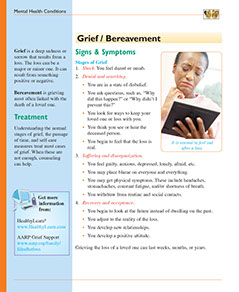
Stages of Grief
1. Shock.
You feel dazed or numb.
2. Denial and searching.
* You are in a state of disbelief.
* You ask questions, such as, “Why did this happen?” or “Why didn’t I prevent this?”
* You look for ways to keep your loved one or loss with you.
* You think you see or hear the deceased person.
* You begin to feel that the loss is real.
3. Suffering and disorganization.
* You feel guilty, anxious, depressed, lonely, afraid, etc.
* You may place blame on everyone and everything.
* You may get physical symptoms. These include headaches, stomachaches, constant fatigue, and/or shortness of breath.
* You withdraw from routine and social contacts.
4. Recovery and acceptance.
* You begin to look at the future instead of dwelling on the past.
* You adjust to the reality of the loss.
* You develop new relationships.
* You develop a positive attitude.
Grieving the loss of a loved one can last weeks, months, or years.
Causes
* A new or lost job, a promotion, demotion, or retirement.
* Relationship changes, such as getting divorced or having a child leave home.
* An illness, injury, and/or disability.
* The death of a family member or friend. Loss of property. Moving to a new place.
Factors that shape a person’s response to a loss, such as death include:
* Age, gender, and health.
* How sudden the loss was.
* Cultural background. Religious beliefs.
* Finances.
* Social network.
* History of other losses or traumatic events.
Each of these factors can add to or reduce the pain of grieving.
Treatment
Understanding the normal stages of grief, the passage of time, and self-care measures treat most cases of grief. When these are not enough, counseling can help.
Questions to Ask
Self-Care / Prevention
* Eat regular meals.
* Get regular physical activity.
* Allow friends and family to help you. Don’t hold your feelings inside. State how you really feel. Visit them, especially during the holidays, if you would otherwise be alone. Travel during the holidays if this helps.
* Share and maintain memories of a lost loved one. Being reminded of the past can help with the process of coming to grips with a loss.
* Try not to make major life changes, such as moving during the first year of grieving.
* Join a support group for the bereaved. People and places to contact include your EAP representative, your student counseling center, churches or synagogues, funeral homes, and hospice centers.
* Adopt a pet.
* Read self-help books about grief and death.
Resources
AARP Grief Support
© American Institute for Preventive Medicine
Mental Health
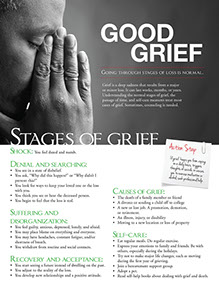
Going through stages of loss is normal.
Grief is a deep sadness that results from a major or minor loss. It can last weeks, months, or years. Understanding the normal stages of grief, the passage of time, and self-care measures treat most cases of grief. Sometimes, counseling is needed.
Stages of grief
Shock: You feel dazed and numb.
Denial and searching:
You are in a state of disbelief. You ask, “Why did this happen?” or “Why didn’t I prevent this?” You look for ways to keep your loved one or the loss with you. You think you see or hear the deceased person. You begin to feel that the loss is real.
Suffering and disorganization:
You feel guilty, anxious, depressed, lonely, and afraid. You may place blame on everything and everyone. You may have headaches, constant fatigue, and/or shortness of breath. You withdraw from routine and social contacts.
Recovery and acceptance:
You start seeing a future instead of dwelling on the past. You adjust to the reality of the loss. You develop new relationships and a positive attitude.
Self-care:
* Eat regular meals. Do regular exercise.
* Express your emotions to family and friends. Be with others, especially during the holidays.
* Try not to make major life changes, such as moving during the first year of grieving.
* Join a bereavement support group. Read self-help books about dealing with grief and death.
* Adopt a pet.
Causes of grief:
* The death of a family member or friend
* A divorce or sending a child off to college
* A new or lost job. A promotion, demotion, or retirement.
* An illness, injury, or disability
* Moving to a new location or loss of property
Action Step
If grief keeps you from coping on a daily basis, triggers thoughts of suicide, or causes you to overuse medication or alcohol, seek professional help.
© American Institute for Preventive Medicine
Home Safety
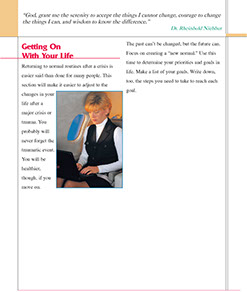
Returning to normal routines after a crisis is easier said than done for many people. This section will make it easier to adjust to the changes in your life after a major crisis or trauma. You probably will never forget the traumatic event. You will be healthier, though, if you move on. The past can’t be changed, but the future can. Focus on creating a “new normal.” Use this time to determine your priorities and goals in life. Make a list of your goals. Write down, too, the steps you need to take to reach each goal.
Balance Body, Mind, and Spirit
* Give yourself time to heal. Know that this will not be an easy time. Let yourself feel whatever you are feeling. Be patient with changes in your feelings.
* Stay involved with other people and activities. Be informed.
* Help others.
* Connect with people. Visit or call people who will support you. Rely on family, friends, co-workers, neighbors, and support groups.
* Think positively about challenges ahead.
* Get extra rest.
* Eat healthy foods.
* Exercise.
* Take extra care of yourself, even if you don’t feel like it.
* Plan your time. Stay busy. Work. Read. Play sports. Do hobbies.
* Express your thoughts and feelings about the event. Find good listeners. Talking about it lessens the power trauma has over you, clears your head, and calms you. It also helps you to heal and feel more in control. It helps to write down your thoughts and feelings, too.
* Find time to relax. Do things you enjoy. Breathe deeply. Meditate. Do yoga.
* Don’t use alcohol or drugs to feel better. You must deal with your emotions so you can heal. Numbing the feelings won’t help.
* Find healthy things to do that make you feel good about yourself or feel more in control.
* Limit TV watching of disasters.
* Don’t make big life decisions in haste.
Spirituality Can Help You Cope
During times of crisis, many people find a deep inner peace and strength through their faith. Faith can give deeper meaning to life and helps you focus on what really matters. Some people may question their faith as they search for meaning in a tragedy. Questions and doubts during hard times are normal. The benefits of spirituality come in many ways.
* Praying and meditating. Prayer vigils.
* Counting your blessings
* Forgiving and healing
* Practicing and receiving unconditional love
* Connecting to a higher power
* Reaching out to help others
* Attending a place of worship can provide a sense of community and shared purpose as well as support, reassurance, and understanding.
Pastoral counselors can help with mental health and spiritual concerns. They are certified mental health professionals. They also have had in-depth training in religion and/or theology. You can choose one of your faith (e.g., Catholic, Jewish, Muslim, Protestant, etc.). Call 800.225.5603 or visitwww.aapc.org.
Effects of the Media
Having easy access to a world of information can be empowering and help allay fears by keeping us informed and connected to the world at large. On the other hand, newspaper and television, in particular, can overwhelm viewers and have a negative effect on many people. This includes increasing fear.
Television’s immediate and powerful images can burn into your memory, especially if a traumatic event is watched over and over. How much is too much? The answer depends on the person. Here are some general tips:
* Control TV watching. Immediately after a crisis, it is natural to want to keep the TV or radio on for much of the day to stay informed. After a couple of days or if you feel anxious, turn it off. Do not expose children under the age of six to televised videotapes of attacks and disasters. Limit TV viewing for older children and watch it with them.
* Use the newspaper, radio, or internet to keep informed.
* Check in a few times a day in case something new has happened. Don’t leave the TV on all day. While TV can give a feeling of being connected, it is also emotionally draining. There is a time to just turn it off.
* Use the media in moderation. Spend time on other activities you enjoy.
* Watch cartoons, other funny shows and videos with your children.
* If waking up to the news from a clock radio every morning is draining, find a nice music station instead.
* Don’t read, watch, or listen to the news for at least an hour before bed.
Helping Children Cope
In the wake of crisis or disaster, helping children cope is a priority in the minds of parents and teachers. According to the American Counseling Association, after any disaster, children are most afraid of the following:
* That the event will recur
* That they or someone they love will be hurt or killed
* That they may be separated from those they love and will be left alone
Things you say and do can help your children cope with a crisis.
Talking with Children
* Comfort children. Let them know that you will keep them safe, that you are safe, and you will take care of them. Tell them how rare disasters are and about all the people who work to keep us safe. Tell them that good acts in the world outnumber the bad.
* Answer children’s questions honestly. Keep in mind their age and maturity when you respond. Give basic answers. Don’t give too much detail. Children will ask for more information if they want it.
* Find out what the child is concerned about. What have they seen? Heard? Experienced? Listen without judging.
* Allow children to express their feelings, but do not push them if they aren’t ready. If they can’t talk about their feelings, let them express feelings through drawing, play, etc.
* Encourage children to feel in control. Let them make choices about meals, clothing, etc.
* As children retell events, ask questions or play out the event. Many children need to hear the same thing over and over before they understand. Help young children to learn words that express their feelings. n Let children know it is normal to feel upset after something bad happens and that the traumatic event was not their fault.
* Remind children of times they have been brave before in a new or difficult situation.
* Do not criticize regressive behavior or shame the child with statements like, “You’re acting babyish.”
* Let children cry and be sad. Don’t expect them to be brave and tough.
* Don’t keep secrets. Children will imagine something much worse is going on or think they are to blame. Don’t be afraid to say, “I don’t know.”
* Tell them about the heroes involved in a tragedy, (e.g., firefighters, police, doctors, nurses, and ordinary people).
* Some children may express hate toward a large group of people. You may feel hate, as well. Let children know that you understand their anger toward specific people who may have caused harm. Help them to separate those feelings from prejudice toward a larger group. Remind them how prejudice causes many problems and that the world can be a better place by being good to others.
Actions to Take to Help Children
Above all, stay calm. Children look to us for how to respond.
* Try to return to normal routines (school, after- school activities, and play, etc.) as soon as possible.
* Make sure the child gets enough rest and eats healthy foods.
* Review family safety plans. This will help children feel prepared in the event an emergency situation occurs.
* Understand there may be a short, temporary decline in school performance. Talk to teachers, coaches, etc. to see how your children are doing in other settings. Let these same persons know how your child is doing at home.
* Spend extra time together as a family. Spend one-on- one time with each child. Give your children hugs and kisses.
* Be a role model for tolerance, understanding, and peace.
* Do things that show how one person can make a difference. Donate time. Send cards. n Don’t let children under age six watch or hear the news. Watch the news with older children and talk to them about it afterward.
* Do relaxing activities together. Read books. Listen to music. Draw or do other artwork. Take a walk, etc.
* Limit how much young children hear adults talking about the event.
* Avoid unnecessary separations from parents or other important caregivers.
* Allow time to cope. Be patient with angry outbursts. Give children a healthy outlet for anger, such as a pillow to punch.
* Tell and show children how much you love them. This is true at all times, but even more so after a crisis.
* If, after six weeks following a crisis, your child is not able to function normally at home, at school, or in play, seek help for your child from a mental health professional.
What Really Matters
After a crisis, many people decide what is truly important to them. You, too, may find yourself experiencing the following common reactions:
* You draw closer to loved ones. You tell them how we feel about them. You spend more time with family and friends.
* You become more spiritual. You look for deeper meaning in your life.
* You make decisions or do things you may have been putting off.
* You work less and play more.
* You slow down the pace of a hectic lifestyle.
* You become more informed about the world.
* You reach out to help others and strive to make the world a better place.
* Realizing how fragile life is, you learn to enjoy each moment more and fret less.
* You learn survival skills.
* Communities, nations, and the world unite.
© American Institute for Preventive Medicine
Medical Care

Decisions you make about your health can affect the length and quality of your life. Choose wisely. To do this, you need to gather facts. Use these sources:
* You. You know more about you than anyone else. Be in touch with how you feel, physically and emotionally. Keep track of past and present health concerns.
* Your doctor. Ask for his or her advice. Your doctor may also have written materials on your condition.
* Medical resources. These include:
– The Internet’s world wide web. Look for credible sites, such aswww.medlineplus.gov,www.healthfinder.gov, and other Web sites which end in .gov. Other credible sites are ones from hospitals, medical centers, and medical associations. Most often, these sites end in .edu and .org. Beware of Web sites that promote health fraud and quackery. Accesshttp://quackwatch.orgfor information. Also, check with your doctor before you follow advice from a Web site. The advice may not be right for your needs.
– Not-for-profit groups. These include the American Cancer Society, the American Heart Association, and the American Diabetes Association. To get information, call their toll-free numbers or access their Web sites.
– Government agencies. One is the National Heart, Lung, and Blood Institute (NHLBI). Accesswww.nhlbi.nih.gov.
– Support groups for conditions, such as breast cancer. Check local hospitals for lists of support groups near you. Also, contact the American Self-Help Group Clearinghouse Self-Help Group Sourcebook Online atwww.mentalhelp.net/selfhelp.
Your job is to gather facts. Once you have the facts, you and your doctor can make the medical decision(s) best suited to your needs.
© American Institute for Preventive Medicine
Mental Health
For most people, gambling is a social event done responsibly. For as much as 4% of all adults, though, gambling can disrupt their lives. About 2 million (1%) of adults in the U.S. meet the criteria for pathological gambling.
Another 4 to 8 million persons (2-3%) are problem gamblers. They are not pathological gamblers, but have problems due to gambling.
Signs & Symptoms
For Pathological Gambling
Pathological gamblers are addicted to gambling. They do 5 or more of these things:
* They are pre-occupied with gambling. They dwell on past gambling events, plan future gambling bouts, and/or think about ways to get money to gamble with.
* They need to increase the amount of money to gamble with to get a desired level of excitement.
* They have tried to control, limit, or stop gambling without success.
* They are restless or very cranky when they try to limit or stop gambling.
* They gamble to escape problems or to relieve negative feelings.
* They gamble to get even for past gambling losses.
* They lie to others to hide how much they are involved with gambling.
* They have stolen or done another illegal act to get money for gambling.
* They have lost a job, a relationship, etc., due to gambling.
* They rely on others to bail them out from money problems due to gambling.
Other Problems Pathological Gamblers Have
* They abuse alcohol or drugs.
* They sleep poorly.
* They are prone to stress-related conditions, such as high blood pressure, headaches, and mood disorders, such as depression.
* They have thoughts of suicide.
* They gamble constantly.
* They want to have wealth and material goods without working hard to get them.
* They think that money is both the cause of and solution to all of their problems.
* They feel important or “in control” and over-confident while betting.
Causes
Problem gambling occurs when gambling can’t be controlled. It may follow years of social gambling, but then may be set into motion by a stressful event or greater exposure to gambling.
Problem gamblers report that one or both parents had a drinking and/or gambling problem.
Treatment
Problem gambling is an illness. It needs professional treatment.
Questions to Ask
Self-Care / Prevention
Along with professional treatment:
* Learn all you can about gambling and its effects.
* Contact Gamblers Anonymous (GA).
* Ask your family and friends to help you take part in non-gambling activities.
* When you feel compelled to gamble, do something else. Exercise. Take a warm bath or shower. Spend time on a hobby.
* Get involved in school, church, and community activities. These can help distract you from gambling.
Resources
© American Institute for Preventive Medicine
Mental Health Care

Boost your happiness level by taking care of your body.
* Get 7-8 hours of sleep a night.
* Exercise every day with activities you enjoy.
* Limit refined carbohydrates like white starchy foods (white bread, rice, and crackers) and sugar (soda, candy, and junk foods). These foods can cause blood sugar spikes and drops, causing a short-lived burst of energy followed by a tired, cranky feeling.
* Take a 10-15 minute walk to clear your mind and enjoy your surroundings.

© American Institute for Preventive Medicine
Home Safety

* Drink tap water instead of bottled water. Two gallons of water are wasted to process every one gallon of bottled water. About 38 billion water bottles a year end up in landfills and oil and gas are needed to make and transport water bottles.
* If you prefer, buy a filter pitcher or install a faucet filter with your sink to remove trace chemicals and bacteria.
* Keep water for drinking in the fridge instead of letting the tap water run to get cold. Drink from glasses or re-usable water bottles.
* Medicines flushed down the toilet get in the water supply. Crush pills and dissolve them in water. Mix this with used coffee grounds or kitty litter and put it in the garbage in a sealed bag.
* Don’t leave the tap water running while you brush your teeth, wash your face, shave, etc. Take showers instead of baths. Spend less time in the shower.
* Have full loads before running the clothes washer, dryer, and dishwasher. Install a low-flow toilet.
* Collect rain water in barrels. Use it to water plants.

© American Institute for Preventive Medicine