Blog

  • Coping With A Crisis

    Home Safety

    The first step in coping with a crisis is to recognize what is happening. Part of this is to accept the feelings and reactions you have as normal responses to an abnormal event. Some reactions show that your body and mind are on a high state of alert. Others are part of the healing process. The second step is to manage the effect the crisis has on you (e.g., how you feel and the ability to live your life).

    Typical Reactions

    Reactions to a crisis or trauma vary widely. You may experience many, only a few, or none of these reactions. These reactions to a crisis or trauma are common. Most people fully recover from even moderate stress reactions within six to sixteen months.

    Behavior Reactions

    *  Crying, anger outbursts, restlessness

    *  Withdrawal, isolating yourself, or clinging to others

    *  Increased urge for alcohol or drugs

    *  Problems with family, friends, co-workers

    *  Being “on guard” or easily startled

    *  Inappropriate humor

    *  Change in eating, sleeping, and or other behaviors

    *  No longer maintaining daily routines. You may be too afraid to leave your home.

    Physical Reactions

    *  Headaches

    *  Upset stomach

    *  Nervousness

    *  Change in appetite

    *  Muscle aches

    *  Tiredness, fatigue, exhaustion

    *  Insomnia

    Emotional Reactions

    *  Anger

    *  Irritability

    *  Emotional numbness

    *  Worry

    *  Fear

    *  Sadness

    *  Grief

    *  Feeling unmotivated

    *  Feeling unsafe

    *  Weakness

    *  Feeling insecure

    *  Helplessness

    *  Hopelessness

    *  Guilt

    *  Feeling overwhelmed

    Mental Reactions

    *  Disbelief

    *  Shock

    *  Recurring thoughts of the event

    *  Confusion

    *  Poor memory

    *  Impaired concentration

    *  Inability to make decisions

    *  Bad dreams

    *  Violent fantasies

    *  Changes in or questions about religious beliefs

    Handling Anxiety

    *  Write down, ahead of time, the steps to take for different disasters (e.g., house, fires, floods, etc.). Go through drills for each plan with the whole family. Make sure the car always has gas. This is in case you have to leave an area.

    *  Know your place of work’s emergency plans. Find out about them from your supervisor, Employee Assistance Program (EAP), etc.

    *  Take a course in first aid from the Red Cross, your police or fire department.

    *  Give each family member a prepaid phone card with about a ten dollar value. Instruct children how to use the card and a pay phone. Some cell phone services may be overwhelmed in an emergency.

    *  Set up a “check-in” plan. Choose someone for family members to call or e-mail to check on each other. Pick someone far enough away who would not likely be part of the same event. Of course, call each other on cell, regular, or pay phones.

    *  Choose two places to meet. One is at home or near your home. Choose another place farther away in case you can’t get home. Make plans for the safety of your children.

    *  If you have children in school, find out the school’s crisis plan. Know the school’s policy for sending children home. Make sure the school has current phone numbers for you and other caregivers in case you can’t be reached. Find out what the school needs to have to release your child to designated caregivers.

    *  If you have a pet, plan for its safety. For more information, contact the Red Cross orwww.disasterrelief.org/library/prepare/pets.html.

    *  When you enter a building, find emergency exits and stairways. Plan ahead how to get out quickly from buildings, vehicles, crowded public places, etc.

    *  Make an emergency supply kit. Put these things in backpacks or containers that one or more family members can easily carry:

    – Three days’ supply of bottled water (one gallon a day per person if possible. Put these next to, not in your containers.)

    – Food that won’t spoil. A hand can opener.

    – Flashlight and extra batteries

    – A battery powered radio or TV and extra batteries

    – First aid kits for the home and the car

    – Sleeping bags or blankets

    – A change of clothing for each person

    – Items for family members with special needs (e.g., baby supplies, medicines, etc.)

    – Duct tape and dry towels that you can make wet to make a room airtight

    – Bleach

    – Important documents, cash, and credit cards

    For more information on being ready for disasters, contactwww.redcross.orgor call your local Red Cross. Ask about their “Preparing for the Unexpected” class. This one and a half-hour class teaches families and employees safety steps to take for many kinds of disasters.

    Deal with Fear

    Handling Anxiety

    Anxiety is a feeling of dread, fear, or distress over a real or imagined threat to your mental or physical well being. When anxiety becomes extreme, possible threats are overestimated. Also, inner strength, support from family, the community, and the nation are underestimated.

    A certain amount of anxiety is normal. It can alert you to seek safety when you are in physical danger. Anxiety is not normal, though, when there is no apparent reason for it or when it overwhelms you and interferes with your day-to-day life. If this is the case, seek help from your doctor, a mental health professional, or your Employee Assistance Program (EAP) at work. Treatment can include medication and counseling. It may also include behavior therapy or taking part in a self-help group.

    Signs and Symptoms of Anxiety

    *  Rapid pulse and/or breathing rate

    *  Racing or pounding heart

    *  Dry mouth

    *  Sweating

    *  Trembling

    *  Shortness of breath

    *  Faintness

    *  Numbness/tingling of the hands, feet, or other body part

    *  Feeling a “lump in the throat”

    *  Stomach problems

    Self-Help for Anxiety

    *  If you are prescribed medication, take it as advised.

    *  Identify your feelings.

    *  Talk to others about your fears. It’s okay to ask for help. If available at your place of work, attend group meetings with an EAP counselor or other mental health professional where people can share feelings.

    *  Maintain your normal routines.

    *  Escape for a little while. Go to a movie. Read a good book. Take a walk in the woods or a trip to a museum.

    *  Take a long, warm shower or bath.

    *  Don’t fight the desire to cry. Tears can help relieve stress and also release a natural pain-relieving substance from the brain.

    *  Laugh a lot. Laughter relaxes muscles and relieves tension.

    *  Recognize the things you can control and what you can’t control. Identify and use your own strengths and resources.

    *  Use measures that have helped you overcome fear and helplessness in the past.

    *  Don’t take on more than you can handle. Make a to-do list. Prioritize important items.

    *  Reward yourself. Treat yourself to little things that make you feel good.

    *  Think positively.
    Take Charge, Coping with a Crisis book by the American Institute for Preventive Medicine. www.HealthyLife.com. All rights reserved.

    © American Institute for Preventive Medicine
  • Connect With Nature Year-Round

    Mental Health Care

    Man standing in front of lake and mountains.

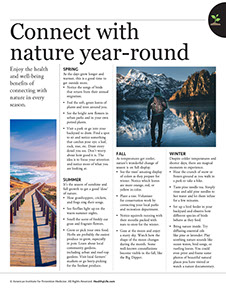
    Enjoy the health and well-being benefits of connecting with nature in every season.

    Spring

    As the days grow longer and warmer, this is a good time to get outside more.

    *  Notice the songs of birds that return from their annual migration.

    *  Feel the soft, green leaves of plants and trees around you.

    *  See the bright new flowers in urban parks and in your own potted plants.

    *  Visit a park or go into your backyard to draw. Find a spot to sit and notice something that catches your eye: a leaf, rock, tree, etc. Draw every detail you see. Don’t worry about how good it is. The idea is to focus your attention and notice more of what you are looking at.

    Summer

    It’s the season of sunshine and full growth to get a good ‘dose’ of nature.

    *  Hear grasshoppers, crickets, and frogs sing their songs.

    *  See fireflies light up on the warm summer nights.

    *  Smell the scent of freshly cut grass and fragrant flowers.

    *  Grow or pick your own food. Herbs are probably the easiest produce to grow, especially in pots. Learn about local community gardens, including urban and roof-top gardens. Visit local farmers’ markets or go berry-picking for the freshest produce.

    Fall

    As temperatures get cooler, nature’s wonderful change of season is on full display.

    *  See the trees’ amazing display of colors as they prepare for winter. Notice which leaves are more orange, red, or yellow in color.

    *  Plant a tree. Volunteer for conservation work by contacting your local parks and recreation department.

    *  Notice squirrels running with their mouths packed with nuts to store for the winter.

    *  Gaze at the moon and enjoy a starry sky. Watch how the shape of the moon changes during the month. Some well-known constellations become visible in the fall, like the Big Dipper.

    Winter

    Despite colder temperatures and shorter days, there are magical moments to experience.

    *  Hear the crunch of snow or frozen ground as you walk in a park or take a hike.

    *  Taste pine needle tea. Simply rinse and add pine needles to hot water and let them infuse for a few minutes.

    *  Set up a bird feeder in your backyard and observe how different species of birds behave as they feed.

    *  Bring nature inside. Try diffusing essential oils like pine or lavender. Play soothing nature sounds like ocean waves, bird songs, or rustling leaves. You could even print and frame some photos of beautiful natural places you have visited or watch a nature documentary.

    Minding Your Mental Health Book. Published by the American Institute for Preventive Medicine. www.HealthyLife.com. All rights reserved.

    © American Institute for Preventive Medicine

  • Choosing & Comparing Health Plans

    Medical Care

    Image of women talking to a pharmaists.

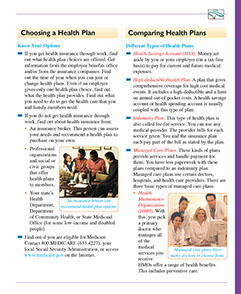
    Different Types of Health Plans

    *  Health Savings Account (HSA). Money set aside by you or your employer (on a tax-free basis) to pay for current and future medical expenses.

    *  High-deductible Health Plan. A plan that has a high-cost yearly deductible that must be met before benefits are paid by the plan. It also includes a limit on annual out-of-pocket costs and a heath saving or health spending account. In-network preventive care services are free.

    *  Indemnity Plan. This type of health plan is also called fee-for-service. You can use any medical provider. The provider bills for each service given. You and the insurance plan each pay part of the bill as stated by the plan.

    *  Managed Care Plans. These kinds of plans provide services and handle payment for them. You have less paperwork with these plans compared to an indemnity plan. Managed care plans use certain doctors, hospitals, and health care providers. There are three basic types of managed care plans.

    – Health Maintenance Organization (HMO). With this, you pick a primary doctor who manages all of the medical services you receive. HMOs offer a range of health benefits. This includes preventive care.

    – Preferred Provider Organization (PPO). With this, a network of providers gives medical services at a discount to its members. With a PPO, you can choose one or more providers from a list of those who participate with the health plan.

    – Point-of-Service (POS). With this, you have the option to go to providers outside of the plan’s network of providers. Some of the cost is still paid for by the plan.

    Plans vary; so do costs and what is covered. With any plan, a basic premium is paid by you and/or your employer. After that, you pay extra costs (deductibles, co-pays, etc.). These costs vary. They depend on the plan. Compare costs and how each plan handles services. These include:

    *  Routine checkups, health screenings, and vaccines.

    *  Preventive services, such as programs for weight control.

    *  Maternity care. Care by specialists.

    *  Hospital care. Emergency and urgent care.

    *  Mental health care.

    *  Substance abuse services.

    *  Physical therapy and home health care.

    *  Alternative health care.

    *  Prescription drugs. Find out what the plan covers.

    – Check out the plan’s formulary. This is a list of preferred generic and brand name drugs that the plan covers. In general, you have higher co-pays for brand name drugs than generic drugs. You pay even more for drugs not on the preferred list. Show your doctor your plan’s formulary when he or she prescribes medications for you.

    – Find out what mail order pharmacy and local pharmacies the plan uses.

    More and more health plans are doing health risk assessments for their enrollees. People who have a higher risk for health problems may need to pay more. Find out if your plan has such a program. Reasons to pay more include being overweight, smoking, and having diabetes or high blood pressure.

    Compare what different plans cover. Decide what is important to you and your family. Choose the plan that best meets your needs. Look at the quality of care, too.

    Know Your Options

    *  If you get health insurance through your work, find out what health plans are offered. Get information from the employee benefits office, the health plans’ Web sites, and/or from the insurance companies.

    *  If you need to buy health insurance, find out about health plans from:

    – The Health Insurance Marketplace atwww.healthcare.govor 800.318.2596. This resource allows individuals, families, and small businesses to learn about their health coverage options; compare health plans based on costs and benefits; choose a plan; and enroll in coverage. The Marketplace also gives information on programs that help people with low-to-moderate incomes and resources pay for coverage. Programs include Medicaid and the Children’s Health Insurance Program (CHIP).

    – Your state’s health department.

    – An insurance broker.

    – Professional organizations and social or civic groups that offer health plans to members.

    *  Find out if you are eligible for Medicare from 800. MEDICARE (633.4227) orwww.medicare.gov.

    Resources

    Agency for Healthcare Research and Quality

    www.ahrq.gov

    Page from the Healthier at Home book by the American Institute for Preventive Medicine. www.HealthyLife.com. All rights reserved.

    © American Institute for Preventive Medicine
  • Choosing A Doctor Or Health Care Provider

    Medical Care

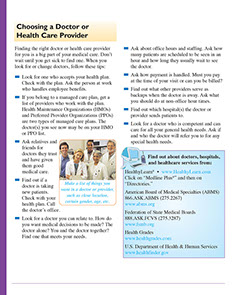
    Finding the right doctor or health care provider for you is a big part of your medical care. Don’t wait until you get sick to find one. When you look for or change doctors, follow these tips:

    *  Look for one who accepts your health plan. Check with the plan. Ask the person at work who handles employee benefits.

    *  If you belong to a managed care plan, get a list of providers who work with the plan. Health Maintenance Organizations (HMOs) and Preferred Provider Organizations (PPOs) are two types of managed care plans. The doctor(s) you see now may be on your HMO or PPO list.

    *  Ask relatives and friends for doctors they trust and have given them good medical care.

    *  Find out if a doctor is taking new patients. Check with your health plan. Call the doctor’s office.

    *  Look for a doctor you can relate to. How do you want medical decisions to be made? The doctor alone? You and the doctor together? Find one that meets your needs.

    *  Ask about office hours and staffing. Ask how many patients are scheduled to be seen in an hour and how long they usually wait to see the doctor.

    *  Ask how payment is handled. Must you pay at the time of your visit or can you be billed?

    *  Find out what other providers serve as backups when the doctor is away. Ask what you should do at non-office hour times.

    *  Find out which hospital(s) the doctor or provider sends patients to.

    *  Look for a doctor who is competent and can care for all your general health needs. Ask if and who the doctor will refer you to for any special health needs.

    Resources

    American Board of Medical Specialties (ABMS)

    866.ASK.ABMS (275.2267)

    www.abms.org

    Federation of State Medical Boards

    888.ASK.FCVS (275.3287)

    www.fsmb.org

    Health Grades

    www.healthgrades.com

    U.S. Department of Health & Human Services

    www.healthfinder.gov

    Page from the Healthier at Home book by the American Institute for Preventive Medicine. www.HealthyLife.com. All rights reserved.

    © American Institute for Preventive Medicine
  • Choose Benefit Options With Both Cost And Care In Mind

    Medical Care

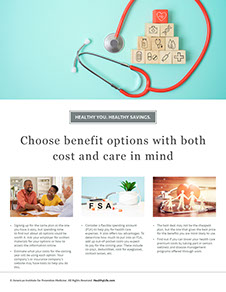
    Wooden blocks with medical icons.

    *  Signing up for the same plan as the one you have is easy, but spending time to find out about all options could be worth it. Ask your employer for written materials for your options or how to access the information online.

    *  Estimate what your costs for the coming year will be using each option. Your company’s or insurance company’s website may have tools to help you do this.

    *  Consider a flexible spending account (FSA) to help pay for health care expenses. It also offers tax advantages. To determine how much to put into an FSA, add up out-of-pocket costs you expect to pay for the coming year. These include co-pays, deductibles, cost for eyeglasses, contact lenses, etc.

    *  The best deal may not be the cheapest plan, but the one that gives the best price for the benefits you are most likely to use.

    *  Find out if you can lower your health care premium costs by taking part in certain wellness and disease management programs offered through work.

    A Year of Health Hints book by the American Institute for Preventive Medicine. www.HealthyLife.com. All rights reserved.

    © American Institute for Preventive Medicine

  • Children’s Medical Records

    Medical History

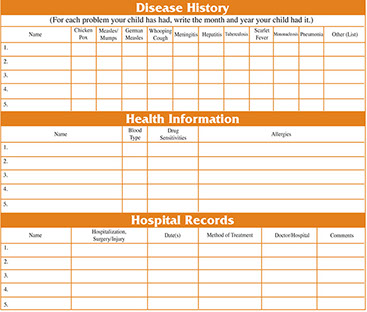
    Children's medical record chart.
    Children's Self-Care Book. Published by the American Institute for Preventive Medicine.

    © American Institute for Preventive Medicine

  • Children Of Parents With Aud

    Child Safety

    Close up of adult holding a bottle of alcohol.

    Children of persons with alcohol use disorder (AUD) are more likely than others to become addicted to alcohol or other drugs.

    It is common for children of parents with AUD to blame themselves for their parent’s drinking problem. In truth, children do not cause the problem, can’t control it, and can’t cure it.

    To help cope with being the child of a parent with AUD, contact Al-Anon /Alateen at al-anon.alateen.org.

    A person with AUD needs professional help. To learn more about alcohol treatment options visitalcoholtreatment.niaaa.nih.gov.

    A Year of Health Hints book by the American Institute for Preventive Medicine. www.HealthyLife.com. All rights reserved.

    © American Institute for Preventive Medicine