Blog

  • Alternative Medicine Systems

    Alternative Medicine

    Image of leaf with tag that has the word "Ayurveda"

    These are complete systems of theory and practice. Often, these systems have been used in other countries for centuries. They can be very different from mainstream medicine that is used in the U.S.

    1.  Ayurveda (“ah-yur-VAY-dah”). This system of diagnosis and treatment has been used in India for more than 5,000 years. It includes yoga, meditation, herbs, massage, specific diets, and controlled breathing.

    2.  Homeopathy This method is based on the idea that “like cures like.” Things that cause certain symptoms in a healthy person can also cure those symptoms in someone who is sick. They must be given in small, highly diluted amounts.

    3.  Naturopathy. This uses methods to allow the body to heal itself rather than treat disease. It uses diet, herbal medicine, acupuncture, homeopathy, body manipulation, etc.

    4.  Reiki  (“RAY-kee”). This Japanese word stands for Universal Life Energy. With Reiki, spiritual energy is channeled through a Reiki practitioner to heal a patient’s spirit. Healing the spirit heals the physical body.

    Page from the Healthier at Home book by the American Institute for Preventive Medicine. www.HealthyLife.com. All rights reserved.

    © American Institute for Preventive Medicine

  • Aim High For Your Career Well-Being

    Work Life

    Man reaching out his hand.

    *  “Career” includes your line of work and how you spend non-work hours.

    *  Choose career goals that suit your personality, skills, talents, and interests.

    *  Take education and training steps needed to achieve your goals. Gain experience as a volunteer.

    *  Find your passion in life. Do something you enjoy every day, week, or month.

    Dos

    *  Do the work you love and work at loving what you do.

    *  Be with people who understand the challenges you face to reach your goals.

    Don’ts

    *  Don’t get stuck in the same routines that prevent you from pursuing your goals.

    *  Don’t spend time with friends and coworkers who criticize your values and interests.

    ays to Well-Being book by the American Institute for Preventive Medicine. www.HealthyLife.com. All rights reserved.

    © American Institute for Preventive Medicine

  • After-Dark Joggers, Heed This Advice

    Personal Safety

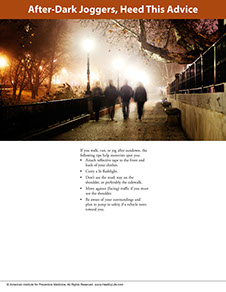
    Image of people walking/jogging in the dark.

    If you walk, run, or jog after sundown, the following tips help motorists spot you.

    *  Attach reflective tape to the front and back of your clothes.

    *  Carry a lit flashlight.

    *  Don’t use the road; stay on the shoulder, or preferably the sidewalk. Move against (facing) traffic if you must use the shoulder.

    *  Be aware of your surroundings and plan to jump to safety if a vehicle veers toward you.

    A Year of Health Hints book by the American Institute for Preventive Medicine. www.HealthyLife.com. All rights reserved.

    © American Institute for Preventive Medicine

  • Advance Directives

    Medical Care

    Hospitals and nursing homes are required to give you information about your rights as a patient under their care. Advance directives are a legal way for you to declare your wishes to choose or refuse medical treatment.

    {Note: If you live in or get medical care in more than one state, have advance directives for all states involved.}

    Two Types of Advance Directives

    *  Living Will. This written document states what medical treatment you would want or not want if you were unable to state it yourself. A living will applies when you can’t express your wishes on your own and you have a terminal illness or condition from which you aren’t expected to survive. In writing, you may choose or refuse:

    – Measures to Support Life, such as a respirator (a machine to breathe for you).

    – Measures to Sustain Life, such as tube feedings and kidney dialysis (a machine that does the work of your kidneys).

    – Measures to Enhance Life. These keep you comfortable, but don’t prolong life. Examples are pain medications and hospice care.

    *  Durable Power of Attorney for Health Care. This written document names a person who would make treatment decisions for you if you are not able to make them yourself. This person would state your wishes. Your condition does not have to be terminal or irreversible to have someone speak on your behalf.

    Each state has its own laws on advance directives. Get forms for them from your lawyer, local hospital or library, or from your state’s Web site. Other places for forms and information:

    *  Caring Connection:www.caringinfo.org– Click on “Planning Ahead” and “State-Specific Advance Directives.”

    *  U.S. Living Will Registry:www.uslivingwillregistry.com

    After you complete advance directives, discuss them with your family and close friend(s). Give your doctor a copy, too.

    Page from the Healthier at Home book by the American Institute for Preventive Medicine. www.HealthyLife.com. All rights reserved.

    © American Institute for Preventive Medicine

  • Accident-Free Boating

    Personal Safety

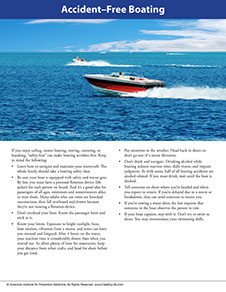
    Image of boat on the water.

    If you enjoy sailing, motor boating, rowing, canoeing, or kayaking, “safety first” can make boating accident-free. Keep in mind the following:

    *  Learn how to navigate and maintain your watercraft. The whole family should take a boating safety class.

    *  Be sure your boat is equipped with safety and rescue gear. By law, you must have a personal flotation device (life jacket) for each person on board. And it’s a good idea for passengers of all ages, swimmers and nonswimmers alike, to wear them. Many adults who can swim are knocked unconscious, then fall overboard and drown because they’re not wearing a flotation device.

    *  Don’t overload your boat. Know the passenger limit and stick to it.

    *  Know your limits. Exposure to bright sunlight, heat, boat motion, vibration from a motor, and noise can leave you stressed and fatigued. After 4 hours on the water, your reaction time is considerably slower than when you started out. So allow plenty of time for maneuvers, keep your distance from other crafts, and head for shore before you get tired.

    *  Pay attention to the weather. Head back to shore-or don’t go out-if a storm threatens.

    *  Don’t drink and navigate. Drinking alcohol while boating reduces reaction time, dulls vision, and impairs judgment. As with autos, half of all boating accidents are alcohol-related. If you must drink, wait until the boat is docked.

    *  Tell someone on shore where you’re headed and when you expect to return. If you’re delayed due to a storm or breakdown, they can send someone to rescue you.

    *  If you’re towing a water-skier, the law requires that someone in the boat observes the person in tow.

    *  If your boat capsizes, stay with it. Don’t try to swim to shore. You may overestimate your swimming skills.

    A Year of Health Hints book by the American Institute for Preventive Medicine. www.HealthyLife.com. All rights reserved.

    © American Institute for Preventive Medicine

  • A To Z Guide To Help Kids Be Healthy & Safe

    Child Safety

    A is for Always use car safety.

    *  When riding in a car, always use seat belts. Use an approved child-safety seat that is right for your child’s age and weight. Install and use it as directed.

    *  Children should ride in the back seat until they are older than age 12 years.

    B is for Back to sleep.

    To lower the risk for sudden infant death syndrome (SIDS):

    *  Place a baby (up to 12 months old) on his or her back to sleep. The mattress should be firm and fit tightly in the crib.

    *  Make sure the baby’s face is not covered during sleep. Do not have pillows, quilts, stuffed toys and other soft products in the crib.

    C is for Cross the street safely.

    *  Teach your child to cross at street corners and obey safety signs.

    *  Look left, then right, then left again before crossing the street. Look straight and left and right while crossing the street.

    D is for Dental health.

    Don’t lay a baby down with a bottle left in the mouth.

    Start brushing your child’s teeth when his or her first tooth appears. Brush the teeth 2 or more times a day. At age 3 or 4, teach your child how to brush. A child younger than 7 years old may need your help to do a thorough job.

    Take your child for dental checkups every 6 months. Follow the dentist’s advice for flossing and how to get enough fluoride.

    Limit sticky, chewy, and sweet food and drinks.

    E is for Exercise.

    *  Make exercise a family activity. Walk. Bike. Dance. Swim. Play basketball and other sports. Include children in household activities like cleaning, dog-walking, and lawn work.

    *  Experts suggest at least 60 minutes of moderate physical activity a day for most children.

    *  Limit TV and computer time.

    F is for Feed your child healthy foods.

    G is for Give positive feedback.

    *  Praise good behaviors.

    *  Hug, read, and play together.

    H is for Hand washing.

    Teach your child to wash his or her hands often. Show them how to do it the right way. Use soap and running water. Take at least 20 seconds to wash the hands. This is the amount of time it takes to sing “Happy Birthday” two times. Dry the hands with clean paper towels that can be thrown away.

    Hand washing is important before your child eats and after he or she goes to the bathroom, plays, handles pets, and sneezes or coughs.

    I is for Install.

    *  Install smoke alarms. Install carbon monoxide detectors, too.

    *  Follow the rules of the city you live in.

    *  Check to see that they work well. Do this every month.

    *  Ask your local fire department for help, if you need it.

    J is for Join.

    Join your child in being physically active and in eating healthy foods. Join group activities as a family.

    K is for Keep harmful things out of children’s reach. These include:

    *  Medicines and vitamins. Store these in “child- safe” bottles.

    *  Bleach and other household products. Read labels to find out which ones can harm a child and for first aid information.

    *  Matches, lighters, guns and bullets.

    *  All knives and sharp utensils.

    L is for Listen and Learn.

    Listen to your child.

    Learn about your child’s interests. Learn who their friends are, too.

    Learn child first aid and CPR.

    M is for Medicine safety.

    *  When you give medicine to your child, make sure it is the right kind and dose for your child’s weight.

    *  Give medicine as advised by your child’s doctor.

    *  Do not give aspirin to anyone under 19 years of age due to its link to Reye’s Syndrome.

    N is for Never leave a baby, toddler, or young child unattended.

    *  Never leave a baby alone on a bed or table.

    *  It takes only seconds for a toddler or curious children to get into something they should not be into.

    *  Never leave a child alone in a bathtub or baby bath.

    *  Never leave a child alone in a car and around cars.

    O is for Obey traffic laws and other rules.

    *  Laws and rules are made to keep people safe. Teach your child to obey them.

    *  Set rules that your child needs to follow.

    P is for Poison Control Center hotline.

    This number is 800.222.1222. Keep it by each phone. Program it in your cell phone.

    Q is for Quit Smoking!

    *  Smoking and secondhand smoke are very harmful to you and your child.

    *  Don’t smoke. Don’t let your child smoke.

    *  Do not allow smoking in your home.

    *  If needed, get help to quit smoking. Get help from your doctor or from 800.QUIT.NOW (784.8669) andwww.smokefree.gov.

    R is for Role model.

    *  Children copy what they see.

    *  Eat healthy foods. Do regular exercise.

    S is for Safety-proof the house.

    *  Set the thermostat on your water heater to 120ºF or less.

    *  Put safety plugs in outlets.

    *  Teach your child to stay away from the stove.

    *  Keep guard rails around space heaters. Gate off unsafe areas.

    *  Do not let young children get toys or other things with small parts. They could choke on them.

    *  Never leave a child alone near water. Wear life jackets when boating or near a lake. Empty buckets with water, etc. right away after use.

    *  Get more safety tips from Safe Kids Worldwide atwww.usasafekids.org.

    T is for Talk to your child.

    Talk about ways to be healthy and safe. Tell your child what you expect of him or her. Tell your child often that you love him or her.

    U is for Use products that are safety approved for kids.

    *  These include: Car seats, cribs, playpens, toys, and sleepwear.

    *  Find out if a product is safe or has been recalled from The U.S. Consumer Product Safety Commission atwww.cpsc.gov.

    V is for Vaccines.

    W is for Wear protective gear.

    *  Wear a helmet when riding a bike, rollerblading, skating, etc.

    *  Wear the right gear when practicing and playing team sports.

    *  Wear clothes or material that reflects the light when outdoors in the dark.

    X is for eXams from a health care provider.

    Children age 3 years and older should get a yearly checkup. Children under age 3 years need checkups when they are 1, 2, 4, 6, 9, 12, 15, 18, and 24 months old.

    Y is for Yearly flu vaccine.

    A yearly flu vaccine is the single best way to prevent getting the flu. All children ages 6 to 59 months should get a flu vaccine. So should others as advised by their doctors.

    Z is for ZZZZs (sleep).

    Get enough sleep each night:

    *  Adults need at least 7 to 9 hours.

    *  Teens need at least 8-1⁄2 to 9-1⁄2 hours.

    *  After 6 months of age, most children need 9 to 12 hours. Up to age 5 years, children may also take daytime naps for a total of 1⁄2 to 2 hours a day.

    Children's Self-Care book by the American Institute for Preventive Medicine. www.HealthyLife.com. All rights reserved.

    © American Institute for Preventive Medicine

  • A Therapists’ Who’s Who

    Mental Health Care

    Alcohol/Drug Abuse Counselor

    Often has a degree in either social work, psychology, or psychiatry and works in a variety of settings, including drug treatment centers and family service agencies.

    Employee Assistance Professional

    Mental health professionals provided by employers to offer confidential services to employees and, often, to their families. These counselors can be occupational physicians, nurses, psychologists, professional counselors, social workers, and/or trained union members. They provide assessment, brief counseling, and when appropriate, referral to community resources. Some are Certified Employee Assistance Professionals (CEAP).

    Marriage Counselor or Family Therapist

    Has a degree in social work, psychology, or psychiatry with post-graduate study and training in marital and/or family problems.

    Pastoral Counselor

    A minister, priest, or rabbi who has a Bachelor’s or Master’s Degree in Divinity (religion) and additional training in psychology or counseling. They can identify mental health problems and make appropriate referrals. Certified Pastoral Counselors have an advanced degree (masters or doctorate) in mental health and may provide counseling.

    Professional Counselor

    Has earned masters or doctoral degree in counseling.

    Psychiatric Nurse or Clinical Nurse Specialist

    Holds a degree in nursing, either as a Registered Nurse (R.N.), a Bachelor’s in Nursing (B.S.N.), or a Master’s in Nursing (M.S.N.). In addition, they have specialized training in the care and treatment of psychiatric patients.

    Psychiatrist

    A medical doctor (M.D.) or doctor of osteopathy (D.O.) who has had a three or four year residency in a psychiatric facility and is board certified in psychiatry. A psychiatrist is the only mental health professional who can prescribe medication and/or medical treatments.

    Psychoanalyst

    A psychiatrist, clinical psychologist, or social worker who has had specialized training in psychoanalysis and has gone through psychoanalysis.

    Psychologist

    Received either a doctorate degree in psychology, education, or counseling (i.e., Ph.D., Psy.D., Ed.D). This professional must also complete at least a one-year internship in a psychiatric hospital or mental health center and have specific training to do psychotherapy.

    Social Worker

    Has earned a Bachelor’s Degree (B.S.), Master’s Degree (M.S.W.) or Doctoral Degree (D.S.W.) in social work. Graduate training involves coursework dealing with individual, group and family assessment and psychotherapy.

    Minding Your Mental Health Book. Published by the American Institute for Preventive Medicine. www.HealthyLife.com. All rights reserved.

    © American Institute for Preventive Medicine

  • A New Start To A Healthy Life!

    Mental Health Care

    Women in kitchen with healthy foods.

    *  Look at healthy eating and other health improvements as health “evolutions.”

    *  When you are ready, make health changes one at a time.

    *  Start slowly with one positive step, such as eating breakfast at least 2 days a week.

    *  Once this becomes a habit, take another healthy step.

    *  Changes that become healthy habits are likely to last.

    Minding Your Mental Health Book. Published by the American Institute for Preventive Medicine. www.HealthyLife.com. All rights reserved.

    © American Institute for Preventive Medicine