Blog

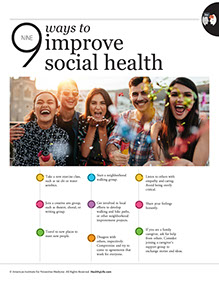
  • 9 Ways To Improve Social Health

    Social Health

    Group of friends popping confetti.

    1.  Take a new exercise class, such as tai chi or water aerobics.

    2.  Join a creative arts group, such as theater, choral, or writing group.

    3.  Travel to new places to meet new people.

    4.  Start a neighborhood walking group.

    5.  Get involved in local efforts to develop walking and bike paths, or other neighborhood improvement projects.

    6.  Disagree with others, respectively. Compromise and try to come to agreements that work for everyone.

    7.  Listen to others with empathy and caring. Avoid being overly critical.

    8.  Share your feelings honestly.

    9.  If you are a family caregiver, ask for help from others. Consider joining a caregiver’s support group to exchange stories and ideas.

    ays to Well-Being book by the American Institute for Preventive Medicine. www.HealthyLife.com. All rights reserved.

    © American Institute for Preventive Medicine

  • Six Things You Should Never Do In Your Car

    Personal Safety

    Image of man driving.

    Driving takes total concentration. If you try to text message, talk on a cell phone, and do other things while driving, you risk having an accident.

    *  Adjust your child’s safety belt before, not after, you start driving.

    *  Don’t peer into the rearview mirror to comb your hair or touch up your makeup.

    *  Don’t drive with one hand holding the wheel and the other holding a hamburger. If you’re hungry, stop and eat.

    *  If a bee or flying insect distracts you or your passengers, pull off the road and get rid of it. Don’t swat at the bug while maneuvering through traffic.

    *  Don’t try to drive and read a road map at the same time. If you’re lost or need to get your bearings, pull off the road and look at a map, or have a passenger help you follow directions. Use a global positioning system (GPS), if you have one.

    *  If your children start to misbehave, don’t turn around to discipline them. Pull off the road and settle the problem, and teach your children how dangerous it is to misbehave in a car.

    Note: You should always wear a safety belt, use approved child safety seats, and heed the warning for air bags given by your car manufacturer. Doing so can make the difference between surviving a car crash intact or not surviving at all, between walking away with just a scratch or never walking again.

    A Year of Health Hints book by the American Institute for Preventive Medicine. www.HealthyLife.com. All rights reserved.

    © American Institute for Preventive Medicine
  • 5 Wellness Factors

    Personal Safety

    Slices of lime and kiwi, with bottles of oil and herbs.

    Wellness is more than not being sick. It includes:

    1.  Your physical health

    2.  Your mental and emotional health

    3.  Your social and community health

    4.  Your financial health

    5.  Your spiritual health

    Wellness goals include:

    *  Feeling healthy and having the energy to do your daily activities

    *  Having a purpose and being satisfied with your life

    *  Giving and receiving support from others with a sense that you belong

    *  Being able to manage your economic resources to support your health and well-being

    Take Action: Think Positive

    Studies have shown that optimism can significantly lower the risk of coronary heart disease.

    1.  Focus on solving problems, not being overwhelmed by them.

    2.  Train your thoughts to look at the glass as half full, not half empty.

    3.  Practice gratitude by writing down three good things you are grateful for that happen each day.

    A Year of Health Hints book by the American Institute for Preventive Medicine. www.HealthyLife.com. All rights reserved.

    © American Institute for Preventive Medicine

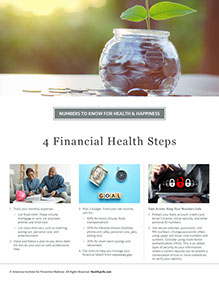
  • 4 Financial Health Steps

    Financial Health

    Couple going over finances.

    1.  Track your monthly expenses.

    –  List fixed costs. These include mortgage or rent, car payment, phones and child care.

    –  List costs that vary, such as clothing, eating out, personal care, and entertainment.

    2.  Make and follow a plan to pay down debt. Do this on your own or with professional help.

    3.  Plan a budget. From your net income, aim for:

    –  50% for basics (house, food, transportation)

    –  30% for lifestyle choices (hobbies, phone and cable, personal care, pets, eating out)

    –  20% for short-term savings and retirement

    4.  Get tools to help you manage your financial health frommymoney.gov.

    Take Action: Keep Your Numbers Safe

    1.  Protect your bank account, credit card, driver’s license, social security, and other personal ID numbers.

    2.  Use secure websites, passwords, and PIN numbers. Change passwords often, using upper and lower case numbers and symbols. Consider using multi-factor authentication (MFA). This is an added layer of security to your information where a system requires you to present a combination of two or more credentials to verify your identity.

    ays to Well-Being book by the American Institute for Preventive Medicine. www.HealthyLife.com. All rights reserved.

    © American Institute for Preventive Medicine
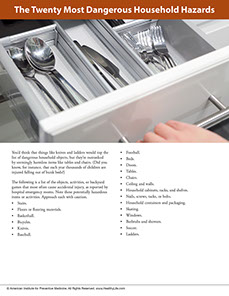
  • The 20 Most Dangerous Household Hazards

    Home Safety

    Image of open kitchen drawer with spoons, knives and forks.

    You’d think that things like knives and ladders would top the list of dangerous household objects, but they’re outranked by seemingly harmless items like tables and chairs. (Did you know, for instance, that each year thousands of children are injured falling out of bunk beds?)

    The following is a list of the objects, activities, or backyard games that most often cause accidental injury, as reported by hospital emergency rooms. Note these potentially hazardous items or activities. Approach each with caution.

    *  Stairs.

    *  Floors or flooring materials. Basketball.

    *  Bicycles.

    *  Knives.

    *  Baseball.

    *  Football.

    *  Beds.

    *  Doors.

    *  Tables.

    *  Chairs.

    *  Ceiling and walls.

    *  Household cabinets, racks, and shelves. Nails, screws, tacks, or bolts. Household containers and packaging. Skating.

    *  Windows.

    *  Bathtubs and showers.

    *  Soccer.

    *  Ladders.

    A Year of Health Hints book by the American Institute for Preventive Medicine. www.HealthyLife.com. All rights reserved.

    © American Institute for Preventive Medicine

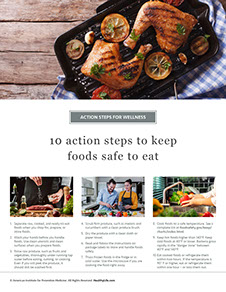
  • 10 Action Steps To Keep Foods Safe To Eat

    Home Safety

    Cooked meat, chicken, on grill pan.

    1.  Separate raw, cooked, and ready-to-eat foods when you shop for, prepare, or store foods.

    2.  Wash your hands before you handle foods, Use clean utensils and clean surfaces when you prepare foods.

    3.  Rinse raw produce, such as fruits and vegetables, thoroughly under running tap water before eating, cutting, or cooking. Even if you will peel the produce, it should still be washed first.

    4.  Scrub firm produce, such as melons and cucumbers with a clean produce brush.

    5.  Dry the produce with a clean cloth or paper towel.

    6.  Read and follow the instructions on package labels to store and handle foods safely.

    7.  Thaw frozen foods in the fridge or in cold water. Use the microwave if you are cooking the food right away.

    8.  Cook foods to a safe temperature. See a complete list atfoodsafety.gov/keep/charts/index.html.

    9.  Keep hot foods higher than 140ºF. Keep cold foods at 40ºF or lower. Bacteria grow rapidly in the “danger zone” between 40ºF and 140ºF.

    10. Eat cooked foods or refrigerate them within two hours. If the temperature is 90ºF or higher, eat or refrigerate them within one hour – or toss them out.

    A Year of Health Hints book by the American Institute for Preventive Medicine. www.HealthyLife.com. All rights reserved.

    © American Institute for Preventive Medicine
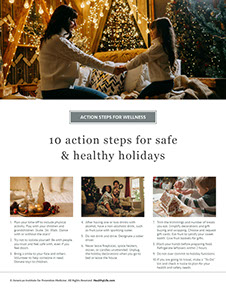
  • 10 Action Steps For Safe & Healthy Holidays

    Personal Safety

    Mother and daughter holding hands with lights hund all around.

    1.  Plan your time off to include physical activity. Play with your children and grandchildren. Skate. Ski. Walk. Dance with or without the stars!

    2.  Try not to isolate yourself. Be with people you trust and feel safe with, even if you feel down.

    3.  Bring a smile to your face and others. Volunteer to help someone in need. Donate toys to children.

    4.  After having one or two drinks with alcohol, have a non-alcoholic drink, such as fruit juice with sparkling water.

    5.  Do not drink and drive. Designate a sober driver.

    6.  Never leave fireplaces, space heaters, stoves, or candles unattended. Unplug the holiday decorations when you go to bed or leave the house.

    7.  Trim the trimmings and number of treats you eat. Simplify decorations and gift buying and wrapping. Choose and request gift cards. Eat fruit to satisfy your sweet tooth. Give fruit baskets for gifts.

    8.  Wash your hands before preparing food. Refrigerate leftovers within 2 hours.

    9.  Do not over commit to holiday functions.

    10. If you are going to travel, make a “To-Do” list and check it twice to plan for your health and safety needs.

    A Year of Health Hints book by the American Institute for Preventive Medicine. www.HealthyLife.com. All rights reserved.

    © American Institute for Preventive Medicine

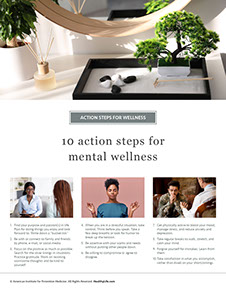
  • 10 Action Steps For Mental Wellness

    Mental Health Care

    Table top zen sand garden.

    1.  Find your purpose and passion(s) in life. Plan for doing things you enjoy and look forward to. Write down a “bucket list.”

    2.  Be with or connect to family and friends by phone, e-mail, or social media.

    3.  Focus on the positive as much as possible. Search for the silver linings in situations. Practice gratitude. Work on resisting worrisome thoughts and be kind to yourself.

    4.  When you are in a stressful situation, take control. Think before you speak. Take a few deep breaths or look for humor to break up the tension.

    5.  Be assertive with your wants and needs without putting other people down.

    6.  Be willing to compromise or agree to disagree.

    7.  Get physically active to boost your mood, manage stress, and reduce anxiety and depression.

    8.  Take regular breaks to walk, stretch, and calm your mind.

    9.  Forgive yourself for mistakes. Learn from them.

    10. Take satisfaction in what you accomplish, rather than dwell on your shortcomings.

    Minding Your Mental Health Book. Published by the American Institute for Preventive Medicine. www.HealthyLife.com. All rights reserved.

    © American Institute for Preventive Medicine