Blog

  • What Is A Serving Size?

    Nutrition

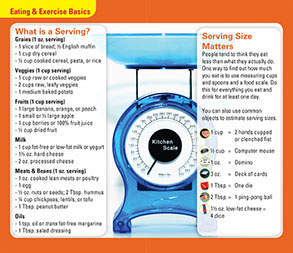
    Image of small plate with food in palm of hand.

    Grains (1 oz. serving)

    *  1 slice of bread; ½ English muffin

    *  1 cup dry cereal

    *  ½ cup cooked cereal, pasta, or rice

    Veggies (1 cup serving)

    *  1 cup raw or cooked veggies

    *  2 cups raw, leafy veggies

    *  1 medium baked potato

    Fruits (1 cup serving)

    *  1 large banana, orange, or peach

    *  1 small or ½ large apple

    *  1 cup berries or 100% fruit juice

    *  ½ cup dried fruit

    Milk

    *  1 cup fat-free or low-fat milk or yogurt

    *  1½ oz. hard cheese

    *  2 oz. processed cheese

    Meats & Beans (1 oz. serving)

    *  1 oz. cooked lean meats or poultry

    *  1 egg

    *  ½ oz. nuts or seeds; 2 Tbsp. hummus

    *  ¼ cup chickpeas, lentils, or tofu

    *  1 Tbsp. peanut butter

    Oils

    *  1 tsp. oil or trans fat-free margarine

    *  1 Tbsp. salad dressing

    Serving Size Matters

    People tend to think they eat less than what they actually do. One way to find out how much you eat is to use measuring cups and spoons and a food scale. Do this for everything you eat and drink for at least one day. You can also use common objects to estimate serving sizes.

    1 cup = 2 hands cupped or clenched fist

    ½ cup = Computer mouse

    1 oz. = Domino

    3 oz. =  Deck of cards

    1 Tbsp. = One die

    2 Tbsp. = 1 ping-pong ball

    1½ oz. low-fat cheese =  4 dice

    Page from Eating and Exercise Tracker book by the American Institute for Preventive Medicine. www.HealthyLife.com. All rights reserved.

    © American Institute for Preventive Medicine

  • Weight Loss Tips

    Weight Control

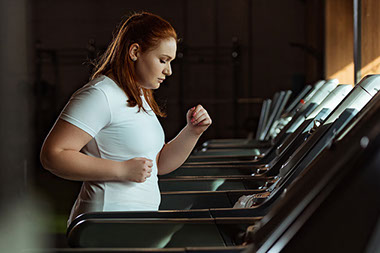
    Women using a treadmill.

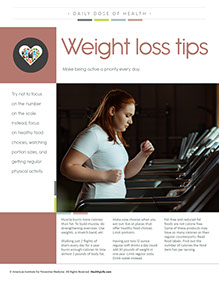
    Make being active a priority every day.

    Try not to focus on the number on the scale. Instead, focus on healthy food choices, watching portion sizes, and getting regular physical activity.

    Muscle burns more calories than fat. To build muscle, do strengthening exercises. Use weights, a stretch band, etc.

    Walking just 2 flights of stairs every day for a year burns enough calories to lose almost 2 pounds of body fat.

    Make wise choices when you eat out. Eat at places that offer healthy food choices. Limit portions.

    Having just two 12 ounce regular soft drinks a day could add 30 pounds of weight in one year. Limit regular soda. Drink water instead.

    Fat-free and reduced fat foods are not calorie free. Some of these products may have as many calories as their regular counterparts. Read food labels. Find out the number of calories the food item has per serving.

    Page from HealthyLife Weigh book by the American Institute for Preventive Medicine. www.HealthyLife.com. All rights reserved.

    © American Institute for Preventive Medicine

  • Weight Loss & Gain

    Weight Control

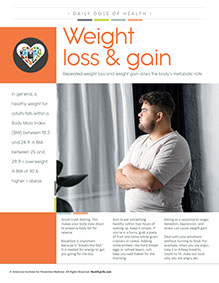
    Man staring out of the window.

    Repeated weight loss and weight gain slows the body’s metabolic rate.

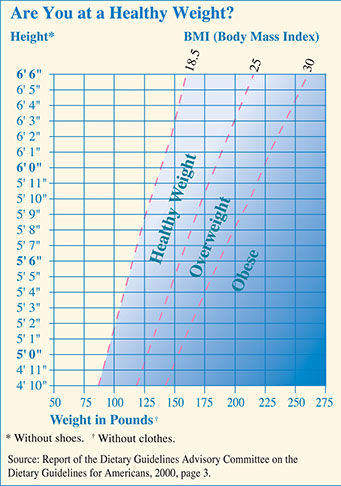
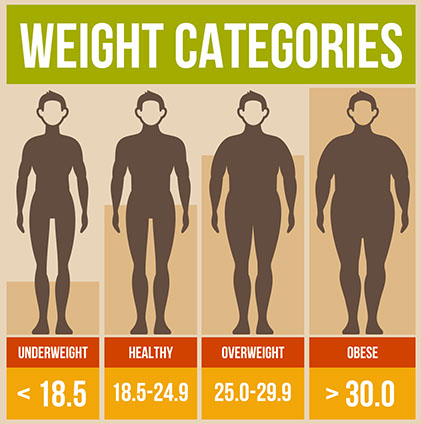
    In general, a healthy weight for adults falls within a Body Mass Index (BMI) between 18.5 and 24.9. A BMI between 25 and 29.9 = overweight. A BMI of 30 & higher = obese.

    Avoid crash dieting. This makes your body slow down to preserve body fat for reserve.

    Breakfast is important because it “breaks the fast.” It is needed for energy to get you going for the day.

    Aim to eat something healthy within two hours of waking up. Keep it simple. If you’re in a hurry, grab a piece of fruit and some whole grain crackers or cereal. Adding some protein, like hard boiled eggs or refried beans, will keep you well fueled for the morning.

    Eating as a response to anger, boredom, depression, and stress can cause weight gain.

    Deal with your emotions without turning to food. For example, when you are angry, take 3 or 4 deep breaths, count to 10, state out loud why you are angry, etc.

    Page from HealthyLife Weigh book by the American Institute for Preventive Medicine. www.HealthyLife.com. All rights reserved.

    © American Institute for Preventive Medicine

  • Weight Control Basics

    Weight Control

    Healthy Body Weight

    Find your weight on the bottom of the graph. Go straight up from that point until you come to the line that matches your height. Then find your Body Mass Index (BMI).

    You can also find out about your BMI from:www.nhlbisupport.com/bmi.

    A BMI above the normal weight range is less healthy for most people. It may be fine if you have lots of muscle and little fat. In general, though, if your BMI is above the normal weight range, consult your doctor or health care provider.

    Illustration of BMI weight categories.

    Whether your weight is “healthy” also depends on:

    *  Your age and family health history

    *  Your fitness level

    *  Your waist measurement (waist circumference). To find this, place a measuring tape snugly around your waist near your navel. Stand relaxed. Do not pull in your stomach.

    Waist Circumference & Health Risks

    Waist measurement helps screen for possible health risks that come with overweight and obesity. If most of your fat is around your waist instead of your hips, you’re at a higher risk for heart disease and type 2 diabetes. This risk goes up with a waist size:

    *  Greater than 35 inches  for women

    *  Greater than 40 inches  for men

    Your “healthy weight” can also depend on other risk factors you have. These include:

    *  Cigarette smoking

    *  High blood glucose (sugar)

    *  High blood pressure

    *  High triglycerides. These are a kind of fat.

    *  Not being active enough

    *  Unhealthy cholesterol levels in the blood

    Health Risks with Excess Weight

    Being overweight is linked with:

    *  Arthritis of the hips and knees

    *  High blood pressure

    *  Stroke

    *  Type 2 diabetes

    *  Heart disease

    *  Gallstones

    *  Cancers of the ovaries, breast, cervix, and uterus in women. Cancer of the prostate gland in men. Cancers of the colon and rectum in women and men.

    Some persons are more prone to get some of these diseases. Losing weight can help control or prevent them. A weight loss of just 7 to 10 percent will help lower your risk of these diseases.

    Causes of Weight Gain

    *  Eating more calories than your body uses

    *  Eating the same number of calories as you age and/or exercising less

    *  Certain genes a person inherits that make it easier to store excess energy as fat. Also, some people are less able to release stored energy from fat. People with this problem cannot get stored energy from their fat cells. This causes them to eat more.

    *  Some medicines. These include:

    –  Antidepressants, such as lithium

    –  Blood pressure medicines, such as Inderal®

    –  Corticosteroids, such as prednisone

    –  Hormones in some birth control pills and in hormone therapy (HT).

    *  Stopping smoking. Some persons gain weight when they stop smoking due to:

    –  A metabolic rate that returns to normal. Nicotine in cigarettes raises the metabolic rate.

    –  Eating more to take the place of smoking

    *  Some illnesses. These include:

    –  Diabetes

    –  Heart or kidney problems that cause fluid to build up in body tissues

    –  Low thyroid gland output

    Controlling Your Weight

    Be Physically Active

    Lose weight by eating fewer calories and increasing physical activity. Spend less time sitting and more time being active. Exercise to help build muscle and reduce body fat. Limit TV time or exercise when you watch TV.

    Get Active

    *  To prevent weight gain, do about 60 minutes of physical activity on most days of the week. Do this every day, if you can. This can be done at one time. It can also be spread out over 2 or 3 times during the day.

    *  To lose weight and to help keep lost weight off, do physical activity for 60 to 90 or more minutes a day.

    Ways to Put Activity in Your Day

    Make an activity plan. Choose activities that you enjoy and will keep doing. For overall fitness:

    *  Do aerobic exercises. Walk. Run. Swim. Bike. Cross country ski, etc.

    *  Do exercises for endurance and to strengthen muscles. Do push ups, pull ups, and use weights. To build endurance, increase the number of times you do these exercises or the amount of weight you lift.

    *  Do stretching exercises, such as leg stretches, reaching from side to side, and yoga.

    *  Do warm-up exercises before aerobics. Loosen your muscles by stretching and/or walking for  5 minutes. After the activity, cool down with 5 minutes of walking and/or stretching.

    *  Choose a good time and place to exercise each day. If you exercise before a meal, wait about 25 minutes before you eat. Wait at least 2 hours after you eat before you exercise hard.

    *  Be in tune with your body when you exercise. If your muscles or joints start to hurt, ease up.

    *  Don’t overdress. Too much sweating can be harmful.

    *  Read about fitness and exercise. Talk about good fitness habits with persons who stay fit.

    Before you begin to exercise, check with your doctor, especially if:

    1. You have been inactive for a long period of time.

    2. You are overweight or have a medical problem.

    3. You are a male over 40 years of age or a female over age 50.

    Choose Foods Wisely

    Know how many calories to eat to lose weight.

    *  To lose 1/2 to 2 pounds of body fat per week, you need to eat 250 to 1,000 less calories each day than what you now eat.

    *  In general, about 1,200 calories per day promotes a healthy weight loss for most women; about 1,600 calories per day for most men.

    *  Follow your doctor’s advice for how many calories to eat each day for weight loss.

    *  Read food labels for calorie content per serving.

    General Eating Tips to Control Your Weight

    *  Eat at regular times. Have half of your food in the first half of the day.

    *  Plan at least 3, but not more than 6 meals a day. Have the first one within 2 hours of waking.

    *  Vary your food choices to get a variety of nutrients.

    *  Eat smaller portions. Limit second helpings.

    *  Watch the FAT! Think: Without fat, less fat, little fat, low-fat. Aim daily to get 30% or less of your calories from fat. Use the chart on the next panel for the maximum grams of fat to eat per day for your calorie needs.

    *  Don’t gobble your meals. You will be more satisfied with less if you eat slowly.

    *  Get 20 to 35 grams of dietary fiber per day.

    –  Eat 5 or more fruits and vegetables.

    –  Choose whole-grain breads, cereals, and pastas; bran; and beans, lentils, and peas.

    *  Eat fewer sweets (candy, cookies, cakes, and sweetened cereals). Limit sugar.

    *  Drink less alcohol or no alcohol.

    *  Drink water instead of soda and other sweetened beverages.

    Follow These Eating Tips

    *  Appetite is a desire for food. Hunger is a true physical need for food. Eat in response to hunger, not appetite.

    *  Use smaller sized plates for meals.

    *  To avoid impulse buying, shop only from a well-planned list. Never shop when hungry.

    *  Blast out your desire for food by yelling the word “STOP.”

    *  Plan your snacks in advance.

    *  Put on tight clothes if you feel like eating too much.

    Eating Pace Tips

    *  Eat slowly. Chances are you will eat less.

    *  Chew food well and swallow before the next bite.

    *  Take sips of water between bites.

    Eating Mood Tips

    * Eat only when relaxed, not to reduce tension.

    * Instead of thinking of “not eating,” think of showing respect for your body by refusing to overeat.

    * Think about feeling bloated or stuffed before you overeat. Be aware of these negative sensations.

    Eating Out Tips

    *  Choose restaurants that have low-calorie foods. Decide what you’ll eat ahead of time.

    *  Don’t starve all day before you go out to eat.

    *  Avoid “all-you-can-eat” restaurants.

    *  Order “a la carte” or “half orders” to keep portions small. Share an order with someone else.

    *  Drink few, if any, alcoholic beverages. Alcohol stimulates the appetite and has calories.

    Eating With Others Tips

    *  Beware of “Saboteurs” who try to undermine your weight loss. They may feel threatened by your success.

    *  Tell others about your weight loss goals.

    *  Meet friends for a walk instead of sitting and talking.

    *  Don’t eat just because others are. Wait until you are hungry.

    Lose Weight Safely

    *  Aim for a slow, steady weight loss.

    *  Don’t follow diets that allow less than 1,000 calories per day.

    *  Only take over-the-counter medicines and other weight loss aids with your doctor’s okay.

    *  Don’t vomit and/or use laxatives to lose weight.

    *  Beware of quick weight loss products and programs. Watch out for these claims:

    – Weight loss with no effort or exercise

    – Weight loss while eating all you want

    – Weight loss of more than 2 pounds a week

    *  Avoid using sauna belts, body wraps, and other unproven weight-loss aids.

    *  Avoid being a yo-yo dieter.

    *  Beware of products and programs that use these terms:

    – “Miraculous breakthrough”

    – “Newly found secret”

    – “Fat buster”

    Resources

    National Weight-control Information Network (WIN)

    877.946.4627

    www.win.niddk.nih.gov

    ChooseMyPlate.gov

    www.choosemyplate.gov

    Cover image to the Weight Control brochure by the American Institute for Preventive Medicine. www.HealthyLife.com. All rights reserved.

    © American Institute for Preventive Medicine

  • Warm Up & Cool Down Properly

    Fitness

    No exercise session should begin without a warm-up-a few minutes of light activity to get your muscles primed for real exertion. Warming up increases the benefits of exercise and reduces your risk of injury.

    And the body does warm up in the true sense of the word-increased activity increases blood flow to the muscles, and the body gradually begins to shift gears from relative inactivity to higher performance.

    The Stretch

    Stretching should take 5 to 10 minutes. Always stretch slowly, gently, and gradually. (Don’t bounce!) Breathe normally-don’t hold your breath when you stretch. And don’t stretch to the point of pain or discomfort. Rather, stretch to the point where you can feel some tension, but not pain. If you feel any pain or discomfort, stop immediately.

    To stretch your arms: Hold one arm straight out from your side, level with the shoulder. Make an arc by raising your arm straight up, then lowering it to your side. Hold your arm out again. Swing it across your chest as far as is comfortable. Swing it toward your back as far as it will comfortably go. Now hold your arm straight out in front of you, bending your elbow in a right angle with the palm toward the floor. Without moving your upper arm, move your forearm straight up and then straight down. Alternate arms.

    To stretch your back: Stand with your feet spread apart. Clasp your hands high above your head. Lean your head back and look up. Stretch your shoulder muscles as if you were reaching for the sky. Hold for 5 seconds. Relax. Repeat two to four times.

    To stretch your legs: Stand erect and balance yourself with your hand against a wall or chair. Bend one knee, grasp that ankle, and draw the leg up and back. Hold. Pull your foot gently until you feel tension (not pain) in your upper front thigh. Hold for 5 seconds or longer. Repeat with your other leg.

    The Quick Warm-Up

    Spend 5 minutes performing a less intense form of your exercise of choice-like taking a brisk walk before you run. This raises your heart rate  slightly and leaves you sweating lightly.

    Follow Up with a Cool-Down

    Cooling down is the reverse of warming up, and it helps your body recover from exercise in three ways. A 5-minute cool-down:

    *  Allows the heart rate to slow down gradually.

    *  Prevents blood from pooling in the legs.

    *  Reduces the likelihood that your muscles will feel stiff after exercise because it reduces the buildup of lactic acid.

    As with the warm-up, cool down slowly. Perform the activity at a slower pace, and/or stretch.

    Page image from A Year of Health Hints book by the American Institute for Preventive Medicine. www.HealthyLife.com. All rights reserved.

    © American Institute for Preventive Medicine

  • Walk Your Way To Fitness

    Fitness

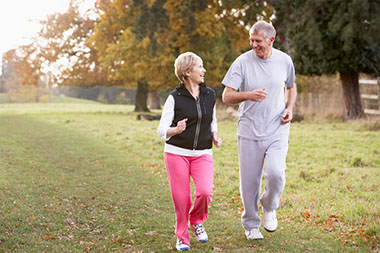
    Image of couple power walking.

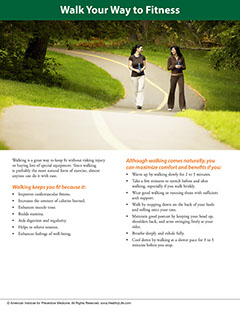
    Walking is a great way to keep fit without risking injury or buying lots of special equipment. Since walking is probably the most natural form of exercise, almost anyone can do it with ease.

    Walking keeps you fit because it:

    *  Improves cardiovascular fitness.

    *  Increases the amount of calories burned.

    *  Enhances muscle tone.

    *  Builds stamina.

    *  Aids digestion and regularity.

    *  Helps to relieve tension.

    *  Enhances feelings of well-being.

    Although walking comes naturally, you can maximize comfort and benefits if you:

    *  Warm up by walking slowly for 2 to 3 minutes.

    *  Take a few minutes to stretch before and after walking, especially if you walk briskly.

    *  Wear good walking or running shoes with sufficient arch support.

    *  Walk by stepping down on the back of your heels and rolling onto your toes.

    *  Maintain good posture by keeping your head up, shoulders back, and arms swinging freely at your sides.

    *  Breathe deeply and exhale fully.

    *  Cool down by walking at a slower pace for 3 to 5 minutes before you stop.

    Page image from A Year of Health Hints book by the American Institute for Preventive Medicine. www.HealthyLife.com. All rights reserved.

    © American Institute for Preventive Medicine

  • Walkwell™ Tracker

    Fitness

    Use this tracker to:

    *  Write down your weekly walking goals.

    *  Assist you in meeting your goals.

    *  Learn about proper walking technique.

    *  Keep a walking and weight record for 52 weeks.

    Why Walk?

    Walking is an easy form of exercise and does not cost a lot. It provides many benefits and has a very low risk of injury. Check the benefits/goals you wish to get from walking.

    *  Have more energy

    *  Feel better

    *  Look better

    *  Burn calories

    *  Lose weight

    *  Maintain a healthy weight

    *  Relieve tension and stress

    *  Build stamina

    *  Increase muscle tone

    *  Improve heart health and lung health

    *  Lower risk of heart disease, type 2 diabetes, and some cancers

    *  Help treat arthritis, heart disease, depression, diabetes, and/or high blood pressure

    *  Slow down bone loss (osteoporosis)

    *  Improve balance and lower the risk of falling

    How Do I Get Started

    Walk How Much?

    Walking is an easy way to get moderate and/or vigorous-intensity physical activity that adults are advised to get each week:

    1.  At least 2 hours and 30 minutes (150 minutes) of moderate-intensity physical activity (walking briskly for 3 miles per hour or faster, but not race-walking) OR

    2.  At least 1 hour and 15 minutes (75 minutes) of vigorous-intensity physical activity (race walking, jogging, or running) OR

    3.  A mix of 1 and 2

    Does 75-150 minutes each week sound like a lot of time? You don’t have to do it all at once. You can break up your activity into shorter times during the day. For example, take a 10-minute walk, 3 times a day, 5 days a week.

    Adults are also advised to do muscle-strengthening activities on 2 or more days a week that work all major muscle groups (legs, hips, back, abdomen, chest, shoulders, and arms).

    How Do I Get Started

    *  Consult your doctor or health care provider before you start an exercise program.

    *  Plan walking into your daily / weekly schedules.

    *  Write walking times on your calendar, daily planner, or “To Do List.”

    *  Choose the best times for you to walk.

    *  Pick times that you know you can stick to.

    *  Throughout the day, walk more. Sit less.

    *  Park your car farther away from the door of a store or business.

    *  Use extra free time to take mini-walks. The steps will add up!

    Wear What?

    *  Good walking shoes with an arch support to absorb shock and cushion your feet

    *  Clothing that fits loosely and is made of fabrics that absorb sweat and remove it from your skin

    *  Sunscreen on exposed skin to protect it from harmful ultraviolet (UV) rays

    *  A hat and sunglasses (if walking outside) to protect your head and eyes from UV rays

    *  A fanny pack to carry:

    – Identification

    – Cell phone

    – Money

    – Sugar snack (if diabetic)

    *  Pedometer – if you want to keep track of your steps

    Walk Where?

    *  Indoors from room to room

    *  Neighborhoods with sidewalks

    *  Parks and hiking trails

    *  The mall

    *  On a treadmill or an elliptical at home or a local gym

    *  Indoors and outdoors at your place of work

    *  Tracks at local schools and community centers

    *  Map out miles and/or 1,000 to 10,000 steps using these Web sites:

    *Also has a smartphone app

    Walk with Whom?

    *  Family members. Make it a family activity.

    *  A friend or neighbor

    *  A mall walking group

    *  Co-workers. Walk during lunch and/or break times.

    *  Join or start a walking club at your place of work or with your neighbors.

    Walking with a buddy or a group of walkers decreases boredom, provides distraction, and helps keep you motivated.

    Get information and support online from:

    www.startwalkingnow.org

    http://walking.about.com/c/ec/115.htm

    Walking Program

    Sample Program Using Steps

    Use a pedometer to track your steps.

    1.  Wear the pedometer every day for one week to find out how many steps you take in a day.

    2.  Record your steps.

    3.  Add the number of steps you took from Sunday to Saturday. This is the total number of steps you took for Week 1.

    4.  Divide this total number of steps by 7 for an average number of steps per day.

    5.  Each week, add more steps each day until you reach 10, 000 or more steps a day. For example, if your average number of steps per day for week 1 was 2,000; add 500 steps per day every week until you are walking 10,000 steps a day.

    Warm Up

    *  Walk slowly for 5 minutes.

    *  Stretch for 5 or more minutes.

    *  Stretch only to the point of comfort. You should feel mild tension, not pain.

    *  Never bounce.

    – To stretch your arms:  Hold one arm straight out from your side, level with shoulder. Swing your arm across your chest as far as it is comfortable. Then swing it toward your back as far as it will comfortably go. Alternate arms.

    – To stretch your back: Stand with your feet apart. Clasp your hands high above your head. Lean your head back and look up. Hold for 5 seconds. Relax. Repeat 2-4 times.

    – To stretch your legs: Stand up straight and balance yourself with your hand against a wall or chair. Bend one knee, grasp that ankle, and draw the leg up and back. Hold for 10 seconds. Repeat with your other leg.

    Walk This Way

    *  Step down on the back of your heels and roll onto your toes. Point your toes forward.

    *  Keep your chin up and your shoulders slightly back.

    *  Swing your arms at your sides. Try alternating bicep curls while you walk.

    *  Breathe in deeply. Exhale fully.

    Cool Down

    *  Walk at a slower pace for 3-5 minutes.

    *  Breathe slowly and rhythmically.

    Get Motivated!

    *  Walk with a buddy.

    *  Bring music with you. Choose music to match your mood and pace!

    *  Walk the dog! If you don’t have one, walk with your neighbor when he or she walks the dog or volunteer at a local animal shelter.

    *  Help the environment. Walking instead of taking the car helps our climate.

    *  Notice the beauty around you.

    *  Use walks to clear your head and sort out problems.

    *  Meet new people! Say “Hello” to the neighbors.

    *  Change it up. Walk in different areas or at different times of the day.

    *  Reward yourself when you reach a goal.

    Walk for a Cause

    Take part in national fundraising fitness-related walks that are held locally.

    American Heart Association’s Heart Walk

    www.heart.org/HEARTORG

    Step Out: Walk to Fight Diabetes

    http://stepout.diabetes.org

    March of Dimes

    www.marchforbabies.org

    Susan G. Koman Breast Cancer 3-Day

    http://ww5.komen.org

    Walk to Cure Diabetes

    www2.jdrf.org

    Walk Like MADD (Mothers Against Drunk Driving)

    www.madd.org

    Walk MS (Multiple Sclerosis)

    www.walkms.org

    Walking Burns Calories

    The number of calories you burn with walking depends on your weight and metabolism, how fast you walk, how long you walk, and factors in your walking environment.

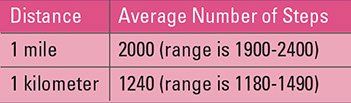
    Step Equivalents for Distances

    Physical Activities / Step Equivalents & Calories Burned per 30 Minutes (155 Pound Person)

    Cover image to the WalkWell book by the American Institute for Preventive Medicine. www.HealthyLife.com. All rights reserved.

    © American Institute for Preventive Medicine

  • Walk For Wellness

    Fitness

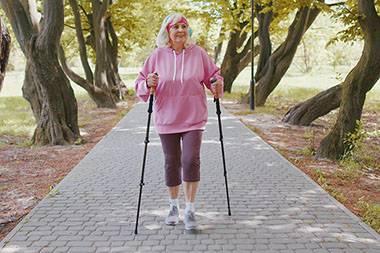
    Older women on a walk and using walking sticks.

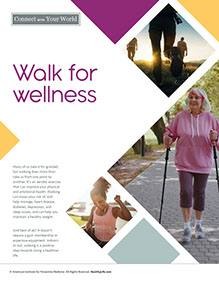
    Many of us take it for granted, but walking does more than take us from one point to another. It’s an aerobic exercise that can improve your physical and emotional health. Walking can lower your risk of, and help manage, heart disease, diabetes, depression, and sleep issues, and can help you maintain a healthy weight.

    And best of all? It doesn’t require a gym membership or expensive equipment. Indoors or out, walking is a positive step towards living a healthier life.

    Page from HealthyLife Weigh book by the American Institute for Preventive Medicine. www.HealthyLife.com. All rights reserved.

    © American Institute for Preventive Medicine