Blog

  • Time To Get Physical

    Fitness

    Get fit and stay fit.

    “Fitness: if it came in a bottle, everybody would have a great body.”

    – Cher

    Having six pack abs doesn’t come from drinking a six pack, and you don’t need to have six pack abs to be fit. Get fit by making exercise and healthy eating a regular part of your life.

    How much exercise do you need?

    Each week, adults should do:

    A.  At least two hours and 30 minutes of moderate aerobic activity, such as brisk walking…OR

    B.  One hour and 15 minutes of vigorous aerobic activity, such as jogging, aerobic dancing, and jumping rope…OR

    C.  A combination of activities from A and B

    For increased fitness or to lose weight or keep lost weight off, do:

    *  Five hours of moderate physical activity a week…OR

    *  Two hours and 30 minutes of vigorous aerobic activity a week

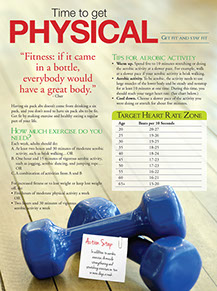
    Tips for aerobic activity

    *  Warm up. Spend five to 10 minutes stretching or doing the aerobic activity at a slower pace. For example, walk at a slower pace if your aerobic activity is brisk walking.

    *  Aerobic activity. To be aerobic, the activity needs to use large muscles of the lower body and be steady and nonstop for at least 10 minutes at one time. During this time, you should reach your target heart rate. (See chart on this page.)

    *  Cool down. Choose a slower pace of the activity you were doing or stretch for about five minutes.

    Target Heart Rate Zone

    Age

    20

    25

    30

    35

    40

    45

    50

    55

    60

    65+

    Beats per 10 Seconds

    20-27

    19-26

    19-25

    18-25

    18-24

    17-23

    17-23

    16-22

    16-21

    15-20

    Action Step

    In addition to aerobic exercise, do muscle strengthening and stretching exercises on two or more days a week.

    Page image from the Ways to Well-Being Book by the American Institute for Preventive Medicine. www.HealthyLife.com. All rights reserved.

    © American Institute for Preventive Medicine

  • Time Management

    Systematic Stress Management Program

    Step 6: Time Management

    Step 6: Time Management Section

    Introduction

    Does Time Get the Best of You?

    Defining Your Life Goals

    Activity Worksheet

    Activity Log

    Time Management Techniques

    Action Plan for Improving Time Usage

    Procrastination Quiz

    How Do I Procrastinate?

    One Dozen Ways to Overcome Procrastination

    Should You Delegate?

    Delegation Caddy

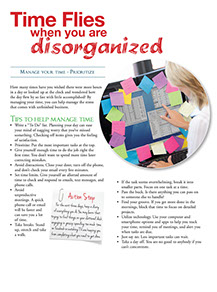
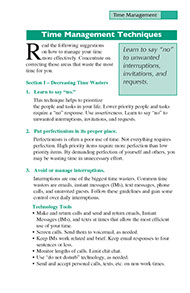
    Read the following suggestions on how to manage your time more effectively. Concentrate on correcting those areas that waste the most time for you.

    Decreasing Time Wasters

    1. Learn to say “no.”

    This technique helps to prioritize the people and tasks in your life. Lower priority people and tasks require a “no” response. Use assertiveness. Learn to say “no” to unwanted interruptions, invitations, and requests.

    2. Put perfectionism in its proper place.

    Perfectionism is often a poor use of time. Not everything requires perfection. High priority items require more perfection than low priority items. By demanding perfection of yourself and others, you may be wasting time in unnecessary effort.

    3. Avoid or manage interruptions.

    Interruptions are one of the biggest time wasters. Common time wasters are emails, instant messages (IMs), text messages, phone calls, and uninvited guests. Follow these guidelines and gain some control over daily interruptions.

    Technology Tools

    *  Make and return calls and send and return emails, Instant Messages (IMs), and texts at times that allow the most efficient use of your time.

    *  Screen calls. Send them to voicemail, as needed.

    *  Keep IMs work-related and brief. Keep email responses to four sentences or less.

    *  Monitor lengths of calls. Limit chit chat.

    *  Use “do not disturb” technology, as needed.

    *  Send and accept personal calls, texts, etc. on non-work times.

    Uninvited Visitors

    *  Close your door.

    *  Face desk away from office traffic.

    *  Establish quiet time – no guests.

    *  Plan regular visiting time.

    *  Remain standing when a visitor is present.

    *  Don’t add to chatter.

    *  Let the visitor know how you honestly feel about interruptions.

    4. Delegate when possible.

    Try assigning some low priority tasks to others. This can free up your time for more important things. Delegation is also a good option for tasks that do not require perfection.

    5. Remember: Handle each piece of paper or mail only once.

    Immediately make your decisions about what attention it requires. Don’t stack papers that you will look at again and again. Deal with emails efficiently, too. Delete ones you do not need. Unsubscribe to mailing lists not relevant to your work or that you do not read. Use your email server’s “Tools” menu to create “Action” and “Archive” folders, labels, and filters to organize emails. Set aside specific times to read and respond to emails.

    6. Transform commuting and waiting time.

    Listen to books, language programs, and education materials on audio cassettes while commuting, exercising, or waiting in line.

    7. Have assigned places and systems for routine items and tasks.

    Always store keys, purse, briefcase, tools, and utensils in the same place. Often used clothing and grooming items also need a special place. This reduces the time wasted searching for routine items.

    Increase Productive Activities

    1. Think of the 80/20 Principle.

    Carefully choose where you will concentrate your efforts. The 80/20 principle states that 80% of the most valuable results come from 20% of the tasks you do. Concentrate your working time on just these important tasks. Avoid the trivial.

    2. Distinguish between activity and productivity.

    Are you wasting time on busy work (activity) that may not lead to a goal or are you spending time productively in a way that will produce results? Concentrate on productive time. Ask yourself often, “Am I just keeping busy or am I really being productive?”

    3. Ask the question: “What is the best use of my time right now?”

    Ask this question when you are uncertain about your use of time. Use this question to get you back on track in the following situations:

    *  after an interruption

    *  when distracted

    *  when procrastinating

    *  when you run out of steam

    4. Make a “To Do” list.

    Make this list every day! Write it down! Keep it at your fingertips! Having a list of activities that can be checked off is gratifying. It also gives you some idea of progress. Don’t list routine items, such as brushing teeth and commuting to work. However, do allow time for these activities.

    5. Follow the ABC Priority System.

    Categorize your activities under A, B, C priorities with “A” being the top priority. Focus your energies on completing the A’s. Perhaps B’s and C’s could be delegated to others. Some C’s may never even have to be done.

    6. Avoid over-commitment.

    This can be caused by inflexible scheduling or over-booking. Know your personal limits and time frames and have realistic expectations.

    7. Schedule quiet time.

    Establish a regular quiet time for yourself. Inform key interrupters and don’t take telephone calls. Allow yourself quiet time to restore your energy.

    8. Balance quiet time and activity time.

    Too much quiet time can reduce the productivity of those around you. They may depend upon your input – emotional and otherwise. Ask your co-workers/family if your quiet time is a problem for them.
    Page from the Systematic Stress Management book by the American Institute for Preventive Medicine. www.HealthyLife.com. All rights reserved.

    © American Institute for Preventive Medicine

    Step 1: Understanding Stress

    Step 3: Type A & B Behavior Patterns

    Step 5: Thinking Differently

    Step 7: Communication & Stress

    Step 2: Stress Management at Work

    Step 4: Biofeedback Training & Relaxation

    Step 6: Time Management

    Steps to Systematic Stress Management™

    RELATED ARTICLES

    © American Institute for Preventive Medicine  –  All Rights Reserved.Disclaimer|www.HealthyLife.com

  • Test Your Fitness Level

    Fitness

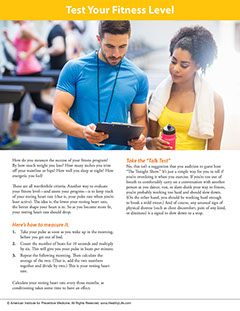
    Image of women talking to her fitness trainer.

    How do you measure the success of your fitness program? By how much weight you lose? How many inches you trim off your waistline or hips? How well you sleep at night? How energetic you feel?

    These are all worthwhile criteria. Another way to evaluate your fitness level-and assess your progress-is to keep track of your resting heart rate (that is, your pulse rate when you’re least active).

    The idea is, the lower your resting heart rate, the better shape your heart is in. So as you become more fit, your resting heart rate should drop.

    Here’s how to measure it.

    1.  Take your pulse as soon as you wake up in the morning, before you get out of bed.

    2.  Count the number of beats for 10 seconds and multiply by six. This will give you your pulse in beats per minute.

    3.  Repeat the following morning. Then calculate the average of the two. (That is, add the two numbers together and divide by two.) This is your resting heart rate.

    Calculate your resting heart rate every three months, as conditioning takes some time to have an effect.

    Take the “Talk Test”

    No, this isn’t a suggestion that you audition to guest host “The Tonight Show.” It’s just a simple way for you to tell if you’re overdoing it when you exercise. If you’re too out of breath to comfortably carry on a conversation with another person as you dance, run, or slam-dunk your way to fitness, you’re probably working too hard and should slow down. (On the other hand, you should be working hard enough to break a mild sweat.) And of course, any unusual sign of physical distress (such as chest discomfort, pain of any kind, or dizziness) is a signal to slow down to a stop.

    Page image from A Year of Health Hints book by the American Institute for Preventive Medicine. www.HealthyLife.com. All rights reserved.

    © American Institute for Preventive Medicine

  • Teach Your Kids Not To Drink

    Substance Use & Abuse

    Underage drinking is a growing problem. All too often, teenage drinking leads to:

    *  Traffic accidents (many of them fatal).

    *  Destruction of property.

    *  Violent or antisocial behavior.

    *  Poor academic performance.

    *  Disciplinary problems.

    *  Withdrawal from social activities.

    *  Problems coping with stress.

    If you suspect (or know) your teenager drinks, don’t ignore it. To discourage or prevent underage drinking:

    *  Be a good role model. The best example you can set is to not drink. But if you choose to drink, drink responsibly. Children of alcoholics are four times as likely to develop a drinking problem as children of nonalcoholic parents.

    *  Show your children that you love them. Be affectionate, and show them you care and are interested in them.

    *  Make an effort to organize family activities. It may be hard to compete with your son’s or daughter’s peers for their attention at times, but make the effort anyway. Shared hobbies and sports can create bonds and strengthen a teen’s resistance to outside influences.

    *  Discuss the potential risks and consequences of alcohol use before it becomes a problem. Answer questions honestly and let your children know how you feel about them drinking before the situation arises.

    *  Tell your children to never get into a car with a drunk driver. Promise you’ll pick them up anytime, anywhere, no questions asked, if they call you instead of putting themselves at risk.

    Page from A Year of Health Hints book by the American Institute for Preventive Medicine. www.HealthyLife.com. All rights reserved.

    © American Institute for Preventive Medicine

  • Taking The Stress Out Of Travel

    Healthy Travel

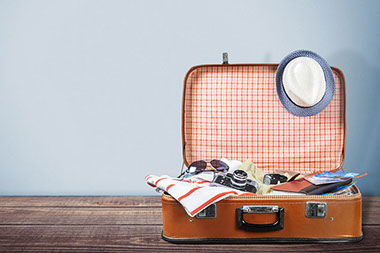
    Image of suit case opened.

    Even if you’re jetting to a sunny climate on your dream vacation, travel can be stressful. Any change in routine, scenery, eating habits, or time zones can take its toll on your well-being.

    Here are some things you can do to minimize travel stress.

    *  Begin to prepare for your trip well in advance of your departure date. Make a list of things to do each day.

    *  Finish packing your bags at least one full day before you leave. Devote the rest of the day to quiet activities, such as reading, napping, taking a leisurely bath, or listening to soothing music.

    *  Allow plenty of time to reach your destination or catch your flight. It’s better to have time to spare than to rush.

    *  Once you reach your destination, don’t over-schedule every day with endless hours of shopping, sightseeing, sports, and partying. Allow for some “downtime.”

    *  Don’t overeat, especially at night.

    *  Get enough sleep. Otherwise, you’ll come home pooped instead of renewed and refreshed.

    *  Get some exercise.

    *  Schedule your return so you have a day or so to “decompress” before you return to work.

    Page image from A Year of Health Hints book by the American Institute for Preventive Medicine. www.HealthyLife.com. All rights reserved.

    © American Institute for Preventive Medicine

  • Take These Weather Wise Steps To Exercise

    Fitness

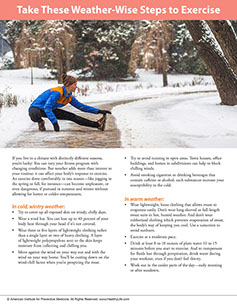
    If you live in a climate with distinctly different seasons, you’re lucky: You can vary your fitness program with changing conditions. But weather adds more than interest to your routine; it can affect your body’s response to exercise. An exercise done comfortably in one season-like jogging in the spring or fall, for instance-can become unpleasant, or even dangerous, if pursued in summer and winter without allowing for hotter or colder temperatures.

    In cold, wintry weather:

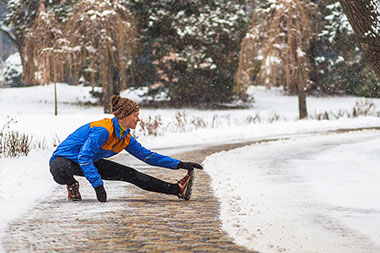
    Image of person streching outside in winter.

    *  Try to cover up all exposed skin on windy, chilly days.

    *  Wear a wool hat. You can lose up to 40 percent of your body heat through your head if it’s not covered.

    *  Wear three to five layers of lightweight clothing rather than a single layer or two of heavy clothing. A layer of lightweight polypropylene next to the skin keeps moisture from collecting and chilling you.

    *  Move against the wind on your way out and with the wind on your way home. You’ll be cutting down on the wind-chill factor when you’re perspiring the most.

    *  Try to avoid running in open areas. Town houses, office buildings, and homes in subdivisions can help to block chilling winds.

    *  Avoid smoking cigarettes or drinking beverages that contain caffeine or alcohol; such substances increase your susceptibility to the cold.

    In warm weather:

    *  Wear lightweight, loose clothing that allows sweat to evaporate easily. Don’t wear long-sleeved or full-length sweat suits in hot, humid weather. And don’t wear rubberized clothing which prevents evaporation of sweat, the body’s way of keeping you cool. Use a sunscreen to avoid sunburn.

    *  Exercise at a moderate pace.

    *  Drink at least 8 to 10 ounces of plain water 10 to 15 minutes before you start to exercise. And to compensate for fluids lost through perspiration, drink water during your workout, even if you don’t feel thirsty.

    *  Work out in the cooler parts of the day-early morning or after sundown.

    Page image from A Year of Health Hints book by the American Institute for Preventive Medicine. www.HealthyLife.com. All rights reserved.

    © American Institute for Preventive Medicine

  • Take That First Step

    Fitness

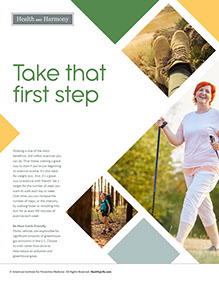
    Smiling women walking with walking sticks.

    Walking is one of the most beneficial, and safest, exercises you can do. That makes walking a great way to start if you’re just beginning an exercise routine. It’s also ideal for weight loss. And, it’s a great way to exercise with friends! Set a target for the number of steps you want to walk each day or week. Over time, you can increase the number of steps, or the intensity, by walking faster or including hills. Aim for at least 150 minutes of exercise each week.

    Be More Earth-Friendly

    Motor vehicles are responsible for significant amounts of greenhouse gas emissions in the U.S. Choose to walk rather than drive to help reduce air pollution and greenhouse gases.

    Page from HealthyLife Weigh book by the American Institute for Preventive Medicine. www.HealthyLife.com. All rights reserved.

    © American Institute for Preventive Medicine