Blog

  • Safe Travel For Pregnant Women

    Healthy Travel

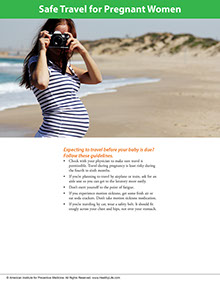
    Image of pregnant women on vacation.

    Expecting to travel before your baby is due? Follow these guidelines.

    *  Check with your physician to make sure travel is permissible. Travel during pregnancy is least risky during the fourth to sixth months.

    *  If you’re planning to travel by airplane or train, ask for an aisle seat so you can get to the lavatory more easily.

    *  Don’t exert yourself to the point of fatigue.

    *  If you experience motion sickness, get some fresh air or eat soda crackers. Don’t take motion sickness medication.

    *  If you’re traveling by car, wear a safety belt. It should fit snugly across your chest and hips, not over your stomach.

    Page image from A Year of Health Hints book by the American Institute for Preventive Medicine. www.HealthyLife.com. All rights reserved.

    © American Institute for Preventive Medicine

  • Safe Hiking Tips

    Fitness

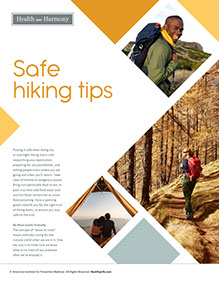
    Women hiking.

    Playing it safe when doing day or overnight hiking starts with researching your destination, preparing for any possibilities, and letting people know where you are going and when you’ll return. Steer clear of remote or dangerous places. Bring non-perishable food to eat, or pack it so that cold food stays cold and hot foods remain hot to avoid food poisoning. Have a sporting goods store fit you for the right kind of hiking boots, to ensure you stay safe on the trail.

    Be More Earth-Friendly

    The concept of “leave no trace” means ethically caring for the natural world when we are in it. One key way is to make sure we leave little to no trace of our presence after we’ve enjoyed it.

    Page from HealthyLife Weigh book by the American Institute for Preventive Medicine. www.HealthyLife.com. All rights reserved.

    © American Institute for Preventive Medicine

  • Rx Drug Use Without Abuse

    Substance Use & Abuse

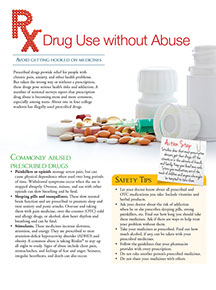
    Image of various medications.

    Avoid getting hooked on medicines.

    Prescribed drugs provide relief for people with chronic pain, anxiety, and other health problems. But taken the wrong way or without a prescription, these drugs pose serious health risks and addiction. A number of national surveys report that prescription drug abuse is becoming more and more common, especially among teens. About one in four college students has illegally used prescribed drugs.

    Commonly abused prescribed drugs:

    *  Painkillers or opioids manage severe pain, but can cause physical dependence when used over long periods of time. Withdrawal symptoms occur when the use is stopped abruptly. Overuse, misuse, and use with other opioids can slow breathing and be fatal.

    *  Sleeping pills and tranquilizers. These slow normal brain function and are prescribed to promote sleep and treat anxiety and panic attacks. Overuse and taking them with pain medicine, over-the-counter (OTC) cold and allergy drugs, or alcohol, slow heart rhythm and breathing and can be fatal.

    *  Stimulants. These medicines increase alertness, attention, and energy. They are prescribed to treat attention-deficit hyperactivity disorder (ADHD) and obesity. A common abuse is taking Ritalin® to stay up all night to study. Signs of abuse include chest pain, stomachaches, and feelings of fear and anger. Seizures, irregular heartbeats, and death can also occur.

    Safety Tips

    *  Let your doctor know about all prescribed and OTC medications you take. Include vitamins and herbal products.

    *  Ask your doctor about the risk of addiction when he or she prescribes sleeping pills, strong painkillers, etc. Find out how long you should take these medicines. Ask if there are ways to help treat your problem without them.

    *  Take your medicines as prescribed. Find out how much alcohol, if any, can be taken with your prescribed medicines.

    *  Follow the guidelines that your pharmacist provides with every prescription.

    *  Do not take another person’s prescribed medicines.

    *  Do not share your medicines with others.

    Action Step

    Studies show that most prescription abusers get their drugs off the streets or in the cabinets of friends and family. Store your medications out of the reach of children and anyone who might be tempted to take them.

    Page from Ways to Well-Being book by the American Institute for Preventive Medicine. www.HealthyLife.com. All rights reserved.

    © American Institute for Preventive Medicine

  • Reward Yourself For Weight Loss

    Weight Control

    When a behavior is followed by a reward, the behavior is more likely to be repeated. So the more you are rewarded for your weight-loss efforts, the more likely you’ll continue to succeed.

    But you don’t have to wait until you lose weight to reward yourself Rewards should begin the very first day of your diet. (Of course, food should not be a reward.)

    Here are just a few examples of the kinds of rewards that can help you to adhere to your weight-control plan.

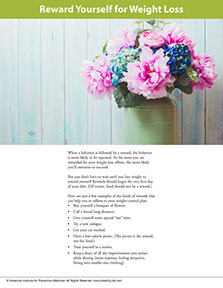
    *  Buy yourself a bouquet of flowers.

    *  Call a friend long-distance.

    *  Give yourself some special “me” time.

    *  Try a new cologne.

    *  Get your car washed.

    *  Have a low-calorie picnic. (The picnic is the reward, not the food.)

    *  Treat yourself to a movie.

    *  Keep a diary of all the improvements you notice while dieting (more stamina, feeling attractive, fitting into smaller-size clothing).

    Page from A Year of Health Hints book by the American Institute for Preventive Medicine. www.HealthyLife.com. All rights reserved.

    © American Institute for Preventive Medicine

  • Rethink Your Drink

    Weight Control

    Avoid liquids that fill you up and out.

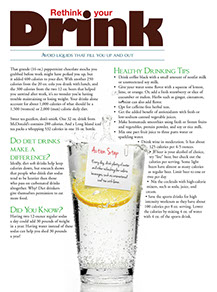
    That grande (16 oz.) peppermint chocolate mocha you grabbed before work might have perked you up, but it added 400 calories to your diet. With another 250 calories from the 20 oz. cola you drank with lunch, and the 300 calories from the two 12 oz. beers that helped you unwind after work, it’s no wonder you’re having trouble maintaining or losing weight. Your drinks alone account for about 1,000 calories of what should be a 1,500 (women) or 2,000 (men) calorie daily diet.

    Sweet tea guzzlers, don’t smirk. One 32 oz. drink from McDonald’s contains 280 calories. And a Long Island iced tea packs a whopping 532 calories in one 16 oz. bottle.

    Did You Know?

    Having two 12-ounce regular sodas a day could add 30 pounds of weight in a year. Having water instead of these sodas can help you shed 30 pounds a year!

    Healthy Drinking Tips

    *  Drink coffee black with a small amount of nonfat milk or unsweetened soy milk.

    *  Give your water some flavor with a squeeze of lemon, lime, or orange. Or, add a fresh strawberry or slice of cucumber or melon. Herbs such as ginger, cinnamon, or mint can also add flavor.

    *  Opt for caffeine-free herbal teas.

    *  Get the added benefit of antioxidants with fresh or low-sodium canned vegetable juices.

    *  Make homemade smoothies using fresh or frozen fruits and vegetables, protein powder, and soy or rice milk.

    *  Mix one part fruit juice to three parts water or sparkling water.

    *  Drink wine in moderation. It has about 125 calories per 4-5 ounces.

    *  If beer is your alcohol of choice, try “lite” beer, but check out the calories per serving. Some light beers have almost as many calories as regular beer. Limit beer to one or two per day.

    *  Nix the cocktails with high-calorie mixers, such as soda, juice, and cream.

    *  Save the sports drinks for high intensity workouts as they have about 100 calories per 8 oz. serving. Lower the calories by mixing 4 oz. of water with 4 oz. of the sports drink.

    Do diet drinks make a difference?

    Ideally, diet soft drinks help keep calories down, but research shows that people who drink diet sodas tend to be heavier than those who pass on carbonated drinks altogether. Why? Diet drinkers give themselves permission to eat more food.

    Action Step

    Every day, drink plenty of water and other refreshing low-calorie beverages, such as unsweetened iced tea with lemon.

    Page from Ways to Well-Being book by the American Institute for Preventive Medicine. www.HealthyLife.com. All rights reserved.

    © American Institute for Preventive Medicine

  • “Remember” To Relax With Biofeedback

    Stress Management

    Image of women deep breathing.

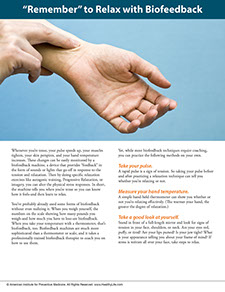
    Whenever you’re tense, your pulse speeds up, your muscles tighten, your skin perspires, and your hand temperature increases. These changes can be easily monitored by a biofeedback machine, a device that provides “feedback” in the form of sounds or lights that go off in response to the tension and relaxation. Then by doing specific relaxation exercises like autogenic training, Progressive Relaxation, or imagery, you can alter the physical stress responses. In short, the machine tells you when you’re tense so you can know how it feels-and then learn to relax.

    You’ve probably already used some forms of biofeedback without even realizing it. When you weigh yourself, the numbers on the scale showing how many pounds you weigh-and how much you have to lose-are biofeedback. When you take your temperature with a thermometer, that’s biofeedback, too. Biofeedback machines are much more sophisticated than a thermometer or scale, and it takes a professionally trained biofeedback therapist to coach you on how to use them.

    Yet, while most biofeedback techniques require coaching, you can practice the following methods on your own.

    Take your pulse. A rapid pulse is a sign of tension. So taking your pulse before and after practicing a relaxation technique can tell you whether you’re relaxing or not.

    Measure your hand temperature. A simple hand-held thermometer can show you whether or not you’re relaxing effectively. (The warmer your hand, the greater the degree of relaxation.)

    Take a good look at yourself. Stand in front of a full-length mirror and look for signs of tension in your face, shoulders, or neck. Are your eyes red, puffy, or tired? Are your lips pursed? Is your jaw tight? What is your appearance telling you about your frame of mind? If stress is written all over your face, take steps to relax.

    Page from A Year of Health Hints book by the American Institute for Preventive Medicine. www.HealthyLife.com. All rights reserved.

    © American Institute for Preventive Medicine

  • “Rehearse” For Stressful Events

    Stress Management

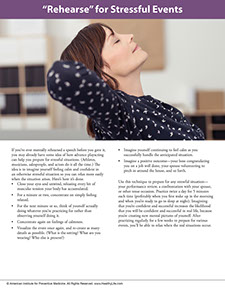
    Image of women giving a business proposal in front of co-workers.

    If you’ve ever mentally rehearsed a speech before you gave it, you may already have some idea of how advance playacting can help you prepare for stressful situations. (Athletes, musicians, salespeople, and actors do it all the time.) The idea is to imagine yourself feeling calm and confident in an otherwise stressful situation so you can relax more easily when the situation arises. Here’s how it’s done.

    *  Close your eyes and unwind, releasing every bit of muscular tension your body has accumulated.

    *  For a minute or two, concentrate on simply feeling relaxed.

    *  For the next minute or so, think of yourself actually doing whatever you’re practicing for rather than observing yourself doing it.

    *  Concentrate again on feelings of calmness.

    *  Visualize the event once again, and re-create as many details as possible. (What is the setting?  What are you wearing? Who else is present?)

    *  Imagine yourself continuing to feel calm as you successfully handle the anticipated situation.

    *  Imagine a positive outcome-your boss congratulating you on a job well done, your spouse volunteering to pitch in around the house, and so forth.

    Use this technique to prepare for any stressful situation-your performance review, a confrontation with your spouse, or other tense occasion. Practice twice a day for 5 minutes each time (preferably when you first wake up in the morning and when you’re ready to go to sleep at night). Imagining that you’re confident and successful increases the likelihood that you will be confident and successful in real life, because you’re creating new mental pictures of yourself. After practicing regularly for a few weeks to prepare for various events, you’ll be able to relax when the real situations occur.

    Page from A Year of Health Hints book by the American Institute for Preventive Medicine. www.HealthyLife.com. All rights reserved.

    © American Institute for Preventive Medicine