Blog

  • Insomnia 3

    SleepWell® Program

    Week 1
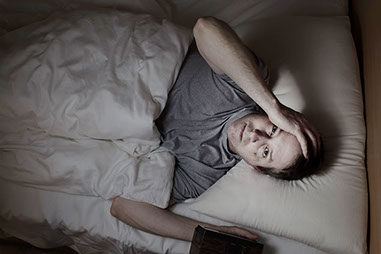
    Image of male in bed awake.

    Insomnia includes problems falling asleep, staying asleep, or waking up too early. It is normal to have a bad night of sleep every now and then. Occasional poor sleep becomes insomnia when this pattern continues for several weeks AND fatigue or feeling drowsy during the day occurs due to lack of sleep.

    There are many causes of insomnia. Too much caffeine, travel, taking care of an ill loved one, or stress can affect your sleep. Quite often, insomnia is a result of conditioning your body to be awake in bed, even if you feel tired or know you need sleep. Having trouble sleeping over several nights may lead to worrying about being able to fall asleep or expecting to lie awake for hours.

    Whether your sleep issues are transient (come and go) or chronic (occur all the time), this guide can help to improve your ability to fall asleep and stay asleep.

    Sleep Problems & Health Conditions

    If you have trouble sleeping or have daytime sleepiness for longer than three weeks, consult your doctor.

    Any condition, illness, injury, or surgery that interrupts sleep due to pain, discomfort, or waking to urinate can cause sleep problems. Health conditions that affect sleep include: arthritis, asthma, COPD, fibromyalgia, narcolepsy, and thyroid disorders. Sleep problems are also linked to many mental illnesses. These include anxiety, depression, bipolar disorder, PTSD, and substance abuse. Over-the-counter medicines, such as decongestants and diet pills can affect sleep, too.

    Sleep Apnea Signs:

    *  Loud snorting sounds while sleeping on the back

    *  Repeated periods when breathing stops for 10 or more seconds during sleep

    *  Waking up many times during the night and excessive daytime sleepiness

    *  Exhaustion and having a hard time concentrating during the day

    Periodic Limb Movements in Sleep (PLMS) and Restless Leg Syndrome Signs:

    *  Creeping, crawling, pulling and/or painful feelings in one or both legs

    *  Jerking or bending leg movements that you can’t control during sleep

    © American Institute for Preventive Medicine

  • Improve Sleep Step-By-Step

    SleepWell® Program

    Week 2

    Image of man waking up happy.

    Take your big goal and break it into small, measurable steps. Each small step should follow the S.M.A.R.T. guidelines. Try making one change at a time, like changing the time you eat dinner in the evening. Follow the chart below, starting with number 1.

    Chart showing how to make a change to help improve sleep.

    For example:

    1. Change: I dimmed the lights an hour before bed.

    2. Continue: I did this every day for a week.

    3. Reflect: After one week, I felt sleepier when I got into bed. I fell asleep in 20 minutes instead of 30.

    4. Continue: I will keep this new habit. I will also find a new change to continue to improve my sleep.

    © American Institute for Preventive Medicine

  • How Much Sleep Do I Need?

    SleepWell® Program

    Week 2

    Image of man sleeping.

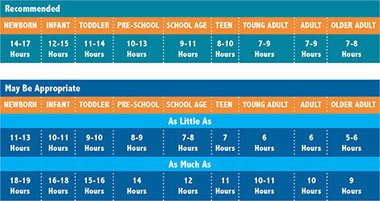
    There is no “one size fits all” sleep guideline. The National Sleep Foundation (NSF) has defined ranges that are adequate for most people (see chart below). However, the best indicator of how much sleep you need is your daytime energy and alertness. If you are meeting the NSF guideline, but you need caffeine to get through your day and are falling asleep at the wheel, you may need more quality sleep.

    For most adults, seven to nine hours is a good amount of sleep. Older adults may not need as much and children need much more.

    Sleep Length Guidelines

    Sleep length guidelines chart.

    © American Institute for Preventive Medicine
  • Effects Of Caffeine, Nicotine & Alcohol

    SleepWell® Program

    Week 2

    Image of a cup of coffee and coffee beans.

    Caffeine

    Caffeine is a stimulant drug. It increases alertness. Caffeine can interfere with sleep in these ways:

    *  It makes it take longer for you to fall asleep.

    *  It makes you wake up more often when you  are sleeping.

    *  It lowers the amount of deep sleep you get.

    Limit caffeine to 300 mg a day.

    More than 500 to 600 mg a day may cause you to feel anxious and nervous and make it harder to sleep well.

    Early is better.

    Drink caffeinated beverages early in your day. It can take eight to 14 hours to clear caffeine from the body. Avoid caffeine at least six hours before bedtime.

    Cut down gradually.

    Daily usage of caffeine can result in physical dependence. If caffeine is stopped abruptly, withdrawal symptoms can occur. These include headache, feeling down, having a hard time concentrating, and fatigue.

    Chart that shows amount of caffeine in drinks.

    Avoid All Nicotine

    Nicotine is a stimulant. Nicotine raises blood pressure, increases heart rate, and makes you feel more alert. Health problems from smoking, chewing, or vaping may make sleep more difficult.

    QUITsmoking, chewing, or vaping. Nicotine withdrawal can cause you to wake up during the night, but this will go away. It is worth it to quit.

    Alcohol

    Alcohol may help you to fall asleep, but it will interfere with quality sleep. Alcohol can lead to lighter sleep and waking up often. All stages of sleep are affected, but deep sleep and REM sleep are most affected. You may not reach the sleep stages needed to feel restored and refreshed upon waking.

    After drinking alcohol you may experience:

    *  More dreaming

    *  More nightmares

    *  Faster heart rate

    *  Sweating

    *  Need to use the bathroom

    Limit Alcohol

    Don’t have more than one alcoholic drink with or after dinner. If you take sleep medicines or other medicines, ask your health care provider if you can have any alcohol. If you are taking sleep medicine, it can be extremely dangerous to drink alcohol.

    © American Institute for Preventive Medicine

  • Dispute Irrational Thoughts

    SleepWell® Program

    Week 4

    Image of man thinking at desk.

    Learn to identify and dispute irrational thoughts. The following strategies help you break down thoughts that cause anxiety and make it hard for you to fall asleep.

    Shades of Gray: Banish Black & White Thinking

    Thinking in all-or-nothing terms using words like “always,” “never,” and “every” can lead to seeing situations and people in absolute terms. This thinking can make it difficult to see options. Logical thinking looks at more than one option. People can act in different ways. Situations can have many outcomes.

    If you notice you are thinking in absolutes, identify alternatives to your black and white thoughts.

    Tips for Rational Thinking

    Use these tips to decide if an alternate thought is helpful for problem-solving. You can allow your thoughts and actions to cause anxiety or view them as a part of everyday life that you can manage.

    1.  Ask: Is your thought based on facts?

    2.  Identify what you are trying to do. Know your purpose.

    3.  Consider many different outcomes and their effects.

    4.  View the situation from many perspectives.

    5.  Don’t assume a situation will have the same outcome as it did in the past.

    6.  Have good evidence for a generalization before you make it.

    7.  Avoid assuming one event caused another just because they happened at the same time.

    Control Catastrophic Thinking

    Seeing the worst possibility or outcome in a situation can lead to anxiety and racing thoughts. Avoid focusing on the negative aspects of a situation or how these could be even worse. The unknown future can seem scary and full of negative potential. Dispute each irrational thought with a rational one. Challenge your “worst case scenario” with a “best case scenario” and options in between.

    *  What is statistically likely in this scenario?

    *  What is the best this situation could turn out?

    *  What can I do to reduce the chances of a situation getting worse?

    © American Institute for Preventive Medicine
  • Discuss Your Sleep Needs With Your Sleep Partner

    SleepWell® Program

    Week 5

    Image of young couple talking.

    If you have a sleep partner, let him or her know what you are doing to improve your sleep.

    DO explain why this is important to you.

    DO tell him or her that you may be getting up and leaving the room during the night. State what you are doing to avoid concern during the night.

    DO share your strategy to improve your sleep.

    DO discuss your bedtimes and wake times. These times may seem unusual. Explain that you are working at improving your sleep.

    DO NOT expect your partner to do what you are doing or follow your new sleep schedule.

    © American Institute for Preventive Medicine

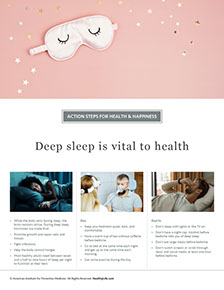
  • Deep Sleep Is Vital To Health

    Sleep Well

    Pink eye mask with closed eyes and gold stars around it.

    *  While the body rests during sleep, the brain remains active. During deep sleep, hormones are made that:

    *  Promote growth and repair cells and tissues

    *  Fight infections

    *  Help the body control hunger

    *  Most healthy adults need between seven and a half to nine hours of sleep per night to function at their best.

    Dos

    *  Keep your bedroom quiet, dark, and comfortable.

    *  Have a warm cup of tea without caffeine before bedtime.

    *  Go to bed at the same time each night and get up at the same time each morning.

    *  Get some exercise during the day.

    Don’ts

    *  Don’t sleep with lights or the TV on.

    *  Don’t have a night cap. Alcohol before bedtime robs you of deep sleep.

    *  Don’t eat large meals before bedtime.

    *  Don’t watch screens or scroll through news and social media at least one hour before bedtime.

    © American Institute for Preventive Medicine

  • Creative Imagination 2

    SleepWell® Program

    Week 4

    Image of women sitting outside in nature, thinking.

    This tool allows you to rehearse an event or thought in your mind so that you are better prepared to deal with it when it occurs.

    Identify an upcoming event or challenge. Picture other people there, what you do, what you say, and how you react to challenges you know are likely to arise. Mentally practice your feelings and actions to increase your confidence. Identify and address gaps in your plan.

    You can also use creative imagination to save thoughts for later. Take stressful thoughts out of your present mind to reduce anxiety and help you feel calmer. Try these techniques:

    *  Imagine your stressful thoughts in a fishbowl or behind thick glass. You can see the thought floating around but you cannot touch it or hear anything that is going on behind the glass.

    *  Imagine your thought is in a bubble floating away in the wind. The bubble dances in the breeze and eventually blows away.

    *  Imagine your thoughts are a baseball. Then imagine whacking that ball high into the sky, far away.

    *  Imagine your worries falling into the depths of the ocean.

    *  Imagine putting your ideas on a shelf to think about later.

    Make it Real

    Write your worries on an index card and put them in a shoebox. Put the box on a shelf, in the back of the closet, or in a drawer.

    Say this: “I can retrieve these thoughts later, but now it is time to sleep.”

    © American Institute for Preventive Medicine

  • Create Self-Enhancing Feelings 2

    SleepWell® Program

    Week 5

    Split image with arrows, one pointing to positive side and the other to a negative side.

    Take responsibility for your thoughts, feelings, and actions. You will feel better about yourself and your life. Blaming others is a natural, child-like reaction. It is more adult-like to figure out the amount of control you have in a given situation and respond to it in a mature way. You may not have control in every situation, but you can choose how you respond to others.

    One reason to become more accountable for your responses is that a “victim” response forms negative, draining feelings. Self-responsibility creates positive energy. With it you can manage every event in a more positive, self-nurturing manner. One way to do this is to look at your language and see if you use “victim” or “accountability” phrases.

    Example “victim” phrase:

    I can’t improve my sleep until my boss gives me a better work shift.

    Example “accountability” phrase:

    I can schedule a meeting with my boss to discuss my shift and my sleep needs.

    The Power of a Phrase

    Fill in after the victim phrase with something you have caught yourself saying or are feeling right now. Use an accountability phrase to re-write this statement.

    Victim Phrase

    *  I can’t…

    *  It’s useless…

    *  I have to…

    *  Why am I always the one who…

    Accountability Phrase

    *  I can…

    *  There’s always a chance…

    *  I choose to…

    *  I’ll be the one who…

    © American Institute for Preventive Medicine
  • Create “If, Then” Plans 2

    SleepWell® Program

    Week 2

    Image of man smiling.

    Use “If, then” plans to overcome roadblocks. “If, then” plans anticipate a challenge and prepare a response in advance. Create “If, then” statements for each challenge you expect to face. These challenges may be:

    *  Your common sleep problem (e.g. alert at bedtime)

    *  How you expect to feel (e.g. anxious)

    *  Something you do not know how to do

    *  Supplies you need (like a dark curtain)

    *  A comment from a supporter or a non-supporter

    Examples:

    IFI have trouble falling asleep for more than 15 minutes,THENI will get out of bed and find something else to do.

    IFI find myself staring at the clock,THENI will turn the face of the clock away from me.

    IFmy spouse wants to watch TV in the bedroom,THENI will talk to him or her about how this hurts my sleep habits. I will suggest we don’t use the TV in the bedroom after 6 p.m.

    © American Institute for Preventive Medicine