Blog

  • Lean On Friends For Weight Loss Support

    Weight Control

    Find a friend or a room full of others on similar paths.

    Getting support as you change lifestyle habits is important. It could be from a buddy who will listen to your woes, applaud your successes, and help you stay on track. Or you could find the support you need in a group program where others’ successes inspire and motivate you.

    Friends don’t let friends eat junk.

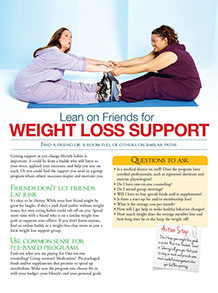
    Image of two friends eating healthy.

    It’s okay to be choosy. While your best friend might be great for laughs, if she’s a junk food junkie without weight issues, her own eating habits could rub off on you. Spend more time with a friend who is on a similar weight loss path or supports your efforts. If you don’t know anyone, find an online buddy in a weight-loss chat room or join a local weight loss support group.

    Use common sense for fee-based programs.

    Find out what you are paying for. One-on-one counseling? Group sessions? Medication? Pre-packaged foods and/or supplements that promise to speed up metabolism. Make sure the program you choose fits in with your budget, your lifestyle, and your personal goals.

    Questions to ask:

    *  Is a medical doctor on staff? Does the program have certified professionals, such as registered dietitians and exercise physiologists?

    *  Do I have one-on-one counseling?

    *  Do I attend group meetings?

    *  Will I have to buy special foods and/or supplements?

    *  Is there a start-up fee and/or membership fees?

    *  What is the average cost per month?

    *  How will I get help to make healthy behavior changes?

    *  How much weight does the average member lose and how long does he or she keep the weight off?

    Action Step

    Don’t keep your weight loss goals a secret. Post it on Facebook. Tweet it. Sharing will give you that push to stay on track and provide some much needed encouragement when you feel like quitting.
    Page from Ways to Well-Being book by the American Institute for Preventive Medicine. www.HealthyLife.com. All rights reserved.

    © American Institute for Preventive Medicine

  • Knowing When Not To Weigh Yourself

    Weight Control

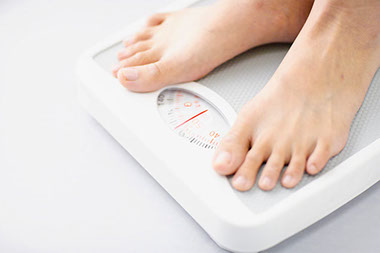
    Image on feet on a scale.

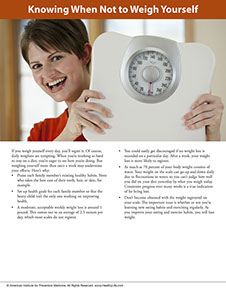
    If you weigh yourself every day, you’ll regret it. Of course, daily weigh-ins are tempting. When you’re working so hard to stay on a diet, you’re eager to see how you’re doing. But weighing yourself more than once a week may undermine your efforts. Here’s why:

    *  Praise each family member’s existing healthy habits. Note who takes the best care of their teeth, hair, or skin, for example.

    *  Set up health goals for each family member so that the heavy child isn’t the only one working on improving health.

    *  A moderate, acceptable weekly weight loss is around 1 pound. This comes out to an average of 2.3 ounces per day, which most scales do not register.

    *  You could easily get discouraged if no weight loss is recorded on a particular day. After a week, your weight loss is more likely to register.

    *  As much as 70 percent of your body weight consists of water. Your weight on the scale can go up and down daily due to fluctuations in water, so you can’t judge how well you did on your diet yesterday by what you weigh today. Consistent progress over many weeks is a true indication of fat being lost.

    *  Don’t become obsessed with the weight registered on your scale. The important issue is whether or not you’re learning new eating habits and exercising regularly. As you improve your eating and exercise habits, you will lose weight.

    Page from A Year of Health Hints book by the American Institute for Preventive Medicine. www.HealthyLife.com. All rights reserved.

    © American Institute for Preventive Medicine

  • Know Your Bmi

    Weight Control

    A simple measurement can help detect your health risks.

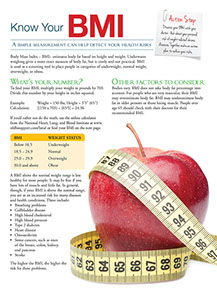
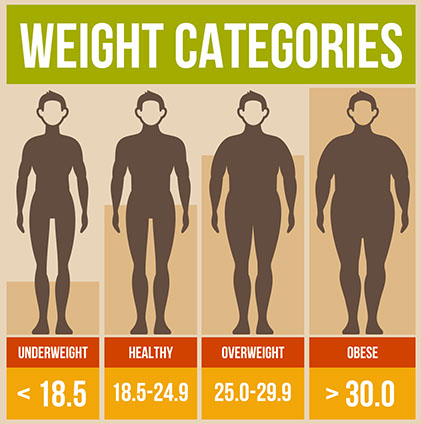
    Body Mass Index − BMI− estimates body fat based on height and weight. Underwater weighing gives a more exact measure of body fat, but is costly and not practical. BMI is used as a screening tool to place people in categories of underweight, normal weight, overweight, or obese.

    Illustration of BMI weight categories.

    What’s your number?

    To find your BMI, multiply your weight in pounds by 703.

    Divide this number by your height in inches squared.

    Example: Weight = 150 lbs; Height = 5’5″ (65″)

    Calculation: [(150 x 703) ÷ (65²)] = 24.96

    If you’d rather not do the math, use the online calculator  from the National Heart, Lung, and Blood Institute atwww.nhlbisupport.com/bmi.

    BMI – WEIGHT STATUS

    Below 18.5 – Underweight

    18.5 – 24.9 – Normal

    25.0 – 29.9 – Overweight

    30.0 and above Obese

    A BMI above the normal weight range is less healthy for most people. It may be fine if you have lots of muscle and little fat. In general, though, if your BMI is above the normal range, you are at an increased risk for many diseases and health conditions. These include:

    *  Breathing problems

    *  Gallbladder disease

    *  High blood cholesterol

    *  High blood pressure

    *  Type 2 diabetes

    *  Heart disease

    *  Osteoarthritis

    *  Some cancers, such as ones   of the breast, colon, kidney,  and pancreas

    *  Stroke

    The higher the BMI, the higher the risk for these problems.

    Other factors to consider

    Bodies vary. BMI does not take body fat percentage into account. For people who are very muscular, their BMI may overestimate body fat. BMI may underestimate body fat in older persons or those losing muscle. People over age 65 should check with their doctors for their  recommended BMI.

    Action Step

    Discuss your BMI with your doctor.  Ask about your personal risk of weight-related chronic diseases. Together, make an action plan to reduce your risks.

    Page from Ways to Well-Being book by the American Institute for Preventive Medicine. www.HealthyLife.com. All rights reserved.

    © American Institute for Preventive Medicine
  • Remember:Kids Are People, Too

    Stress Management

    Image of young child stressed.

    Don’t think for one minute that kids lead stress-free lives. Carefree as childhood may seem to adults, children experience stresses that are as real to them as car payments and broken water heaters are to you.

    Coach your children in stress management so they can learn to handle setbacks and disappointments. Here’s how:

    *  Find a calm, quiet time to discuss with your children what it feels like to be stressed. Choose simple examples that are appropriate to their age levels.

    *  Ask your children about any physical signs of stress they may be experiencing, like upset stomach or sweaty palms.

    *  Teach your children that they can calm down, and show them how to make themselves feel better.

    *  Tell your children to take a slow, deep breath and imagine that they are sucking in air down to their feet. Then tell them to exhale all the “stressed” air out of their bodies and let go of tense feelings.

    *  Tell your children to imagine a comforting mental image. Suggest they picture themselves somewhere associated with relaxation-safe in bed, at a favorite playground, on the sofa with the family pet, sitting in Dad’s lap, or something similar. Encourage them to include as many details as possible in this image, to make it clear and memorable.

    *  Encourage your children to practice deep breathing or conjure up a comforting mental image whenever they feel stressed.

    Page from A Year of Health Hints book by the American Institute for Preventive Medicine. www.HealthyLife.com. All rights reserved.

    © American Institute for Preventive Medicine
  • Keep Produce At Its Peak

    Nutrition

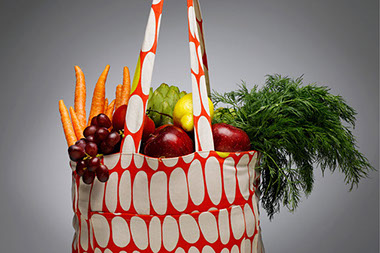
    Image of reusable bag filled with produce.

    Produce-fresh fruits and vegetables-is a gold mine of nutrients, usually with a price to match. To get the most nutrition for the “lettuce” you fork over for fresh produce, follow these suggestions.

    *  Select fruits and vegetables that look crisp or feel firm.

    *  When buying citrus fruits and pineapple, choose fruits that feel heavy for their size.

    *  Don’t buy produce that’s soft or bruised.

    *  Don’t buy more than you can use within a few days. If not used within a few days, store it under refrigeration. Most kinds of produce kept at room temperature ripens-or spoils-more rapidly. That’s fine if you’re eager to eat an avocado or banana, but not so great if you want to be able to use every last orange or lemon in the bag.

    *  Don’t soak produce in water-nutrients will leach out.

    *  Pat produce dry after washing, to prolong freshness.

    *  Don’t cut vitamin C rich fruits or vegetables, like strawberries and peppers, until just prior to eating. Exposure to the air destroys vitamin C.

    Page from A Year of Health Hints book by the American Institute for Preventive Medicine. www.HealthyLife.com. All rights reserved.

    © American Institute for Preventive Medicine
  • Keep Fat At Bay With Water Each Day

    Weight Control

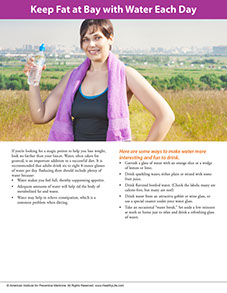
    Image of water bottle.

    If you’re looking for a magic potion to help you lose weight, look no farther than your faucet. Water, often taken for granted, is an important addition to a successful diet. It is recommended that adults drink six to eight 8-ounce glasses of water per day. Reducing diets should include plenty of water because:

    *  Water makes you feel full, thereby suppressing appetite.

    *  Adequate amounts of water will help rid the body of metabolized fat and waste.

    *  Water may help to relieve constipation, which is a common problem when dieting.

    Here are some ways to make water more interesting and fun to drink.

    *  Garnish a glass of water with an orange slice or a wedge of lemon or lime.

    *  Drink sparkling water, either plain or mixed with some fruit juice.

    *  Drink flavored bottled water. (Check the labels; many are calorie-free, but many are not!)

    *  Drink water from an attractive goblet or wine glass, or use a special coaster under your water glass.

    *  Take an occasional “water break.” Set aside a few minutes at work or home just to relax and drink a refreshing glass of water.

    Page from A Year of Health Hints book by the American Institute for Preventive Medicine. www.HealthyLife.com. All rights reserved.

    © American Institute for Preventive Medicine