Blog

  • Improving Your Ear-Q

    Systematic Stress Management Program

    Step 7: Communication & Stress Section

    Introduction

    What is Your Ear-Q?

    Ten Blocks to Effective Listening

    Listening Blocks in My Life

    Skills for Active Listening

    Improving Your Ear-Q

    Assertiveness

    Assertiveness Inventory

    Assertiveness with Other People

    The Benefits of Assertiveness

    Assertiveness Training – The L.A.D.D.E.R. Technique

    My Practice L.A.D.D.E.R.

    Image of friends sitting and talking to eachother.

    The following are recommended ways to build your listening skills.

    *  Take 51% of the responsibility for understanding what is being said.

    *  Look for areas of personal interest in what is being said.

    *  Plan to report the conversation back to someone else.

    *  Maintain the proper attitude. Keep an open mind.

    *  Stand or sit close to the speaker.

    *  Listen for the speaker’s meaning.

    *  Identify the speaker’s purpose by looking for central themes or ideas.

    *  Avoid becoming defensive.

    *  Limit and overcome distractions. Pay attention.

    *  Go to a lecture and just listen.

    *  Practice active listening skills: paraphrasing, clarifying, and giving feedback.

    *  Take notes on something you’ve heard.

    *  Commit yourself to better listening.

    Listening Exercises

    Exercise #1: List 3 new skills you’d like to try to become a more effective listener.

    Exercise #2: Ask someone to tell you a 3 – 5 minute story. Use the three skills of active listening (paraphrasing, clarifying, and feedback) as well as the skills listed in “Improving Your Ear-Q.” Ask the storyteller to rate you as a listener afterward.

    Scoring – The score is based on the speaker’s assessment of the 3 – 5 minute exchange.

    3 = Used the skill well

    2 = Made an effort to use the skill

    1 = Needs improvement

    Page from the Systematic Stress Management book by the American Institute for Preventive Medicine. www.HealthyLife.com. All rights reserved.

    © American Institute for Preventive Medicine

    Step 1: Understanding Stress

    Step 3: Type A & B Behavior Patterns

    Step 5: Thinking Differently

    Step 7: Communication & Stress

    Step 2: Stress Management at Work

    Step 4: Biofeedback Training & Relaxation

    Step 6: Time Management

    Steps to Systematic Stress Management™

    RELATED ARTICLES

    © American Institute for Preventive Medicine  –  All Rights Reserved.Disclaimer|www.HealthyLife.com

  • Immunizations: Your Best Shot Against Infectious Diseases

    Healthy Travel

    Image of mother comforting young daughter as she gets a shot.

    Polio, yellow fever, cholera, malaria, and typhoid are not typical problems in the United States and most developed countries. But outbreaks are common in certain rural or undeveloped parts of the world.

    Here’s what to do if you plan to travel outside the United States.

    *  Be sure you’ve been immunized against diphtheria, pertussis (whooping cough), tetanus, polio, measles, rubella, and mumps. Most people are routinely immunized against these diseases in childhood. You should have a booster shot for tetanus every ten years, however.

    *  Ask your doctor if he or she recommends medicine to prevent malaria or immunizations against influenza, pneumonia, or hepatitis.

    *  Contact your doctor or local health department to determine if you need to receive additional immunizations for your trip. Vaccination requirements for specific countries are also listed in the booklet, Health Information for International Travel-The Yellow Book, available from the Centers for Disease Control and Prevention (CDC).

    For information, call the CDC Travelers’ Information Line at 1.800.CDC.INFO (232.4636). Or accesswww.cdc.gov/travelon the Internet and select “Travelers’ Health.” You can find out what immunizations are advised for the places you are planning to go to. You can also find out about specific notices and outbreak advisories.

    Most immunizations are not required, but are recommended to protect the health of the traveler. Under the International Health Regulations adapted by the World Health Organization (WHO), a country may, under certain conditions, require an International Certificate of Vaccination against yellow fever from international travelers. A copy of the International Certificate of Vaccination, CDC 731 (formerly PHS-731), may be purchased from the U.S. Government Printing Office, Washington, DC 20402,http://bookstore.gpo.gov, 1.866.512.1800.

    Page image from A Year of Health Hints book by the American Institute for Preventive Medicine. www.HealthyLife.com. All rights reserved.

    © American Institute for Preventive Medicine

  • If You’re Sick, Rest

    Fitness

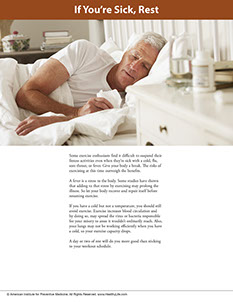
    Image of person blowing nose with a tissue.

    Some exercise enthusiasts find it difficult to suspend their fitness activities even when they’re sick with a cold, flu, sore throat, or fever. Give your body a break. The risks of exercising at this time outweigh the benefits.

    A fever is a stress to the body. Some studies have shown that adding to that stress by exercising may prolong the illness. So let your body recover and repair itself before resuming exercise.

    If you have a cold but not a temperature, you should still avoid exercise. Exercise increases blood circulation and by doing so, may spread the virus or bacteria responsible for your misery to areas it wouldn’t ordinarily reach. Also, your lungs may not be working efficiently when you have a cold, so your exercise capacity drops.

    A day or two of rest will do you more good than sticking to your workout schedule.

    Page image from A Year of Health Hints book by the American Institute for Preventive Medicine. www.HealthyLife.com. All rights reserved.

    © American Institute for Preventive Medicine

  • If You Can’t Alter Traffic, Alter Your Mood

    Stress Management

    Image of man driving, smiling with a passenger who is also smiling.

    Cars are inching along bumper to bumper. The weather is foul. You’ve already been late to work twice this week. Every muscle in your body is beginning to feel tense. What a way to start the morning. Boy, are you in for a bad day!

    Auto commutes don’t have to be “stress on wheels,” though. Here are some ways to avoid commuter stress.

    *  Before you set out, listen to radio traffic reports to find out if and where traffic is tied up.

    *  Take less heavily traveled routes.

    *  Leave 10 to 15 minutes earlier, to allow for unexpected delays.

    *  Look at a map and plan alternate routes should you encounter unexpected slow-downs along the way.

    If, despite such avoidance tactics, you end up caught in traffic anyway, don’t let stress get the best of you. Some hints:

    *  Loosen your grip on the steering wheel.

    *  Take a few deep breaths.

    *  Don’t dwell on negative factors over which you have no control, like rude drivers or the odds of arriving late.

    *  Listen to a radio talk show or all-news station.

    *  Play some CDs of pleasant music, narrated books, or self-improvement courses. (Learn French on your way to work, for example.)

    *  Keep a notebook and pencil or a cassette recorder handy to make notes for planning your day, make shopping lists, and so forth.

    Not only do these strategies help you make good use of otherwise wasted time, you might actually enjoy the drive!

    Page from A Year of Health Hints book by the American Institute for Preventive Medicine. www.HealthyLife.com. All rights reserved.

    © American Institute for Preventive Medicine

  • Identify Your Burnout Traits

    Systematic Stress Management Program

    Step 2: Stress Management at Work

    Introduction

    Work Stress Factors

    Burnout Self Inventory

    Identify Your Burnout Traits

    Work Stressor Questionnaire

    Ten Tips for Preventing Burnout

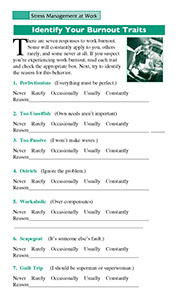
    There are seven responses to work burnout. Some will constantly apply to you, others rarely, and some never at all. If you suspect you’re experiencing work burnout, read each trait and check the appropriate box. Next, try to identify the reason for this behavior.

    1. Perfectionism: (Everything must be perfect.)

    Never    Rarely    Occasionally    Usually    Constantly

    2. Too Unselfish: (Own needs aren’t important)

    Never    Rarely    Occasionally    Usually    Constantly

    3. Too Passive: (I won’t make waves.)

    Never    Rarely    Occasionally    Usually    Constantly

    4. Ostrich: (Ignore the problem.)

    Never    Rarely    Occasionally    Usually    Constantly

    5. Workaholic: (Over-compensates)

    Never    Rarely    Occasionally    Usually    Constantly

    6. Scapegoat: (It’s someone else’s fault.)

    Never    Rarely    Occasionally    Usually    Constantly

    7. Guilt Trip: (I should be superman or superwoman.)

    Never    Rarely    Occasionally    Usually    Constantly

    Page from the Systematic Stress Management book by the American Institute for Preventive Medicine. www.HealthyLife.com. All rights reserved.

    © American Institute for Preventive Medicine

    Step 1: Understanding Stress

    Step 3: Type A & B Behavior Patterns

    Step 5: Thinking Differently

    Step 7: Communication & Stress

    Step 2: Stress Management at Work

    Step 4: Biofeedback Training & Relaxation

    Step 6: Time Management

    Steps to Systematic Stress Management™

    RELATED ARTICLES

    © American Institute for Preventive Medicine  –  All Rights Reserved.Disclaimer|www.HealthyLife.com
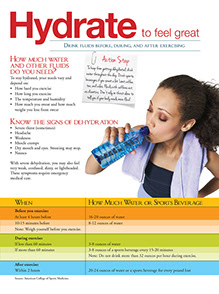
  • Hydrate To Feel Great

    Fitness

    Drink fluids before, during, and after exercising.

    How much water and other fluids do you need?

    To stay hydrated, your needs vary and depend on:

    *  How hard you exercise

    *  How long you exercise

    *  The temperature and humidity

    *  How much you sweat and how much weight you lose from sweat

    Know the signs of dehydration:

    *  Severe thirst (sometimes)

    *  Headache

    *  Weakness

    *  Muscle cramps

    *  Dry mouth and eyes. Sweating may stop.

    *  Nausea

    With severe dehydration, you may also feel very weak, confused, dizzy, or lightheaded. These symptoms require emergency medical care.

    Action Step

    To keep from getting dehydrated, drink water throughout the day. Drink sports beverages if you sweat a lot. Limit coffee, tea, and colas. Don’t rely on thirst alone to tell you if your body needs more fluid.

    Page image from the Ways to Well-Being book by the American Institute for Preventive Medicine. www.HealthyLife.com. All rights reserved.

    © American Institute for Preventive Medicine

  • Turning Your Cookie Jar Into An Activities Director

    Weight Control

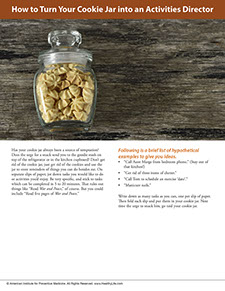
    Image of cookie jars lined up with cookies in them.

    Has your cookie jar always been a source of temptation? Does the urge for a snack send you to the goodie stash on top of the refrigerator or in the kitchen cupboard? Don’t get rid of the cookie jar, just get rid of the cookies and use the jar to store reminders of things you can do besides eat. On separate slips of paper, jot down tasks you would like to do or activities you’d enjoy. Be very specific, and stick to tasks which can be completed in 5 to 20 minutes. That rules out things like “Read War and Peace,” of course. But you could include “Read five pages of War and Peace.”

    Following is a brief list of hypothetical examples to give you ideas.

    *  “Call Aunt Marge from bedroom phone.” (Stay out of that kitchen!)

    *  “Get rid of three items of clutter.”

    *  “Call Tom to schedule an exercise ‘date’.”

    *  “Manicure nails.”

    Write down as many tasks as you can, one per slip of paper. Then fold each slip and put them in your cookie jar. Next time the urge to snack hits, go raid your cookie jar.

    Page from A Year of Health Hints book by the American Institute for Preventive Medicine. www.HealthyLife.com. All rights reserved.

    © American Institute for Preventive Medicine

  • How To Survive A Dieting Setback

    Weight Control

    Image of women in front of a cupcake and apple on a scale.

    Everyone experiences occasional setbacks, especially people on diets. The trick is to prevent a minor slip from becoming a major disaster that thwarts your long-term weight-loss goals.

    The most determined dieter cheats once in a while-it’s only human. Don’t chastise yourself or give up because you’ve had a slip-up in your eating plans. Remember, a temporary setback does not equal a permanent failure!

    Here’s what to remember when you go astray.

    *  Setbacks are a natural part of learning self-control.

    *  Acknowledge your mistake and plan how you’ll respond to a similar situation the next time. Make it work to your advantage.

    *  Remember, long-term success is still quite possible.

    *  Give yourself positive feedback. If you eat half of a candy bar, for instance, praise yourself for not eating the whole thing.

    Page from A Year of Health Hints book by the American Institute for Preventive Medicine. www.HealthyLife.com. All rights reserved.

    © American Institute for Preventive Medicine