Blog

  • How To Prevent Motion Sickness

    Healthy Travel

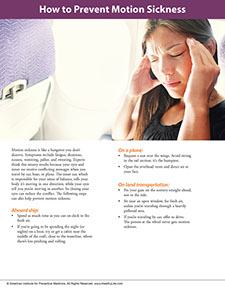
    Motion sickness is like a hangover you don’t deserve. Symptoms include fatigue, dizziness, nausea, vomiting, pallor, and sweating. Experts think this misery results because your eyes and inner ear receive conflicting messages when you travel by car, boat, or plane. The inner ear, which is responsible for your sense of balance, tells your body it’s moving in one direction, while your eyes tell you you’re moving in another. So closing your eyes can reduce the conflict. The following steps can also help prevent motion sickness.

    Aboard ship:

    *  Spend as much time as you can on deck in the fresh air.

    *  If you’re going to be spending the night (or nights) on a boat, try to get a cabin near the middle of the craft, close to the waterline, where there’s less pitching and rolling.

    On a plane:

    *  Request a seat over the wings. Avoid sitting in the tail section; it’s the bumpiest.

    *  Open the overhead vents and direct air at your face.

    On land transportation:

    *  Fix your gaze on the scenery straight ahead, not to the side.

    *  Sit near an open window, for fresh air, unless you’re traveling through a heavily polluted area.

    *  If you’re traveling by car, offer to drive. The person at the wheel never gets motion sickness.

    In addition, the following steps are helpful no matter what your means of transportation.

    *  Get plenty of rest before setting out. Fatigue makes you more vulnerable to motion sickness.

    *  Avoid drinking alcohol before or during travel, and don’t overindulge the night before.

    *  Take an over-the-counter motion sickness medication (such as Dramamine) approximately 30 minutes before travel begins. Read the package for cautions and other important information.

    *  If over-the-counter medications don’t bring relief, ask your doctor about a prescription medication containing scopolamine, available as a patch that’s usually worn behind your ear.

    *  Don’t read while traveling and don’t try to focus on any other stationary object. Aboard a ship, lie down on your back and close your eyes.

    *  If any of your traveling companions get sick, move as far away from them as possible; otherwise, you may get sick, too.

    Some people report that taking tablets of powdered gingerroot relieves their motion sickness. Others find relief by pressing on an acupressure point about midway on the inside of the wrist, where the hand and forearm meet.

    If preventive measures fail and you feel sick anyway, you can try the following:

    *  Breathe slowly and deeply.

    *  Remove yourself from smoke and food odors, and get some fresh air.

    *  To reduce tension and anxiety, concentrate on relaxing all your muscles, as though you’re a limp rag doll, and visualize a peaceful scene.

    *  To settle a queasy stomach, eat dry crackers.
    Page image from A Year of Health Hints book by the American Institute for Preventive Medicine. www.HealthyLife.com. All rights reserved.

    © American Institute for Preventive Medicine
  • How To Prevent Jet Lag

    Healthy Travel

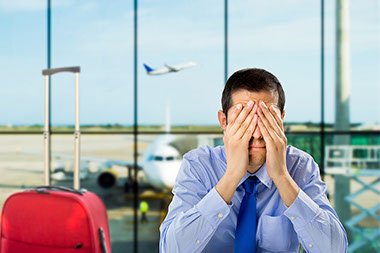
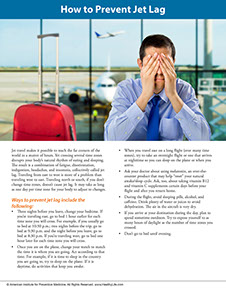
    Image of man covering his face while at the airport.

    Jet travel makes it possible to reach the far corners of the world in a matter of hours. Yet crossing several time zones disrupts your body’s natural rhythm of eating and sleeping. The result is a combination of fatigue, disorientation, indigestion, headaches, and insomnia, collectively called jet lag. Traveling from east to west is more of a problem than traveling west to east. Traveling north or south, if you don’t change time zones, doesn’t cause jet lag. It may take as long as one day per time zone for your body to adjust to changes.

    Ways to prevent jet lag include the following:

    *  Three nights before you leave, change your bedtime. If you’re traveling east, go to bed 1 hour earlier for each time zone you will cross. For example, if you usually go to bed at 10:30 p.m.; two nights before the trip, go to bed at 9:30 p.m. and the night before you leave, go to bed at 8:30 p.m. If you’re traveling west, go to bed one hour later for each time zone you will cross.

    *  Once you are on the plane, change your watch to match the time it is where you are going. Act according to that time. For example, if it is time to sleep in the country you are going to, try to sleep on the plane. If it is daytime, do activities that keep you awake.

    *  When you travel east on a long flight (over many time zones), try to take an overnight flight or one that arrives at nighttime so you can sleep on the plane or when you arrive.

    *  Ask your doctor about using melatonin, an over-the-counter product that may help “reset” your natural awake/sleep cycle. Ask, too, about taking vitamin B12 and vitamin C supplements certain days before your flight and after you return home.

    *  During the flight, avoid sleeping pills, alcohol, and caffeine. Drink plenty of water or juices to avoid dehydration. The air in the aircraft is very dry.

    *  If you arrive at your destination during the day, plan to spend some time outdoors. Try to expose yourself to as many hours of daylight as the number of time zones you crossed.

    *  Don’t go to bed until evening.

    Page image from A Year of Health Hints book by the American Institute for Preventive Medicine. www.HealthyLife.com. All rights reserved.

    © American Institute for Preventive Medicine
  • How To Locate A Physician Away From Home

    Healthy Travel

    Image of doctor with medical icons.

    The best made travel plans can’t guarantee against illness or injuries. Although travelers don’t like thinking about the possibility of a medical emergency, a little forethought can save you a lot of misery or aggravation. Knowing what to do and who to contact should you need medical help, especially when traveling abroad, reduces anxiety and avoids wasting time when minutes count.

    Specialized travel medical clinics exist in some areas. Consult the following for names of physicians you can contact, if need be, in the area you plan to visit.

    International Association for Medical Assistance to Traveler (IAMAT)

    1623 Military Rd. #279

    Niagra Falls, NY 14304-1745

    716.754.4883

    www.iamat.org

    Overseas Citizens Services (OCS), Bureau of Consular Affairs

    1.888.407.4747

    http://travel.state.gov/about/contact/contact_4745.html

    The American Embassy or American, British, or Canadian consul or consulate in the country you’re visiting.

    Page image from A Year of Health Hints book by the American Institute for Preventive Medicine. www.HealthyLife.com. All rights reserved.

    © American Institute for Preventive Medicine

  • How To Help A Heavy Child Lose Weight

    Weight Control

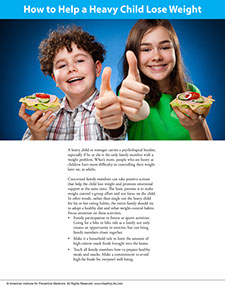
    Image of 2 kids holding a healthy snack in one hand and a thumbs up with the other hand.

    A heavy child or teenager carries a psychological burden, especially if he or she is the only family member with a weight problem. What’s more, people who are heavy as children have more difficulty in controlling their weight later on, as adults.

    Concerned family members can take positive actions that help the child lose weight and promote emotional support at the same time. The basic premise is to make weight control a group effort and not focus on the child. In other words, rather than single out the heavy child for his or her eating habits, the entire family should try to adopt a healthy diet and other weight-control habits. Focus attention on these activities.

    *  Family participation in fitness or sports activities. Going for a hike or bike ride as a family not only creates an opportunity to exercise, but can bring family members closer together.

    *  Make it a household rule to limit the amount of high-calorie snack foods brought into the home.

    *  Teach all family members how to prepare healthy meals and snacks. Make a commitment to avoid high-fat foods for everyone’s well-being.

    Page from A Year of Health Hints book by the American Institute for Preventive Medicine. www.HealthyLife.com. All rights reserved.

    © American Institute for Preventive Medicine

  • How To Buy Sports Shoes That Fit

    Fitness

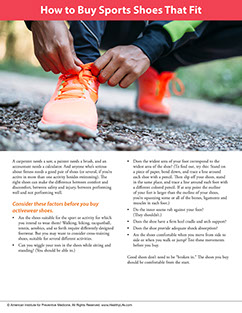
    Image of person lacing tennis shoe.

    A carpenter needs a saw, a painter needs a brush, and an accountant needs a calculator. And anyone who’s serious about fitness needs a good pair of shoes (or several, if you’re active in more than one activity besides swimming). The right shoes can make the difference between comfort and discomfort, between safety and injury, between performing well and not performing well.

    Consider these factors before you buy activewear shoes.

    *  Are the shoes suitable for the sport or activity for which you intend to wear them? Walking, hiking, racquetball, tennis, aerobics, and so forth require differently designed footwear. But you may want to consider cross-training shoes, suitable for several different activities.

    *  Can you wiggle your toes in the shoes while sitting and standing? (You should be able to.)

    *  Does the widest area of your foot correspond to the widest area of the shoe? (To find out, try this: Stand on a piece of paper, bend down, and trace a line around each shoe with a pencil. Then slip off your shoes, stand in the same place, and trace a line around each foot with a different colored pencil. If at any point the outline of your feet is larger than the outline of your shoes, you’re squeezing some or all of the bones, ligaments and muscles in each foot.)

    *  Do the inner seams rub against your foot? (They shouldn’t.)

    *  Does the shoe have a firm heel cradle and arch support?

    *  Does the shoe provide adequate shock absorption?

    *  Are the shoes comfortable when you move from side to side or when you walk or jump? Test these movements before you buy.

    Good shoes don’t need to be “broken in.” The shoes you buy should be comfortable from the start.

    Page image from A Year of Health Hints book by the American Institute for Preventive Medicine. www.HealthyLife.com. All rights reserved.

    © American Institute for Preventive Medicine

  • How Do I Procrastinate?

    Systematic Stress Management Program

    Step 6: Time Management

    Step 6: Time Management Section

    Introduction

    Does Time Get the Best of You?

    Defining Your Life Goals

    Activity Worksheet

    Activity Log

    Time Management Techniques

    Action Plan for Improving Time Usage

    Procrastination Quiz

    How Do I Procrastinate?

    One Dozen Ways to Overcome Procrastination

    Should You Delegate?

    Delegation Caddy

    Let Me Count the Ways

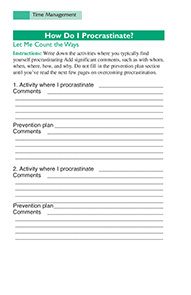
    Instructions: Write down the activities where you typically find yourself procrastinating Add significant comments, such as with whom, when, where, how, and why. Do not fill in the prevention plan section until you’ve read the next sections on overcoming procrastination. List 5 activities where you procrastinate. And, then list your prevention plan.

    Page from the Systematic Stress Management book by the American Institute for Preventive Medicine. www.HealthyLife.com. All rights reserved.

    © American Institute for Preventive Medicine
    Step 1: Understanding Stress

    Step 3: Type A & B Behavior Patterns

    Step 5: Thinking Differently

    Step 7: Communication & Stress

    Step 2: Stress Management at Work

    Step 4: Biofeedback Training & Relaxation

    Step 6: Time Management

    Steps to Systematic Stress Management™

    RELATED ARTICLES

    © American Institute for Preventive Medicine  –  All Rights Reserved.Disclaimer|www.HealthyLife.com

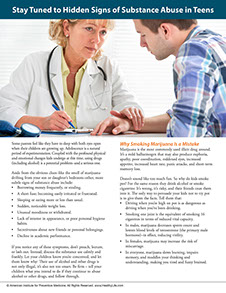
  • Hidden Signs Of Substance Abuse In Teens

    Substance Use & Abuse

    Some parents feel like they have to sleep with both eyes open when their children are growing up. Adolescence is a natural period of experimentation. Coupled with the profound physical and emotional changes kids undergo at this time, using drugs (including alcohol) is a potential problem-and a serious one.

    Aside from the obvious clues-like the smell of marijuana drifting from your son or daughter’s bedroom-other, more subtle signs of substance abuse include:

    *  Borrowing money frequently, or stealing.

    *  A short fuse; becoming easily irritated or frustrated.

    *  Sleeping or eating more or less than usual.

    *  Sudden, noticeable weight loss.

    *  Unusual moodiness or withdrawal.

    *  Lack of interest in appearance, or poor personal hygiene habits.

    *  Secretiveness about new friends or personal belongings.

    *  Decline in academic performance.

    If you notice any of these symptoms, don’t preach, lecture, or lash out. Instead, discuss the substance use calmly and frankly. Let your children know you’re concerned, and let them know why: Their use of alcohol and other drugs is not only illegal, it’s also not too smart. Be firm; tell your children what you intend to do if they continue to abuse alcohol or other drugs, and follow through.

    Warn Your Kids Not to Sniff Inhalants

    As unappealing as it may sound to adults, some children deliberately inhale the vapors from household products to produce a cheap and dangerous-yet legal-high. The sniffer’s repertoire includes glue, nail polish remover, paint, lacquer thinner, cleaning fluid, or plastic cement-precisely the types of products that usually carry a warning on the label saying, “Use in a well-ventilated area. Do not inhale fumes.”

    Alarmingly, the kids who are most likely to try this are usually about 12 years old. As parents, here’s what you can do.

    *  Look for signs of abuse-nausea, sneezing, coughing, disorientation, or evidence of hallucinations.

    *  Warn your child that deliberately sniffing toxic fumes can lead to leukemia, a fatal blood disease, or sudden death.

    Why Smoking Marijuana Is a Mistake

    Marijuana is the most commonly used illicit drug around. It’s a mild hallucinogen that may also produce euphoria, apathy, poor coordination, reddened eyes, increased appetite, increased heart rate, panic attacks, and short-term memory loss.

    Doesn’t sound like too much fun. So why do kids smoke pot? For the same reason they drink alcohol or smoke cigarettes: It’s wrong, it’s risky, and their friends coax them into it. The only way to persuade your kids not to try pot is to give them the facts. Tell them that:

    *  Driving when you’re high on pot is as dangerous as driving when you’ve been drinking.

    *  Smoking one joint is the equivalent of smoking 16 cigarettes in terms of reduced vital capacity.

    *  In males, marijuana decreases sperm count and lowers blood levels of testosterone (the primary male hormone)-in effect, reducing virility.

    *  In females, marijuana may increase the risk of miscarriage.

    *  In everyone, marijuana slows learning, impairs memory, and muddles your thinking and understanding, making you tired and fuzzy brained.

    Hopefully, marijuana won’t appeal to your youngsters once they realize how it affects their brains, lungs, hearts, and the rest of their bodies.

    Page from A Year of Health Hints book by the American Institute for Preventive Medicine. www.HealthyLife.com. All rights reserved.

    © American Institute for Preventive Medicine
  • Herbed Vegetable Combo

    Nutrition

    4 Servings, about 3/4 cup each

    Ingredients:

    2 Tbsp. water

    1 cup zucchini squash, thinly sliced

    1-1/4 cups yellow squash, thinly sliced

    1/2 cup green pepper, cut into 2 inch strips

    1/4 cup celery, cut into 2 inch strips

    1/4 cup onion, chopped

    1/2 tsp. caraway seed

    1/8 tsp. garlic powder

    1 medium tomato, cut into 8 wedges

    Directions:

    1.  Heat water in large fry pan. Add squash, green pepper, celery, and onion.

    2.  Cover and cook over moderate heat until vegetables are tender-crisp, about 4 minutes. Sprinkle seasonings over vegetables.

    3.  Top with tomato wedges. Cover and cook over low heat until tomato wedges are just heated, about 2 minutes.

    Per Serving:

    Calories – 25

    Total fat – Trace

    Sodium – 11 mg

    Page from HealthyLife Weigh Recipe book by the American Institute for Preventive Medicine. www.HealthyLife.com. All rights reserved.

    © American Institute for Preventive Medicine
  • Get Help For Addictive Behaviors

    Substance Use & Abuse

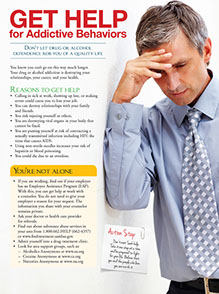
    Image of counseling group.

    Don’t let drug or alcohol dependence rob you of a quality life.

    You know you can’t go on this way much longer. Your drug or alcohol addiction is destroying your relationships, your career, and your health.

    Reasons to get help:

    *  Calling in sick at work, showing up late, or making errors could cause you to lose your job.

    *  You can destroy relationships with your family and friends.

    *  You risk injuring yourself or others.

    *  You are destroying vital organs in your body that cannot be fixed.

    *  You are putting yourself at risk of contracting a sexually transmitted infection including HIV, the virus that causes AIDS.

    *  Using non-sterile needles increases your risk of hepatitis or blood poisoning.

    *  You could die due to an overdose.

    You’re not alone

    *  If you are working, find out if your employer has an Employee Assistance Program (EAP). With this, you can get help at work with a counselor. You do not need to give your employer a reason for your request. The information you share with your counselor remains private.

    *  Ask your doctor or health care provider  for referrals.

    *  Find out about substance abuse services in your area from 1.800.662.HELP (662-4357) orwww.findtreatment.samhsa.gov.

    *  Admit yourself into a drug treatment clinic.

    *  Look for area support groups, such as:

    – Alcoholics Anonymous atwww.aa.org

    – Cocaine Anonymous atwww.ca.org

    – Narcotics Anonymous atwww.na.org

    Action Step

    Don’t wait. Seek help. Take it one step at a time and be prepared to fight for your life. Believe that you and the people who love you are worth it.

    Page from Ways to Well-Being book by the American Institute for Preventive Medicine. www.HealthyLife.com. All rights reserved.

    © American Institute for Preventive Medicine
  • Healthy Weight

    Weight Control

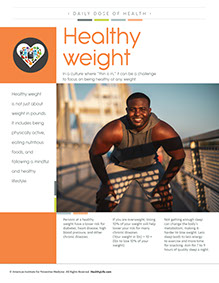
    Smiling man outside exercising.

    In a culture where “thin is in,” it can be a challenge to focus on being healthy at any weight.

    Healthy weight is not just about weight in pounds. It includes being physically active, eating nutritious foods, and following a mindful and healthy lifestyle.

    Persons at a healthy weight have a lower risk for diabetes, heart disease, high blood pressure, and other chronic diseases.

    If you are overweight, losing 10% of your weight will help lower your risk for many

    chronic diseases.

    (Your weight in lbs) ÷ 10 =

    (lbs to lose 10% of your weight)

    Not getting enough sleep can change the body’s metabolism, making it harder to lose weight. Less sleep leads to less energy to exercise and more time for snacking. Aim for 7 to 9 hours of quality sleep a night.

    Page from HealthyLife Weigh book by the American Institute for Preventive Medicine. www.HealthyLife.com. All rights reserved.

    © American Institute for Preventive Medicine