Blog

  • Define Your Exercise Goals

    Fitness

    Your goals are about you and for you. Other people’s fitness goals should not interfere with ones you set for yourself.

    *  Write down your goals.

    *  Your goals need to be clear and measurable. In other words, will they be easy to identify and actually reach? Clearly defined goals are more readily achieved.

    *  Review and adjust your goals as needed. It is not uncommon to change goals.

    *  Although this may seem time consuming, it will help you reach your goals. Unwritten goals tend to be vague and easy to forget.

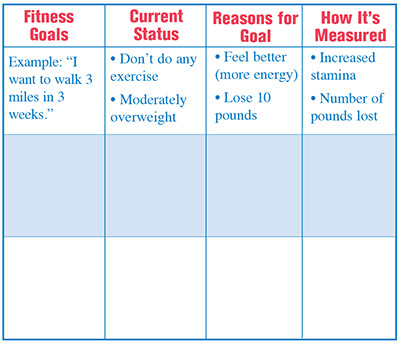
    Write Down Your Short-Term Goals

    Chart showing how to track your short term goals.

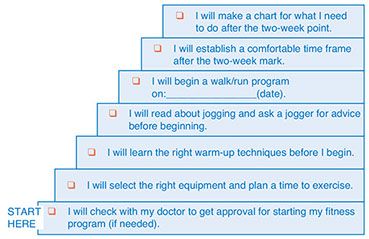
    Write Down Your Long-Range Goals

    Read the following example: “I want to increase my endurance level so that I can run in a 5 Kilometer race 6 months from now.

    Resources

    CDC (Center for Disease Control and Prevention)

    800.CDC.INFO (232.4636)

    www.cdc.gov

    Healthfinder.gov

    www.healthfinder.gov

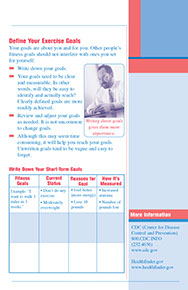
    Page image from the HealthyLife Weigh book by the American Institute for Preventive Medicine. www.HealthyLife.com. All rights reserved.

    © American Institute for Preventive Medicine

  • Define Your Life Goals

    Systematic Stress Management Program

    Step 6: Time Management

    Step 6: Time Management Section

    Introduction

    Does Time Get the Best of You?

    Defining Your Life Goals

    Activity Worksheet

    Activity Log

    Time Management Techniques

    Action Plan for Improving Time Usage

    Procrastination Quiz

    How Do I Procrastinate?

    One Dozen Ways to Overcome Procrastination

    Should You Delegate?

    Delegation Caddy

    The first step in time management is learning to set goals – and reach them. Writing goals on paper helps clarify what’s important to you. This activity provides both a clearer view of your priorities and an organized approach to handling daily events. Unwritten goals tend to be vague and easy to forget. Identify your goals and then write them down in each category. Consider the following areas when writing goals:

    *  Personal

    *  Career

    *  Family

    *  Spiritual

    *  Leisure Time

    *  Education

    1. Long Range

    List your lifetime goals and prioritize them.

    2. Mid Range

    List and prioritize your goals for the next 3 – 5 years.

    3. Short Term

    List and prioritize your goals as if you had just six months to live.

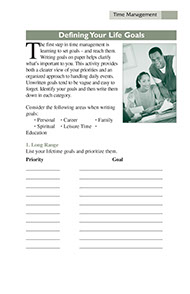
    Page from the Systematic Stress Management book by the American Institute for Preventive Medicine. www.HealthyLife.com. All rights reserved.

    © American Institute for Preventive Medicine

    Step 1: Understanding Stress

    Step 3: Type A & B Behavior Patterns

    Step 5: Thinking Differently

    Step 7: Communication & Stress

    Step 2: Stress Management at Work

    Step 4: Biofeedback Training & Relaxation

    Step 6: Time Management

    Steps to Systematic Stress Management™

    RELATED ARTICLES

    © American Institute for Preventive Medicine  –  All Rights Reserved.Disclaimer|www.HealthyLife.com

  • Dash Eating Plan

    Nutrition

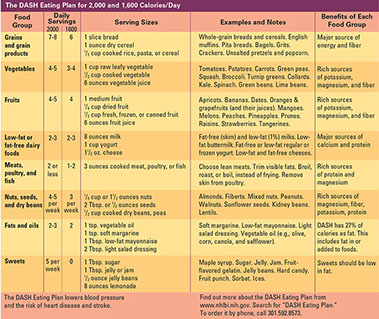
    DASH stands for Dietary Approach to Stop Hypertension. Research shows that following the DASH eating plan can help prevent and lower high blood pressure. This eating plan is rich in:

    *  Fruits and vegetables

    *  Fat-free or low-fat milk and milk products

    *  Whole grains

    *  Fish, poultry, beans, seeds, and nuts

    *  Potassium, magnesium, calcium, and fiber. These nutrients are linked with lowering blood pressure.

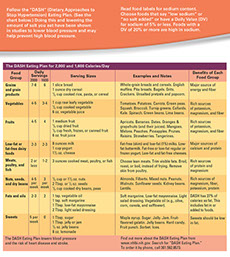
    Dash eating plan chart.

    Resources

    Get more information, including menus and recipes for different-calorie DASH Eating Plans, fromwww.nhlbi.nih.gov. Search for “DASH Eating Plan.”

    Healthy Eating brochure by the American Institute for Preventive Medicine. www.HealthyLife.com. All rights reserved.

    © American Institute for Preventive Medicine

  • Dance With Or Without The Stars

    Fitness

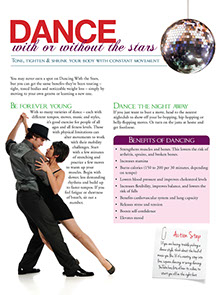
    Image of older couple ballroom dancing.

    Tone, tighten & shrink your body with constant movement.

    You may never earn a spot on Dancing With the Stars, but you can get the same benefits they’ve been touting – tight, toned bodies and noticeable weight loss – simply by moving to your own groove or learning a new one.

    Be forever young.

    With so many varieties of dance – each with different tempos, moves, music and styles, it’s good exercise for people of all ages and all fitness levels. Those with physical limitations can alter movements to work with their mobility challenges. Start with a few minutes of stretching and practice a few moves to warm up your muscles. Begin with slower, less demanding rhythms and build up to faster tempos. If you feel fatigue or shortness of breath, sit out a number.

    Dance the night away.

    If you just want to bust a move, head to the nearest nightclub to show off your be-bopping, hip-hopping or belly-flopping moves. Or turn on the jams at home and  get footloose.

    Benefits of dancing

    *  Strengthens muscles and bones. This lowers the risk of arthritis, sprains, and broken bones.

    *  Increases stamina

    *  Burns calories (150 to 200 per 30 minutes, depending on tempo)

    *  Lowers blood pressure and improves cholesterol levels

    *  Increases flexibility, improves balance, and lowers the risk of falls

    *  Benefits cardiovascular system and lung capacity

    *  Releases stress and tension

    *  Boosts self-confidence

    *  Elevates mood

    Action Step

    If you are having trouble picking a dance style, think about the kind of music you like. If it’s country, step into line, square dancing, or swing dancing. YouTube has lots of how-to videos to start you off on the right foot.

    Page image from Ways to Well-Being book by the American Institute for Preventive Medicine. www.HealthyLife.com. All rights reserved.

    © American Institute for Preventive Medicine

  • Control Portion Sizes

    Weight Control

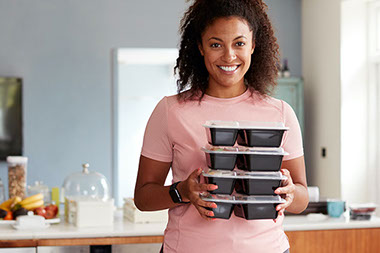
    Smiling women holding 4 pre-prepped meals.

    It’s all about portion control!

    *  First, learn how much food you need. Get a personalized MyPlate Plan atmyplate.gov/eat-healthy/what-is-myplatethat identifies how many cups, ounces, etc. of different foods you should eat for your daily needs.

    *  Use measuring cups, spoons, etc.

    *  Estimate portions. One cup of cereal is about the size of 2 hands, cupped. Three ounces of meat is about the size of a computer mouse. One Tbsp. is the size of 1 thumb.

    *  Limit second helpings, especially of foods high in fat and sugar.

    Page from HealthyLife Weigh book by the American Institute for Preventive Medicine. www.HealthyLife.com. All rights reserved.

    © American Institute for Preventive Medicine

  • Control Your Cholesterol & Triglycerides

    Nutrition

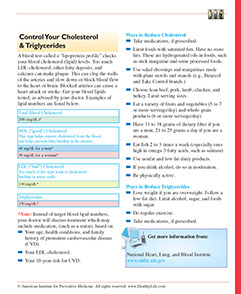
    A blood test called a “lipoprotein profile” checks your blood cholesterol (lipid) levels. Too much LDL-cholesterol, other fatty deposits, and calcium can make plaque. This can clog the walls of the arteries and slow down or block blood flow to the heart or brain. Blocked arteries can cause a heart attack or stroke. Get your blood lipids tested, as advised by your doctor. Examples of lipid numbers are listed below.

    *Note: Instead of target blood lipid numbers, your doctor will discuss treatment which may include medication, (such as a statin), based on:

    *  Your age, health conditions, and family history of premature cardiovascular disease (CVD).

    *  Your LDL-cholesterol.

    *  Your 10-year risk for CVD.

    Ways to Reduce Cholesterol

    *  Take medications, if prescribed.

    *  Limit foods with saturated fats. Have no trans fats. These are hydrogenated oils in foods, such as stick margarine and some processed foods.

    *  Use salad dressings and margarines made with plant sterols and stanols (e.g., Benecol and Take Control brands.)

    *  Choose lean beef, pork, lamb, chicken, and turkey. Limit serving sizes.

    *  Eat a variety of fruits and vegetables (5 to 7 or more servings/day) and whole-grain products (6 or more servings/day).

    *  Have 31 to 38 grams of dietary fiber if you are a man; 21 to 25 grams a day if you are a woman.

    *  Eat fish 2 to 3 times a week (especially ones high in omega-3 fatty acids, such as salmon).

    *  Use nonfat and low-fat dairy products.

    *  If you drink alcohol, do so in moderation.

    *  Be physically active.

    Ways to Reduce Triglycerides

    *  Lose weight if you are overweight. Follow a low-fat diet. Limit alcohol, sugar, and foods with sugar.

    *  Get regular exercise.

    *  Take medications, if prescribed.

    Resources

    National Heart, Lung, and Blood Institute

    www.nhlbi.nih.gov

    Page from Healthier at Home book by the American Institute for Preventive Medicine. www.HealthyLife.com. All rights reserved.

    © American Institute for Preventive Medicine