Blog

  • Assertiveness Training – The L.A.D.D.E.R. Technique

    Systematic Stress Management Program

    Step 7: Communication & Stress Section

    Introduction

    What is Your Ear-Q?

    Ten Blocks to Effective Listening

    Listening Blocks in My Life

    Skills for Active Listening

    Improving Your Ear-Q

    Assertiveness

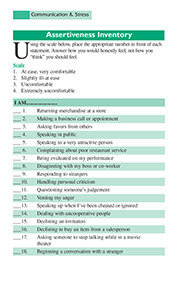
    Assertiveness Inventory

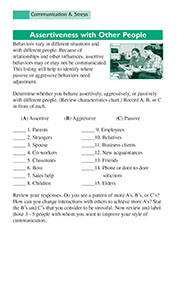
    Assertiveness with Other People

    The Benefits of Assertiveness

    Assertiveness Training – The L.A.D.D.E.R. Technique

    My Practice L.A.D.D.E.R.

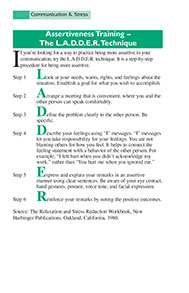
    If you’re looking for a way to practice being more assertive in your communication, try the L.A.D.D.E.R. technique. It is a step-by-step procedure for being more assertive.

    Step 1

    Look at your needs, wants, rights, and feelings about the situation. Establish a goal for what you wish to accomplish.

    Step 2

    Arrange a meeting that is convenient, where you and the other person can speak comfortably.

    Step 3

    Define the problem clearly to the other person. Be specific.

    Step 4

    Describe your feelings using “I” messages. “I” messages let you take responsibility for your feelings. You are not blaming others for how you feel. It helps to connect the feeling statement with a behavior of the other person. For example, “I felt hurt when you didn’t acknowledge my work.” rather than “You hurt me when you ignored me.”

    Step 5

    Express and explain your remarks in an assertive manner using clear sentences. Be aware of your eye contact, hand gestures, posture, voice tone, and facial expression.

    Step 6

    Reinforce your remarks by noting the positive outcomes.

    Page from the Systematic Stress Management book by the American Institute for Preventive Medicine. www.HealthyLife.com. All rights reserved.

    © American Institute for Preventive Medicine

    Step 1: Understanding Stress

    Step 3: Type A & B Behavior Patterns

    Step 5: Thinking Differently

    Step 7: Communication & Stress

    Step 2: Stress Management at Work

    Step 4: Biofeedback Training & Relaxation

    Step 6: Time Management

    Steps to Systematic Stress Management™

    RELATED ARTICLES

    © American Institute for Preventive Medicine  –  All Rights Reserved.Disclaimer|www.HealthyLife.com

  • Are You A Type B?

    Systematic Stress Management Program

    Step 3: Type A & B Behavior Section

    Introduction

    Are You a Type A?

    Self Inventory of Type A Behaviors

    Are You a Type B?

    Take Steps to Become Type B

    12 Ways to Develop a Trusting Heart

    Reducing Time Urgency

    Type A Behavior Worksheet

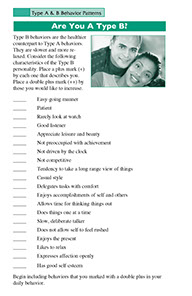
    Image of smiling man.

    Type B behaviors are the healthier counterpart to Type A behaviors. They are slower and more relaxed. Consider the following characteristics of the Type B personality. Place a plus mark (+) by each one that describes you. Place a double plus mark (++) by those you would like to increase.

    *  Easy-going manner

    *  Patient

    *  Rarely look at watch

    *  Good listener

    *  Appreciate leisure and beauty

    *  Not preoccupied with achievement

    *  Not driven by the clock

    *  Not competitive

    *  Tendency to take a long range view of things

    *  Casual style

    *  Delegates tasks with comfort

    *  Enjoys accomplishments of self and others

    *  Allows time for thinking things out

    *  Does things one at a time

    *  Slow, deliberate talker

    *  Does not allow self to feel rushed

    *  Enjoys the present

    *  Likes to relax

    *  Expresses affection openly

    *  Has good self-esteem

    Begin including behaviors that you marked with a double plus in your daily behavior.

    Page from the Systematic Stress Management book by the American Institute for Preventive Medicine. www.HealthyLife.com. All rights reserved.

    © American Institute for Preventive Medicine

    Step 1: Understanding Stress

    Step 3: Type A & B Behavior Patterns

    Step 5: Thinking Differently

    Step 7: Communication & Stress

    Step 2: Stress Management at Work

    Step 4: Biofeedback Training & Relaxation

    Step 6: Time Management

    Steps to Systematic Stress Management™

    RELATED ARTICLES

    © American Institute for Preventive Medicine  –  All Rights Reserved.Disclaimer|www.HealthyLife.com

  • Are You Type A?

    Systematic Stress Management Program

    Step 3: Type A & B Behavior Section

    Introduction

    Are You a Type A?

    Self Inventory of Type A Behaviors

    Are You a Type B?

    Take Steps to Become Type B

    12 Ways to Develop a Trusting Heart

    Reducing Time Urgency

    Type A Behavior Worksheet

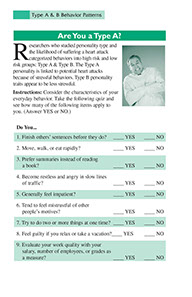
    Researchers who studied personality type and the likelihood of suffering a heart attack categorized behaviors into high risk and low risk groups: Type A & Type B. The Type A personality is linked to potential heart attacks because of stressful behaviors. Type B personality traits appear to be less stressful.

    Instructions: Consider the characteristics of your everyday behavior. Take the following quiz and see how many of the following items apply to you. (Answer YES or NO.)

    Do You…

    1.  Finish others’ sentences before they do?

    2.  Move, walk, or eat rapidly?

    3.  Prefer summaries instead of reading a book?

    4.  Become restless and angry in slow lines of traffic?

    5.  Generally feel impatient?

    6.  Tend to feel mistrustful of other people’s motives?

    7.  Try to do two or more things at one time?

    8.  Feel guilty if you relax or take a vacation?

    9.  Evaluate your work quality with your salary, number of employees, or grades as a measure?

    10. Schedule more and more activities into less and less time?

    11. Think about other things while talking to someone?

    12. Show nervous gestures, like grinding your teeth, clenching fists, or drumming fingers?

    13. Assume more than your share of responsibility?

    14. Accentuate words in conversation when there is no reason?

    15. Do a slow burn when service is not up to par?

    Total # yes responses: _____

    Scoring: If you answered “Yes” to ten or more, then claim your “A” for “Type A” behavior. However, this is one of the few times when an “A” is the lowest grade.

    Page from the Systematic Stress Management book by the American Institute for Preventive Medicine. www.HealthyLife.com. All rights reserved.

    © American Institute for Preventive Medicine

    Step 1: Understanding Stress

    Step 3: Type A & B Behavior Patterns

    Step 5: Thinking Differently

    Step 7: Communication & Stress

    Step 2: Stress Management at Work

    Step 4: Biofeedback Training & Relaxation

    Step 6: Time Management

    Steps to Systematic Stress Management™

    RELATED ARTICLES

    © American Institute for Preventive Medicine  –  All Rights Reserved.Disclaimer|www.HealthyLife.com

  • Read Food Labels

    Nutrition

    Information on food labels can help you choose healthy foods. What do you look for?

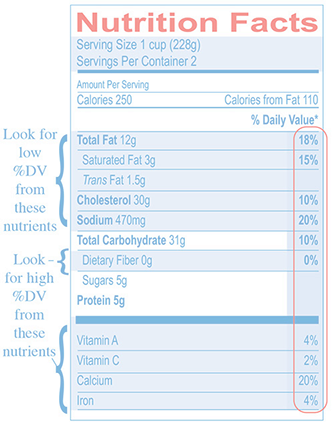
    A. Read the “Nutrition Facts”

    Look at serving size and how many servings are in the product. Serving sizes are given in familiar units, such as cups or pieces. This is followed by the metric amount (e.g., the number of grams). Serving sizes are often based on the amount of food people typically eat.

    B. Read calories per serving

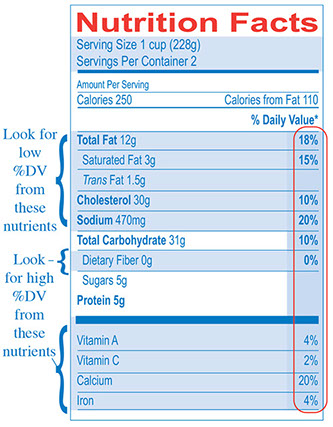
    Calories tell you how much energy you get from a serving of this food. The label also tells you how many of the calories in one serving come from fat. In the example, there are 250 calories in a serving of this macaroni and cheese; 110 calories are from fat. This means almost half of the calories come from fat.

    C. Look at the nutrients per serving

    The nutrients listed first are the ones people eat enough, or too much of. Eating too much saturated and trans fats or too much sodium may increase your risk of heart disease, some cancers, and high blood pressure.

    Most people don’t get enough dietary fiber, vitamin A, vitamin C, calcium, and iron in their diets. Eating enough of these nutrients can improve your health and help reduce the risk of some diseases and conditions. For example, getting enough calcium can reduce the risk of osteoporosis, in which bones become brittle and break as one ages.

    D. Look at Percent Daily Value (%DV)

    Daily Values (DVs) are a way to tell if a food is high or low in nutrients. In general 5% DV or less is low in a nutrient; 20% or more is high in a nutrient.

    The Percent Daily Value (%DV) on food labels is based on a 2000 calorie diet. This means that they are not exact for what Daily Values are for 1200-1300, 1500-1600, and 1800 calorie diets. So, use food label %DVs as a general guide to see if a food gives any nutrients for the calories it has.

    Quick Tip

    In general, look for foods that have low %DV for total fat, saturated fat, cholesterol, and sodium. Balance foods that have 20% or more of these with ones that have 5% DV or less.

    In general, look for foods that have 20% or more for fiber and/or at least one of the vitamins and iron or other minerals that can be listed.

    Compare Nutrition Facts for Three Cereals

    After comparing these three labels, which cereal would you choose?

    One advantage for all three is that they are a set portion (a small box that is one serving size). Overall, the wheat squares may be the best choice based on the nutrients you get for the calories it has. It would even be better to choose wheat squares that are not sweetened. The same serving size would have less added sugar and calories. Corn flakes is also a good choice. One serving has 70 calories. This is close to the amount of calories in 1 serving of grains & starches (80 calories).

    Can These Meals Be Part of a Healthy Daily Diet?

    Besides looking at saturated fat, of the two choices, the Deluxe Combo Pizza has more dietary fiber (6g) and less sodium (550mg).

    Four Cheese Pizza:

    This choice is harder to fit into a healthy diet. One serving (the whole pizza) uses 50% of a daily saturated fat allowance, leaving only 50% for all other foods and drinks that day.

    Deluxe Combo Pizza:

    This meal is easier to fit into a healthy diet. One serving (the whole pizza), gives 18% of a daily saturated fat allowance. This leaves 82% for all other foods and drinks that day.

    Is this a Healthy Snack Food?

    Answer: The good thing about this snack food is that it does not have trans fat. This is because it has vegetable oil, not “hydrogenated” vegetable oil. It does, though, have 250 calories and 12 grams of fat. That is a lot for a snack. Eat foods like this less often. Make 2 or 3 servings out of this individual snack bag, too.

    Ingredient List

    This lists what’s in the food from most to least by weight. There is more of the first ingredient than the second and so on. Choose foods that list acceptable ingredients first, second, and third. Also, check the list for ingredients that you may be allergic or sensitive to, such as milk, eggs, peanuts, and wheat.

    Preparation Instructions

    Look at the instructions on package directions. You can change the way the food is prepared to lower total fat, saturated fat, and sodium, as well as to increase nutrients, such as fiber and vitamin C.

    Open Dating

    Look at this so you won’t buy food items that are spoiled or will spoil before you use them. Buy them before “sell by” or “expiration date,” which is the last date the product should be used.

    Resources

    Food and Drug Administration (FDA)

    www.fda.gov
    Page from HealthyLife Weigh book by the American Institute for Preventive Medicine. www.HealthyLife.com. All rights reserved.

    © American Institute for Preventive Medicine

  • An Easy Guide For Healthy Eating

    Nutrition

    Image of women eating a healthy salad.

    Get your plate and body in shape.

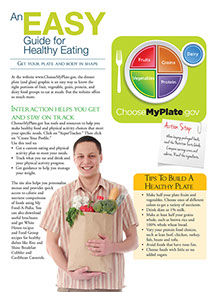
    At the websitewww.ChooseMyPlate.gov, the dinner plate (and glass) graphic is an easy way to know the right portions of fruit, vegetable, grain, protein, and dairy food groups to eat at meals. But the website offers so much more.

    Interaction Helps You Get and Stay On Track

    ChooseMyPlate.govhas tools and resources to help you make healthy food and physical activity choices that meet your specific needs. Click on “SuperTracker.” Then click on “Create Your Profile.” Use this tool to:

    *  Get a custom eating and physical activity plan to meet your needs.

    *  Track what you eat and drink and your physical activity progress.

    *  Get guidance to help you manage your weight.

    The site also helps you personalize menus and provides quick access to calorie and nutrient comparisons of foods using My Food-A-Pedia. You can also download useful brochures and get White House recipes and Food Group recipes for healthy dishes like Rise and Shine Breakfast Cobbler and Caribbean Casserole.

    Tips to build a healthy plate

    *  Make half your plate fruits and vegetables. Choose ones of different colors to get a variety of nutrients.

    *  Drink skim or 1% milk.

    *  Make at least half your grains whole, such as brown rice and 100% whole wheat bread.

    *  Vary your protein food choices, such as lean beef, chicken, turkey, fish, beans and tofu.

    *  Avoid foods that have trans fats.

    *  Choose foods with little or no added sugars.

    Action Step

    When buying packaged foods, read the Nutrition Facts labels. Compare serving sizes and calories. Read the ingredients.

    Page from Ways to Well-Being book by the American Institute for Preventive Medicine. www.HealthyLife.com. All rights reserved.

    © American Institute for Preventive Medicine

  • An Apple A Day Isn’t Enough!®

    Nutrition

    Women singing into a wooden spoon with a table filled with vegetables.

    Eating healthy foods is one of many steps to good health!

    *  Aim for 7 to 8 hours of quality sleep a night.

    *  Do regular exercise. Avoid sitting for long periods.

    *  Wash your hands often to lessen the chance of picking up cold and flu viruses and other germs.

    *  Maintain a healthy weight.

    *  Balance work and play.

    *  Have regular screening tests and exams, as advised by your doctor.

    Page from HealthyLife Weigh book by the American Institute for Preventive Medicine. www.HealthyLife.com. All rights reserved.

    © American Institute for Preventive Medicine

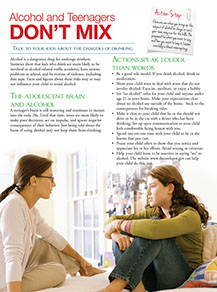
  • Alcohol & Teenagers Don’t Mix

    Substance Use & Abuse

    Talk to your kids about the dangers of drinking.

    Alcohol is a dangerous drug for underage drinkers. Statistics show that kids who drink are more likely to be involved in alcohol-related traffic accidents, have serious problems at school, and be victims of violence, including date rape. Facts and figures about these risks may or may not influence your child to avoid alcohol.

    Actions speak louder than words.

    *  Be a good role model. If you drink alcohol, drink in moderation.

    *  Show your child ways to deal with stress that do not involve alcohol. Exercise, meditate, or enjoy a hobby.

    *  Set “no alcohol” rules for your child and anyone under age 21 in your home. Make your expectations clear about no alcohol use outside of the home. Stick to the consequences for breaking rules.

    *  Make it clear to your child that he or she should not drive or be in the car with a driver who has been drinking. Set up open communication so your child feels comfortable being honest with you.

    *  Spend one-on-one time with your child so he or she knows that you care.

    *  Praise your child often to show that you notice and appreciate his or her efforts. Avoid teasing or criticism.

    *  Help your child learn to be assertive in saying “no” to alcohol. The websitewww.thecoolspot.govcan help your child do this, too.

    The adolescent brain and alcohol:

    A teenager’s brain is still maturing and continues to mature into the early 20s. Until that time, teens are more likely to make poor decisions, act on impulse, and ignore negative consequences of their behavior. Just being told about the harm of using alcohol may not keep them from drinking.

    Action Step

    Chances are when you bring up the subject of alcohol (or drugs or sex); your teen may run for the hills. Be prepared for what you want to say and how you want to say it. Listen carefully without interrupting.

    Page from Ways to Well-Being book by the American Institute for Preventive Medicine. www.HealthyLife.com. All rights reserved.

    © American Institute for Preventive Medicine

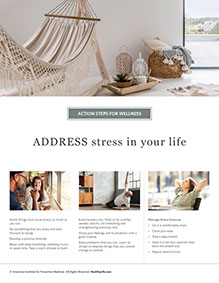
  • Addressstress In Your Life

    Stress Management

    Indoor hammack.

    *  Avoid things that cause stress, as much as you can.

    *  Do something that you enjoy and look forward to doing.

    *  Develop a positive attitude.

    *  Relax with deep breathing, soothing music, or quiet time. Take a warm shower or bath.

    *  Exercise every day. Walk or do another aerobic activity. Do stretching and strengthening exercises, too.

    *  Share your feelings and frustrations with a good listener.

    *  Solve problems that you can. Learn to accept or tolerate things that you cannot change or control.

    Manage Stress Exercise

    *  Sit in a comfortable chair.

    *  Close your eyes.

    *  Take a deep breath.

    *  Hold it in for four seconds then blow the breath out.

    *  Repeat several times.

    Page from HealthyLife Weigh book by the American Institute for Preventive Medicine. www.HealthyLife.com. All rights reserved.

    © American Institute for Preventive Medicine