
Tag: addiction

  • Recognize Addiction

    Substance Use & Abuse

    How to tell if you have a drinking or drug problem.

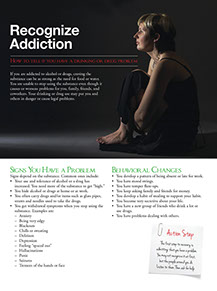
    If you are addicted to alcohol or drugs, craving the substance can be as strong as the need for food or water. You are unable to stop using the substance even though it causes or worsens problems for you, family, friends, and coworkers. Your drinking or drug use may put you and others in danger or cause legal problems.

    Signs You Have a Problem:

    Signs depend on the substance. Common ones include:

    *  Your use and tolerance of alcohol or a drug has increased. You need more of the substance to get “high.”

    *  You hide alcohol or drugs at home or at work.

    *  You often carry drugs and/or items such as glass pipes, straws and needles used to take the drugs.

    *  You get withdrawal symptoms when you stop using the substance. Examples are:

    – Anxiety

    – Being very edgy

    – Blackouts

    – Chills or sweating

    – Delirium

    – Depression

    – Feeling “spaced out”

    – Hallucinations

    – Panic

    – Seizures

    – Tremors of the hands or face

    Behavioral Changes:

    *  You develop a pattern of being absent or late for work.

    *  You have mood swings.

    *  You have temper flare-ups.

    *  You keep asking family and friends for money.

    *  You develop a habit of stealing to support your habit.

    *  You become very secretive about your life.

    *  You have a new group of friends who drink a lot or  use drugs.

    *  You have problems dealing with others.

    Action Step

    The first step to recovery is admitting that you have a problem. You may not recognize it at first, but the people around you do. Listen to them. Then ask for help.

    Page from Ways to Well-Being book by the American Institute for Preventive Medicine. www.HealthyLife.com. All rights reserved.

    © American Institute for Preventive Medicine
  • Are You Addicted To Shopping?

    WELL-BEING

    Image of couple holding shopping bags.

    Whether you like to look at clothing, housewares, tools, or electronics, shopping is a favorite pastime for many people. As the holidays approach, shopping becomes even more popular. Big sales, special deals, and promotions all seek to get more people to buy, buy, buy.

    But for some people, shopping is more than just fun around the holidays. It can actually be an addiction, according to the National Institute on Alcohol Abuse and Alcoholism.

    Signs of Shopping Addiction

    Many people think addiction is only for drugs and alcohol. But many behaviors including shopping can become an addiction. Access to online shopping can make the problem worse. You can buy whatever you want from the privacy of your home and just a few mouse clicks.

    It can be difficult to know if you just like to shop, or if it’s really a problem. If three or more of these statements apply to you, you may be addicted to shopping:

    *  You frequently buy things you don’t need.

    *  You have many unopened packages of items or clothing with the tags still on.

    *  You purchase things you can’t afford by using credit cards.

    *  You hide your purchases from your spouse or family.

    *  You feel a strong need to shop when you’re sad, angry, or anxious.

    *  You have secret credit cards or open new cards when others ones are maxed out.

    *  You think obsessively about shopping and money.

    *  You buy much more than planned, and feel guilty or ashamed afterward.

    *  Your relationships with family or friends have been affected by your shopping.

    © American Institute for Preventive Medicine

  • Casual Smokers At Risk

    MEDICAL NEWS

    Image of a person placing on a nicotine patch.

    People who smoke just a few cigarettes a day are exposed to the same serious health risks as heavier smokers, breaking a common myth that social or casual smoking is somehow safe or that they can easily quit.

    Casual smokers who smoke between 1 and 4 cigarettes a day, are tripling their risk of dying of heart disease and lung cancer, according to Dr. Robin J. Mermelstein, a clinical psychologist and director of the Center for Health Behavior Research at the University of Illinois at Chicago who specializes in smoking cessation counseling. Light smokers represent about 7 million of the U.S. smoking population.

    For light smokers looking to quit and stay smoke-free, Dr. Mermelstein offers the following advice:

    *Think about the reasons you smoke.It will give you a clearer path to quitting. Does smoking relieve stress? Is it a large part of your social life?

    *Get your head in the game.Get support products like nicotine replacement therapy and online help. Customized online support services provide encouragement to help you break your behavioral and psychological link to cigarettes and is proven effective in helping smokers quit.

    *Choose nicotine replacement that’s right for you.Lighter smokers may be less likely to use nicotine replacement therapy to help them quit, which means they could be setting themselves up for failure. Nicotine replacement therapies are clinically proven to reduce the physical withdrawal symptoms like cigarette cravings and can double a smoker’s chance of quitting successfully.

    For light smokers or heavier smokers, research shows the most successful approach to quitting is a combination of medicine, such as nicotine replacement patches, that can help reduce the physical cravings of nicotine, and behavioral strategies that help smokers cope with those triggers to light up. Your employer may offer some of these options.

    © American Institute for Preventive Medicine
  • Rx Painkiller Deaths On The Rise

    MEDICAL NEWS

    Image of open pill bottle with 3 pills next to the bottle.

    From 1999 to 2010, deaths from prescription pain relief drugs increased more than 400 percent in women and 265 percent in men. These facts are from a recent report from the Centers for Disease Control and Prevention (CDC).

    “Prescription painkiller deaths have skyrocketed in women (6,600 in 2010), four times as many as died from cocaine and heroin combined,” said CDC Director Tom Frieden, M.D., M.P.H. “Stopping this epidemic in women – and men – is everyone’s business. Doctors need to be cautious about prescribing and patients about using these drugs.”

    Use Rx pain relief medicines wisely

    *  Let your doctor know about all prescribed and OTC medicines you take. This includes ones that treat depression, anxiety, or sleep problems. It includes vitamins and herbal products, too.

    *  Ask your doctor the risk of addiction when he or she prescribes sleeping pills, strong painkillers, etc. Find out how long you should take the medicines. Ask if there are ways to help treat your problem without them.

    *  Find out how much alcohol, if any, can be taken with your prescribed medicines.

    *  Follow the guidelines that your doctor and pharmacist provide with every prescription.

    *  Do not take another person’s prescribed medicines.

    *  Do not share your medicines with others.

    © American Institute for Preventive Medicine