Tag: Alternative & Holistic Medicine

  • Telehealth: What To Know

    MEDICAL NEWS

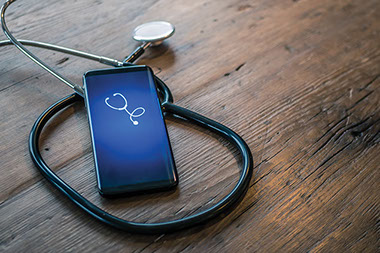
    Phone and stethoscope.

    Telehealth or telemedicine uses video calls or other technology to help you see your doctor. This allows you to have medical appointments from home instead of going to the doctor’s office.

    Getting ready

    If you want to use telehealth, but don’t know how, contact your doctor’s office. Different doctors and hospitals use different apps and technology for their telemedicine appointments. Ask them for instructions on how to get set up.

    Before your appointment, check with your insurance company about coverage for telehealth appointments. Prepare a list of questions to ask your doctor so you’ll be sure to cover everything.

    If you need help

    If you’re feeling overwhelmed, ask a tech-savvy friend or family member to help. Usually, you only need:

    1.  A strong internet connection. Your connection needs to be fast enough for video chats.

    2.  A smartphone, tablet or computer that connects to your wi-fi and has a working microphone, speaker and camera. Most newer devices have all of these built in.

    Telehealth can be a safe and convenient way to have your medical appointments. Don’t be intimidated by technology. With a little help, you can be up and running – and it may become your favorite way to have your doctor visits!

    Source: National Institutes on Aging
    © American Institute for Preventive Medicine

  • Alternative Medicine Systems

    Alternative Medicine

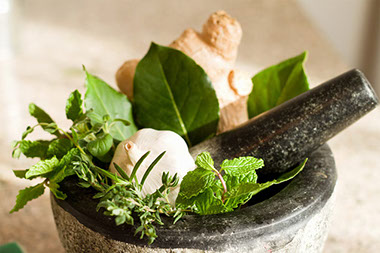
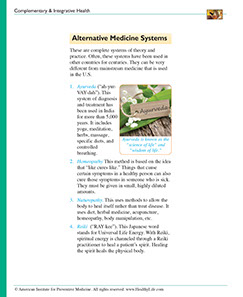
    Image of leaf with tag that has the word "Ayurveda"

    These are complete systems of theory and practice. Often, these systems have been used in other countries for centuries. They can be very different from mainstream medicine that is used in the U.S.

    1.  Ayurveda (“ah-yur-VAY-dah”). This system of diagnosis and treatment has been used in India for more than 5,000 years. It includes yoga, meditation, herbs, massage, specific diets, and controlled breathing.

    2.  Homeopathy This method is based on the idea that “like cures like.” Things that cause certain symptoms in a healthy person can also cure those symptoms in someone who is sick. They must be given in small, highly diluted amounts.

    3.  Naturopathy. This uses methods to allow the body to heal itself rather than treat disease. It uses diet, herbal medicine, acupuncture, homeopathy, body manipulation, etc.

    4.  Reiki  (“RAY-kee”). This Japanese word stands for Universal Life Energy. With Reiki, spiritual energy is channeled through a Reiki practitioner to heal a patient’s spirit. Healing the spirit heals the physical body.

    Page from the Healthier at Home book by the American Institute for Preventive Medicine. www.HealthyLife.com. All rights reserved.

    © American Institute for Preventive Medicine
  • The Healing Touch

    Alternative Medicine

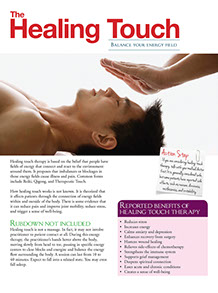
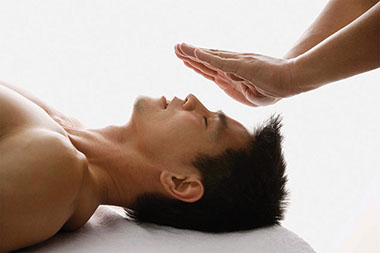
    Image of person having healing touch therapy.

    Balance your energy field

    Healing touch therapy is based on the belief that people have fields of energy that connect and react to the environment around them. It proposes that imbalances or blockages in those energy fields cause illness and pain. Common forms include Reiki, Qigong, and Therapeutic Touch.

    How healing touch works is not known. It is theorized that it affects patients through the connection of energy fields within and outside of the body. There is some evidence that it can reduce pain and improve joint mobility, reduce stress, and trigger a sense of well-being.

    Rubdown not included

    Healing touch is not a massage. In fact, it may not involve practitioner to patient contact at all. During this energy therapy, the practitioner’s hands hover above the body, moving slowly from head to toe, pausing in specific energy centers to clear blocks and energize and balance the energy flow surrounding the body. A session can last from 10 to 40 minutes. Expect to fall into a relaxed state. You may even fall asleep.

    Reported benefits of healing touch therapy

    *  Reduces stress

    *  Increases energy

    *  Calms anxiety and depression

    *  Enhances recovery from surgery

    * Hastens wound healing

    *  Relieves side-effects of chemotherapy

    *  Strengthens the immune system

    *  Supports grief management

    *  Deepens spiritual connection

    *  Eases acute and chronic conditions

    *  Creates a sense of well-being

    Action Step

    If you are considering healing touch therapy, talk with your medical doctor first. It is generally considered safe, but some patients have reported side effects, such as nausea, dizziness, restlessness, and irritability.

    Page from Ways to Well-Being book by the American Institute for Preventive Medicine. www.HealthyLife.com. All rights reserved.

    © American Institute for Preventive Medicine
  • Complementary & Integrative Health

    Alternative Medicine

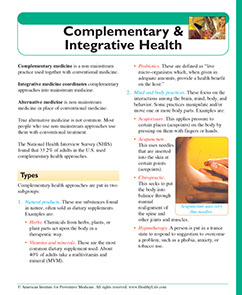
    Image of complementary medicine.

    Complementary medicine is a non-mainstream practice used together with conventional medicine.

    Integrative medicine coordinates complementary approaches into mainstream medicine.

    Alternative medicine is non-mainstream medicine in place of conventional medicine.

    True alternative medicine is not common. Most people who use non-mainstream approaches use them with conventional treatment.

    The National Health Interview Survey (NHIS) found that 33.2% of adults in the U.S. used complementary health approaches.

    Natural products.

    These use substances found in nature, often sold as dietary supplements. Examples are:

    *  Herbs. Chemicals from herbs, plants, or plant parts act upon the body in a therapeutic way.

    * Vitamins and minerals. These are the most common dietary supplement used. About 40% of adults take a multivitamin and mineral (MVM).

    * Probiotics. These are defined as “live micro-organisms which, when given in adequate amounts, provide a health benefit on the host.”

    Mind and body practices

    These focus on the interactions among the brain, mind, body, and behavior. Some practices manipulate and/or move one or more body parts. Examples are:

    *  Acupressure. This applies pressure to certain places (acupoints) on the body by pressing on them with fingers or hands.

    *  Acupuncture. This uses needles that are inserted into the skin at certain points (acupoints).

    *  Chiropractic. This seeks to put the body into balance through manual realignment of the spine and other joints and muscles.

    *  Hypnotherapy. A person is put in a trance state to respond to suggestion to overcome a problem, such as a phobia, anxiety, or tobacco use.

    *  Meditation. This increases calmness and physical relaxation by using:

    – A quiet location that is free of or has few distractions.

    – A comfortable posture.

    – A specific focus on a word or sensation.

    – An openness to let distractions come and go without judging them.

    *  Massage therapy. This uses touching and rubbing techniques to relieve sore muscles and promote relaxation.

    *  Qi gong (“chee-GUNG”). This is part of traditional Chinese medicine. It uses movement, meditation, and controlled breathing to enhance the flow of “qi” in the body. (Qi is an ancient term for vital energy.)

    *  Relaxation therapies. These include breathing exercises, guided imagery, and progressive muscle relaxation.

    *  Tai chi. This is a series of postures and exercises of moving the body slowly and gently, and with awareness while breathing deeply.

    *  Yoga. A system of exercising using postures, breathing, and meditation.

    Page from the Healthier at Home book by the American Institute for Preventive Medicine. www.HealthyLife.com. All rights reserved.

    © American Institute for Preventive Medicine